












EHS compliance reporting software

EHS compliance reporting, without the year-end rebuild

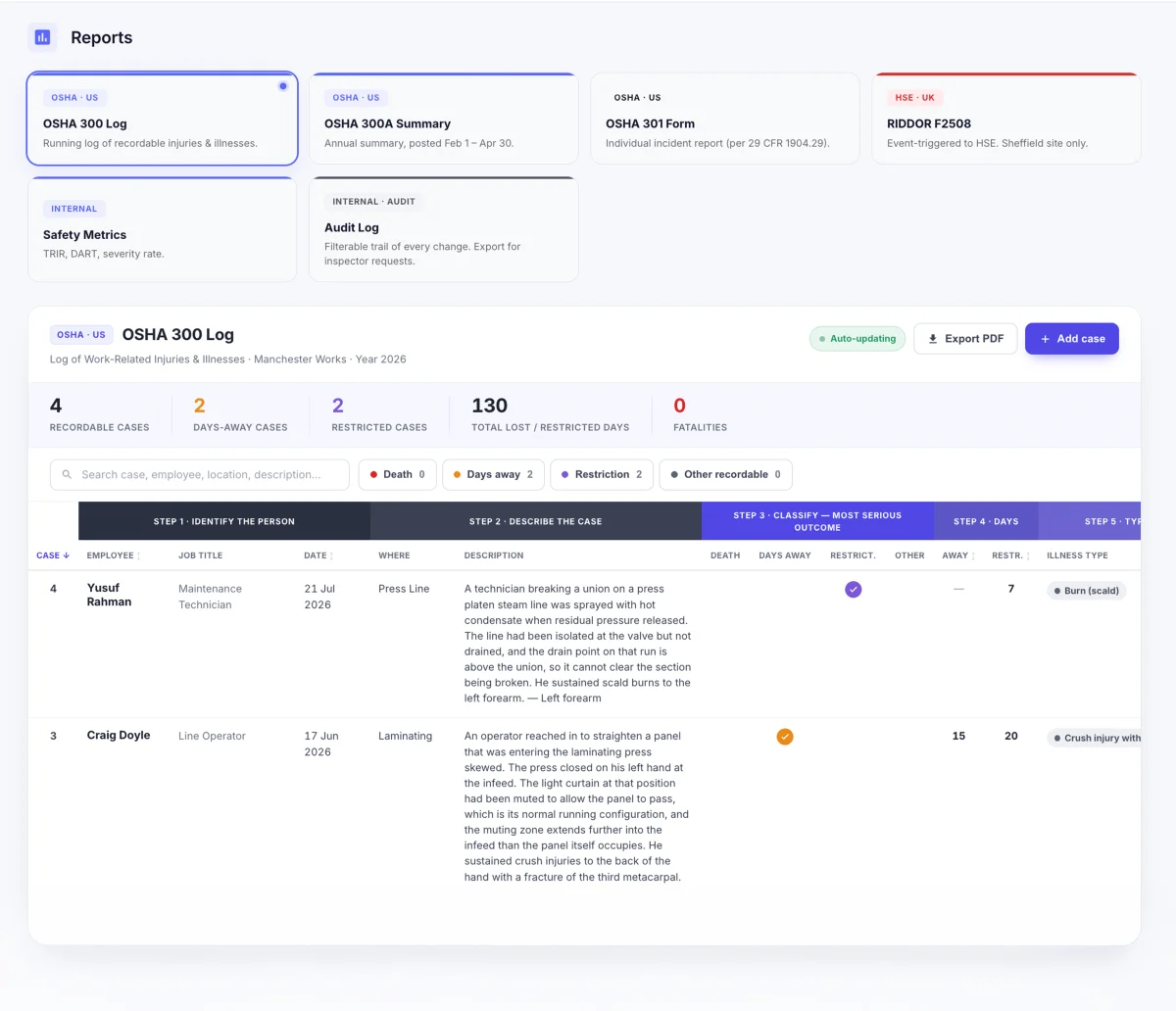
Injury and illness recordkeeping that produces its own forms — OSHA 300, 300A and 301, RIDDOR reports, WHS notices — with notification clocks that start themselves and rates calculated as you go.

Safety and compliance team reviewing reports
Trusted by10,000+ Safety Managers

Every jurisdiction gives you a window. None of them are long.

In the US, 29 CFR 1904.40 gives you four business hours to produce injury records once an inspector asks. A RIDDOR specified injury is reported without delay. Australian WHS requires immediate notification. The form has to exist before the window opens.

Also called
OSHA recordkeeping software, injury and illness reporting software, RIDDOR reporting software
Forms produced
OSHA 300, 300A and 301 with an ITA-ready export, RIDDOR reports, WHS notifiable incident notices
Who files
You do. We produce the completed forms and the validated ITA file — the declaration stays yours.
The difference

What changes when the form comes out of the record.

A regulator asking for your injury records does not wait while you assemble them, and a serious outcome starts its notification clock whether anyone noticed or not. The form has to exist before the window opens.

Legacy EHS platforms compared with EHS Solutions by SDS Manager
SituationLegacy EHS platformsEHS Solutions by SDS Manager
The inspector asks for your 300 logProduced from the system, if recordability decisions were kept current — which often means a year-end rebuild happened first.Produced from the records as they stand. The log was never a separate exercise.
You need a form the system doesn't haveYou get a builder. Configuring it is technical work, and it lands on the safety manager — or on a professional services engagement.Our team builds it, typically within a day. Nothing for you to configure and nothing billed against consulting hours.
A regulation or threshold changesA release to wait for, or a change request to pay for.You tell us. It's live the next day.

Each site follows the rules that apply to it — a US plant, a UK depot and an Australian site can run different regimes in one system.

  • Your regimes, set up by us

    Thresholds, forms and deadlines configured to your sites before go-live.

  • Every site on its own rules

    A US plant, a UK depot and an Australian site, each following what applies to it.

  • You keep the filing

    We produce the completed forms and the validated ITA file. The declaration stays yours.

See it running on your own process, not a demo dataset.Book a walkthrough
Capabilities

Everything the regulator asks for, ready before they ask

The statutory forms, the deadlines attached to them, and the injury rates you report — all worked from the same records your team already made.

Bring us last year's 300 log

Or your RIDDOR submissions. We'll show you the same output coming straight out of the records.

Book a walkthrough

In practice

Operator reviewing records on a production line
“Somebody files, a reviewer decides whether it is reportable and to whom, and the clock runs from there against the right regime. We operate across two countries with different thresholds and I no longer keep a personal list of dates in a notebook.”
Compliance DirectorHealthcare provider group · 3,100 employees, EMEAVerified review · Gartner Peer Insights
What it costs

The software is the invoice

Legacy vendors quote a license, then bill the setup, the migration, the training days and every change afterwards. It's a relic of an era when software took a year to install.

You pay for the software, not the consultants.

Priced on headcount, however many sites you run. Under 200 people, start a free trial and go. Above that, ask us for a number and you'll get one.

On your invoice
  • The software
  • Every module
  • Your headcount
  • Setup of your rules
  • Reports built for you
  • Changes, whenever
  • Support
Never on your invoice
  • Implementation fee
  • Configuration project
  • Consulting hour blocks
  • Change requests
  • Professional services minimum
  • Data extraction on exit
  • No implementation fee
  • No professional services minimum
  • No hours to buy for changes
FAQ

Frequently asked questions

Still have questions? Our compliance experts will answer them against your own process rather than generically.

Talk to our compliance experts
EHS compliance reporting software turns the safety records your team already keeps into the statutory output regulators require — the recordkeeping log, the annual summary, the incident report forms, the notifications — and tracks the deadlines attached to them. EHS Solutions by SDS Manager does this from the incident record itself. The alternative is transcription: re-entering known information into prescribed layouts, usually late and usually under pressure.
The difference between a recordable and a reportable injury is what you do with it: a recordable injury goes on your OSHA 300 log, while a reportable injury must be notified to OSHA directly. Recordable means it meets OSHA's recording criteria — death, days away from work, restricted work or transfer, medical treatment beyond first aid, loss of consciousness, or a significant diagnosis by a licensed healthcare professional. Reportable means a severe outcome: a fatality within 8 hours, and an in-patient hospitalization, amputation or loss of an eye within 24 hours. Every reportable injury is also recordable, but most recordable injuries are not reportable. In EHS Solutions by SDS Manager both decisions are settled at triage, so the log entry and the notification clock start from the same call.
EHS Solutions by SDS Manager produces OSHA 29 CFR 1904 recordkeeping forms — 300, 300A and 301 plus an ITA-ready export — RIDDOR reports in the UK, and notifiable incident notices under Australian WHS legislation. Because reportability thresholds are configured per customer in a no-code rule pack engine, the same approach extends to other national regimes, your group's internal standard, or whatever your insurer requires.
You have to keep OSHA 300 logs for five years following the end of the calendar year they cover, under 29 CFR 1904.33. The same five-year retention applies to the 300A annual summaries, the 301 incident report forms and the privacy case list. During that period you must also update the 300 log if you discover a recordable case you missed, though the 300A and 301 don't have to be updated. In EHS Solutions by SDS Manager retained years stay produceable as forms rather than only viewable as data, and prior records are brought across at onboarding so the five-year view survives a system change.
The OSHA 300A annual summary must be certified by a company executive and posted where employees can see it from 1 February to 30 April of the year following the year it covers. Separately, the electronic submission through OSHA's Injury Tracking Application is due by 2 March. EHS Solutions by SDS Manager tracks both dates per establishment, so the certification, the posting period and the submission each appear as deadlines rather than as something someone has to remember.
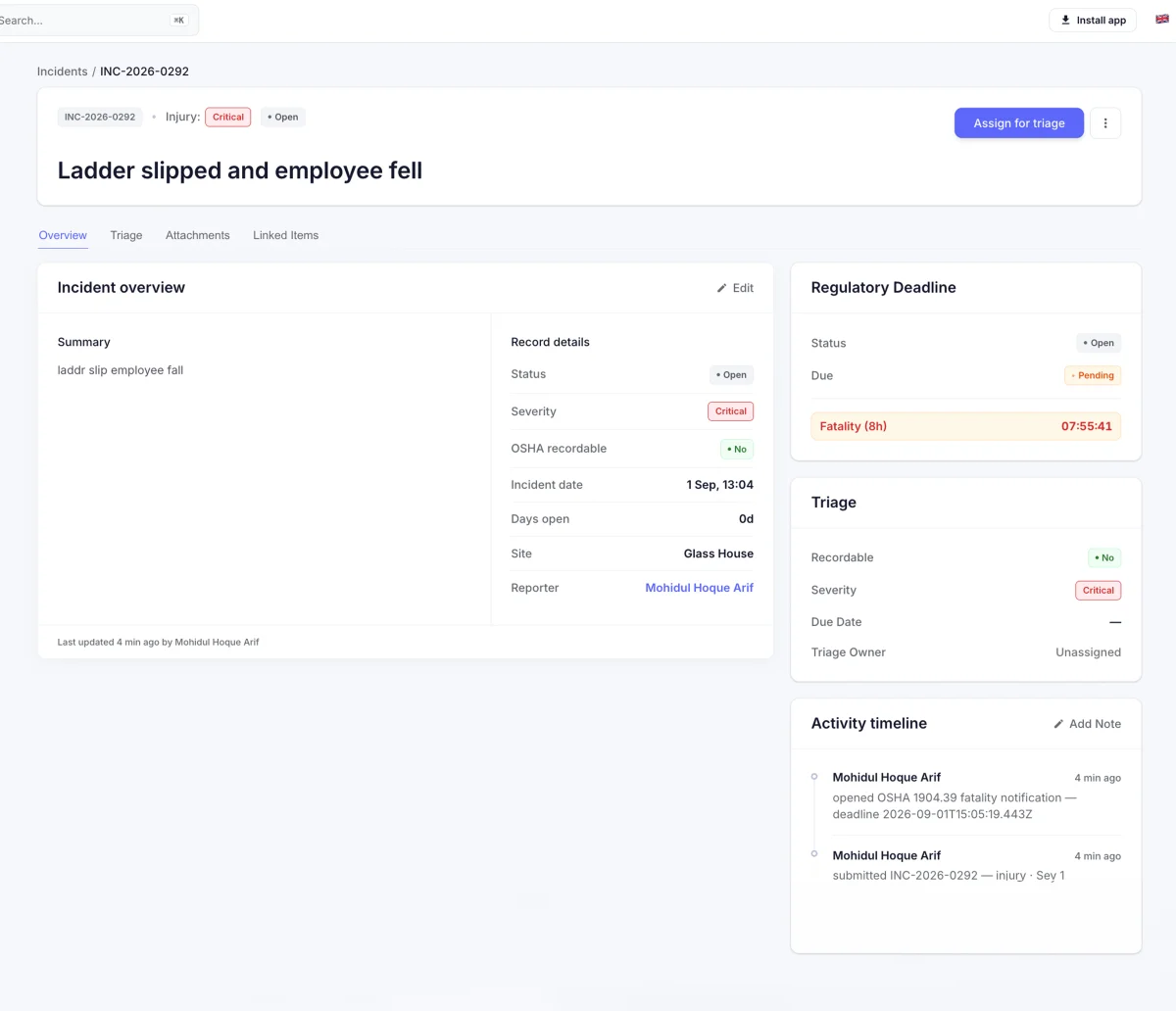
Notification deadlines start when a serious outcome is identified on a case, and in EHS Solutions by SDS Manager the relevant clock is created automatically and counts down on the record where people can see it. Making the call is logged with the office contacted and the reference received, so a discharged obligation is permanent evidence rather than someone's recollection. If a serious case hasn't been picked up, administrators are alerted, because the clock doesn't pause for a weekend.
No — and be careful of anyone who claims otherwise for every jurisdiction. EHS Solutions by SDS Manager produces the completed forms and, for OSHA's electronic submission, a validated file ready to upload. The filing itself stays with you, because that's a legal declaration by your organisation.
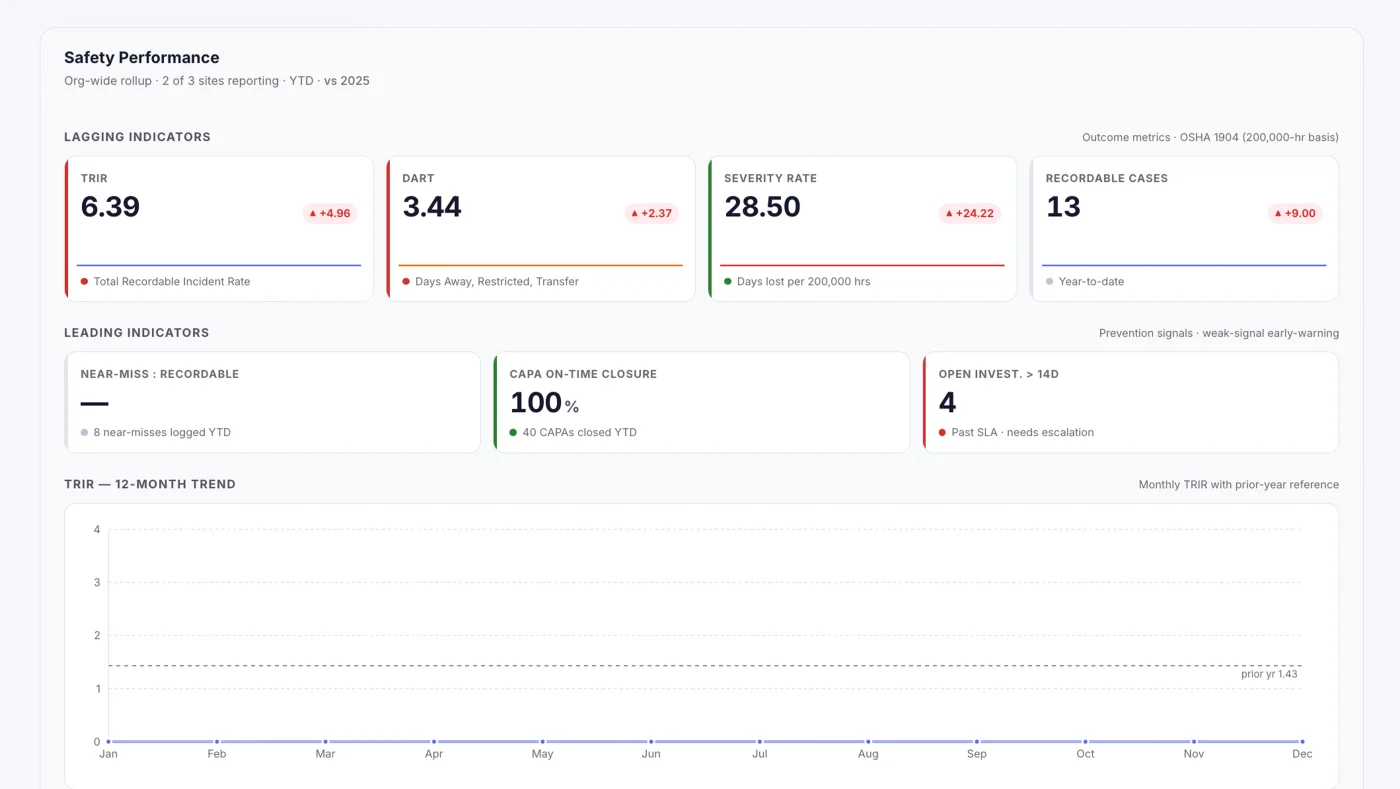
TRIR and DART are calculated from your recorded cases and the employee hours you enter, using the standard 200,000-hour basis. In EHS Solutions by SDS Manager contractor hours are reported separately rather than folded into your rate, and because the rates come from the same records as the forms, the number you report and the log you'd hand an inspector agree.
If you need a report we don't already have, our team builds it, typically within a day — a regulation we haven't listed, your group's internal standard, or a format your insurer specifies. It isn't a builder handed over for your safety manager to learn, and it isn't billed against consulting hours. Statutory forms are already in the system; anything beyond them is a request, not a project.
Yes, one system can handle sites in different countries, and that's the point of separating reportability from the software. Records are kept per establishment, which is OSHA's unit rather than the company's — so each site follows the regime and thresholds that apply to it, keeps its own log, and certifies its own 300A, while group-level figures still roll up. A US plant, a UK depot and an Australian site don't need three different tools.
Yes, your existing OSHA 300 logs come across at onboarding. Spreadsheets, exports from a previous system or a structured import are brought in as complete years rather than loose cases, so the five-year retention 1904.33 requires isn't split between an old system and a new one. The privacy case list moves with the same separation the rule requires.
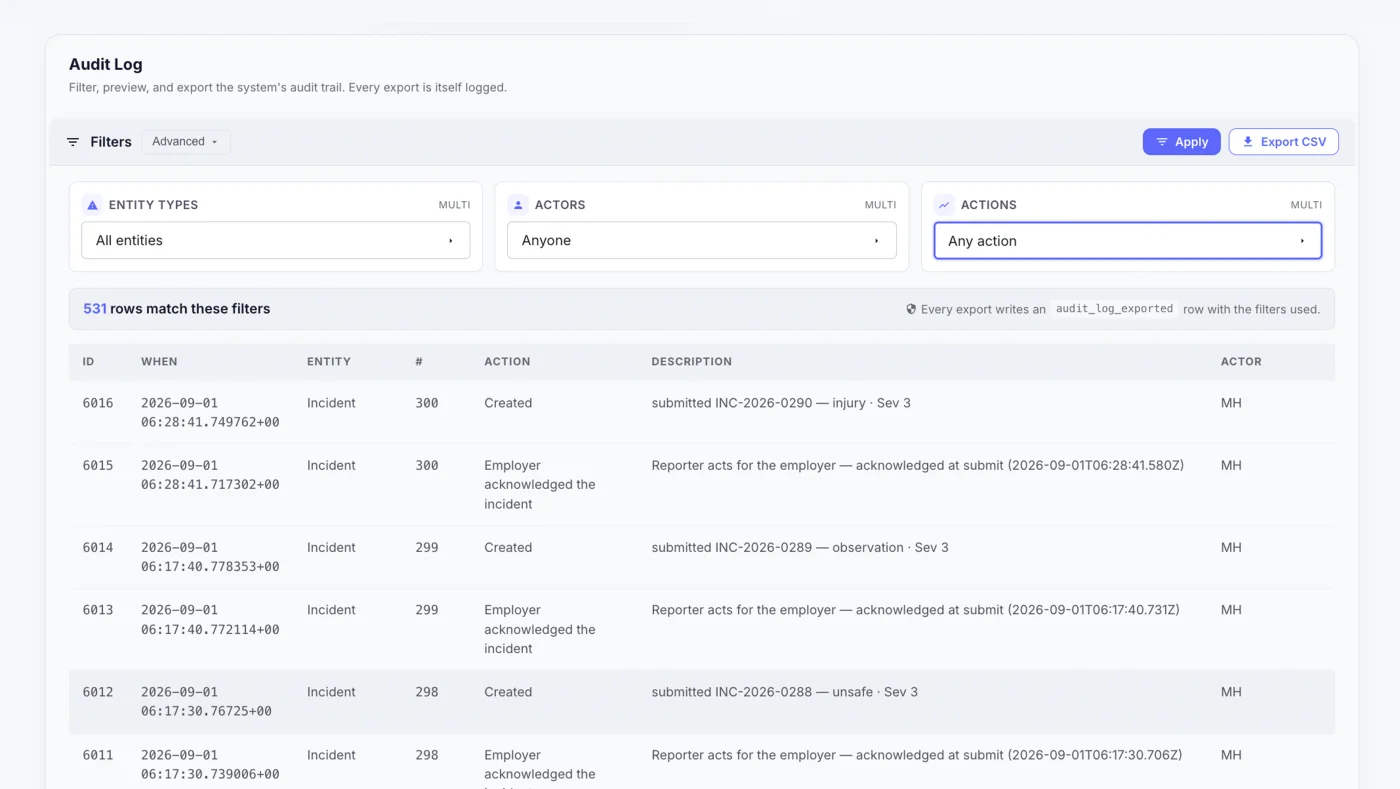
A recordability decision can change, and in EHS Solutions by SDS Manager the change is a recorded decision rather than an edit. It's raised with a reason and approved by someone other than the person requesting it, and both the original call and the revised one stay readable — which is exactly what a line-out correction is supposed to preserve.
Chemical and SDS management connects directly, because EHS Solutions by SDS Manager is built by SDS Manager, whose core product is a chemical and safety data sheet compliance database. When an illness or exposure case involves a substance, the safety data sheet sits in the same system as the record that produces the statutory form, rather than in a separate library somebody has to go and search. SDS Manager is part of the NetPower group, headquartered in Norway with offices in the United States, Vietnam and Bangladesh.

Bring us last year's 300 log

Or your RIDDOR submissions. We'll show you the same output coming straight out of the records.
Set up around the regimes, thresholds and deadlines that apply to your sites.