












Incident investigation software

“Human error” is not a root cause

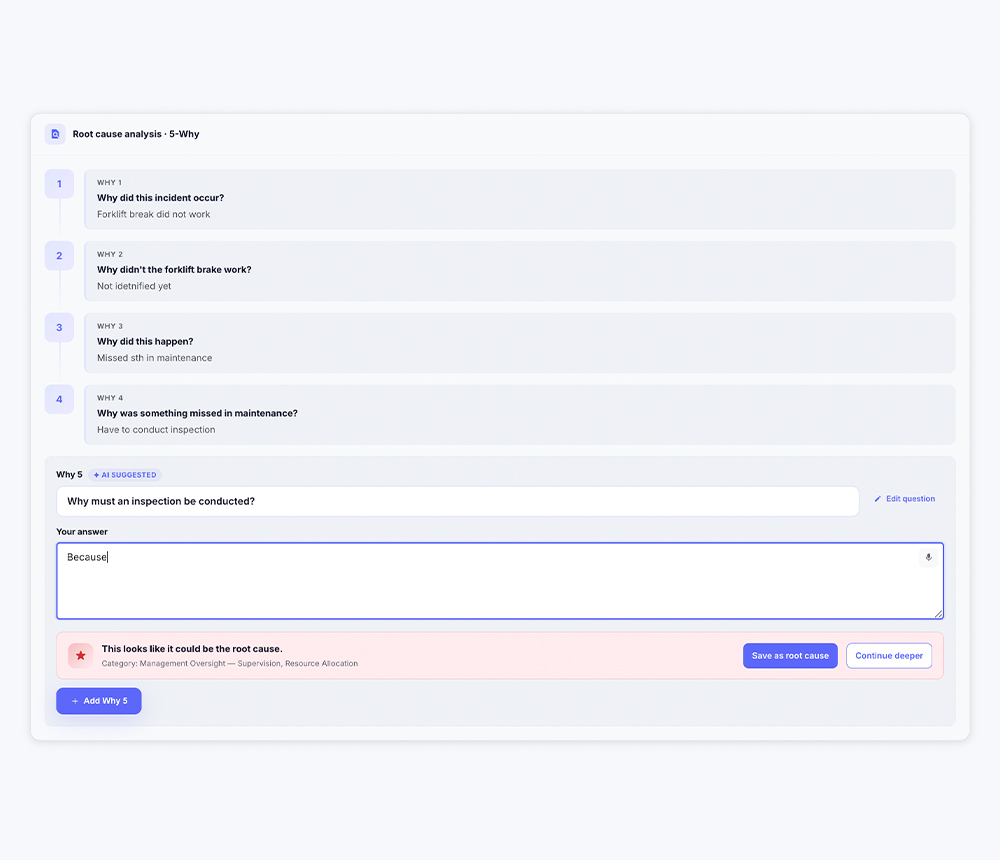
Incident investigation software where the next question comes from the last answer, so any supervisor can run a proper accident investigation and reach the procedure behind the behaviour.

An investigator interviewing a machine operator on the shop floor
Trusted by10,000+ Safety Managers

An investigation form is not an investigation

Every system can hold a cause field. The question is what a supervisor writes in it on their first attempt, whether the evidence behind it survives a challenge two years later, and whether the write-up ever gets finished.

Also called
Root cause analysis software, accident investigation software, incident investigation software
Methods included
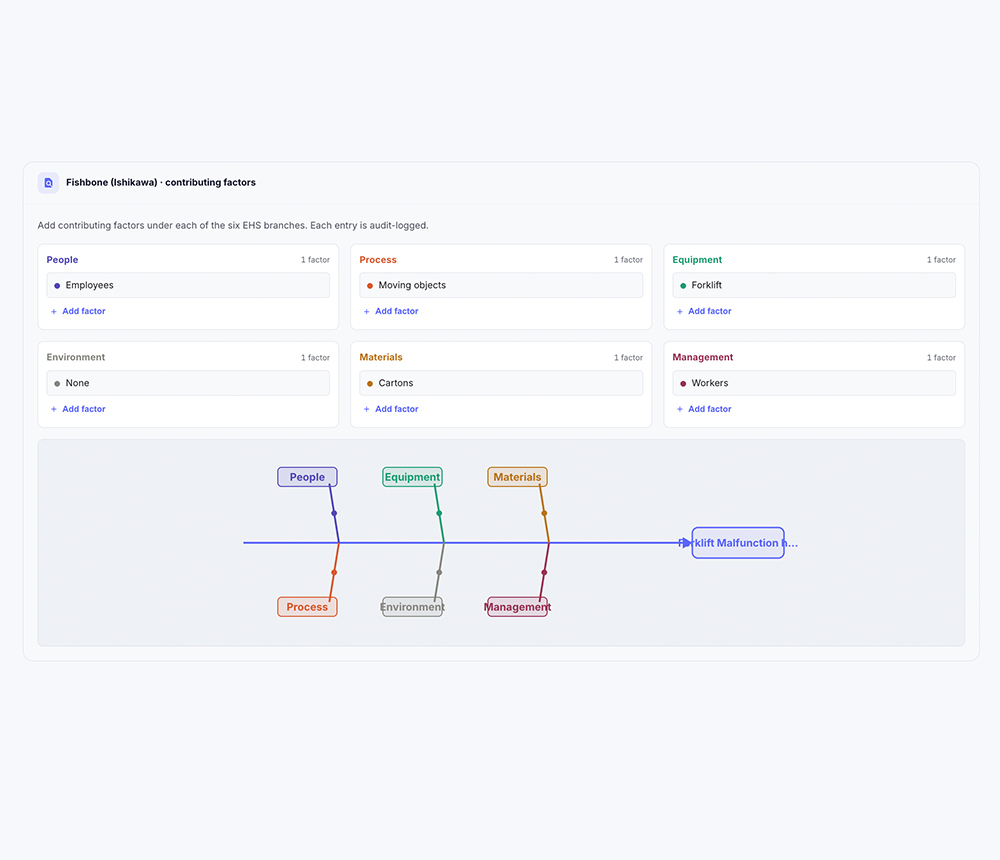
Guided 5 Whys, fishbone (Ishikawa) across six branches, and decision tree — used singly or together, chosen per investigation
Standard it supports
ISO 45001 clause 10.2, Incident, nonconformity and corrective action
The difference

What changes when the method asks the next question.

Every system can hold a cause field. What separates them is what a supervisor writes in it on their first attempt, whether the evidence behind it survives a challenge two years later, and whether the write-up ever gets finished at all.

Legacy EHS platforms compared with EHS Solutions by SDS Manager
SituationLegacy EHS platformsEHS Solutions by SDS Manager
A supervisor picks up their first investigationA blank method they've never used. The cause comes out as human error, and the action is a retraining note.Each answer proposes the next question, so a first investigation reaches the procedure behind the behaviour.
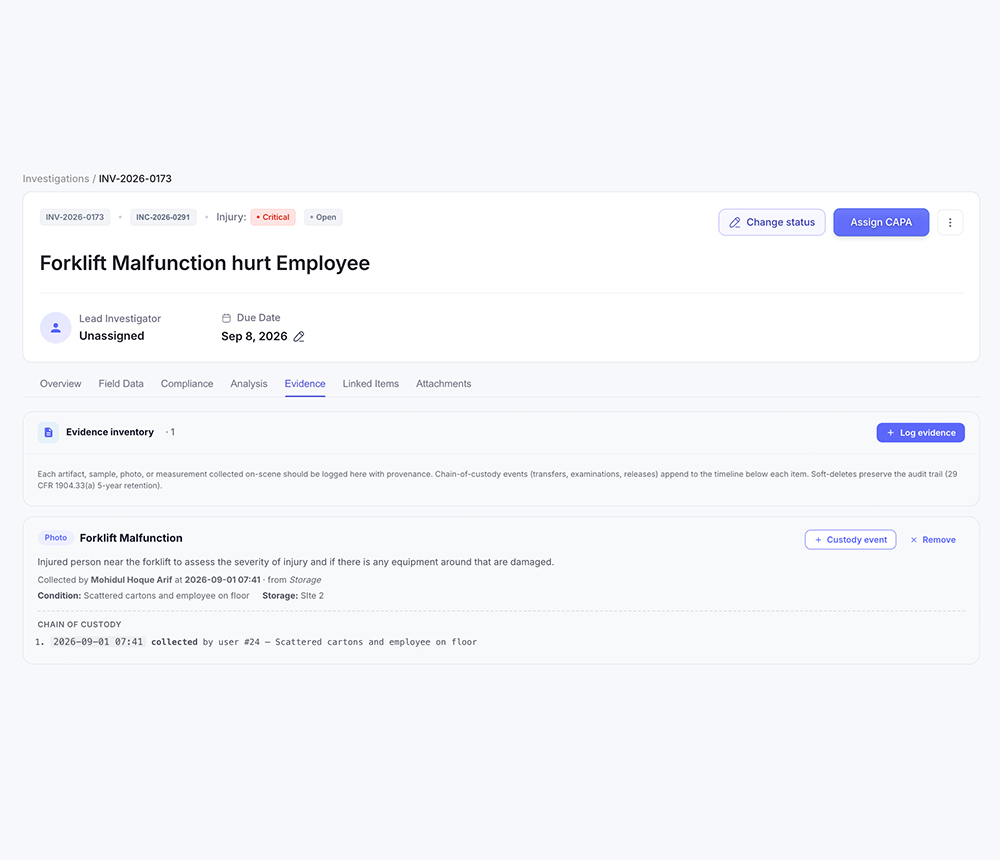
A part leaves site for supplier analysisA spreadsheet somebody updates, if they remember. Two years later nobody can say where it went.Every handover recorded with a named account and a system-set time, append-only, never rewritten.
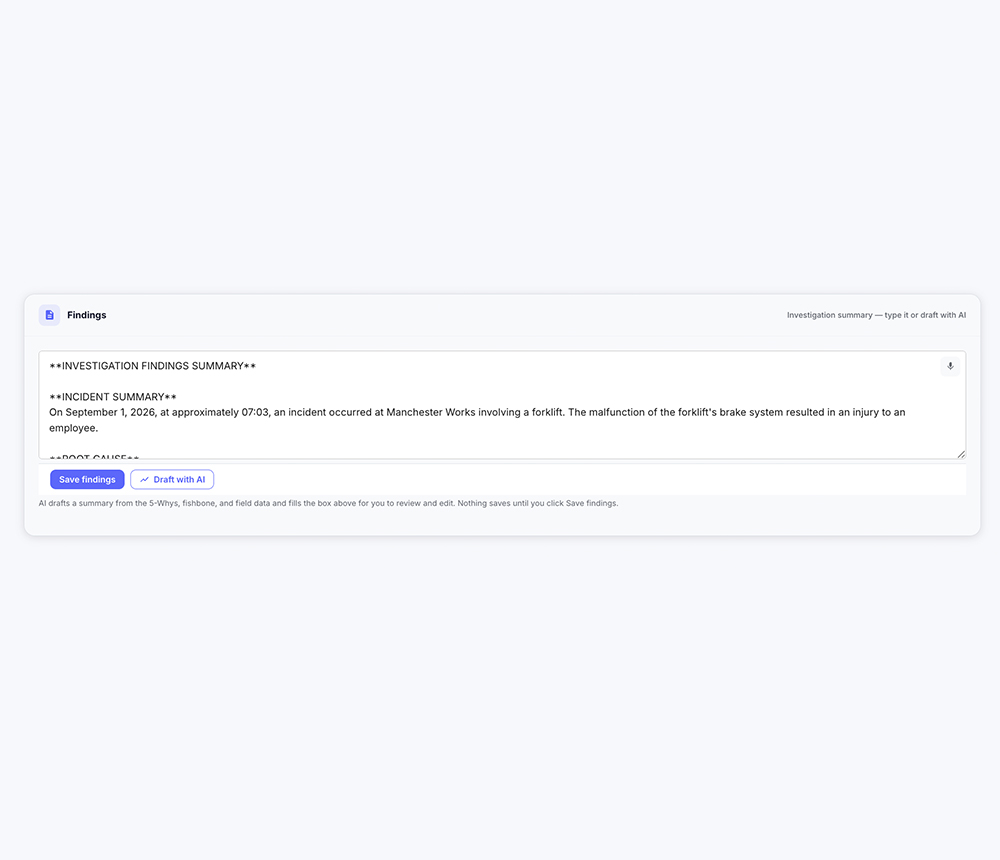
The findings need writing upA blank page that sits unfinished for three weeks because nobody wants to start it.A draft assembled from evidence already in the case, which a person edits, accepts or throws away.

The quality of an investigation should not depend on who happened to pick it up.

  • Guided, not blank

    The next question comes from the last answer, so a first investigation goes as deep as a tenth.

  • Evidence that survives a challenge

    Named collector, every handover recorded, append-only from collection to release.

  • Configured, not coded

    We set up your methods, review rules and closure requirements in a no-code rule pack engine.

See it running on your own process, not a demo dataset.Book a walkthrough
Incident investigation

What happens, in order

Each step hands its work to the next, so nothing is gathered twice.

  1. It opens itself

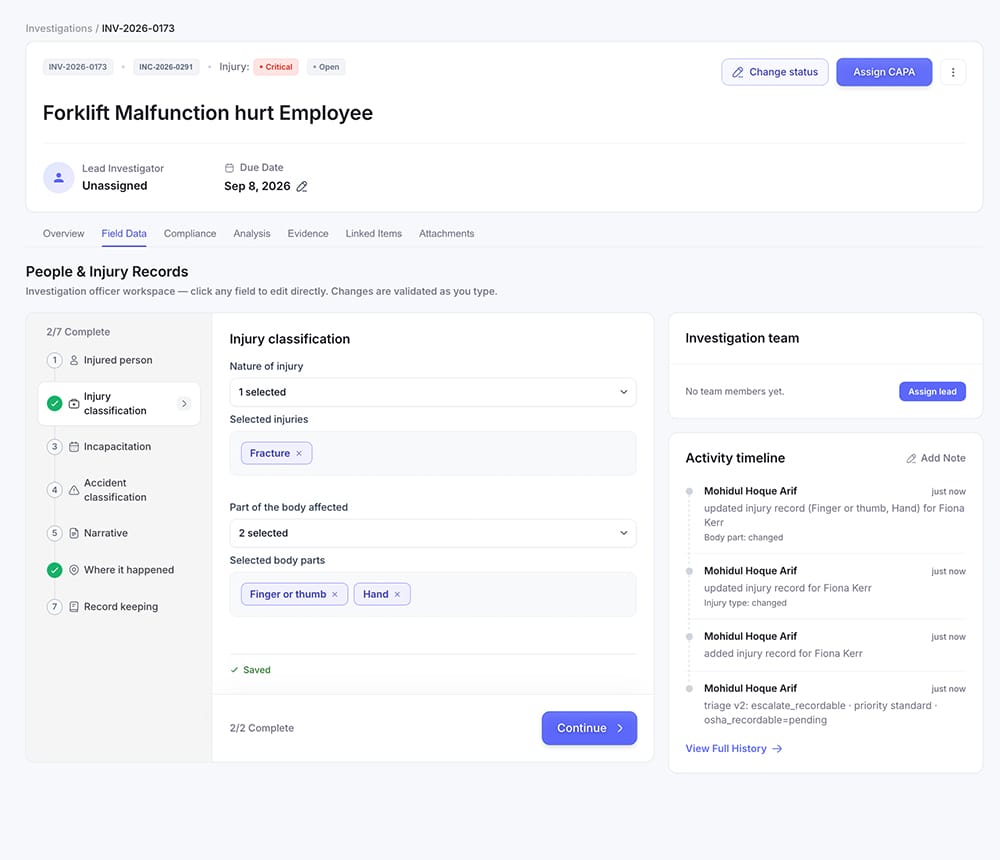
    Triage escalates a case and the investigation appears with the whole record attached.

  2. Root cause analysis tools

    Guided 5 Whys, fishbone and decision tree, with evidence tracked as it's collected.

  3. The findings get written

    A draft assembled from the case, edited and approved by a person.

  4. Someone else checks

    Independent review, completeness checked, then actions come out of it.

Why it matters

What changes for your team

The same six things every safety lead says are hardest about investigations.

Anyone can run one properly

Guided analysis means the quality of an investigation stops depending on who happened to pick it up.

Causes get found, not blamed

Working past the operator's decision to the procedure behind it is the difference between a fix and a retraining note.

Repeat problems become visible

Tagged causes mean the same issue at three sites reads as one pattern instead of three write-ups.

Nothing sits unfinished

The draft removes the blank page, which is where most investigations stall.

It holds up when challenged

Chain of custody, cited standards and a full audit trail, so the record can't be rewritten after the fact.

Something actually gets fixed

Actions come out of the cause with owners and dates, linked back to why they exist.

Bring us one you've investigated

Walk us through a real case and we'll show you how it would run under your own rules.

Book a walkthrough

In practice

Workers reviewing safety records together on site
“An investigation used to be a blank page at the end of a long day. Now it asks me the next question as I go and drafts the findings from the answers. I edit it, and nothing is filed until I say so. For one person covering fifteen hundred employees that is the whole difference.”
Rui FariaSetúbal Química · Chemicals, PortugalVerified review · Trustpilot
What it costs

The software is the invoice

Legacy vendors quote a license, then bill the setup, the migration, the training days and every change afterwards. It's a relic of an era when software took a year to install.

You pay for the software, not the consultants.

Priced on headcount, however many sites you run. Under 200 people, start a free trial and go. Above that, ask us for a number and you'll get one.

On your invoice
  • The software
  • Every module
  • Your headcount
  • Setup of your rules
  • Reports built for you
  • Changes, whenever
  • Support
Never on your invoice
  • Implementation fee
  • Configuration project
  • Consulting hour blocks
  • Change requests
  • Professional services minimum
  • Data extraction on exit
  • No implementation fee
  • No professional services minimum
  • No hours to buy for changes
FAQ

Frequently asked questions

Still have questions? Our safety experts will answer them against your own process rather than generically.

Talk to our safety experts
Incident investigation software takes a case that warrants investigating, guides the analysis that finds why it happened, holds the evidence behind that conclusion, and turns the cause into actions. In EHS Solutions by SDS Manager the investigation opens from triage with the whole record already attached, so nothing is gathered twice, and the actions it produces stay linked to the cause that created them.
The difference between a cause and a root cause is how far back you stop. A cause is what happened immediately before the harm, usually something a person did. A root cause is the organisational condition that made that action the reasonable choice at the time, which is almost always a procedure, a design or a pressure rather than a decision. An investigation that stops at the first answer produces a retraining note; one that reaches the root cause produces a fix.
Guided 5 Whys, fishbone (Ishikawa) across six branches, and decision tree, used singly or together and chosen per investigation, so a minor case doesn't get the treatment a serious one needs. Alongside them: evidence logging with chain of custody, regulatory and standards citations against findings, cause categorisation so repeat problems surface across sites, and AI-drafted findings you edit and approve. Which methods are available, and when each is expected, is part of your configuration.
No, your people don't need root cause analysis training to use it. The method is guided and the next question is proposed from the answer just given, so a supervisor running their first investigation follows the same sequence an experienced facilitator would.
AI writes a draft of the investigation report, not the report. Nothing enters the record until a person saves it, and the draft is assembled only from evidence already in the case rather than from anything invented. Sections without evidence are left out instead of filled in, and drafts never name individuals, because statutory narratives shouldn't.
Chain of custody is recorded as a sequence of handovers: collected, transferred, examined, released, each attributed to a real account rather than a typed name, with a system-set time. The log is append-only, so entries can be added but never rewritten. If a finding is challenged two years later, you can show where a physical sample was on any day since it left the machine.
If evidence genuinely can't be obtained, the field is marked unavailable with a reason — the physician was unreachable, the equipment was destroyed. The gap and its explanation both stay in the record, which is more defensible than a blank field or a guess.
Whether someone else has to sign off depends on your process, and most organisations want independent review. Where you require it, EHS Solutions by SDS Manager holds to it and records who reviewed what. Where you don't, it stays out of the way. Which roles qualify as a reviewer is part of your configuration.
Yes. Any incident type can be escalated to a full investigation, including near misses, and investigations can also be opened on their own — for an audit finding, a trend, or a concern somebody raised — then linked to an incident later if one turns out to be related. Investigating near misses is where root cause analysis is cheapest, because nobody has been hurt yet.
Yes. ISO 45001 clause 10.2 requires you to react to an incident, investigate it, evaluate the need for action to eliminate root causes, implement the action, review its effectiveness, and retain documented information on both the actions taken and the results. In EHS Solutions by SDS Manager the analysis, the evidence, the findings, the independent review and the actions raised from the cause are all held on the same record.
Chemical and SDS management connects directly, because EHS Solutions by SDS Manager is built by SDS Manager, whose core product is a chemical and safety data sheet compliance database. When an investigation involves a substance, the safety data sheet is attached to the case from that database, so whoever is analysing it has the hazard information in front of them rather than in another system. SDS Manager is part of the NetPower group, headquartered in Norway with offices in the United States, Vietnam and Bangladesh.
Setup takes days, and your team's part is describing how you investigate today. In EHS Solutions by SDS Manager your methods, review requirements, closure criteria and cause categories are configured before go-live, by our team. There's no implementation fee and no consulting hours to buy.

Bring us one you've investigated

Walk us through a real case and we'll show you how it would run under your own rules.