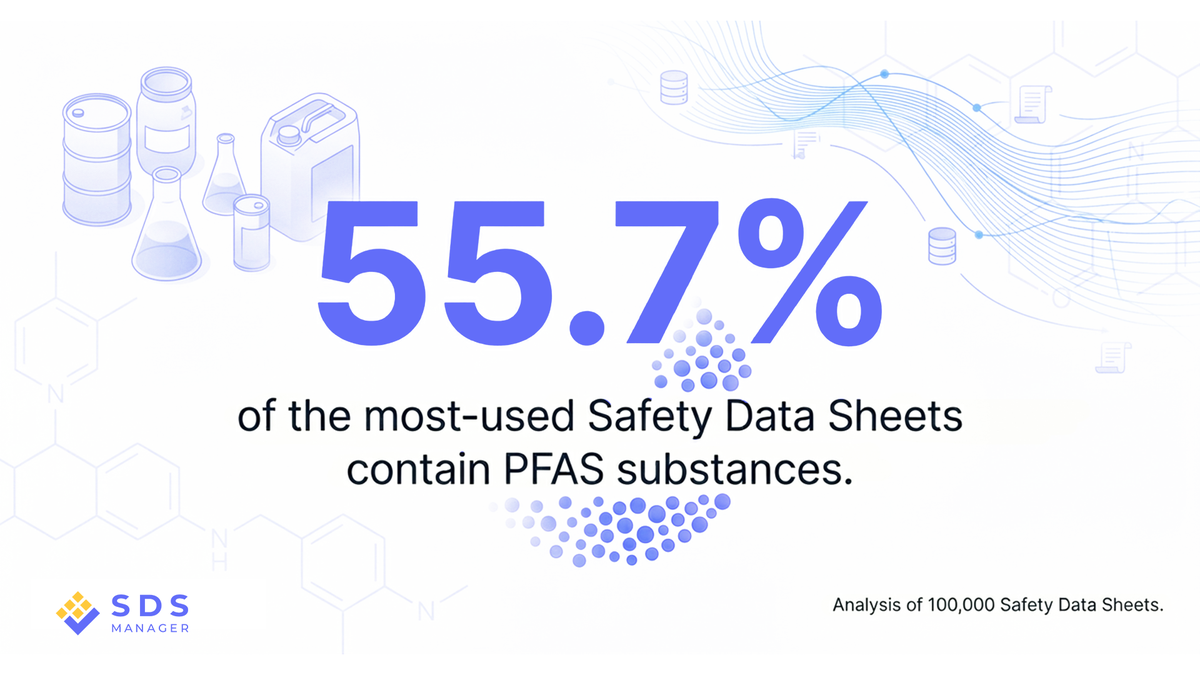
PFAS substances span refrigerants, food packaging, cosmetics, and candle manufacturing, with 88.8% of affected documents already above the legal disclosure threshold under REACH Article 33
More than half of the most actively used Safety Data Sheets in commercial circulation contain at least one per- and polyfluoroalkyl substance, according to new research published by SDS Manager, a chemical safety and compliance platform managing over 16 million Safety Data Sheets across 800 companies in 43 countries.
The study, which analysed the 100,000 most-used SDS documents in the SDS Manager library against a unified reference list of 18,721 PFAS CAS numbers drawn from the EPA CompTox PFASSTRUCT list and the OECD global PFAS database, identified 55,732 documents containing at least one PFAS substance. Of those, 88.8% carry the relevant substance at concentrations above the 0.1% threshold that triggers mandatory disclosure obligations under REACH Article 33. A further 4.3% , representing 2,396 individual documents, are missing Section 15 entirely, the regulatory information section through which SVHC status and applicable restrictions are communicated to downstream users.
The legal obligation, in other words, is not contingent on the outcome of the EU universal PFAS restriction currently under evaluation by ECHA's scientific committees. For the overwhelming majority of affected documents, it is already in force.
"The scale of PFAS presence across consumer-facing sectors is larger than most compliance teams appreciate," said Erlend Bruvik, Founder of SDS Manager. "Nearly 9 in 10 PFAS-containing documents in our library carry concentrations above the legal disclosure threshold. That obligation exists today, and the data shows it spans beauty brands, food producers, and consumer goods companies, not just industrial operators."
The Wrong Conversation
Public discourse on PFAS has long centred on a small number of legacy restricted substances, principally perfluorooctanoic acid and perfluorooctane sulfonic acid, the chemicals that contaminated drinking water near military bases, generated billions in litigation against 3M and DuPont, and prompted the Stockholm Convention listings that have dominated regulatory agendas for over a decade.
According to the SDS Manager data, those substances account for fewer than 100 of the 55,732 PFAS-containing documents identified, under 0.2% of the total.
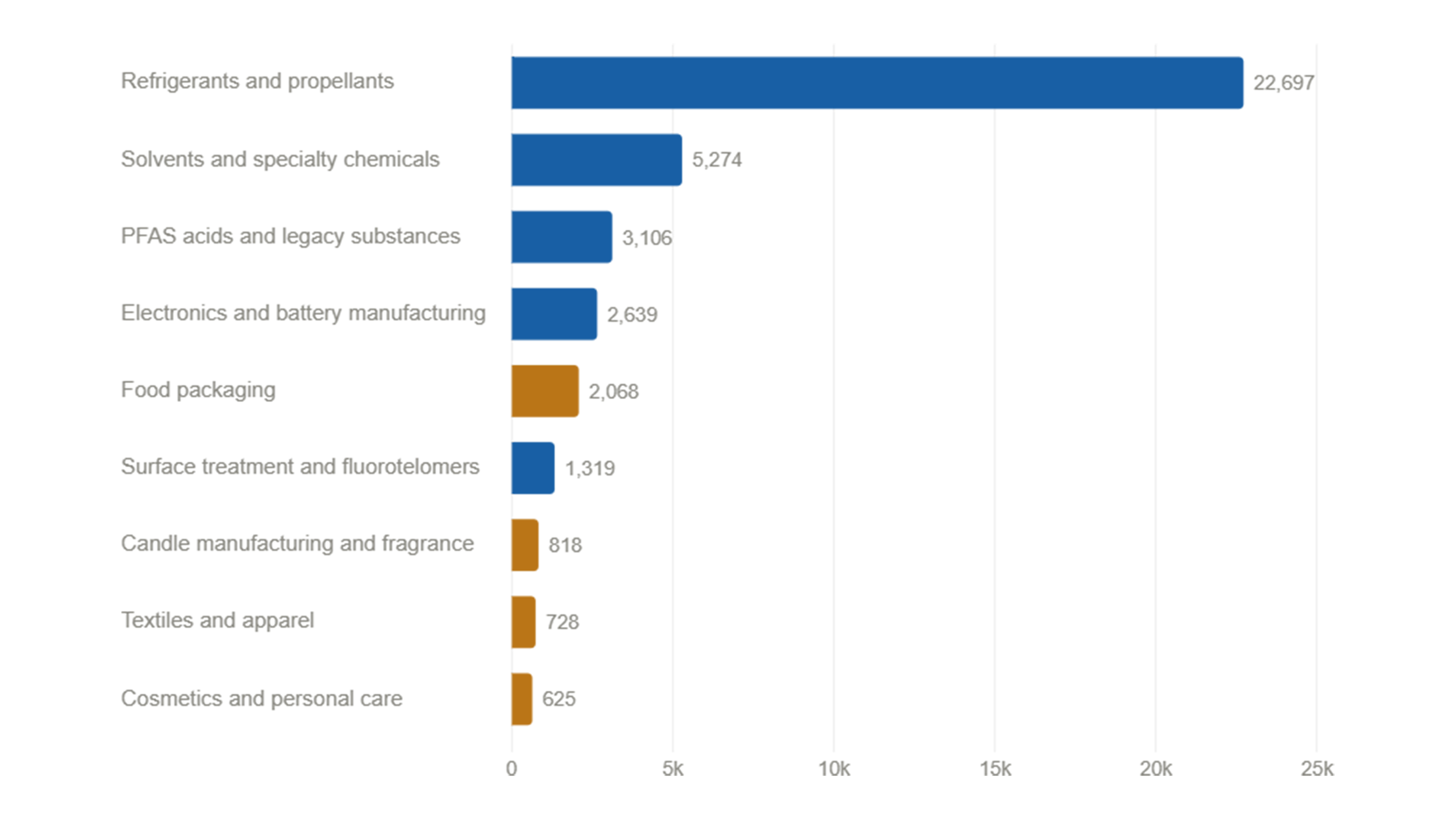
The actual picture is substantially broader, and substantially more concentrated in sectors that have not historically featured in PFAS compliance programmes. Refrigerants and propellants account for 22,697 PFAS-containing documents, representing 35.6% of the matched set. These are the hydrofluorocarbons and hydrofluoroolefins used in air conditioning systems, industrial cooling equipment, heat pumps, and aerosol propellants. HFC-134a, the refrigerant found in most car air conditioning systems sold before 2017, appears in 6,670 documents alone. These substances are regulated under the Kigali Amendment and the EU F-Gas Regulation, but they are almost never addressed within corporate PFAS compliance programmes. Most HVAC companies, automotive suppliers, and industrial refrigeration operators have not framed their SDS documentation obligations in PFAS terms at all.
Where Consumer Supply Chains Enter the Picture
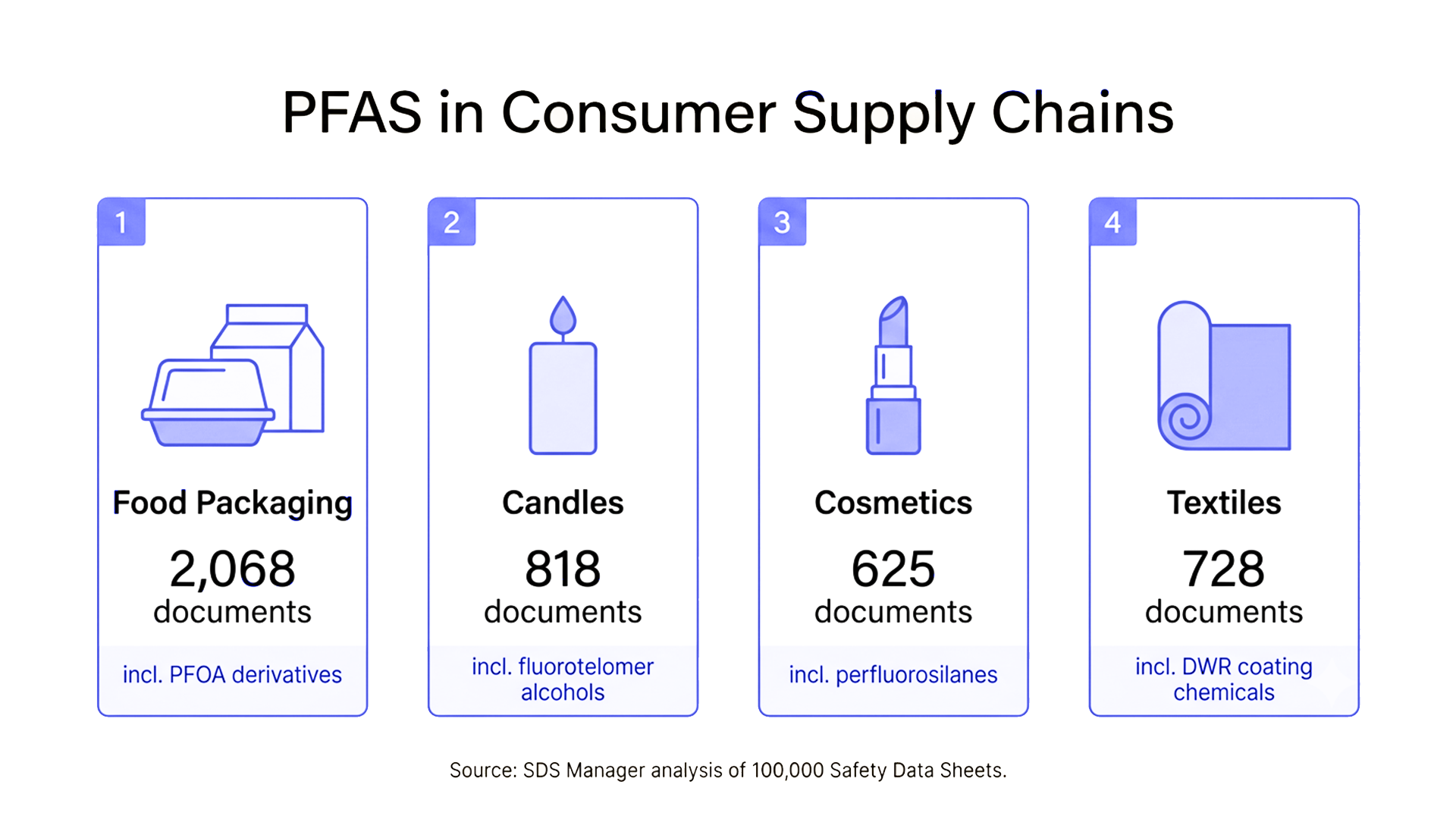
Beyond industrial applications, the analysis identified PFAS-containing documents across four consumer-facing sectors that are likely to attract the widest regulatory and public attention.
Food packaging accounts for 2,068 documents. The substances involved include perfluorobutanoic acid, identified in 597 documents and used in grease-resistant food contact materials, perfluorohexanoic acid in 381 documents, and potassium perfluorobutanesulfonate in 173 documents. Diethanolamine salt of PFOA, a derivative of one of the most comprehensively restricted substances in global chemical regulation, appeared in 28 active food packaging documents, raising questions about whether document revision processes are capturing the full scope of PFOA-related restrictions when they are triggered.
Candle manufacturing and fragrance accounts for 818 documents, including 2:1 fluorotelomer alcohol in 125 documents and perfluoroalkyl acrylate in 92, both with documented use in wax coatings and fragrance fixatives. Cosmetics and personal care accounts for 625 documents, with perfluorohexylethyl triethoxysilane identified in 117 and perfluorooctyl iodide in 102. Several US states have enacted bans on intentionally added PFAS in cosmetics as of January 2025, yet active SDS documentation in the category indicates that reformulation and document update programmes have not reached completion across the industry. Textiles and apparel accounts for a further 728 documents, driven by fluorotelomer alcohols widely used in durable water repellent fabric coatings.
These are not the industries that feature in PFAS litigation or regulatory impact assessments. They supply directly to consumers, and in the majority of cases their compliance teams have not been asked to treat PFAS as an active documentation priority.
The Compliance Gap the Data Reveals
The concentration finding is where the analysis becomes most immediately consequential for legal exposure. Of the 55,732 PFAS-containing documents for which concentration data was available and parseable, 88.8% contain the matched PFAS substance at levels above 0.1% by weight. Article 33 of the REACH Regulation imposes a mandatory obligation on suppliers of articles containing SVHC substances above that threshold to communicate the information to downstream users and, upon request, to consumers. That obligation does not depend on future regulatory decisions. It is active now, for more than 49,000 documents currently circulating across the SDS Manager customer base.
The documentation quality gap compounds the risk independently. The 4.3% of PFAS-containing documents missing Section 15 entirely represent 2,396 SDS files actively in use without any regulatory information section. For those documents, the primary mechanism through which companies and their downstream customers are legally required to receive compliance information is simply absent.
The findings are consistent with the broader pattern identified by ECHA's own enforcement activity. The agency's REACH-EN-FORCE-6 project found that only 5 of 45 audited articles met the business-to-business communication requirement under Article 33, a non-compliance rate of approximately 89% , a figure the agency described as "not acceptable."
The Substitution Problem
One finding in the data warrants specific attention from companies that consider their PFAS exposure already addressed.
The analysis identified 6:2 fluorotelomer alcohol and 8:2 fluorotelomer alcohol in active SDS documentation across the library. These are substances that were widely adopted as replacements for PFOA following the early PFOA restrictions. Under current PFAS definitions, they remain PFAS substances. Their presence in active documentation serving customers across 43 countries indicates that companies which completed substitution programmes at significant cost, and moved on, may be carrying PFAS obligations they have not re-examined under the broader current-generation PFAS framework.
A Global Picture
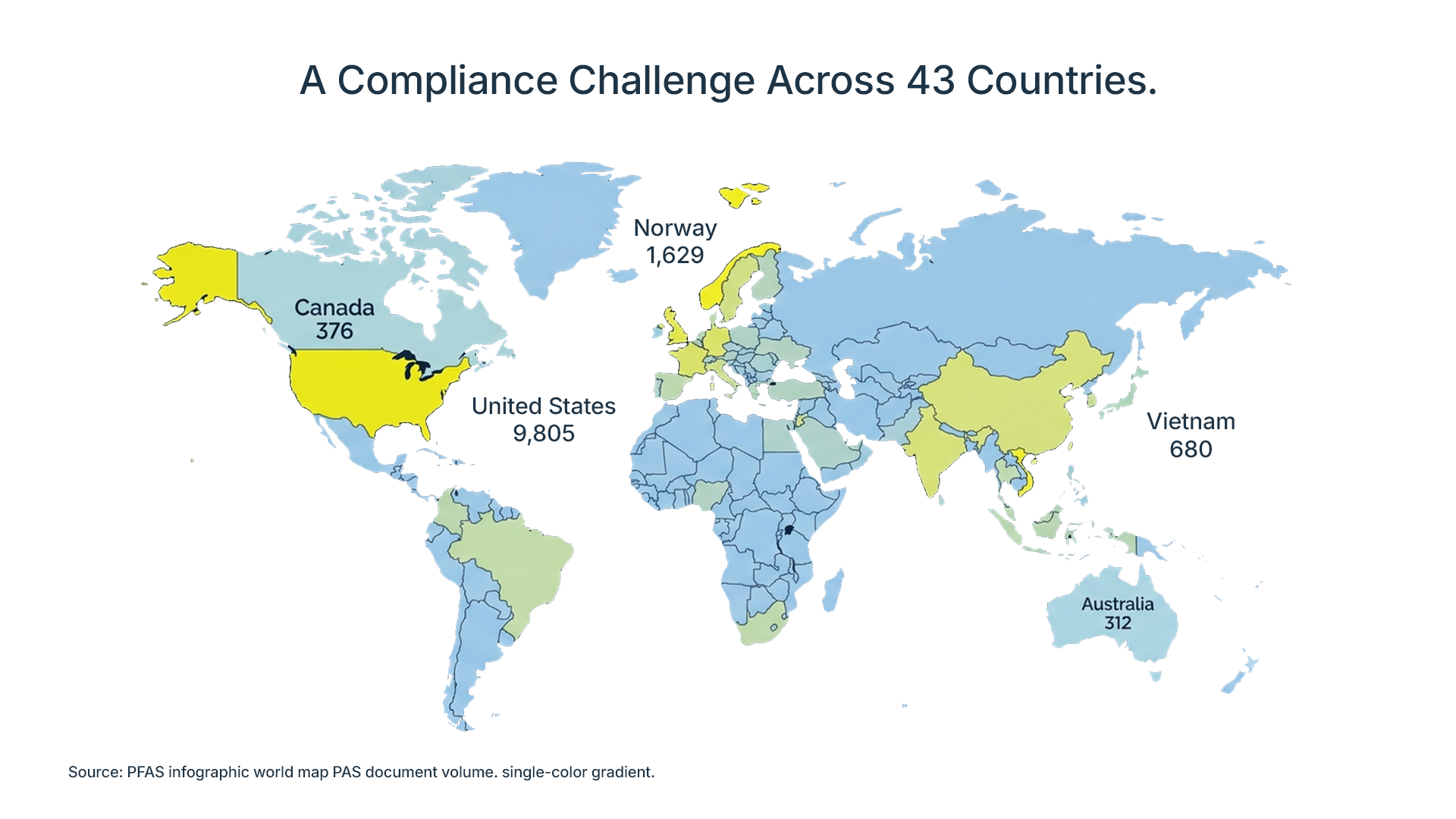
The 55,732 PFAS-containing documents identified span 43 countries. The United States accounts for the largest concentration with 9,805 customer-linked documents, reflecting both the scale of the US customer base and the breadth of PFAS substance use across American industry. Norway sits second with 1,629, its position reflecting the industrial profile of the Norwegian economy and significant oil, gas, and maritime sector representation in the SDS Manager customer base.
Vietnam's third-place ranking with 680 documents is among the more significant geographic findings. It points to a PFAS compliance obligation that extends into manufacturing economies in Southeast Asia, where awareness of EU and US regulatory developments may be substantially lower than in the markets where those regulations originate. The supply chains flowing from those manufacturing bases into European and North American retail are subject to the same documentation obligations as the end markets they supply.
Policy Implications
The EU universal PFAS restriction process continues on its current trajectory. ECHA's committees for Risk Assessment and Socio-Economic Analysis are working through their evaluation of the updated restriction proposal submitted by five member states in August 2025, with final opinions expected by the end of 2026.
The SDS Manager analysis makes clear that the restriction outcome is not the only compliance question on the table. The concentration data, the Section 15 gaps, and the Article 33 obligations already in force represent an immediate compliance agenda that exists independently of how the restriction proposal is ultimately resolved. The study's authors argue that measurements of this kind, actual operational compliance behaviour across active documents rather than modelled assumptions, should inform how regulators assess whether existing REACH obligations are functioning as intended, including whether the Article 33 "without delay" standard requires greater specificity to produce consistent industry behaviour.
"When regulators write impact assessments for REACH updates, they model what should happen," said Bruvik. "Our data measures what is actually in the documents being accessed by workers and procurement teams right now. We think that distinction matters for every conversation about whether the regulation is working."

Mehreen Iqbal

Started with a Bachelors in Microbiology, then a Masters in Public Health; Currently a Workplace Safety Expert.