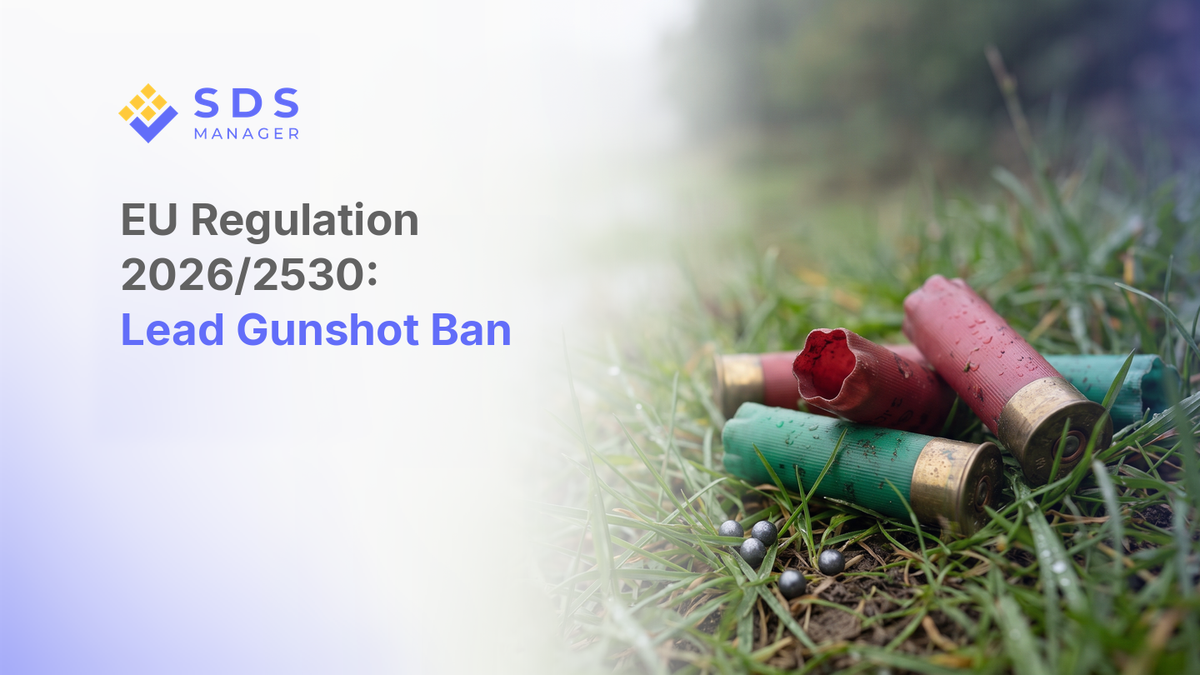
The European Commission has adopted Regulation (EU) 2026/2530, which bans lead gunshot for hunting and outdoor sport shooting across the EU from 7 December 2033. The regulation amends entry 63 (lead and its compounds) of REACH Annex XVII. It was signed on 16 November 2026, published in the Official Journal on 17 November 2026, and enters into force on 7 December 2026.
The new rule extends an existing ban. Since 2023, lead gunshot has been banned in and around wetlands. From 2033 it is banned everywhere outdoors, with a seven-year transition for hunters, shooters, retailers and manufacturers to switch.
What the restriction covers
The ban applies to shotgun ammunition containing 1% or more lead by weight, measured as lead metal. That is the same threshold as the existing wetlands restriction. From 7 December 2033 it covers:
- Shooting, carrying or transporting lead gunshot while hunting or travelling to a hunt
- Shooting lead gunshot in outdoor sport shooting
- Placing lead gunshot on the market for those uses
The restriction does not apply to:
- Indoor shooting
- Police, military, defence and other security uses, including the protection of critical infrastructure and public spaces
- Historic firearms, including muzzle-loaders and modern replicas
- Firearm and ammunition testing, research, ballistic protection and forensic work
- Air-weapon pellets, lead in primers and in cartridge wads
Outdoor sport shooting with 1.9 to 2.6 mm shot also has an exemption with no end date. It applies only at ranges that put risk-management measures in place, for example containing and treating drainage water and recovering spent lead at least every three years. Shooters must also be active members of a shooting federation.
Key dates
The main deadline is 7 December 2033, seven years after entry into force.
| Date | What happens | |
|---|---|---|
| 17 November 2026 | Published in the Official Journal | |
| 7 December 2026 | Regulation enters into force | |
| 7 June 2027 | Retailers must display a lead warning in shops and online* | |
| 7 June 2028 | Ammunition packaging must carry the lead warning* | |
| 7 December 2033 | Ban on lead gunshot for hunting and outdoor sport shooting applies; existing wetlands provisions (entry 63, paragraphs 11 to 14) end | |
| 7 December 2034 | Member States publish their lists of qualifying sport shooting ranges* |
Until 2033, the wetlands ban in force since 15 February 2023 continues to apply. Member States may also keep stricter national rules on the use of lead ammunition.
Editor's note: confirm these dates against the English Official Journal text before publishing. They come from the Annex points we could not check word for word.
What changed from the original proposal
The final text is narrower than ECHA's original proposal. Lead bullets and single slugs were removed from the scope entirely. The Commission cited their use in defence and the EU's 2025 defence readiness strategy. Lead fishing tackle, which ECHA assessed alongside ammunition, is not covered either.
The transition was also lengthened, from five years to seven. Member State licensing of ranges was considered and dropped, and so was a requirement to recover more than 90% of spent lead. The packaging warning was shortened so it fits on small packs.
What it means for SDS and chemical compliance teams
Companies that make, import, distribute or sell shotgun ammunition in the EU have until 7 December 2033 to change products and stock. The retail and packaging warnings start years earlier.
Ammunition is an article under REACH, so it does not normally come with a safety data sheet. The SDS link is through lead itself. Entry 63 already appears in Section 15 of SDSs for lead and lead compounds, and suppliers may revise that section to reference the amended entry. Teams that manage lead or lead-containing products should:
- Check whether Section 15 of their lead SDSs cites the amended entry 63
- Flag products containing 1% or more lead for review as supplier SDS updates arrive
- Track Annex XVII amendments by application date, not publication date: this one was published in 2026 and applies in 2033
Sources
- Commission Regulation (EU) 2026/2530, Official Journal (ELI)
- Official Journal copy, Spanish text (BOE mirror)
- EUR-Lex: CELEX 32026R2530
- Bird-Watchers.com: MEPs clear path to EU-wide lead shot ban
- FACE: EU lead shot restriction, focus turns to implementation

Arysha Alif Khan

Arysha Alif Khan is an EHS and chemical safety specialist with a background in biochemistry, biotechnology, and public health. She works closely with the product and regulatory teams to turn complex chemical regulations, SDS requirements, and workplace safety standards into clear, practical guidance for people.