Lockout/tagout (LOTO) is the procedure of shutting off a machine, locking its energy sources in the off position and tagging them, so the machine cannot start up or release stored energy while someone works on it.
In this article, you'll learn the six lockout steps in order, what US and Canadian rules ask your site to have in writing, and how locks, tags and crews work together.
Key Takeaways
- Lockout/tagout (LOTO) shuts off a machine, locks its energy sources off and tags them so no one can start it or release stored energy during servicing. A lock physically holds a breaker, switch or valve off, while a tag only warns.
- OSHA requires a lock wherever the device can take one unless the employer proves a tag gives full protection, and in Canada a tag on its own does not count as lockout.
- The six lockout/tagout steps are prepare, shut down, isolate, apply locks and tags, release stored energy and verify zero energy.
- Only the worker who applied a lockout lock may remove it, unless that worker is not at the site and the employer follows the removal conditions in US or Canadian rules.
- In the US, the OSHA lockout/tagout standard, 29 CFR 1910.147, requires written energy control procedures, certified worker training and an inspection of each procedure at least once a year.
- In Canada, lockout rules come from federal regulations for federally regulated workplaces and from provincial or territorial regulations for most others, with CSA Z460 as the national standard.
- The main exceptions to lockout/tagout are unplugged cord-and-plug equipment whose plug stays under the exclusive control of the worker doing the servicing, and minor servicing that is routine, repetitive and part of production, done with other measures, such as machine guarding, that give effective protection.
What Is Lockout/Tagout (LOTO)?
Lockout/tagout (LOTO) controls hazardous energy during servicing. Hazardous energy is any power that could start a machine or injure someone if it were released. Under LOTO, you cut every energy source, hold each one off with your own lock, and prove nothing can move before you start work.
Hazardous energy comes in more forms than electricity. A machine can carry electrical, mechanical, hydraulic, pneumatic, chemical and thermal energy, plus gravity acting on raised parts. Electrical hazards get the most attention, but a hydraulic ram or a raised weight can still move after the electricity is off.
You control each source at an energy isolating device (a breaker, switch or valve that physically cuts off energy).
The Occupational Safety and Health Administration (OSHA), the US federal safety regulator, calls the practice the control of hazardous energy. Most Canadian regulations call it lockout.
LOTO applies to servicing and maintenance, including cleaning, unjamming and adjusting, wherever an unexpected startup or release of stored energy could injure someone.
OSHA estimates that following its lockout/tagout standard prevents about 120 deaths and 50,000 injuries a year among US workers.
In Canada, 32 workers died in 2024 after being caught in or compressed by equipment or objects, according to accepted fatality claims compiled by the Association of Workers' Compensation Boards of Canada (AWCBC). Caught-in and crushing deaths are the kind of workplace fatalities in Canada that lockout is designed to prevent.
What Is the Difference Between Lockout and Tagout?
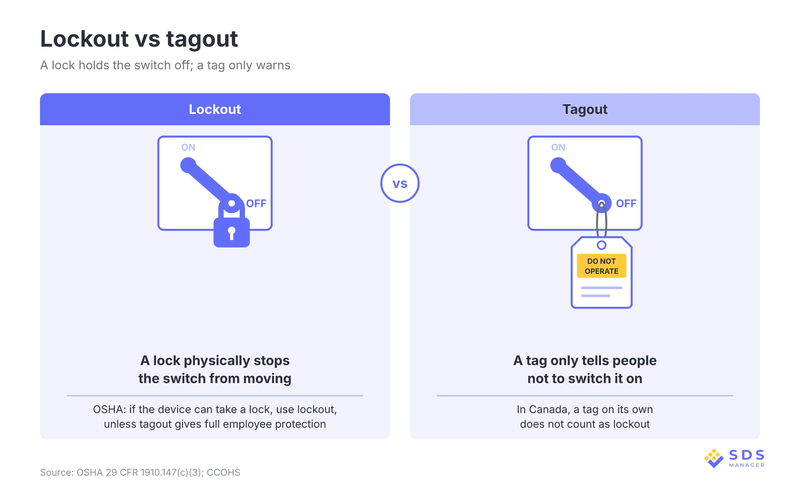
Lockout puts a padlock on an energy isolating device so it cannot be switched on; tagout attaches a warning tag that tells people not to switch it on. The difference is physical restraint: a lock stops the switch from moving, while a tag only warns.
Under OSHA's rule, if an energy isolating device can take a lock, you must use lockout unless you can show that tagout gives full employee protection. Full employee protection means the tag goes where the lock would go, plus whatever extra steps make the machine as safe as a lock would, such as removing a fuse or a valve handle.
Since January 2, 1990, every new machine, and every machine that is replaced or has a major repair or modification, must have isolating devices that accept a lock.
Canadian guidance is stricter than OSHA's rule: a tag always goes on with the lock, and a tag on its own does not count as lockout. In practice, a lock and a tag usually go on together in both countries, because the lock holds the switch off and the tag names who is working.
A tag alone can seem enough when the whole crew knows a job is underway, but it doesn’t protect workers as well as a lock. OSHA's own rule warns that tags can give a false sense of security, because a tag cannot stop anyone who misses it, ignores it or cannot read it.
What Are the 6 Steps of a Lockout/Tagout Procedure?
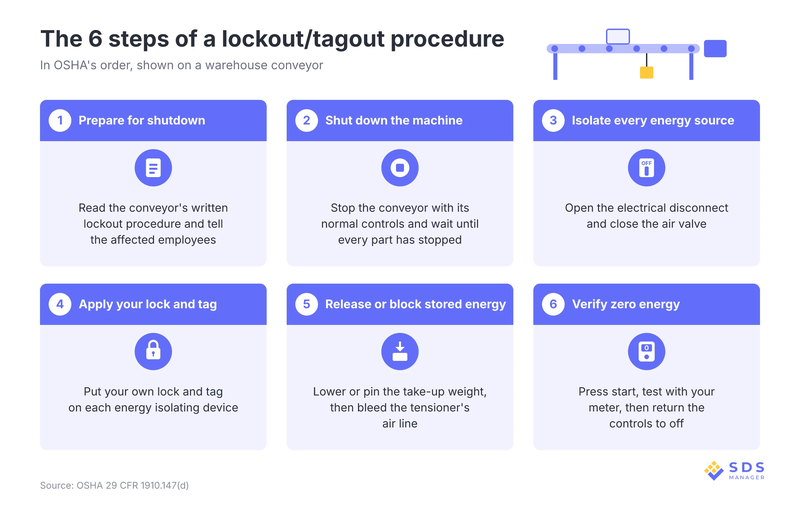
The six steps of a lockout/tagout procedure, in OSHA’s order, are:
- Prepare for shutdown.
- Shut down the machine.
- Isolate every energy source.
- Apply locks and tags.
- Release or block stored energy.
- Verify the machine is at zero energy.
The Canadian Centre for Occupational Health and Safety (CCOHS) lists the same actions as nine steps, counting notifying workers, doing the work and removing locks as steps of their own.
The steps involve two roles. An authorized employee is the worker who applies the lock and does the servicing. An affected employee is a worker who runs the machine or works in the area where it is being serviced. Canadian rules call them authorized and affected workers.
Step 1: Prepare for Shutdown
Start by reading the machine's written lockout procedure, which lists every energy source, its type and size, and how to control it. Take a warehouse conveyor as an example. Its procedure lists the 480-volt drive motor, the take-up weight (a hanging weight that keeps the belt tight) and the air line that feeds the belt tensioner.
Before you shut anything down, tell the affected employees what will stop, why and for how long, so nobody tries to restart the conveyor or walks into the work area. Then gather your locks, tags and a test meter rated for the voltage you will check.
Check the hazards at the work spot before you start, too. In Canada, a short written check done just before a job starts is called a field level hazard assessment.
Step 2: Shut Down the Machine
Stop the machine with its normal controls, such as the stop button on the conveyor panel, so the shutdown itself does not create a hazard. Cutting the power in the middle of a cycle can drop a load or throw material off the belt. Wait until every moving part has stopped before you go on.
Step 3: Isolate Every Energy Source
Isolate each energy source at its energy isolating device: open the electrical disconnect, close the air valve, and block or chain any part that could move. Isolate electrical power at the disconnect rather than at the control circuit, because a fault or a second switch can power a control circuit again.
Pressing stop can feel like enough for a quick job, and it does stop the motion. But a stop button, emergency stop or selector switch is not an energy isolating device, because someone else can press start again, and a control fault can bypass the button.
Equipment you work inside, such as a tank before a confined space entry, needs the same isolation of every pipe and power line that feeds it.
Step 4: Apply Your Lock and Tag
Each authorized employee puts their own lock and tag on each energy isolating device, to hold each switch off and each valve closed. Only authorized employees apply lockout devices. Put your lock on the conveyor's disconnect yourself, so nobody can switch the motor back on while your arms are inside the frame.
Step 5: Release or Block Stored Energy
Stored energy (energy left in springs, air or hydraulic lines, raised parts or capacitors after shutdown) can move a machine that has no power connected. Release it or block it: bleed air lines, vent pressure, discharge capacitors, and lower or block raised parts.
On the conveyor, lower the take-up weight to its rest or pin it with a mechanical block, then bleed the tensioner's air line. Where stored energy can build back up to a level that could hurt someone, such as pressure behind a leaking valve, keep checking until the work is finished or the build-up can no longer happen.
Step 6: Verify the Machine Is at Zero Energy
Verify the machine is at zero energy state (no power connected and no stored energy left) before you touch it. Clear everyone away from the machine, press the normal start button, test the circuits with your meter, and check that the pressure gauges read zero.
Then return the controls to off, because a switch left in the on position would restart the machine as soon as the power comes back. Some sites call this test the tryout.
Once the machine is verified at zero energy, do only the work the lockout covers; if the job spreads to another part of the machine, isolate and lock that part too. When the work is done, release the machine in this order, and restart it only after the last lock comes off:
- Remove tools, put the guards back and inspect the machine to confirm its parts are intact.
- Check that everyone is clear of the machine or out of reach of its moving parts.
- Remove your own lock and tag, because each worker removes only the devices they applied.
- Tell the affected employees the locks are off before anyone restarts the machine.
Under OSHA’s rule, another worker’s lock can come off only when its owner is not available. The employer must direct the removal and follow a written procedure that workers have been trained on.
Before removing the lock, the employer must confirm the owner is not at the site. The employer must also make every reasonable effort to tell the owner their lock was removed, and make sure they know before they start work again.
Canadian rules add similar conditions, and some also require every worker to be accounted for before the machine goes back into service.
Recording that removal, with a second person as witness, is good practice and gives the owner a clear record when they return.
If you need to power the machine up mid-job to test or position it, clear the area, remove the locks, power it up for the test, then shut it down and lock it out again before you continue.
What Do OSHA and Canadian Lockout/Tagout Rules Require?
OSHA and Canadian lockout/tagout rules share one core set of requirements: a written lockout procedure for each machine, training for every worker who applies a lock, and regular checks that the procedures work. Each written procedure sets out the lockout steps for one machine or for a group of similar machines.
United States
In the US, the rules come from one standard: the OSHA lockout/tagout standard, 29 CFR 1910.147. In plain words, it asks every employer whose workers service machines to:
- Write a lockout procedure for each machine, or for each group of similar machines.
- Supply the locks, tags and other lockout devices, and use them only for lockout.
- Train every worker who locks out a machine. Also teach everyone else what lockout is and never to restart a locked machine.
- Tell workers nearby before a machine is locked out and before it restarts.
- Let only the worker who put a lock on take it off, except under the strict removal rules in Step 6.
- Inspect each procedure at least once a year.
OSHA calls these together a site’s energy control program
Canada
Canada has two sets of lockout rules. The federal government sets them for federally regulated workplaces, such as banks, airlines, interprovincial transport and telecoms. Each province or territory sets them for most other workplaces, in its occupational health and safety (OHS) regulations.
If your employer is not federally regulated, the rules of the province or territory where you work apply.
Each province sets its own details. One provincial lockout regulation, for example, covers when lockout applies, personal locks, group lockout and what to do when lockout is not practicable (cannot be done in practice).
The federal and provincial rules each add their own requirements to the shared basics:
| Region | Where the Rule Is | What Stands Out |
|---|---|---|
| Canada, federal | Canada Occupational Health and Safety Regulations | Written authorization each time lockout isn’t possible |
| British Columbia | OHS Regulation | No combination locks |
| Alberta | OHS Code | A written list of lock holders; complex group lockouts certified by an engineer |
| Ontario | Regulation 851 (Industrial Establishments) | Electrical power locked out and tagged before work near exposed live parts |
| Other provinces and territories | Their own OHS regulations | Similar lock and tag duties |
The rules agree on isolation, personal locks and verification, and differ in detail, mainly on group lockout and on other methods when lockout is not practicable.
What Must a Lockout/Tagout Procedure Include?
A lockout/tagout procedure must state which machine it covers and why it exists. It must then set out the steps to shut down, isolate, block and secure the machine. It must also explain how locks and tags are applied, removed and transferred, who is responsible for each step, and how to test that isolation worked.
OSHA's rule lists four required parts:
- A statement of the procedure's intended use
- Steps for shutting down, isolating, blocking and securing the machine
- Steps for applying, removing and transferring locks and tags, with who is responsible for them
- Steps for testing the machine to confirm the lockout worked
Canadian rules add two practical points. Some require each disconnecting device to be clearly labelled, and others require the lockout procedure to be readily available to the workers who do the work.
A lockout procedure is one of the written safe work practices a site keeps for its high-risk jobs.
Under OSHA's rule, a machine can go without a written procedure only when all eight of the rule's conditions hold, such as a single energy source that is easy to find and isolate, no stored energy that could remain or build back up after shutdown, a single lock that cuts all power, and no past accidents from unexpected startup during servicing.
For the warehouse conveyor, a filled-in procedure covers each energy source like this:
- Electric drive motor (480 V): switch off the disconnect at the motor control panel, then padlock and tag it. To verify, press start at the local control, then return it to off.
- Gravity take-up weight: this is stored energy with no switch, so lower the weight to its rest or pin it with the mechanical block. To verify, check that the take-up can’t move.
- Compressed-air belt tensioner: close the air shutoff valve, lock its handle and bleed the line. To verify, check that the gauge reads zero.
What Lockout/Tagout Training Is Required?
Lockout/tagout training is required at three levels:
- Authorized employees: the types and size of energy at each machine, and how to isolate and control it
- Affected employees: the purpose of the lockout procedure and how it is used
- Other workers in the area: what the procedure is, and the rule never to restart or re-energize a machine that is locked or tagged out
Where a site uses tags, training also covers their limits. A tag is a warning, not a restraint. It must never be removed without permission from the authorized employee responsible for it, or ignored or bypassed, and it must stay legible and attached.
In federally regulated workplaces in Canada, a qualified person (someone with the knowledge and training for the task) appointed by the employer must train each worker in the safe use of the tools and machinery they use. In the US, the employer certifies each worker's training with their name and dates, and a training matrix keeps those records in one place.
A worker who believes it is dangerous to service equipment that has not been locked out can refuse unsafe work under Canadian law.
How Often Must Lockout/Tagout Procedures Be Inspected?
OSHA requires each lockout/tagout procedure to be inspected at least once a year by an authorized employee who is not one of the people using it. The inspector watches or reviews the procedure in use and reviews each authorized employee's duties with them. Where tags are used instead of locks, the review covers affected employees too.
The employer certifies each inspection with the machine, the date, the workers included and the inspector's name, and retrains workers wherever the inspection finds gaps in what they know or how they use the procedure.
In Canada, the national lockout standard, CSA Z460, also calls for regular audits of lockout procedures. A good baseline is to audit each procedure at least once a year, the same as the US minimum, and again whenever the machine or the procedure changes.
When Is Lockout/Tagout Required?
Lockout/tagout is required whenever workers service or maintain a machine where an unexpected startup or release of stored energy could injure them. Servicing includes installing, setting up, adjusting, inspecting, cleaning, lubricating, unjamming and changing tools.
Normal production is covered too, in two cases: when a worker removes or bypasses a guard or other safety device, or puts any part of their body where the machine works on material, or into another danger zone (an area where moving parts can hurt them) during its cycle.
Canadian rules name the same tasks, such as cleaning, oiling, adjusting, repairing and clearing jams, and cover normal production when a machine's guards do not protect workers from its moving parts or a guard is removed. A guard that is missing or open is a machine guarding failure and a lockout trigger at the same time.
A two-minute job can seem too short for a full lockout. US and Canadian rules agree that some short tasks are exempt, but only the ones listed as exceptions, under their conditions; every other servicing job needs a lockout, however quick.
In the US, the lockout/tagout standard covers general industry. Agriculture, maritime work, oil and gas well drilling, and electric utility generation, transmission and distribution have their own rules, and electrical work on circuits also has its own electrical safety rules.
What Are the Exceptions to Lockout/Tagout?
The main exceptions to lockout/tagout are:
Cord-and-plug equipment
Under OSHA's rule and some Canadian rules, unplugging replaces lockout when the plug stays under the exclusive control of the worker doing the servicing. A worker who unplugs a deli slicer before cleaning the blade and keeps the plug within reach needs no lock, because no one else can plug it back in.
Minor servicing
OSHA exempts tool changes and adjustments during production that are routine, repetitive and part of using the machine, as long as other measures, such as machine guarding, give the worker effective protection.
Hot tap work
OSHA exempts hot tapping (cutting a new connection into a pipeline for gas, steam, water or petroleum products while it is still under pressure) where the employer shows that service must continue, shutting the line down is impractical, and a documented procedure and special equipment with proven protection are used.
Unplugging is the right method for a small shop's corded tools. It stops being enough when the machine is hard-wired, or when the plug is out of sight and someone else can reach it.
Other methods in Canada
Canadian rules allow a method other than lockout only when lockout is not practicable for the task, and only under conditions. The federal regulations require written instructions that keep the hazard not significantly greater than it would be under lockout, written authorization each time, and direct supervision by a qualified person. CSA Z460 calls these other methods and expects them to give effective personal protection, based on a risk assessment.
Provincial rules set similar limits. Some allow equipment to keep running only where stopping it is not reasonably practicable (possible once risk is weighed against cost and effort) and written procedures cover the work.
What Are Lockout/Tagout Devices?
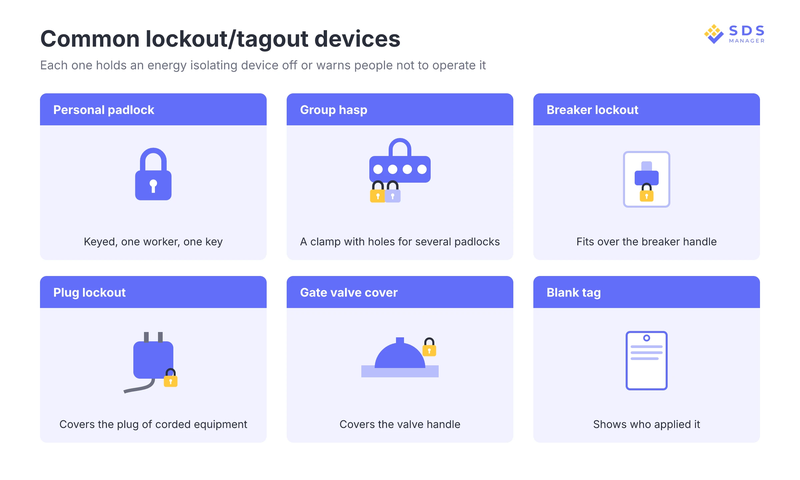
Lockout/tagout devices are the locks, tags, hasps, valve covers, breaker locks, plug covers and blocks that hold an energy isolating device in the off position or warn people not to operate it. The employer must supply them.
A LOTO lock is a keyed padlock used only for lockout and assigned to one worker, who keeps its only key. CCOHS advises one worker, one lock, one key, with no master keys, so no one else can open a lock that protects you.
Common lockout devices include breaker lockouts, plug lockouts, gate valve covers, ball valve lockouts and group hasps. A hasp is a clamp with holes for several padlocks, so the device stays locked until every padlock is off.
OSHA's rule sets five tests that every lockout device and tag must pass:
- Singularly identified: used only for controlling energy, never for other jobs such as locking a toolbox.
- Durable: able to last in the site's conditions, including weather, wet areas and chemicals, for as long as it is expected to stay on.
- Standardized: told apart from other locks and tags by color, shape or size. OSHA sets no color code, as its interpretation letter on lock colors confirms, only that each site standardize its own devices.
- Substantial: a lock strong enough that removing it takes excessive force or unusual tools such as bolt cutters, and a tag attached firmly enough that it cannot come off by accident.
- Identifiable: shows who applied it. Some Canadian rules likewise require each lock to be marked with the worker's name or another identifying mark.
What Must Lockout/Tagout Tags Have?
Lockout/tagout tags must show the name of the worker who applied them and carry a warning such as Do Not Start, Do Not Open, Do Not Close, Do Not Energize or Do Not Operate. Canadian guidance from CCOHS adds the reason for the lockout and the date and time the tag went on.
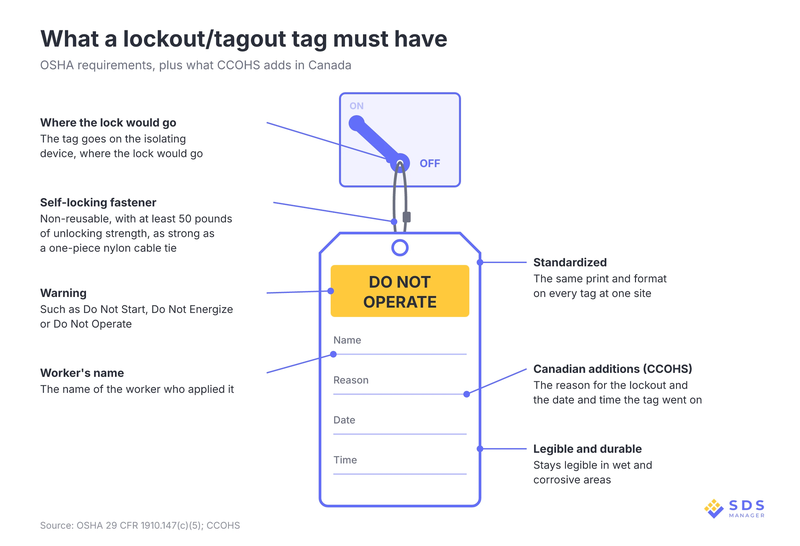
Tags on one site use the same print and format, so workers recognize them at a glance. They must stay legible in the conditions where they hang, including wet and corrosive areas.
OSHA requires a non-reusable, self-locking fastener with an unlocking strength of at least 50 pounds, at least as strong as a one-piece nylon cable tie. Many sites also add a contact name or phone number, as site practice rather than a rule.
How Does Group Lockout/Tagout Work?
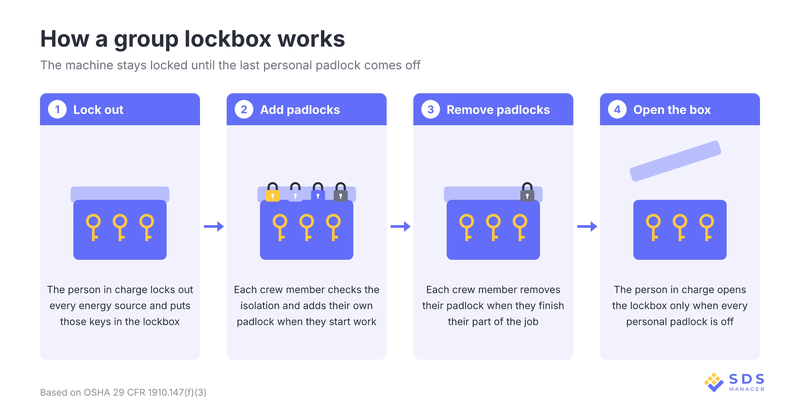
Group lockout/tagout puts one authorized employee in charge of isolating the machine, and every crew member then attaches a personal lock, usually to a group hasp or lockbox, so the machine cannot be restarted until the last person removes theirs.
A group lockbox is a box that holds the isolation keys and takes each worker's padlock. It usually works in this order:
- The person in charge locks out every energy source and puts those keys in the lockbox.
- Each crew member checks the isolation and adds their own padlock to the lockbox when they start work.
- Each crew member removes their padlock when they finish their part of the job.
- The person in charge opens the lockbox only when every personal padlock is off.
The person in charge also keeps track of which crew members are exposed to the machine's hazards during the job. Some provinces also require a posted record of each group lockout at the work site, such as a signed checklist or a written report.
Group lockout covers mixed crews, including workers from outside the company. When three maintenance workers and an outside electrician replace the warehouse conveyor's belt, each adds a padlock to the same lockbox, and the conveyor stays locked until the electrician, the last one finished, removes theirs.
Shift changes: At a shift change, lockout/tagout protection passes from the off-going worker to the oncoming worker under a written transfer procedure, so the machine is never left without a lock. The usual order is for the oncoming worker to lock on before the off-going worker removes their lock, or for a supervisor to lock on until the oncoming worker arrives, and the handover is recorded.
Outside contractors: The host employer and the contractor tell each other their lockout procedures, and the host makes sure its own workers follow the contractor's rules. Each contractor worker uses their own lock. Where several crews work on the same equipment, a permit to work records which crew holds which isolation.
Where several employers share a construction project, Canadian provinces that use the role require the prime contractor to coordinate health and safety between them. Lockout is part of that coordination whenever one employer's crew works on equipment that another employer's crew can switch on.
Swap the Lockout Binder for Scheduled Inspections
OSHA's most-cited lockout/tagout gaps are missing procedures, skipped inspections and untrained lock holders, not missing locks.
Every machine you service needs a written procedure, unless it meets all eight of OSHA's conditions for going without one. Each procedure needs an inspection on a set schedule, at least yearly under OSHA. Every worker who holds a lock needs training on the procedure they use.
Procedures in a binder, inspection dates in one spreadsheet and training records in another are easy to lose track of. A missed inspection or an out-of-date training record usually comes to light only when someone asks to see it.
Start with a list of the machines your crews service. Mark which ones have a written procedure, record each procedure's last inspection date, and note who is trained on each one.
EHS Solutions by SDS Manager schedules each yearly lockout inspection in its Audit & Inspection module and flags lock holders' training in its Safety Training module before the refresher date your site sets.
Start a free trial and have every lockout inspection scheduled and every lock holder's training current.
Frequently Asked Questions
What Is the Difference Between LOTO and LOTOTO?
LOTO and lockout/tagout/tryout (LOTOTO) differ by one step: LOTOTO names the try step, where you test the controls to confirm the machine will not start. LOTO procedures include the same test as their last step, so the two terms describe the same procedure.
How Do You Lock Out a Circuit Breaker?
You lock out a circuit breaker by switching it off, fitting a breaker lockout device over the handle and securing it with your own padlock and tag. Then test the circuit with a meter to confirm it is dead before you start work.
Does Lockout/Tagout Training Expire?
No. Lockout/tagout training does not expire on a fixed date under OSHA's standard or the main Canadian lockout regulations. Workers are retrained when their job or the lockout procedure changes, when new equipment or a process change brings a new hazard, and when an inspection shows, or the employer has reason to believe, that they have gaps in what they know or how they use the procedure.
Do You Need a Lockout/Tagout Procedure for Every Machine?
No. A lockout/tagout procedure can cover a group of similar machines with the same or similar controls, as OSHA has said in a 1999 interpretation letter, when the procedure identifies the machines it covers. A generic procedure used on its own does not meet OSHA's rule.
Does the OSHA Lockout/Tagout Standard Apply to Construction?
No. The OSHA lockout/tagout standard, 1910.147, excludes construction. Electrical work in construction follows 1926.417, which requires de-energized circuits to be made inoperative and tagged at every point where they can be energized.
Is There a Lockout/Tagout Color Code?
No. Neither OSHA nor the main Canadian lockout regulations set a lockout/tagout color code. OSHA only requires each site to standardize its locks and tags by color, shape or size, so many sites assign colors by trade, department or contractor and record the scheme in their program.
What Is the Difference Between De-energization and Lockout?
De-energization and lockout differ in purpose: de-energization disconnects equipment from its energy and releases what is stored, while lockout places personal locks so the equipment cannot be re-energized until the work is done. A lockout always starts with de-energization.
What Is CSA Z460?
CSA Z460 is Canada’s national standard for controlling hazardous energy. The current edition, CSA Z460:20, makes lockout the main method and allows other methods only after a risk assessment. It is a standard, not a regulation, so it’s legally binding only where a regulation or contract refers to it.
What Are the Most Common Lockout/Tagout Violations?
The most common lockout/tagout violations are missing written procedures, skipped yearly inspections and no energy control program. Lockout/tagout ranked No. 3 on OSHA’s preliminary list of the most frequently cited standards for fiscal year 2026. OSHA’s serious citations in general industry were:
- No written procedure: 448
- Skipped yearly inspection: 238
- No energy control program: 227
- Steps done out of order: 203
- Untrained authorized employee: 172

Arysha Alif Khan

Arysha Alif Khan is an EHS and chemical safety specialist with a background in biochemistry, biotechnology, and public health. She works closely with the product and regulatory teams to turn complex chemical regulations, SDS requirements, and workplace safety standards into clear, practical guidance for people.