
The leading causes of workplace fatalities in Canada are occupational diseases, followed by vehicle and transport incidents, being struck or caught by objects and equipment, and falls.
In 2024, Canada's workers' compensation boards accepted 1,046 deaths as work-related. More than half of them came from disease. Most of those diseases are cancers and lung diseases from breathing in asbestos and other harmful substances years ago.
Because occupational diseases take years to appear, the exposures that will cause future deaths are happening on job sites today.
In this article, you'll learn what causes most deaths at work in Canada, how many workers die each year, who is most at risk, and how to prevent the leading causes.
Key Takeaways
- Occupational disease is the leading cause of workplace fatalities in Canada: 57% of the 1,046 accepted workplace deaths in 2024 came from exposure to harmful substances, according to the Association of Workers' Compensation Boards of Canada (AWCBC).
- Cancer accounted for at least 403 accepted workplace deaths across Canada in 2024. Asbestos alone caused 36 of British Columbia's 79 workplace disease deaths in 2025.
- Vehicle and transport incidents caused about 172 accepted workplace deaths across Canada in 2024, nearly three times as many as falls (about 60).
- Canada's compensation boards accepted 993 workplace death claims in 2022, 1,057 in 2023 and 1,046 in 2024 (AWCBC).
- In 2024, 566 (54%) of the accepted workplace deaths across Canada were workers aged 65 or older.
- Preventing workplace deaths across Canada starts with controlling harmful substances such as asbestos and silica dust, because exposure to them causes more deaths than any type of accident.
What Is the Leading Cause of Workplace Fatalities in Canada?
Occupational disease is the leading cause of workplace death in Canada. In 2024, 598 of the 1,046 deaths accepted by workers' compensation boards came from exposure to harmful substances, according to the national work injury, disease and fatality statistics published by the Association of Workers' Compensation Boards of Canada (AWCBC).
An accepted death is one that a province's or territory's workers' compensation board has agreed was caused by work. An occupational disease is an illness caused by conditions at work, such as breathing dust, fibres or fumes over months or years.
| Cause | Accepted deaths, 2024 | Share of all deaths |
|---|---|---|
| Exposure to harmful substances | 598 | 57% |
| Vehicle and transport incidents | About 172 | 16% |
| Being struck or caught by objects and equipment | About 88 | 8% |
| Falls | About 60 | 6% |
| Assaults and violent acts | 15 | 1% |
| Contact with electricity | 11 | 1% |
| All other causes | About 100 | 10% |
The vehicle, struck-or-caught, falls and all-other-causes figures each combine several smaller categories, and they are minimums, because AWCBC does not publish categories with three or fewer deaths.
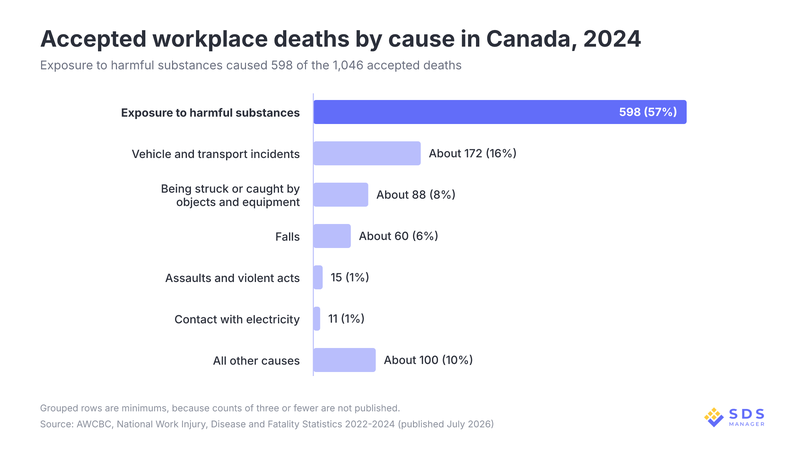
Disease deaths differ from accident deaths, which come from a single event such as a crash or a fall. Compensation boards call accident deaths injury deaths.
All accident causes together caused fewer deaths than harmful substances alone.
With disease, the harm builds slowly. Dust, fibres or fumes that a worker breathes in can damage the lungs or cause cancer years or even decades later. That gap between the exposure and the illness is called latency.
Think of a worker who fitted asbestos pipe insulation decades ago. The illness may appear only after retirement, and the death still counts as a workplace death once the compensation board accepts the claim.
Of all accepted deaths in 2024, at least 403 (39%) were cancers and 144 were lung and breathing diseases.
In 367 deaths, the cause was traced back to nonmetallic minerals. This group includes asbestos and silica, the fine dust released when stone, concrete or brick is cut.
British Columbia had 138 workplace deaths in 2025, and 79 of them were from disease. Asbestos caused 36 of those 79, according to WorkSafeBC's 2025 Day of Mourning figures.
Past workplace exposure to asbestos causes about 1,900 lung cancers and 430 mesotheliomas in Canada each year, according to the Occupational Cancer Research Centre. Mesothelioma is a cancer of the lining of the lungs or abdomen, caused mainly by asbestos.
Canada banned most uses of asbestos in 2018.
Asbestos is the best-known cause, but many other chemicals at work can also cause occupational diseases, including skin and lung conditions.
Which Accidents Cause the Most Workplace Deaths?
Vehicle and transport incidents cause the most accident deaths at work in Canada, nearly three times as many as falls. Highway crashes alone caused 96 accepted deaths in 2024.
Not all vehicle and transport deaths happen in highway crashes. In 2024, 36 workers on foot died after being struck by a vehicle or mobile equipment, up from 14 in 2022. Aircraft incidents caused another 18 deaths, and crashes off public roads caused 12.
Driving and yard traffic are work hazards even for people who are not hired as drivers. Picture a loader reversing across a yard where people walk between buildings.
Being struck or caught by objects and equipment causes the next-most accident deaths. In 2024, 45 workers died after being struck by an object and 32 after being caught in or crushed by equipment or objects.
Being caught in means a body part is pulled into or pinned by a machine, which can happen when the machine starts or moves while someone is clearing, cleaning or fixing it.
Falls caused about 60 accepted deaths in 2024: 42 were falls from a height and 17 were falls on the same level, such as a slip on a wet floor.
On Ontario construction sites, falls from height caused about 43% of construction deaths over the past 15 years, more than any other cause, according to the Construction Death Review by Ontario's Chief Coroner. Across all types of work in Canada, though, falls cause fewer deaths than vehicles or objects.
Where people work at height, fall protection and Working at Heights training are the main ways to prevent a fall.
How Many Workplace Deaths Are There in Canada Each Year?
Workplace deaths in Canada have stayed between about 850 and 1,100 a year for two decades. Workers' compensation boards accepted 1,046 death claims in 2024, 1,057 in 2023 and 993 in 2022, according to AWCBC.
The 1,046 accepted deaths in 2024 work out to nearly three per day of the year.
The yearly count was 1,098 in 2005, 852 in 2015 and 1,081 in 2021.
Each death is counted in the year the compensation board accepts the claim, not the year the person died, so many of the deaths counted in any one year come from exposures or incidents that happened years earlier.
The total includes only accepted compensation claims, so workers without board coverage, such as most farm workers, are not counted.
National figures for 2025 are expected in 2027, but some provinces, such as British Columbia and Quebec, have published their own.
Which Industries and Workers Are Most at Risk?
Construction, farming, forestry and the trades have the most deaths at work in Canada, and older workers and men account for most of them.
Which Industries Have the Most Workplace Deaths?
Agriculture, forestry, fishing and hunting (175) and construction (171) had the most accepted workplace deaths of any industry in Canada in 2024.
| Industry | Accepted deaths, 2024 |
|---|---|
| Agriculture, forestry, fishing and hunting* | 175 |
| Construction | 171 |
| Public administration | 109 |
| Manufacturing | 101 |
| Transportation and warehousing | 85 |
| Mining, quarrying, and oil and gas | 53 |
| Not assigned to an industry** | 212 |
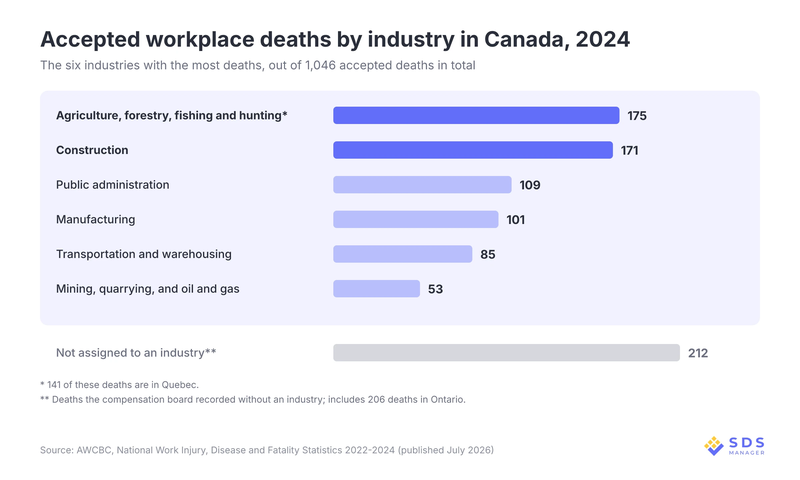
By type of job, four groups had the most accepted deaths in 2024:
- industrial, electrical and construction trades: 218
- firefighters, police, military and other front-line public protection workers: 152
- transport and heavy equipment operators: 124
- maintenance and equipment operation trades: 94
In 2024, at least 7 in 10 of the 152 deaths among front-line public protection workers were from cancer. The BC Injury Research and Prevention Unit found that 84.6% of the death claims accepted for firefighters in nine provinces and territories from 2007 to 2021 were for cancer.
Which Workers Are Most Likely to Die From Work?
Older workers and men are the most likely to die from work in Canada. Of the 1,046 accepted deaths in 2024, 566 (54%) were workers aged 65 and older, and 987 (94%) were men; 55 were women.
Young workers aged 15 to 24 accounted for 40 accepted deaths in 2024.
Disease deaths come from past exposures, but asbestos is still in many older buildings, so renovation, maintenance and demolition crews can be exposed today.
Cutting into old drywall or pipe insulation is one way it happens.
Workers are also exposed to silica dust, diesel exhaust and smoke from fires today.
CAREX Canada, which estimates how many Canadians are exposed to cancer-causing substances at work, puts the number exposed to asbestos at about 235,000, based on 2016 census data.
A short toolbox talk on asbestos in older buildings before renovation or demolition work tells the crew what to look for and when to stop.
Which Provinces Have the Most Workplace Deaths?
Ontario (320), Quebec (246) and Alberta (203) had the most accepted workplace deaths in 2024.
Disease caused most deaths in seven of the 11 provinces and territories that report deaths by cause, while accidents caused most in New Brunswick, Saskatchewan, and the Northwest Territories and Nunavut. Manitoba had equal numbers of each.
| Province or territory | 2024 deaths | 2024 from accidents | 2024 from disease | 2025 deaths |
|---|---|---|---|---|
| Newfoundland and Labrador | 26 | 11 | 15 | - |
| Prince Edward Island | 6 | 1 | 5 | - |
| Nova Scotia | 17 | 7 | 10 | - |
| New Brunswick | 19 | 13 | 6 | - |
| Quebec | 246 | 74 | 172 | 257 |
| Ontario | 320 | 78 | 242 | - |
| Manitoba | 22 | 11 | 11 | - |
| Saskatchewan | 27 | 18 | 9 | 27 |
| Alberta | 203 | 91 | 112 | 144 |
| British Columbia | 146 | 68 | 78 | 138 |
| Northwest Territories and Nunavut | 10 | 9 | 1 | - |
| Yukon | 4 | - | - | - |
The split between accident and disease deaths comes from the 2026 Report on Work Fatality and Injury Rates in Canada. 2025 figures are shown where the province had published them by October 2026.
Provinces with more workers tend to have more deaths, so a death rate (deaths for every 100,000 workers) is a fairer way to compare them.
Among provinces with more than 100,000 workers, Saskatchewan had the highest rate of accident deaths from 2020 to 2024, at 4.1, and Alberta was next at 3.8, according to the 2026 Report on Work Fatality and Injury Rates in Canada.
Each province and territory also sets its own workplace safety law, including its own hazard assessment requirements for employers.
How Can Workplace Deaths Be Prevented?
Start with the substances your workers handle: identify each one and limit exposure. Then control vehicles, machines, then heights, in order of how many deaths each causes.
| Cause | What it looks like | How to avoid it |
|---|---|---|
| Harmful substances | Dust from cutting concrete or stone, fibres from old insulation, solvent or diesel fumes in a closed space | Keep a current safety data sheet (SDS) for every product, use ventilation and wet cutting, and check older buildings for asbestos before renovation or demolition |
| Vehicles and mobile equipment | A loader reversing near people on foot, long drives between job sites | Mark walkways away from moving equipment, use a spotter when reversing, and plan rest breaks and safe routes for work driving |
| Objects and machinery | A machine starting while someone clears a jam, a load slipping from a hoist | Shut off and lock out energy sources before clearing, cleaning or repairing equipment, and keep people out from under loads |
| Falls | An unguarded roof edge, ladder or floor opening, a wet floor | Use guardrails or a fall arrest harness wherever someone could fall, train workers to use them, and clean up spills fast |
When you see a harmful substance, vehicle, machine or fall hazard with nothing in place to protect workers, report it to your supervisor or your health and safety committee. Report any other workplace hazard you spot the same way.
Know Which Chemicals Your Workers Handle
Harmful substances, including chemicals, asbestos and silica dust, are the leading cause of workplace death. There is no warning sign on the day a worker is exposed.
To find and stop exposure early, you need to know which workers handle which substances.
On many sites, there is no record of who handles what. SDSs, risk assessments and training sign-ins are kept in separate binders and files. As a result, nobody can see when the ventilation or protective equipment for a substance is overdue for a check, or when a product on the shelf still has an outdated safety data sheet.
Start with one list that shows each harmful substance on site, who works with it, where they use it and since when.
SDS Manager keeps every safety data sheet for the site in one up-to-date library and logs where each product is used.
Start a free trial and give every worker the right safety data sheet with one QR code scan.
Frequently Asked Questions
What Is the Leading Cause of Workplace Injuries in Canada?
The leading causes of workplace injuries in Canada are overexertion, such as lifting, pushing or pulling more than the body can handle. It caused 57,956 accepted lost-time claims (injuries that kept a worker off work) in 2024, ahead of falls on the same level (43,266) and being struck by an object (40,767), according to AWCBC.
What Is the Fatal Injury Rate in Canada?
The fatal injury rate in Canada is the number of workers who die from a work injury for every 100,000 workers in a year. Across 2020-2024, the average was lowest in Prince Edward Island (0.7) and Manitoba (1.3) and highest in the Northwest Territories and Nunavut (9.1), based on workers covered by each compensation board (University of Regina, 2026).
Why Are Workplace Deaths Not Falling When Injury Rates Are?
Workplace deaths are not falling when injury rates are because most of Canada’s accepted workplace deaths come from diseases caused by exposures years or decades earlier, while the injury rate reflects conditions in workplaces today. In 2024, every province and territory reported a lower lost-time injury rate than its 2021-2023 average, yet accepted deaths stayed near 1,000.
What Happens After a Workplace Death in Canada?
After a workplace death in Canada, most provinces require the employer to call 911, keep the scene as undisturbed as possible and report the death right away to the provincial safety regulator. The regulator may then investigate, and the family can claim survivor benefits from the workers' compensation board, such as a spouse's pension and funeral costs.
When Is the National Day of Mourning in Canada?
April 28 is Canada's National Day of Mourning for workers killed or injured on the job. Flags fly at half-mast on Parliament Hill and many workplaces hold a moment of silence at 11 a.m. Compensation boards such as Saskatchewan's release their previous year's death counts around that date.

Arysha Alif Khan

Arysha Alif Khan is an EHS and chemical safety specialist with a background in biochemistry, biotechnology, and public health. She works closely with the product and regulatory teams to turn complex chemical regulations, SDS requirements, and workplace safety standards into clear, practical guidance for people.