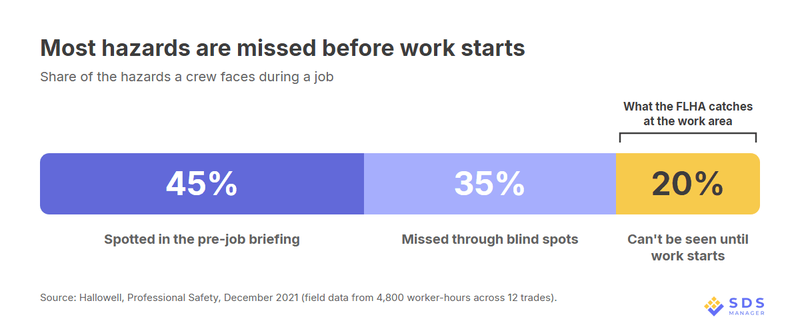
In a 2021 review of field research, safety researcher Matthew Hallowell found that workers in pre-job briefings identify only about 45% of the hazards they face. He also found that about 20% of hazards can't reasonably be identified until work starts. So one final check has to happen at the work area, on the day, before work starts.
A field level hazard assessment (FLHA), also called a field level risk assessment (FLRA), is that check: a short written assessment that a crew completes at the work area right before a task starts. To fill one out, the crew lists the task's steps, writes down the hazards in each step, rates the risk, picks a control for each hazard and signs the form together.
In this article, we'll walk you through what an FLHA should include, how to fill one out step by step, and what completed examples look like.
Key Takeaways
- A field level hazard assessment (FLHA) is done by the workers who will do the task, at the actual work area, on the day, so hazards the job plan could not foresee are controlled before work starts.
- A field level risk assessment (FLRA), the term CCOHS uses, is the same check as an FLHA under another name, and FLRA forms usually rate each hazard by likelihood and severity.
- Canadian occupational health and safety (OHS) laws generally don't name the FLHA. However, Alberta's OHS Code requires employers to assess a work site before work begins and record the results in a dated written report, and an FLHA checks that assessment against the conditions on the day.
- When an FLHA finds a hazard that no available control can bring down, that step of the task does not start until a supervisor resolves it.
- An FLHA is filled out with the whole crew at the work area, and every worker signs it only after the crew has gone through each hazard and its control together.
- A new FLHA is needed at the start of each shift and after changes such as a new task, new equipment, a new contractor arriving or a change in the weather.
What Is the Purpose of a Field Level Hazard Assessment?
The purpose of a field level hazard assessment (FLHA) is to find the hazards at the actual work area, on the day, before anyone starts. The crew can then control those hazards instead of discovering them through an injury.
"Field" refers to the place where the work is done. It could be a construction site, a plant floor, or a customer's basement.
An FLHA answers four questions, and each one matches a part of the form:
- What are we about to do? The task and its steps.
- What could hurt someone? The hazards in each step.
- How bad could it be? The risk rating.
- What are we doing about it? The controls the crew agrees on before starting.
The Canadian Centre for Occupational Health and Safety (CCOHS) recommends field-level risk assessments for work environments that keep changing. Its risk assessment fact sheet, last revised in 2025, says they are used to identify, assess and manage hazards on site as work progresses.
Is a Field Level Risk Assessment (FLRA) the Same as an FLHA?
Yes, a field level risk assessment (FLRA) is the same on-site check as a field level hazard assessment. Forms that use the "risk" name usually ask you to rate each hazard by how likely it is to cause harm and how serious that harm would be. That rating measures risk, not the hazard itself.
The difference between a hazard and a risk is simple: a hazard is the thing that can hurt you, and the risk is how likely and how severe that harm is.
Canadian employers use other names for the same check, too:
- Site-specific hazard assessment: the name in Alberta's guidance and the Northwest Territories and Nunavut code of practice.
- Tailboard: a common name among utility crews.
- Pre-job hazard assessment: used by some companies.
- Field level risk assessment: the term CCOHS uses, and the name on Actsafe’s forms in BC.
Is a Field Level Hazard Assessment Legally Required in Canada?
No, FLHA is not legally required by name. Canadian OHS laws generally don't use the term field level hazard assessment, but every Canadian jurisdiction requires employers to protect workers from hazards, and several spell out hazard assessment requirements. An FLHA is the usual way crews check the work area for hazards again on the day, on top of the employer's own assessment.
Here is how three sets of rules word the duty:
- Alberta: Section 7 of Alberta's OHS Code (Alberta Regulation 191/2021) requires the employer to assess a work site and identify hazards before work begins. The employer must also prepare a report of the results and the controls, and record the date on it. Section 8 requires the employer to involve affected workers.
- Ontario: Section 25(2)(h) of the Occupational Health and Safety Act requires employers to take every precaution reasonable in the circumstances to protect workers. The Act has no general duty to write a hazard assessment.
- Federally regulated workplaces: Part XIX of the Canada Occupational Health and Safety Regulations requires a hazard prevention program that includes a method for identifying and assessing hazards.
The FLHA does appear by name in guidance. The Hazard Assessment Code of Practice for the Northwest Territories and Nunavut says site-specific assessments are also called field-level hazard assessments, even in workplaces where nobody works out in the field.
What Should a Field Level Hazard Assessment Include?
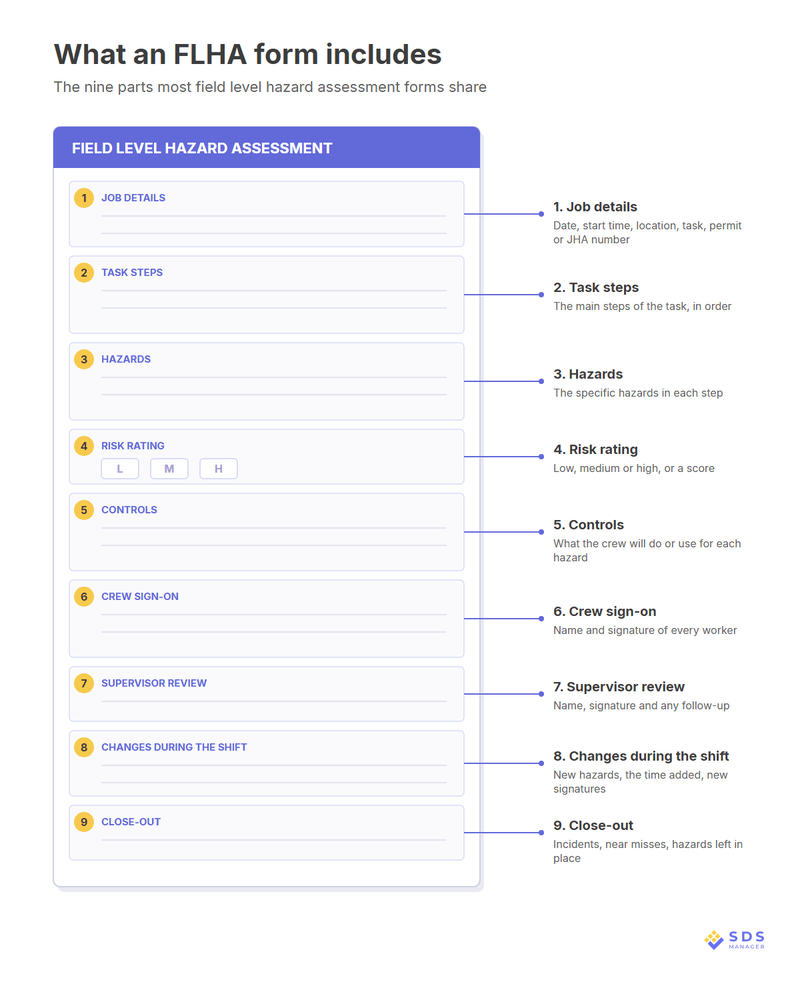
A field level hazard assessment form should record the job details, each hazard and its control, and the names of everyone who reviewed it. That way, anyone can see what the crew checked and when.
Most FLHA booklets, cards and apps share the same parts, in roughly the same order. Alberta's October 2023 hazard assessment handbook includes a site-specific hazard assessment template you can compare against your own.
An FLHA Form Includes:
| Part of the form | What you write | |
|---|---|---|
| Job details | The date, start time, work location and task, plus any permit or job hazard analysis (JHA) number | |
| Task steps | The main steps of the task, in order | |
| Hazards | The specific hazards in each step | |
| Risk rating | How likely and how serious each hazard is, as low, medium or high, or as a score | |
| Controls | What the crew will do or use to deal with each hazard | |
| Crew sign-on | The name and signature of every worker doing the task | |
| Supervisor review | The supervisor's name, signature and any follow-up | |
| Changes during the shift | Any new hazard, the time it was added, and new signatures | |
| Close-out | Incidents, near misses and hazards left in place when the task ends |
How Do You Fill Out a Field Level Hazard Assessment?

You fill out a field level hazard assessment in seven steps at the work area. For a simple task, such as moving some light materials, filling one out can be a quick conversation. For complex, high-risk work, such as a critical crane lift, it can take considerably longer.
Step 1: Gather the Crew at the Work Area
Do the FLHA where the work will happen, not in the truck or the lunchroom. A foreman or supervisor usually leads it, according to Alberta's 2023 handbook.
Start a blank form, write the date and time, and look at four things:
- the people,
- the equipment,
- the materials and
- the environment, including the weather, lighting and ground.
Fill the form in with the crew, not for them. A 2022 US study by Memarian, Brooks and Le looked at 30 job hazard analysis forms. It found that 83% had been filled in by management before they reached the crew.
Safety managers interviewed for the same study said crews often "pencil whipped" the forms, meaning they filled them in without really reading them. A prefilled or copied form lists the hazards someone expected, not the ones in front of you.
Step 2: Write Down the Task and Break It Into Steps
Write the task at the top of the form. Then break it into its main steps, in the order you'll do them.
If the job already has a JHA, copy its steps across and check them against what you see. A JHA is a written, step-by-step hazard plan prepared in advance for that type of job. If a high-risk task has no JHA or written procedure, ask your supervisor for one before going further.
Step 3: List the Specific Hazards in Each Step
Write down the hazards in each step. Good hazard identification names the object or condition, not the injury it could cause. "Slips, trips and falls" is an outcome. "Extension cord across the walkway" is a hazard you can fix.
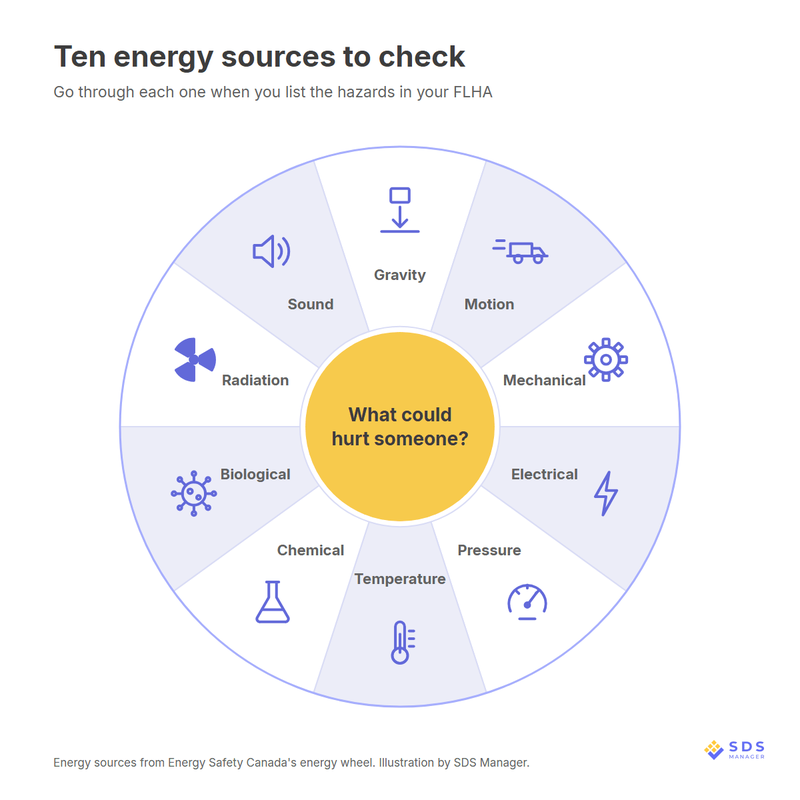
To find hazards that are easy to overlook, go through the sources of energy that can hurt people. Energy Safety Canada's energy wheel lists ten of them:
- gravity, such as a fall or a dropped tool
- motion, such as a reversing vehicle
- mechanical, such as rotating parts on a grinder
- electrical
- pressure, such as an air hose or a pressurized line
- temperature, such as hot surfaces or cold weather
- chemical
- biological, such as mould or bird droppings
- radiation, such as a welding arc
- sound
For any chemical product, read its WHMIS label (the hazard label required under Canada's Workplace Hazardous Materials Information System) and its safety data sheet (SDS). The SDS is the supplier's document that lists the product's hazards and the protection it needs.
Step 4: Rate the Risk of Each Hazard
Rate each hazard by how likely it is to cause harm and how serious that harm would be, using the scale on your form. Many forms score this with a risk matrix that combines likelihood and severity into one number. A hazard that is likely to happen and could cause a serious injury rates high. Rate every hazard before choosing controls, because the rating tells you how strong the control needs to be.
Step 5: Choose a Control for Every Hazard
Choose a control for every hazard, starting with the strongest one that works. Alberta's OHS Code sets the order, known as the hierarchy of controls:
- Remove the hazard.
- If removing it isn't reasonably practicable, meaning it can't be done with reasonable effort in the circumstances, use engineering controls. These change the equipment or the work area, such as a guard or a barrier.
- Next, use administrative controls. These change how the work is done, such as a procedure or a spotter.
- Last, use personal protective equipment (PPE), such as gloves or a respirator.
You can combine controls where that gives workers greater protection.
A control is always something the crew does or uses. "Be careful" and "use caution" don't count, and CCOHS advises against writing general statements like these.
If no control you have brings the risk down, don't start that step. Write the hazard on the form and tell your supervisor, who can add controls, change the job or bring in help.
If the danger is serious and still isn't dealt with, you have the right to refuse unsafe work. In Alberta, you may refuse work if you believe on reasonable grounds that it involves an "undue hazard" (OHS Act, section 17).
No one may take disciplinary action against you for doing so (section 18). CCOHS notes that every jurisdiction in Canada gives workers the right to refuse work they believe is unsafe, and that the refusal process differs from one jurisdiction to the next.
Step 6: Review the FLHA With the Crew and Sign It
Every worker doing the task signs the FLHA after the crew has gone through the hazards and controls together. The person leading the FLHA reads out each hazard and its control, and workers add anything that was missed. Alberta's site-specific hazard assessment template tells crews to review the completed form with all workers before work starts.
Your signature means you heard and understood the controls, so sign after the review, not before it. Keep the form at the work area, where anyone can check it during the shift.
Step 7: Hand In the FLHA When the Task Is Done
When the task is done, note anything that changed, any near misses and any hazards left in place, then give the form to your supervisor. Alberta's OHS Code doesn't specifically require a supervisor to review each FLHA, but it is common practice. Supervisor review is how the hazards a crew finds reach someone who can fix them.
If the crew found a hazard that the site's formal hazard assessment missed, Alberta's handbook says that assessment should be updated to include it. The formal hazard assessment is the written assessment the employer prepares in advance for the site or job.
Examples of Field Level Hazard Assessment
Field level hazard assessment examples show each task step next to its hazards, risk ratings and controls. These three examples are everyday jobs, and each has at least one hazard that comes from the day's conditions rather than from the job itself.
Example 1: Restocking a Store’s Storeroom
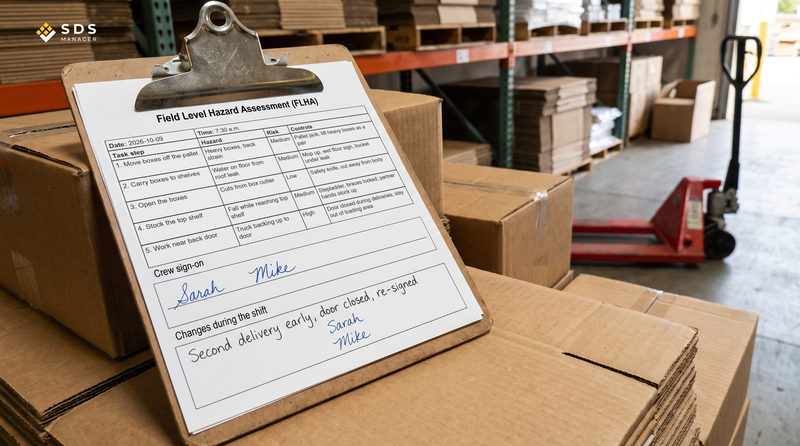
Say two workers are unloading a delivery and restocking the shelves in a store's back room. Their completed form looks like this.
| Task step | Hazard | Risk | Controls |
|---|---|---|---|
| Move boxes off the delivery pallet | Heavy boxes that can strain your back | Medium | Use the pallet jack, and lift heavy boxes as a pair |
| Carry boxes to the shelves | Water on the floor from a roof leak after last night's rain | Medium | Mop it up, put out a wet floor sign, and set a bucket under the leak |
| Open the boxes | Cuts from the box cutter | Low | Use a safety knife and cut away from your body |
| Stock the top shelf | Fall while reaching the top shelf | Medium | Use a stepladder with the braces locked, not a chair or a box. Don't stand on the top or the pail shelf (the fold-out shelf for a paint can), and have your partner hand stock up instead of carrying it while climbing |
| Work near the back door | A delivery truck backing up to the door | High | Keep the door closed during deliveries and stay out of the loading area |
Halfway through the shift, a second delivery arrives early. The workers stop, add the second truck and its control to the form, and both sign again.
Example 2: Cutting Grass in a Park
A groundskeeper is mowing a public park on a hot afternoon. The FLHA lists five hazards:
- Stones and sticks thrown by the mower (Medium): walk the area first, pick up anything loose, and wear safety glasses.
- Engine noise (Medium): wear hearing protection.
- People and pets walking nearby (Medium): stop the mower whenever someone comes close.
- A steep bank beside the pond (High): use a string trimmer on the bank instead of the mower.
- Heat (Medium): drink water often, take breaks in the shade, and wear a hat.
Example 3: Cleaning a Restaurant Kitchen After Closing
One cook is cleaning up alone after the restaurant closes. The fryer oil is still hot, so the cook waits for it to cool before draining it. The floor is wet and greasy, so the cook wears non-slip shoes and puts out a sign.
The oven cleaner is a strong chemical, so the cook reads its label and safety data sheet before using it. Section 8 of an SDS lists the protection a product needs, such as gloves and eye protection, and under WHMIS the SDS must be readily available to the workers who use the product.
Because no one else is in the building, the cook agrees to text the manager at set times and when the job is done, and the manager knows what to do if a text doesn't arrive.
When Do You Need to Redo an FLHA?
You need to redo the FLHA when:
- a new shift starts
- the crew moves to a new task, or a new work process starts
- the weather or the site environment changes
- new equipment or a new contractor arrives
- non-routine work is added to the job
These triggers come from the code of practice for the Northwest Territories and Nunavut and Alberta's 2023 handbook.
Alberta's OHS Code sets similar triggers for the employer's own hazard assessment. It must be repeated at reasonably practicable intervals, when a new work process is introduced, when a process or operation changes, and before major additions or alterations to a work site.
What Is the Difference Between an FLHA and a JHA?
A JHA is written in advance for a type of job, while an FLHA checks that job against the conditions at the work area on the day. Many employers, and CCOHS, call the same document a job safety analysis (JSA), so the FLHA vs JHA comparison applies to a JSA as well. CCOHS describes a JSA as breaking a job into steps, identifying the hazards in each step, and deciding how to prevent them.
A routine job makes the difference clear. A JHA for cleaning a warehouse's floor drains is written once and reused. The FLHA that morning is where the crew notices that a forklift route now crosses the work area.
Hazard assessments also come in two types. Alberta's legislation refers to a formal hazard assessment, which the employer prepares. Alberta's handbook treats site-specific (field-level) assessments as a second type, done at the work area.
FLHA vs JHA at a Glance
Neither one replaces the other: the JHA sets out the safe way to do the job, and the FLHA checks it against the day's conditions.
Digitize Your FLHA Forms So Every Form Gets Reviewed
A signed FLHA protects one crew for one task. Paper forms from different crews and sites end up in trucks and binders, though. So nobody sees when the same hazard keeps appearing, and the fix that would remove it for good never gets made.
This week, pull one week of FLHAs from one crew. Check that each form names specific hazards, has a real control for every hazard, and carries every worker's signature.
The Audit & Inspection module in EHS Solution by SDS Manager makes that review part of the routine. Crews complete pre-start checks on a phone, even with no signal, and attach photos and signatures to each answer. Your existing FLHA form can be set up as the template. Any failed item can be raised as a corrective action, and checks from every site can be compared in one view.
Frequently Asked Questions
Do Late Arrivals and Visitors Need to Sign the FLHA?
Yes, late arrivals and visitors need to read and sign the FLHA before they start work in the area. The person who led the FLHA goes over the hazards and controls with them first, because those controls apply to anyone in the work area.
How Long Should You Keep Completed FLHA Forms?
Completed FLHA forms have no set retention period under Alberta's OHS Code or the federal Part XIX rules, although Part XIX requires employers to keep a record of identified hazards. Follow your employer's records policy instead. Keeping them is still worthwhile, because completed forms show what the crew checked if an incident is investigated later.
Can You Complete an FLHA on a Phone Instead of Paper?
Yes, you can complete an FLHA on a phone or tablet, as long as it records the same information as a paper form. In Alberta, the OHS Act says a required report must be in writing. A stored electronic copy counts if workers can readily access it at the work site (section 55(6)).
Are Field Level Hazard Assessments Only for Construction?
No, field-level hazard assessments are used in any workplace where conditions change from day to day, not only in construction. The code of practice for the Northwest Territories and Nunavut notes they are used in non-field workplaces too. Utilities, maintenance, oil and gas, and home care are common examples.
Is There an Official Government FLHA Form?
No, there is no single official government FLHA form, so employers can use their own. In Alberta, the Alberta Construction Safety Association's 2023 Certificate of Recognition (COR) checklist asks that site-specific hazard assessment tools include a way to reassess hazards, a field for worker sign-off and a place to record controls.

Arysha Alif Khan

Arysha Alif Khan is an EHS and chemical safety specialist with a background in biochemistry, biotechnology, and public health. She works closely with the product and regulatory teams to turn complex chemical regulations, SDS requirements, and workplace safety standards into clear, practical guidance for people.