Every Canadian worker has the legal right to refuse unsafe work, but the term "unsafe" carries a specific legal test, not a general feeling of discomfort. A worker needs reasonable grounds to believe the work poses a real threat before a refusal is protected.
In this article, we will work through what that standard actually means, with concrete examples of refusals that qualify and refusals that don't. Plus the process a refusal triggers once it's made.
Key Takeaways
- Right to refuse unsafe work means a valid work refusal that requires a good-faith belief on reasonable grounds that work endangers the health or safety of the workers or another person in some jurisdictions.
- Thresholds differ by jurisdiction. Federal law requires the threat to be imminent or serious; either alone is enough. Alberta comes closest, treating a serious and immediate threat as an undue hazard. Ontario and British Columbia set no severity or timing threshold at all.
- The process is federally and provincially specific: the Canada Labour Code Part II governs federally regulated workers, while each province runs its own Occupational Health and Safety Act with different section numbers and sometimes different tests.
- A worker who refuses must notify their supervisor immediately, and the employer must investigate before the refusal can be resolved or escalated.
- Ontario limits the right for police, firefighters, correctional and certain health care workers, but only where the danger is normal to that job or where refusing would endanger someone else. Federally, the normal-condition limit applies to every worker, not just specific occupations.
- Disciplining a worker for a genuine refusal is illegal, and the burden falls on the employer to prove any resulting action wasn't retaliation.
- An employer can assign refused work to another worker while an inspector's investigation and decision are pending. But only after telling that worker about the refusal and the reasons for it, in the presence of a health and safety representative or committee member. That worker holds the same right to refuse.
What Is the Right to Refuse Unsafe Work?
The right to refuse unsafe work lets an employee stop performing a specific task when they have reasonable grounds to believe it presents either a serious or imminent danger, not necessarily both. It isn't a general right to avoid work someone dislikes, and it isn't triggered by minor or routine hazards that ordinary workplace controls already manage.
For example, a worker can refuse to operate a forklift with failed brakes, since that's an immediate hazard with a specific cause. A worker generally can't refuse a shift simply because the warehouse is colder than usual, since that's a routine condition without a specific hazard behind it.
Damaged or defective protective equipment is one of the clearest triggers for a valid refusal, and it's worth knowing what to do the moment gear fails, not just that a refusal is available.
Federally, the Canada Labour Code defines "danger" as a hazard, condition, or activity that could reasonably be expected to be an imminent or serious threat to life or health before it can be corrected.
Provincial thresholds don't just differ in wording. British Columbia tests refusals against an objective "undue hazard" standard, judged by how a reasonable person would view the situation, while Ontario's test turns on whether a condition is "likely to endanger" the worker, a lower bar that doesn't require the same objective reasonable-person analysis.
Who Does the Right to Refuse Apply To?
The right to refuse unsafe work applies to:
- Nearly all workers covered by an OHS Act or the Canada Labour Code have the right to refuse, regardless of job type or seniority.
- Federally regulated employees (banking, telecommunications, interprovincial transport, and similar sectors) fall under Canada Labour Code Part II, Section 128.
- Provincially regulated employees fall under their province's OHS Act, which covers most other workplaces.
Ontario limits the right for police officers, firefighters, correctional staff, and workers in health care and related institutional settings, but only where the danger is inherent in the job or a normal condition of employment.
Federally, that same normal-condition limit applies to every worker, not just specific occupations, alongside a separate exception where refusing would directly endanger someone else, which also applies across the board rather than to any specific group.
Workers on ships or aircraft in operation face additional limits under federal law, since a refusal mid-operation can itself create a hazard.
A ship is "in operation" from the moment it casts off from a wharf until it's next secured alongside a wharf in Canada, and an aircraft from the moment it first moves under its own power for takeoff until it comes to rest at its first Canadian destination.
During that window, a worker must report the danger to the person in charge instead of stopping work outright, and that person decides on the spot whether to act, with the formal refusal process only resuming once the vessel or aircraft is no longer in operation.
Independent contractors and self-employed people sit outside this protection in most cases. The right to refuse is built around the statutory definition of "worker" or "employee," and most Canadian OHS legislation doesn't extend that definition to someone running their own business, even when they're working on-site alongside protected employees.
This creates a gap worth flagging directly: someone hired as a contractor for a specific job generally can't invoke the same right to refuse that a permanent or temporary employee on the same site would have, regardless of how similar the actual hazard is.
Is the Right to Refuse the Same in Every Province?
No, the right to refuse unsafe work is not the same in every province. The gap between standards matters in practice, not just on paper.
In BC, the question is whether a reasonable person in the same position would see an undue hazard. Ontario asks only whether the condition is likely to endanger the worker. That's a lower bar, so the same situation can fall short in BC and still support a valid refusal in Ontario.
A worker moving between jurisdictions can't assume the same facts will get the same result.
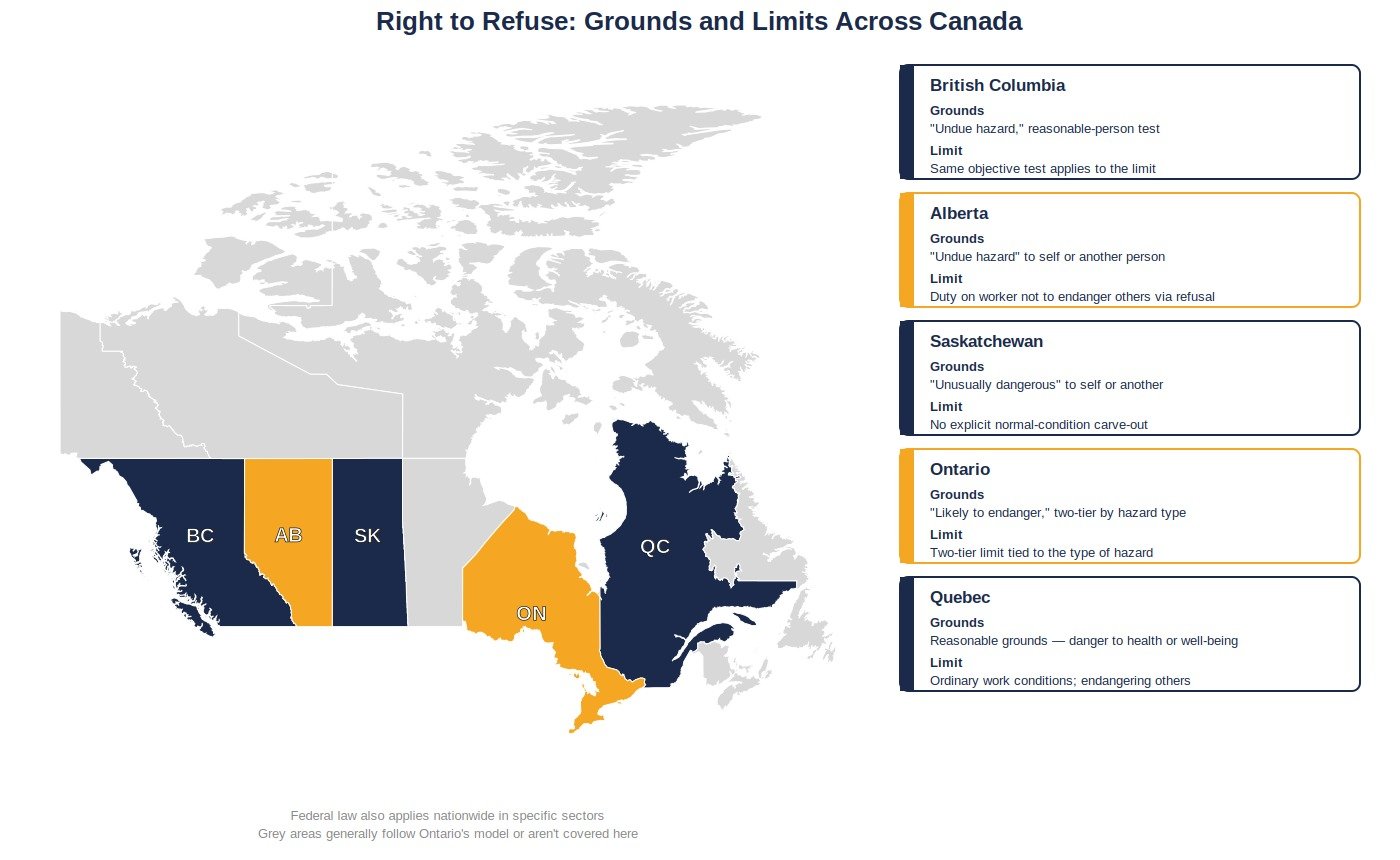
Each jurisdiction also draws its limits differently, not just its grounds:
- Federal (Canada Labour Code, s. 128(2)): a worker can't refuse if doing so would directly endanger another person, or if the danger is a normal condition of employment.
- Ontario (OHSA, s. 43(3)): the grounds split into two tiers with different limits. A worker can refuse unsafe equipment, a machine, or a contravention of the Act if it endangers themselves or another worker. A worker can refuse over the physical condition of the workplace or workplace violence only where it endangers themselves.
- Alberta (OHS Act, s. 17(2)–(3)): the standard is an "undue hazard" to the worker or another person, but the limit works differently than the federal or Ontario model. Rather than excluding normal-condition hazards outright, s. 17(3) puts a duty on the refusing worker to ensure, as far as is reasonable, that their refusal itself doesn't endanger anyone else.
- British Columbia (WCA, OHS Regulation, s. 3.12): an "undue hazard," tested against how a reasonable person would view the situation with the same information.
- Quebec (Act respecting occupational health and safety, s. 13): a worker can't exercise the right if refusing would put another person's life, health, safety, or well-being in immediate danger, or if the working conditions are ordinary conditions for that kind of work, the same two-part limit used federally.
- Saskatchewan (Saskatchewan Employment Act, s. 3-31): the standard is whether an act or series of acts is "unusually dangerous" to the worker or another person. Unlike the other jurisdictions above, the legislation doesn't carve out a separate normal-condition-of-employment exception in the same explicit terms.
| Jurisdiction | Grounds standard | Key limit |
|---|---|---|
| Federal | Reasonable cause to believe danger exists | Excludes normal conditions of employment and refusals that would directly endanger another person |
| Ontario | Likely to endanger (equipment/Act contravention: self or others; workplace condition/violence: self only) | Two-tier limit tied to the type of hazard |
| Alberta | Undue hazard to self or another person | Duty on the refusing worker not to endanger others through the refusal itself |
| British Columbia | Undue hazard, reasonable-person test | Same objective test applies to the limit as to the grounds |
| Quebec | Reasonable grounds to believe danger to health, safety, or well-being | Excludes ordinary work conditions and refusals that would immediately endanger another person |
| Saskatchewan | Unusually dangerous to self or another person | No explicit normal-condition carve-out in the legislation |
The remaining provinces and territories, such as Nova Scotia and New Brunswick, generally follow a version of Ontario's model, combining a reasonable-grounds standard with a normal-condition-of-employment limit. The exact wording and process still vary enough that a worker should confirm which Act applies to their specific location rather than assuming any province's rules carry over directly.
The steps a worker takes, and the body that resolves a dispute, also change by jurisdiction. A worker should confirm which Act applies to their employer before relying on any single province's process.
What Does a Valid Work Refusal Actually Look Like?
A work refusal moves through a defined sequence, and skipping a step can affect whether the refusal stays protected.
Reasonable Grounds To Believe Danger Exists
The worker's belief has to be genuine and objectively reasonable, not just personally felt. A broken guard on a saw, a visibly damaged ladder, or a confirmed gas leak all meet this standard. A vague sense of unease, without a specific hazard behind it, generally doesn't.
Following basic chemical handling practices also cuts down on how often a worker ends up facing this decision in the first place.
Notifying The Employer Or Supervisor
The worker must report the refusal, and the reason for it, to their employer or supervisor right away. This step is mandatory rather than procedural: a delay in reporting can undermine whether the refusal stays protected.
Building general chemical safety awareness across a team also makes it easier for workers to recognize when a situation actually crosses that threshold.
The Employer's Investigation
The employer must investigate promptly, alongside the worker and a health and safety committee member or representative. What happens next differs by jurisdiction.
Federally, if the employer decides no danger exists, they must inform the worker of that decision and their reasons in writing.
In Ontario, the employer's initial investigation carries no equivalent statutory duty to issue written reasons. That obligation instead falls to the Ministry inspector, if and when the matter escalates.
Escalating To The Joint Health And Safety Committee Or Ministry
If the worker still isn't satisfied after the employer's investigation, the refusal continues. In Ontario, either party contacts an inspector from the Ministry of Labour, Immigration, Training and Skills Development (MLITSD).
While this is pending, the worker must remain in a safe place near their workstation and stay available for the investigation, rather than leaving the site. Federally, the matter goes first to the joint health and safety committee, then to the Head of Compliance and Enforcement if it remains unresolved.
What The Inspector Decides, And How To Appeal
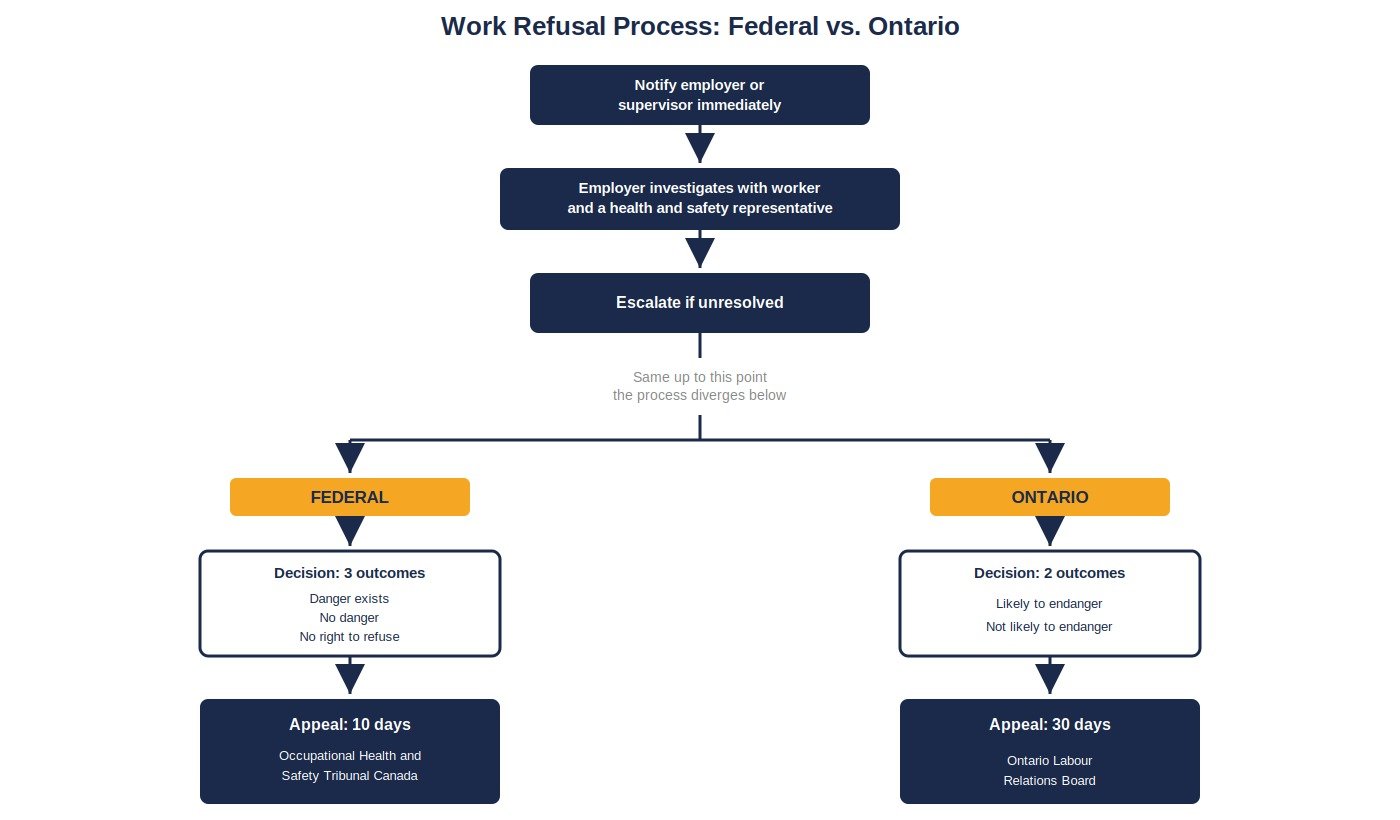
In Ontario, the inspector's decision is binary: the work is either likely to endanger the worker, or it isn't. Either party can appeal that decision within 30 days to the Ontario Labour Relations Board (OLRB).
Federally, the process works differently. The Head of Compliance and Enforcement reaches one of three conclusions instead of two:
- A danger exists;
- A danger exists, but a statutory exception applies, such as a normal condition of employment;
- Or that no danger exists.
Only the worker, or someone the worker designates, can appeal, and only the second and third findings within 10 days, to the Canada Industrial Relations Board. An employer that wants to challenge a finding that danger does exist appeals the resulting direction instead, within 30 days, to the same Board.
Either party can appeal a "danger" or "no danger" finding within 10 days to the Occupational Health and Safety Tribunal Canada.
Examples of Valid and Invalid Work Refusals
| Valid refusals | Invalid refusals | |
|---|---|---|
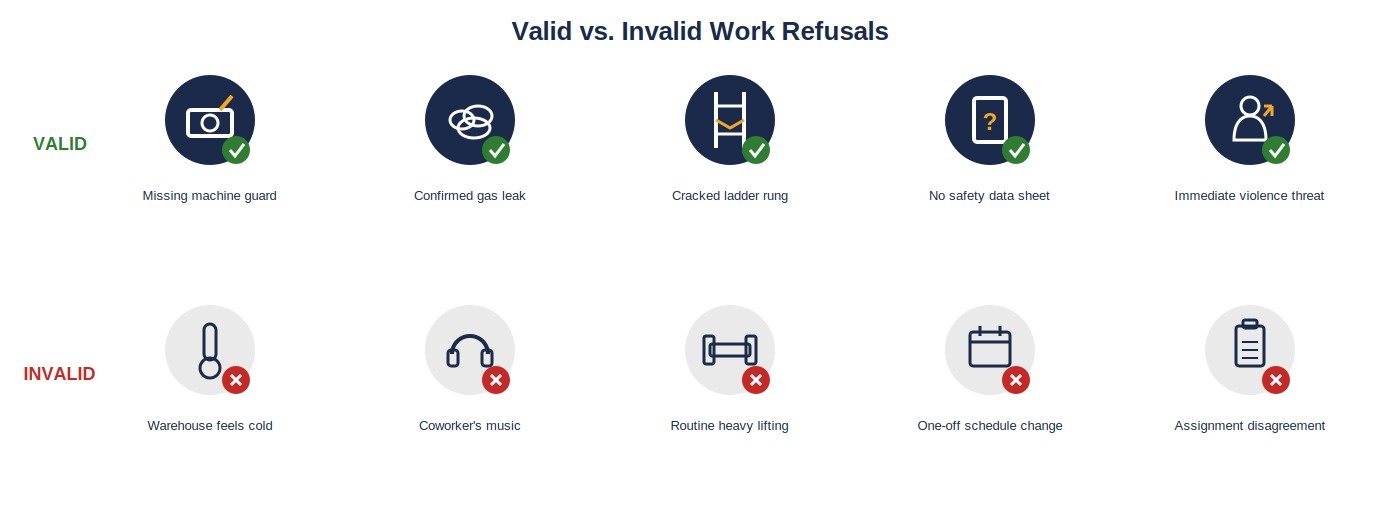
| A machine guard is missing, exposing moving parts | A task feels physically tiring but poses no specific hazard | |
| A confined space hasn't been tested for atmosphere before entry | A coworker's music or a minor personality conflict | |
| A ladder has a visibly cracked rung | A workplace is colder or warmer than preferred | |
| A worker is asked to handle a chemical with no label or safety data sheet available | Routine heavy lifting that's a standard, controlled part of the job | |
| Scaffolding shows visible structural damage | A one-off scheduling change with no safety implication | |
| A worker faces an immediate, credible threat of violence on site | A disagreement over how a task should be assigned |
Federal law does allow discipline in one narrow case: an employer may discipline a worker if it can demonstrate the worker wilfully abused the right to refuse. That only becomes available once all investigations and appeals have been exhausted, and the burden of showing the abuse sits with the employer.
Can the Employee Refuse Work If the Hazard Isn't an Immediate Danger?
Yes, in most jurisdictions. Only federal law explicitly requires the danger to be "imminent or serious." The other four jurisdictions covered above test for a serious, undue, or unusual hazard without requiring immediacy, which means a slower-developing risk can still support a valid refusal outside the federal system. A hazard that's genuinely minor or speculative, such as general workplace discomfort, still won't qualify anywhere, immediacy or not.
Can an Employee Be Disciplined for Refusing Work?
No, an employee can not be disciplined for refusing work, not for a genuine refusal made in good faith. Disciplining, threatening, or dismissing a worker for exercising this right is illegal under every Canadian OHS framework.
Federally, if an employer does take disciplinary action, they must give the worker written reasons within 15 working days of a request, and the worker can file a complaint with the Canada Industrial Relations Board within 90 days of learning of the action, or of when they ought to have known about it.
The burden then shifts to the employer to prove the action wasn't retaliation for the refusal itself.
In Ontario, the route differs, but the principle is the same: the worker files a reprisal complaint with the Ontario Labour Relations Board, and the employer again carries the burden of proving no reprisal occurred. Ontario sets no statutory filing deadline, though the Board presumes prejudice to the employer after about a year.
Federal law does allow discipline in one narrow case: an employer may discipline a worker if it can demonstrate the worker wilfully abused the right to refuse. That only becomes available once all investigations and appeals have been exhausted, and the burden of showing the abuse sits with the employer.
Purpose vs. Practice — Where Work Refusals Get Complicated
The clearest disputes happen at the edge of the "reasonable grounds" standard, not in obvious cases like a missing machine guard.
A worker who refuses because a task feels risky, without pointing to a specific hazard, often loses at the investigation stage. Inspectors have repeatedly found that a hypothetical or general fear doesn't meet the legal test.
This creates a real tension in practice, though a narrower one than it might first appear. A worker decides alone, often under pressure, whether a situation crosses the threshold for a valid refusal.
An investigator then assesses that same decision afterward, but against what the worker actually knew and believed at the time, not against whether a danger turned out to be real. The gap isn't between in-the-moment judgment and hindsight about the outcome. It's between deciding alone in the moment and having that decision reviewed later by someone who wasn't there.
That keeps the actual legal test intact: reasonableness based on the worker's information at the time, rather than implying the investigation retroactively grades the worker against what was later discovered.
How Do You Build a Right to Refuse Unsafe Work Policy That Actually Works?
- State the legal standard that actually applies to the jurisdiction, not a generic import from another one. An Ontario policy that copies the federal "serious or imminent danger" wording sets a higher bar than the OHSA actually requires, and risks discouraging valid refusals that would meet Ontario's own, lower threshold.
- Name a specific person or role workers must notify immediately, available across all shifts, plus a backup contact for when that person is unreachable. A policy that names one person with no fallback effectively has no notification process outside their working hours.
- Set a fixed timeline for the employer's initial investigation, immediately or forthwith, and document who was involved.
- Build in the joint health and safety committee's role at the escalation stage. This step is a legal requirement federally, under s. 128(10.1) of the Canada Labour Code, but it isn't a mandatory stage under Ontario's OHSA, where the escalation goes straight to a Ministry inspector instead. Including the committee anyway, even where it isn't required, is still useful practice for building internal trust in the process.
- State the reassignment rule accurately: the employer can generally assign the refused work to another worker, including while the original refusal is still unresolved, but only if that worker has been told about the refusal and its reasons, and the employer is satisfied it won't put them in danger too.
- Set out how pay works during a refusal. Workers are generally entitled to their regular pay throughout a legitimate refusal, whether they're temporarily reassigned to other duties or waiting for the investigation to conclude, and a policy should say so directly rather than leaving it ambiguous.
- Keep safety data sheets accessible at the point of use, not filed away separately. A worker asked to handle a chemical with no accessible safety data sheet has reasonable grounds to refuse on that basis alone, and it's one of the more preventable reasons a refusal happens in the first place.
- Train supervisors on the difference between a valid refusal and a routine complaint, using real examples specific to the workplace.
- Keep a written record of every refusal and its outcome, since these records matter if a disciplinary dispute or appeal follows later.
The Right to Refuse Comes Down to One Thing
The right to refuse unsafe work exists to let a worker stop, safely, the moment a real hazard appears, without needing to prove anything in advance. What decides whether that protection holds up afterward is whether the belief was reasonable and the process was followed. It doesn't depend on whether the danger turned out, in hindsight, to be as serious as it felt in the moment.
A meaningful share of valid refusals trace back to a preventable gap: a missing safety data sheet, an unaddressed hazard nobody logged, or an incident that took months to surface because no one tracked it.
An EHS software that connects chemical records, hazard tracking, and incident management in one system closes those gaps before they turn into a refusal. A workplace that trains supervisors on the reasonable-belief standard and documents refusals consistently avoids most of the other disputes that end up at an inspector's desk.
Frequently Asked Questions
Does a Worker Get Paid While Refusing Unsafe Work?
Yes, a worker is generally paid while refusing unsafe work, though the details vary by jurisdiction. Federally, pay continues for the rest of the scheduled work period and the next shift, unless the employer gives at least an hour's notice not to come in. In Ontario, pay isn't set out in the statute directly, but the Ministry treats the worker as being at work during the first stage. The interpretation is that the worker is considered at work during that stage, which is why employers sometimes dispute it.
What Is the Difference Between Refusing Work and Stopping Work?
The difference between refusing work and stopping work is scope. A work refusal is an individual action over one specific task, while a work stoppage, used in provinces like Ontario, can apply more broadly once a joint committee member confirms a serious risk. Stoppages carry a higher threshold and a wider effect than an individual refusal.
Do Part-Time or Temporary Workers Have the Right to Refuse?
Yes, part-time and temporary workers have the same right to refuse as full-time employees. The right attaches to the work itself, not the worker's contract type.
Can a Union Refuse Work on Behalf of a Group of Employees?
No, a union can't refuse work on behalf of a group, since the right belongs to each individual worker. Employees can refuse simultaneously over the same hazard, and the Canada Labour Code even allows them to designate one person to attend the investigation, but a coordinated group refusal risks being treated as an illegal strike instead.
Is a Work Refusal the Same as a Strike?
No, a work refusal is not the same as a strike. A refusal is a protected individual safety action unrelated to bargaining, while a strike is an organized, collective withholding of labour tied to a bargaining impasse under an entirely separate legal framework.
Can an Employer Assign the Work to Someone Else?
Yes, an employer can assign refused work to someone else while an inspector's investigation and decision are pending. The new worker must first be told about the refusal and its reasons, in the presence of a health and safety representative or committee member, and that worker holds the same right to refuse.

Mehreen Iqbal

Started with a Bachelors in Microbiology, then a Masters in Public Health; Currently a Workplace Safety Expert.