
An electrical hazard is anything at work that can send electric current through your body or start a fire or explosion. The most common electrical hazards are electric shock, arc flash, burns, fires and contact with power lines.
A frayed cord or a wet floor near a socket can look harmless. But either one can send current through a worker’s body, and even a small current can stop a person from breathing.
You can control most of them in three ways:
- Switch the power off before work.
- Keep cords and tools in good repair.
- Fit devices that cut the power when current leaks or a circuit overloads.
In this article, you'll learn the main types of electrical hazards, how to spot and stop each one, how much current it takes to hurt you, and who is responsible for electrical safety at work around the world.
Key Takeaways
- Electrical hazards include electric shock and electrocution, arc flash and arc blast, electrical burns, fires and explosions, and contact with overhead and buried power lines.
- Electrocution, death caused by an electric shock, is the one electrical hazard that is always fatal.
- To avoid electric shock, check cords and tools for damage before each shift and plug portable tools into a ground-fault circuit interrupter (GFCI).
- To avoid arc flash and shock during repairs, switch the power off and lock it out, so nobody can turn it back on, before anyone works on the equipment.
- To avoid power-line contact, keep yourself and anything you hold that can carry current at least 10 feet from overhead lines of up to 50,000 volts, as OSHA requires for workers who are not qualified to work near live parts.
- A current of 50 to 150 milliamps (thousandths of an amp) passing through the body for one second can cause extreme pain and stop breathing.
- Exposure to electricity killed 130 US workers in 2024, according to the Bureau of Labor Statistics.
What Are the Main Types of Electrical Hazards?
The main types of electrical hazards in the workplace are electric shock and electrocution, arc flash and arc blast, electrical burns, fires and explosions, and contact with power lines.
A potential hazard when working with electricity is anything that lets current reach your body, such as a cracked cord or a wet hand on a power tool.
Electricians and engineers work on electrical equipment directly, but office workers and salespeople, who only use plugged-in equipment, can also be exposed to electrical hazards.
Exposure to electricity killed 130 US workers in 2024, out of 5,070 work deaths, according to the Bureau of Labor Statistics (BLS) census of fatal work injuries.
Electrical hazards are one of the main types of workplace hazards. They can also hurt workers who never touch a live part, because an arc flash burns at a distance and an electrical fire spreads beyond the equipment where it started.
| Hazard | How it hurts | How to prevent it |
|---|---|---|
| Electric shock and electrocution | Current flows through your body; electrocution is always fatal | Inspect cords before each shift and use a GFCI |
| Arc flash and arc blast | Heat over 35,000°F burns skin and can set clothing on fire | Switch the power off and lock it out before opening a panel |
| Electrical burns | Current heats tissue, often deeper inside than it looks | Report hot or discolored plugs, outlets and casings |
| Electrical fires and explosions | Wiring or equipment overheats or sparks near something flammable | Plug heaters straight into a wall outlet, one per outlet |
| Contact with power lines | A ladder, long tool or vehicle touches or comes close to a line | Stay at least 10 feet from lines up to 50,000 volts |
1. Electric Shock and Electrocution
What it is: Electric shock happens when your body becomes part of an electrical circuit and current flows through it. Electrocution is death caused by an electric shock, which makes it the one electrical hazard that is always fatal.
Causes: Shocks often start with one of four conditions:
- touching an exposed live part or a damaged cord
- a tool case that becomes live because its ground path (the wire that carries stray current safely to earth) is missing or broken
- water on hands, floors or equipment
- work on equipment that was left switched on
Water matters because wet skin lets far more current into the body than dry skin does.
How to spot it:
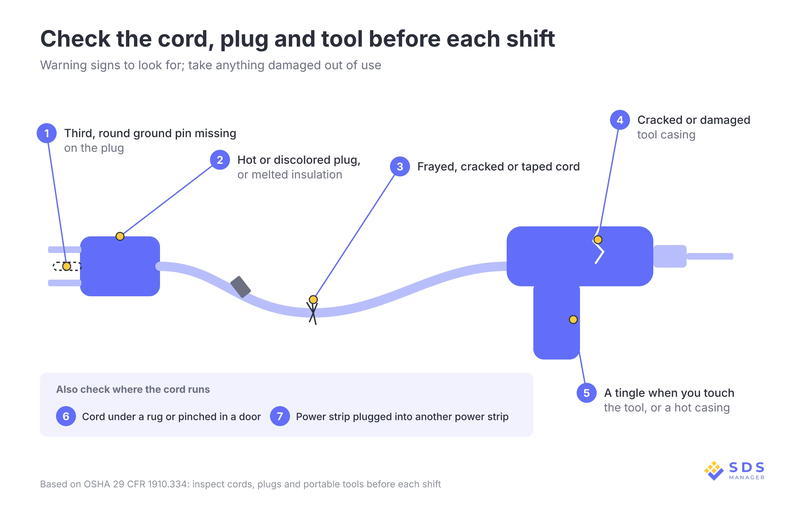
- frayed, cracked or taped cords
- plugs with the third, round ground pin missing
- cracked or damaged tool casings
- a tingle when you touch a tool or appliance
- power tools used in the rain or on wet floors
- breakers that keep tripping
How to prevent it:
- Inspect cords, plugs and portable tools before each shift, and take damaged ones out of use. In the US, the Occupational Safety and Health Administration (OSHA) requires this check. Cords and tools that stay plugged in where nothing can damage them need a check only when they are moved.
- Plug portable tools into a ground-fault circuit interrupter (GFCI), a device that cuts the power when current leaks to the ground.
- Keep tools, cords and hands dry, and keep equipment off wet floors.
- Leave every ground pin in place, because the pin gives stray current a path that does not run through you.
- Before any repair, switch the power off and lock it out so nobody can turn it back on.
Many people expect the circuit breaker to trip before a shock can hurt anyone, and breakers do cut the power when more current flows than the wires can safely carry. But fuses and circuit breakers are designed to protect wires and equipment from overheating. A GFCI is the device built to react to the small leak of current that hurts a person.
Falls after a shock: A shock too small to injure you directly can still make your muscles jerk and throw you off a ladder, a scaffold or a lift. Near electricity, use ladders made of fiberglass or dry wood, which do not carry current, and switch nearby circuits off before working at height. On lifts, use fall protection as well.
First Aid for an Electric Shock
After an electric shock at work, start with your own safety: never touch the person until the power is off, because current can pass through them into you.
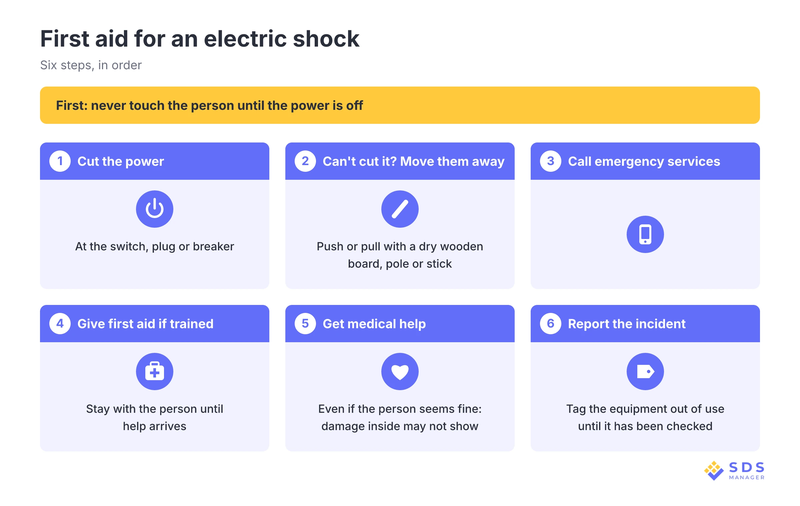
- Cut the power at the switch, plug or breaker.
- If you can't cut the power, push or pull the person away from the source with a dry wooden board, pole or stick, which does not carry current.
- Call emergency services.
- Give first aid if you are trained, and stay with the person until help arrives.
- Get medical help even if the person seems fine, because a shock can damage tissue, nerves and muscles inside the body without visible signs.
- Report the incident, and tag the equipment out of use until it has been checked.
2. Arc Flash and Arc Blast
What it is: An arc flash is a burst of heat and light when electricity jumps through the air between conductors (wires or metal parts that carry current), and an arc blast is the pressure wave that comes with it. Temperatures in an arc flash can exceed 35,000 degrees Fahrenheit. The pressure wave can injure the body. The blast also brings deafening noise and flying hot metal.
Causes: An arc can start when a dropped tool or a part that has come loose touches two live parts at once, when dust or corrosion builds up on contacts, when someone opens or tests a panel with the power on, or when equipment is faulty.
How to spot it:
- arc flash warning labels on panels
- panel covers left open while the equipment is on
- burn marks or pitted metal from past arcing
- buzzing or crackling from a panel
How to prevent it:
- Switch the power off and lock it out before opening a panel.
- Leave live panel work to a qualified worker (trained to work safely near live parts), and only when switching the power off is not possible or would create a greater hazard.
- Wear arc-rated clothing (made to resist catching fire in an arc flash) and face protection for any live work, because most arc flash burns happen when the arc sets flammable clothing on fire.
- Keep panel covers closed and fastened.
3. Electrical Burns
What it is: Electrical burns are the most common injury from an electric shock, and they come in three kinds: burns from current passing through the body, burns from the heat of an arc, and burns from touching overheated equipment.
Causes: Current heats tissue along its path through the body, so the burn is often deeper inside than it looks on the skin. Arc heat causes arc burns, and overloaded or faulty equipment causes burns from touching hot surfaces.
How to spot it:
- hot casings or plugs
- discolored plugs or melted insulation
- a burning smell near equipment
- after a shock, small marks where current entered and left the body, which can hide deeper damage
How to prevent it:
- Report hot or discolored plugs, outlets and casings, and stop using the equipment until it has been checked.
- Spread high-power equipment across outlets, so plugs and cords stay cool.
4. Electrical Fires and Explosions
What it is: Electrical fires start when wiring or equipment overheats or sparks near something flammable. A spark can also set off an explosion where flammable gases, vapors or dust are in the air.
Causes: Common causes of electrical fires include:
- overloaded circuits and power strips
- damaged extension cords, or cords rated too low for the equipment plugged into them
- loose connections
- cords run under rugs or through doorways
- heaters left near paper or fabric
An explosion needs only a tiny spark: one from a single flashlight battery can ignite an explosive atmosphere (air that holds enough flammable gas, vapor or dust to explode).
How to spot it:
- lights that flicker
- breakers that trip often
- power strips plugged into other power strips
- cords under rugs or pinched in doors
- heaters close to paper, boxes or fabric
How to prevent it:
- Plug heaters and other high-power appliances straight into a wall outlet, one per outlet.
- Replace damaged extension cords instead of taping them, and use cords rated for the equipment plugged into them.
- Keep at least 3 feet clear in front of electrical panels up to 150 volts, and never use that space for storage, as OSHA requires.
- In spray booths, fuel stores and rooms with flammable dust in the air, use only equipment rated for explosive atmospheres.
- Keep a fire extinguisher rated for electrical fires (Class C in the US) close by.
5. Contact With Overhead and Buried Power Lines
What it is: Power-line contact happens when a person, a ladder, a long tool or a vehicle touches or comes close to an overhead line, or when digging cuts into a buried cable.
Causes: Power-line contact often happens during ordinary jobs: carrying ladders, poles or pipes near lines, raising a dump-truck bed or a lift, digging without locating cables, and trimming trees close to lines.
How to spot it:
- overhead lines across yards, loading docks and parking lots
- utility poles and line markers near the work area
- warning markers for buried cables
- long items that will need to be raised or turned near a line
How to prevent it:
- Keep yourself and the longest object you hold that can carry current at least 10 feet from overhead lines up to 50,000 volts, plus 4 inches for every extra 10,000 volts, as OSHA's electrical work rules require for workers who are not qualified.
- Ask the utility to switch off or cover the lines before work close to them.
- Locate buried cables before you dig, and in the US, call 811 a few days ahead.
- Stay inside if your vehicle touches a power line, and call 911 and the utility.

What Are Examples of Electrical Hazards at Work?
Common examples of electrical hazards at work include overloaded power strips in offices, damaged extension cords and overhead lines on construction sites, open panels in factories, and wet floors near equipment in kitchens. Each workplace has its own usual sources of electrical hazards to check during hazard identification.
Electrical hazards on construction sites get extra attention, because electrocution is one of OSHA's Focus Four hazards, the four hazards OSHA counts as the top causes of construction deaths.
| Workplace | What to look for |
|---|---|
| Office | Power strips plugged into each other, cords under rugs, space heaters near paper or boxes |
| Construction site | Overhead lines, temporary power without GFCIs, damaged cords, wet ground |
| Factory or warehouse | Open panels, machines repaired while live, forklifts near overhead lines or blocking panels |
| Kitchen or food plant | Water near equipment, wash-down areas, steam |
| Laboratory or workshop | Damaged cords on benchtop equipment, flammable vapors near sparks |
| Outdoors and farms | Overhead lines over fields and yards, raised augers and irrigation pipes |
When Does Electricity Become Hazardous to Humans?
Electricity becomes hazardous to humans when current flows through the body, and very little current can cause harm. A one-second shock of 50 to 150 milliamps (thousandths of an amp) can cause extreme pain and stop breathing, and one of 1,000 milliamps or more can stop the heart from pumping.
The harm grows with the current. The chart below shows what a one-second shock from hand to foot does at each current level.
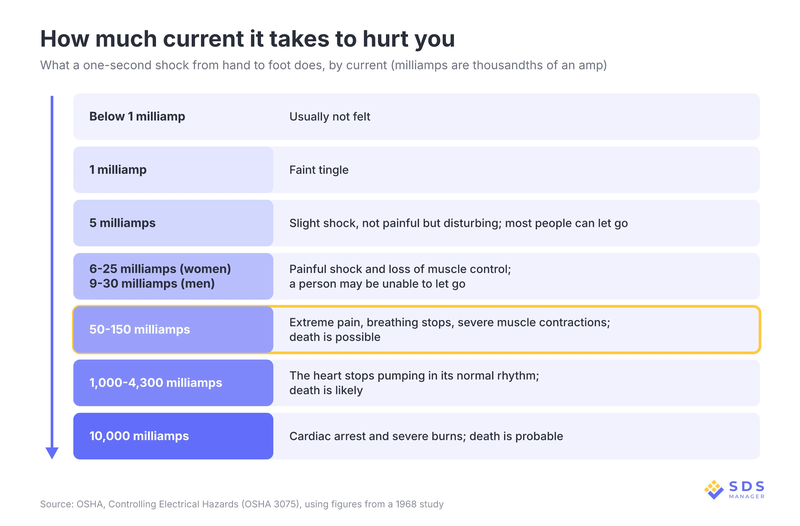
Four things decide how bad a shock is:
- how much current flows,
- the path it takes through the body,
- how long the body stays in the circuit, and
- the current’s frequency (how many times a second it changes direction)
Employer and Worker Responsibility for Electrical Safety at Work
Electrical safety at work is mainly the employer’s job, but the responsibilities extend to employees too. Here’s how it is divided:
Employers
- Switch the power off before anyone works on or near live parts. Leave it on only if switching it off would create a greater danger or isn’t possible.
- Lock and tag the switch so nobody turns it back on, using lockout/tagout (LOTO). Power that’s off but not locked can be switched back on by someone else.
- Have a qualified worker test that the parts are dead (carry no voltage) before anyone touches them.
- Train every worker who could get a shock in the safe work habits for their job, as part of an electrical safety program.
- In the US, protect temporary outlets on construction sites with GFCIs, or keep a schedule of tested and recorded cord and tool checks.
Qualified workers
- Only they may work on or near exposed live parts.
- Their training covers telling live parts from other parts, checking the voltage and how far to stay from parts at each voltage.
- When live work can’t be avoided, they work under a written permit issued through the site’s permit to work system.
Every other worker
- Check cords and tools before each shift.
- Tag anything damaged, and report hot or damaged plugs and outlets.
- Stay clear of live parts and power lines.
- Never remove or work around another person’s lock.
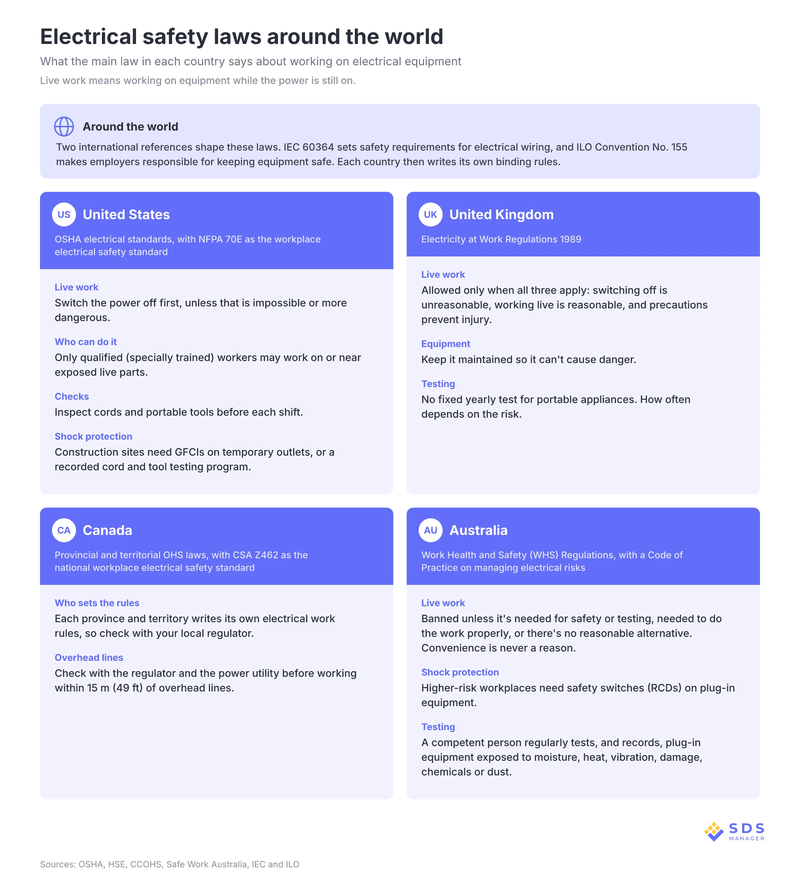
Around the world, employers must keep electrical equipment safe, and a safe and healthy workplace is a basic right at work. Each country sets its own rules. In the UK, for example, workers must have the power turned off and kept off until the job is finished.
Track Damaged Cords From Tag to Repair
Cords, plugs and portable tools get a visual check before each shift, and anything damaged is tagged and taken out of use.
A paper tag records the failure, but it can't show whether the cord was repaired before someone plugged it in again.
Start with your most-used tools and extension cords. Give each damaged item an owner and a repair date.
EHS Solutions by SDS Manager runs your pre-shift checks as inspection checklists with photo evidence in its Audit & Inspection module, and tracks each failed item until the repair is signed off.
Start a free trial and catch damaged cords before anyone uses them again.
Frequently Asked Questions
Can You Still Get a Shock From an Outlet With a GFCI?
Yes. You can still get a shock from an outlet with a GFCI, because the device trips only after a small current, about 5 to 6 milliamps, has leaked. The shock is usually brief and not fatal. Test fixed GFCIs monthly and portable ones before each use.
Is Static Electricity a Workplace Hazard?
Yes. Static electricity is a workplace hazard mainly where a spark can ignite flammable vapors, gases or dust. A static shock can exceed 10,000 volts but lasts too briefly to harm a person directly. Grounding equipment is one way to stop static from building up.
What Is the Difference Between Electric Shock and Electrocution?
The difference between electric shock and electrocution is the outcome. An electric shock is current passing through your body, which you can survive. Electrocution is death caused by an electric shock.
Can Low-Voltage Electricity Kill You?
Yes. Low-voltage electricity can kill you, because the harm depends on how much current flows through the body, not on the voltage alone. A one-second shock of 50 to 150 milliamps can stop breathing, and an ordinary wall outlet can push that much current through wet skin.
What Kind of Fire Extinguisher Do You Use on an Electrical Fire?
Use an extinguisher rated for electrical fires, which is Class C in the US. Never use water on a fire in live equipment, because water carries current.

Arysha Alif Khan

Arysha Alif Khan is an EHS and chemical safety specialist with a background in biochemistry, biotechnology, and public health. She works closely with the product and regulatory teams to turn complex chemical regulations, SDS requirements, and workplace safety standards into clear, practical guidance for people.