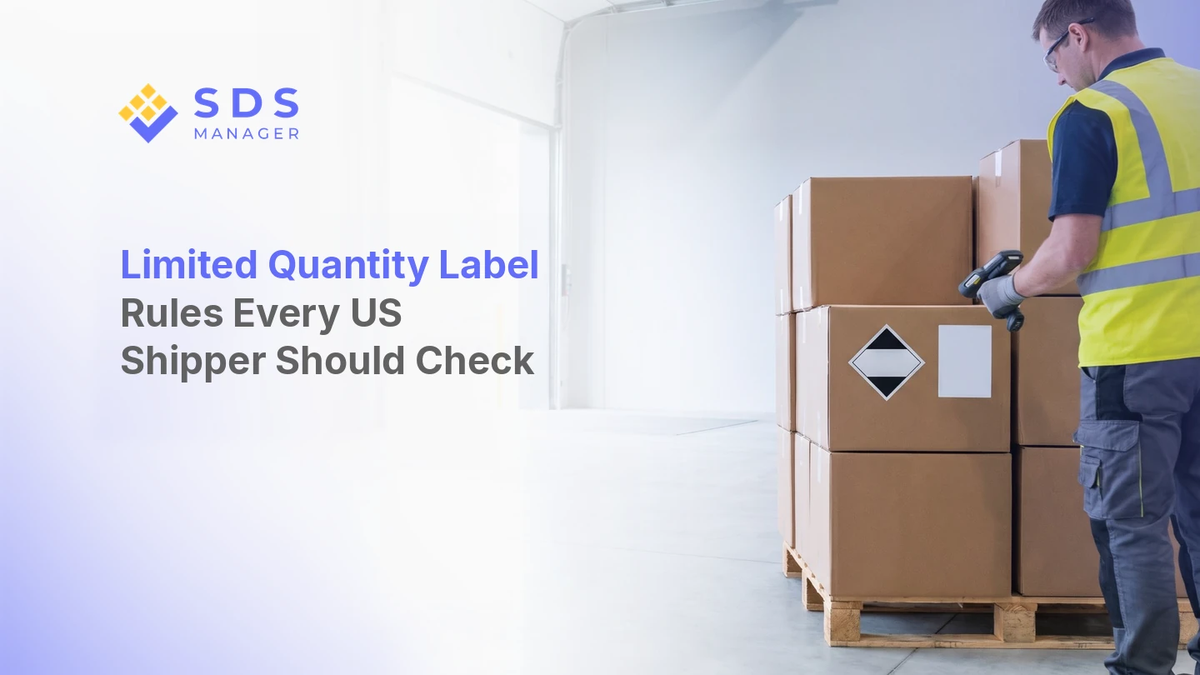
A limited quantity label is the mark the US Department of Transportation (DOT) requires on packages shipped under the limited quantity exception.
That exception lets hazardous products such as paints, aerosols and cleaners ship under lighter rules when they’re packed in small inner containers.
The mark is a square set on one corner, with black triangles at the top and bottom and a white center (49 CFR 172.315). Air shipments use a version with a black “Y” in the white center.
In this article, you’ll learn what DOT requires the label to look like, how to check that a product qualifies, when shipping papers or placards still apply, and what to check before each package ships.
Key Takeaways
- A limited quantity package is still a hazardous materials shipment, but it gets lighter packaging, labeling and paperwork rules when it stays within DOT's limits.
- Each limited quantity package may weigh no more than 30 kg (66 lb) gross, and the box and packing material count toward the 30 kg limit.
- The standard limited quantity mark is a black-and-white square-on-point at least 100 mm on each side, and the 50 mm version is allowed only on packages too small for the 100 mm mark.
- Since September 3, 2026, shippers may print a 25 mm limited quantity mark on the shipping label for highway, rail and domestic vessel shipments.
- Limited quantity packages shipped by air must carry the Y mark and stay within the tighter air limits for each inner container and box.
- Whether a product can ship as a limited quantity depends on Section 14 of its SDS and column 8A of DOT's Hazardous Materials Table.
- By ground, limited quantity shipments need no shipping papers unless the material is a hazardous substance, hazardous waste or marine pollutant, and marked packages never need placards.
- A limited quantity package is ready to ship only after the product, each inner container, the gross weight and the mark have been checked against the mode.
What Are the DOT Limited Quantity Label Requirements?
The requirements for DOT limited quantity label are:
The legal limit
Each package may weigh 30 kg (66 lb) gross at most, packaging included, so the box and its filler count along with the product. Marked pallets have a higher limit. When they move by highway or rail between a manufacturer, a distribution center and a retail outlet, each may hold up to 250 kg (550 lb) net instead of 30 kg gross.
Each inner packaging also has its own limit, which depends on the hazard class and packing group (the danger level, I high to III low).
The mark
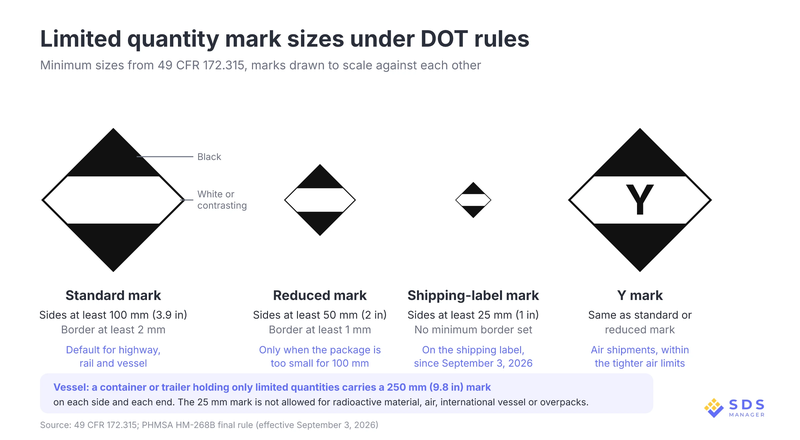
The limited quantity marking is a square-on-point with black top and bottom triangles, a black border and a white or contrasting center, under DOT's marking rule, 49 CFR 172.315. It must be at least 100 mm with a 2 mm border on one side or end of the outer package, and 50 mm with a 1 mm border only when the package is too small.
On a standard carton, a limited quantity sticker is a diamond with sides at least 100 mm (about 4 inches) long, black at the top and bottom and white in the middle.
The mark comes in five versions, and each one has its own minimum size and the condition that allows it.
| Mark | Minimum size | Border | When it is allowed |
|---|---|---|---|
| Standard mark | 100 mm (3.9 in) on each side | 2 mm | Default for highway, rail and vessel |
| Reduced mark | 50 mm (2 in) on each side | 1 mm | Only when the package is too small for 100 mm |
| Shipping-label mark | 25 mm (1 in) on each side | No minimum set | On the package's shipping label, any package size, since September 3, 2026; not for radioactive material, air, international vessel or overpacks; the label must tell carriers electronically that the package is a limited quantity and which modes are allowed |
| Vessel cargo unit mark | 250 mm (9.8 in) on each side | No minimum set | Each side and each end of a container or trailer holding only limited quantities, by vessel |
| Y mark | Same as standard or reduced mark | Same as standard or reduced mark | Air shipments |
Colors
The package color may form the center if it contrasts, so a white or light carton can show through the middle of a printed outline.
Placement
The mark goes on one side or one end, where it can be read and is not covered by tape or another label. If a package carries several marks, a shipping label may cover one as long as another stays visible, according to a 2023 PHMSA interpretation.
The Y mark for air
The Y mark is the limited quantity mark with a black Y in the center. Air packages carry the Y mark and meet the air limits, which are tighter than the ground limits, so the Y tells handlers that the package may travel by aircraft. For air, the whole mark sits on one side, alongside the UN number, the proper shipping name and the hazard labels.
A limited quantity package keeps its hazmat status. It skips most of the packaging, labeling and paperwork rules, as long as it stays within the weight limit and the limits for each inner packaging (the bottle, can or tube inside) and shows the mark for its mode.
The limits and exceptions come from the Hazardous Materials Regulations in Title 49 of the Code of Federal Regulations (49 CFR), which the Pipeline and Hazardous Materials Safety Administration (PHMSA) writes for the Department of Transportation (DOT).
The limited quantity symbol tells carriers and handlers that the box holds small, regulated containers packed to these rules. It is a transport mark rather than a Globally Harmonized System (GHS) label: GHS labels describe a chemical's hazards to the workers who handle and use it, while the limited quantity mark tells transport workers how the package is regulated in transit. Knowing the difference between GHS labels and transport labels explains why one product can carry both.
It is easy to read "limited quantity" as "not hazmat", because the exception removes much of the packaging, labeling and paperwork. The goods still meet DOT's definition of what counts as a hazardous material, though, so the mark, hazmat training and the limits for each hazard class still apply.
Which Products Can Ship as a Limited Quantity?
A product can ship as a limited quantity when the Hazardous Materials Table (DOT's master list of regulated materials) lists a limited quantity exception for its entry and each inner packaging stays within that entry's limit. Paints, aerosols, flammable cleaners, adhesives and perfumes are common examples.
Three lookups confirm whether a product qualifies, and the first one uses a document you already have on file:
Read Section 14 of the SDS
The safety data sheet (SDS) is the supplier's hazard document for a chemical, and its Section 14, transport information, gives the United Nations (UN) number, hazard class and packing group that the shipping label needs. Knowing how to read a safety data sheet makes this step quick, because every compliant SDS puts transport information in the same section.
SDS Manager's free DOT transport label generator reads Section 14 for you and prints the product's transport label, so nobody retypes the UN number by hand.
Find the entry in the Hazardous Materials Table and read column 8A
Column 8A names the exception section, so a section number such as 173.150 means a limited quantity option exists, and "None" means no limited quantity option. The fastest way into the table is the UN number, since each of the UN numbers in hazmat shipping identifies one material or a group of similar materials.
Check the inner packaging limit
The section named in column 8A sets the limit per inner packaging by packing group. For flammable liquids by ground, it is 0.5 L for packing group I, 1 L for packing group II and 5 L for packing group III. Column 7 (special provisions) can raise that limit: where an entry carries provision 149, packing group II inner packagings may hold up to 5 L as limited quantities. The whole package must also stay within the gross weight limit.
Column 8A entries can change when PHMSA updates the Hazardous Materials Table, so read the current table rather than an old printout. The HM-215S limited quantity changes are one recent example of such an update.
Products that look alike can get different limits, because the special provisions in column 7 differ from one entry to the next.
| Product | UN number and class | Column 8A | Largest inner packaging by ground |
|---|---|---|---|
| Paint, lacquer or varnish (packing group II or III) | UN 1263, Class 3 | 173.150 | 5 L (packing group II through special provision 149; packing group III by the class limit) |
| Flammable cleaner or solvent, n.o.s. (packing group II) | UN 1993, Class 3 | 173.150 | 1 L |
| Adhesive containing a flammable liquid (packing group II) | UN 1133, Class 3 | 173.150 | 5 L (special provision 149) |
| Perfume or cologne with flammable solvents (packing group II) | UN 1266, Class 3 | 173.150 | 5 L (special provision 149) |
| Aerosol spray (flammable or not) | UN 1950, Division 2.1 or 2.2 | 173.306 | 1 L per can |
Aerosols follow a can size rule: metal aerosol cans shipped as limited quantities hold 1 L or less.
Note: Air is stricter.
By air with the Y mark, a packing group II paint can holds 0.5 L at most and a box 1 L in total, and packing group I flammable liquids cannot go by air as limited quantities at all. Special provision 149 raises only the ground limit, so a 5 L paint can that ships by truck cannot fly as a limited quantity.
Do Limited Quantity Shipments Need Shipping Papers or Placards?
No, limited quantity shipments need shipping papers or placards unless the material is a hazardous substance (a listed material with a reportable quantity), hazardous waste or marine pollutant, under 49 CFR 173.150 and 49 CFR 173.306 for aerosols.
Limited quantities that are marked or listed as such on the shipping paper need no placards, at any load.
The placard exception has no weight limit, so a trailer carrying more than 1,001 lb of marked limited quantity packages still needs no placards. Shipments by air or vessel are different, because they always need shipping papers, even as limited quantities.
Each mode changes a different part of the exception: air brings back the shipping papers and hazard labels, and vessel adds a larger mark on cargo units that hold only limited quantities.
| Mode | Mark | Shipping papers | Placards | Weight and size limits |
|---|---|---|---|---|
| Highway and rail | Standard mark (or Y mark if the package meets air limits) | Not required, unless hazardous substance, hazardous waste or marine pollutant | Not required | Class limits per inner packaging and per package (higher limit for marked pallets) |
| Air | Y mark, plus hazard labels and markings | Required | Not used for air | Air limits per inner packaging and per box |
| Vessel | Standard mark; larger mark on cargo units holding only limited quantities | Required | Not required for marked packages | Class limits per inner packaging and per package |
Carriers can add their own limited quantity rules on top of DOT's, such as which services accept the packages, so read your carrier's hazmat terms before the first shipment. Those terms work alongside general chemical transportation safety best practices, which apply whether or not a load is placarded.
Loading still matters when no placards go on the trailer. Block and brace marked boxes so they can't shift, fall or be crushed in transit, because a split carton leaks the same chemical whatever mark is on it. Securing the load is part of how to transport chemicals safely.
Can You Print Your Own Limited Quantity Labels?
Yes, you can print your own limited quantity labels, as long as the printed mark keeps the minimum size, border and colors and stays readable until delivery. DOT sets the specification for the mark, not where it comes from, so a label from an office printer is as valid as a pre-printed roll when it meets the same specification.
- Print to size: Printer settings such as "fit to page" can shrink a 100 mm mark below the minimum, so print at 100% scale and measure the first label with a ruler.
- Pick the version for the mode: Use the plain mark for ground shipments and the Y mark for air.
- Use durable stock: Paper labels can smear or peel on a wet dock or when boxes rub together, so use weather-resistant label stock.
- Buy rolls for volume: Label suppliers sell pre-printed rolls in the standard and reduced sizes, plain and with the Y, which saves checking size and border on every print run.
The limited quantity mark is only part of what goes on the box, because the product's transport details still come from its SDS. Instead of retyping those details for each product, you can print transport labels from your SDS library.
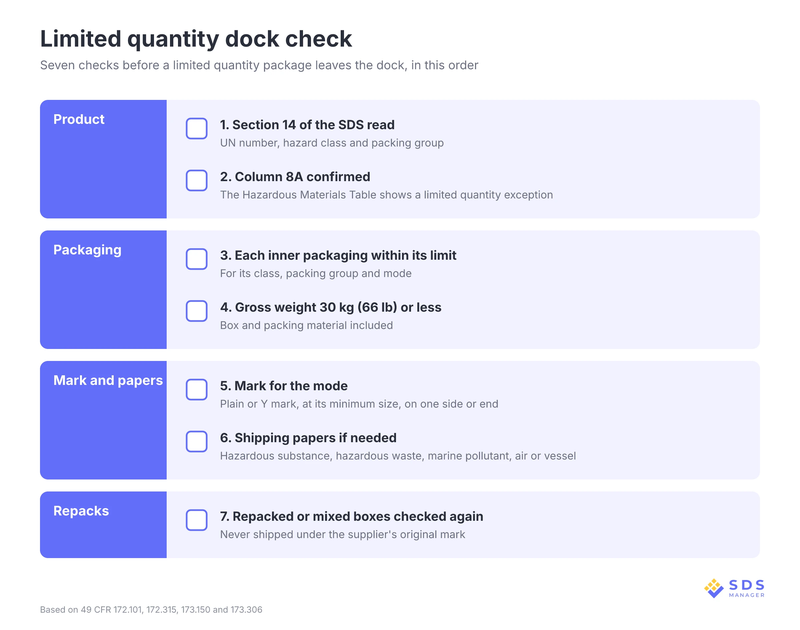
How Do You Check a Limited Quantity Package Before It Ships?
Check the product, the packaging and the mark against the mode, in that order, before the package leaves the dock:
The free warehouse safety audit checklist gives the same item-by-item check for the rest of the warehouse.
Make Every Limited Quantity Label Match the SDS
No limited quantity package leaves the dock until its product is confirmed in column 8A and its mark matches the mode.
The dock check slows down when transport details are kept in SDS PDFs and supplier binders. Staff retype UN numbers and hazard classes onto labels by hand, and a repacked box or a new supplier version can ship with an old label.
Today, pull Section 14 for the five products you ship most and confirm each one in column 8A.
SDS Manager's free transport label generator reads the transport details from Section 14 of any SDS in its library of 30 million+ sheets and prints them on a transport label, as a PDF in the size you need.
Start free and print each transport label straight from its SDS.
Frequently Asked Questions
Does a Limited Quantity Package Need a Hazmat Label?
No. A limited quantity package shipped by ground does not need a hazmat label (a hazard class label, such as the red flammable liquid diamond), because limited quantity packages need no hazard class labels unless they go by air. Air shipments still carry the hazard labels alongside the Y mark.
Can I ship limited quantity packages with USPS?
Yes, you can ship limited quantity packages with the United States Postal Service (USPS), and it uses the same marks as DOT, including the Y mark for air transport. If you want a reduced-size mark printed within the shipping label, you need written approval first from the USPS director of Product Classification.
What Is the Difference Between Limited Quantity and Excepted Quantity?
The difference between limited quantity and excepted quantity is the size of each inner packaging. Excepted quantities are far smaller: 30 g or 30 mL per inner packaging, and 1 g or 1 mL for the most toxic materials. They also carry their own excepted quantity mark instead of the limited quantity mark.
Do You Need Training to Ship Limited Quantities?
Yes. You need hazmat training to ship limited quantities, because anyone who prepares or marks the package needs hazmat training, refreshed at least every three years. DOT's training rules carry no limited quantity exemption, so the person packing and marking the box at the dock counts.
Can a Package With the Y Mark Ship by Ground?
Yes. A package with the Y mark can ship by ground, as long as its inner packagings and the whole box meet the tighter air limits. A box packed only to the larger ground limits must carry the plain mark instead.
What Happened to the ORM-D Marking?
The Other Regulated Materials-Domestic (ORM-D) marking ended on December 31, 2020, when ORM-D could no longer be used, and the limited quantity mark replaced it. PHMSA removed ORM-D from the rules in 2022, so any leftover ORM-D boxes need the limited quantity mark before they ship.
Does the Limited Quantity Mark Replace the UN Number on the Box?
Yes. The limited quantity mark replaces the UN number and proper shipping name on the box for ground shipments, unless the material is a hazardous substance or hazardous waste. For air, the Y mark goes on in addition to the UN number and proper shipping name.
Do Limited Quantities Need UN-Specification Packaging?
No. Limited quantities do not need UN-specification packaging when they are packed in combination packagings (inner containers inside a strong outer box) that meet the limits. The packaging still has to meet DOT's general packaging rules, so it must be strong enough to hold up in normal transport.
Do You Need a Hazmat Endorsement to Haul Limited Quantities?
No. A driver does not need a hazmat endorsement to haul limited quantities alone, because the endorsement covers loads that need placards, and marked limited quantities need none. A load that also carries fully regulated hazmat may still need placards, and then the endorsement applies.

Arysha Alif Khan

Arysha Alif Khan is an EHS and chemical safety specialist with a background in biochemistry, biotechnology, and public health. She works closely with the product and regulatory teams to turn complex chemical regulations, SDS requirements, and workplace safety standards into clear, practical guidance for people.