Maintenance, repair and cleaning jobs differ from the normal work on a site. They take guards off machines, open pipes that normally stay closed and send people into tanks and pits that stay shut the rest of the time.
Because none of this is routine, these jobs go wrong when the person doing the work doesn't know what is still switched on, what another crew is doing nearby, or what the last shift left unfinished.
A permit to work puts that missing information on paper before the job starts.
A permit to work (PTW) is a written form that lets named people do one high-risk job, at a set place and time, only after someone has checked the hazards and put the listed safety controls in place.
Those checks only work if the people named on the permit know their part. If you do, supervise or hire out this kind of work, you may approve, accept or work under permits, so you need to know what each one checks and what your signature confirms.
In this article, you'll learn when you need a permit, which types exist, what a permit should include and how the process runs from request to close-out.
Key Takeaways
- A permit to work records who may do a high-risk job, where, when, and which controls must be in place first. Signing the permit does not make the job safe; the controls on it do.
- The permit to work process runs from the work request, through risk assessment, isolation and issue, to hand-back and cancellation.
- Common permit types include hot work, cold work, confined space, electrical isolation, work at height and excavation permits.
- Nobody should issue a permit to work to themselves. The issuer and the permit holder both sign at issue, shift handover and hand-back.
- A permit to work is valid only for the period written on it, and most regulators require a handover or a fresh check when a job runs into a new shift.
- In the United States, OSHA requires a written permit before anyone enters a permit-required confined space, and that permit can't last longer than the job takes.
- No single law requires a permit to work for all high-risk work, but laws in Australia, Singapore and parts of Canada require written permits for jobs such as confined space entry.
What Is a Permit to Work System?
A permit to work system is the set of rules, people, training and checks that controls how permits are requested, issued, used and closed on a site. The permit form, which some sites call a safe work permit, is only one part of it.
The permit itself authorizes named people to do one specific job, in one place, for a set time, and lists the precautions that must be in place first. The system around it is how managers, supervisors, operators and the people doing the job tell each other what is safe and what isn't.
A signature on a permit does not make a job safe. The isolations, gas tests, barriers and other controls listed on it do. The permit confirms those controls are in place and tells everyone involved what they are.
It also puts the controls from the risk assessment into practice at the job, but it never replaces the assessment.
A working permit system has five parts:
- Clear rules on who may authorize particular jobs, and the limits of their authority
- Training in how to issue, use and close permits
- Monitoring and auditing to check the system works as intended
- A clear list of the types of work the site treats as hazardous
- A standard way to record each task, its risk assessment, how long the permit lasts, and other work happening at the same time
The permit system is one part of a wider safe system of work. Sites keep it for the jobs where a formal, signed approval adds control, so the first decision is which jobs those are.
When Is a Permit to Work Required?
A permit to work is required for non-routine, high-risk work such as hot work (welding, cutting, grinding), confined space entry and work at height. Permit guidance from safety regulators names four kinds of work where permits fit best:
- Work outside normal production, such as maintenance, repair, inspection, testing, cleaning and dismantling
- Jobs that are not part of the usual routine
- Jobs where two or more people or teams have to coordinate to finish safely
- Jobs that one team hands over to another partway through
You spot these jobs through hazard identification when you plan the work, before anyone picks up a tool.
Two everyday jobs show the difference. Cleaning out a water tank needs a permit because the worker climbs into a confined space where the air can run low on oxygen and rescue is hard. Changing a light bulb in an office is routine and low-risk, so a permit would add paperwork but no extra safety.
What Are the Different Types of Permit to Work?
The most common types of permit to work are:
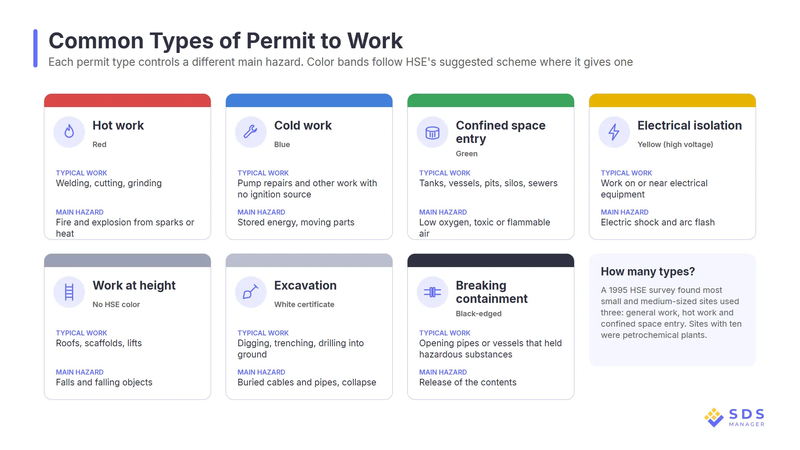
Each type controls a different main hazard, and a site chooses the types that match the work it does.
Several of them depend on isolation, which means switching off energy or substances and locking them off so they can't reach the work.
What Should a Permit to Work Include?
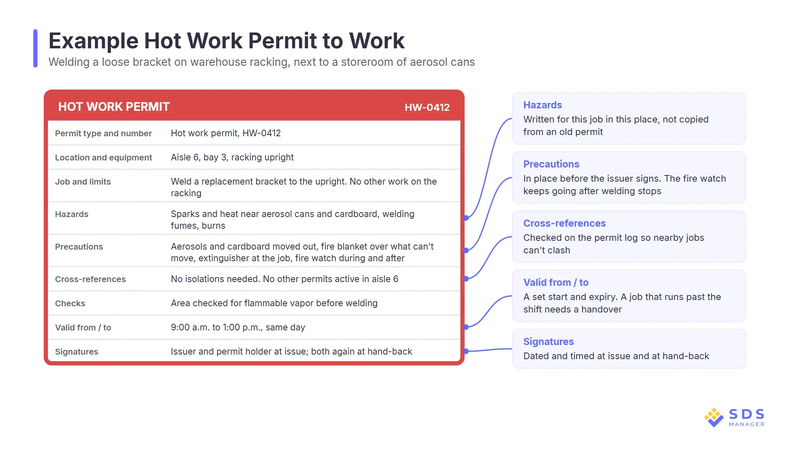
A permit to work should describe the job, the place, the equipment, the hazards, the precautions and isolations, the people involved and how long the permit lasts.
It should also carry dated, timed signatures from the people who issue, accept and close it.
Welding a loose bracket on warehouse storage racking, next to a storeroom of aerosol cans, is a common hot work job. Here is what its permit could look like.
What Changes on Each Type of Permit?
Each permit type adds its own fields to these core details, because each one controls a different hazard.
| Permit type | Fields added to the core details | Where the rule comes from |
|---|---|---|
| Confined space entry | Air test results with the tester's name and time, named entrants and attendant, an entry and exit log, ventilation, the rescue plan, how workers keep in contact, and a link to any hot work permit | OSHA, CCOHS, Ontario, Singapore WSH Council |
| Hot work | Combustibles moved at least 35 ft (11 m) away or covered, gas checks before and during the work, an extinguisher at the job, and a named fire watch who stays at least 30 minutes (OSHA) or 60 minutes (NFPA 51B, CCOHS) after the work ends | OSHA, NFPA 51B, CCOHS |
| Electrical isolation | The isolation point, locks and notices, proof the equipment is dead, earthing, guards on nearby live parts, and sign-off before power is restored | Ireland's Health and Safety Authority |
| Work at height | The fall-prevention plan and equipment, and the edge protection in place | Singapore Ministry of Manpower |
| Excavation | Underground cables and pipes located before digging, and the depth of the dig | OSHA, Singapore WSH regulations |
Fields also come off. Permit guidance tells sites not to fill permits with routine notes, such as standard PPE and housekeeping, because general site rules can bury the hazards of the job.
Once a permit is issued, nobody edits its fields. IOGP, the international oil and gas producers' association, says any change to a permit goes back for a new approval.
Do Permit Requirements Change by Country?
The core details are the same in every country, but some regulators set out exactly what a permit must contain:
- UK: HSE's guidance on permit-to-work systems (HSG250) lists 13 parts of a permit form, starting with the permit title and reference number and ending with cancellation.
- US: OSHA's confined space standard lists 15 items a confined space entry permit must contain.
- Australia: a confined space entry permit must name the space, the workers going in, the time period and the controls. It also needs space to confirm the work is done and everyone is out.
- Canada: each province sets its own rules. In British Columbia, the supervisor signs the permit and posts it at the entrance. Ontario needs a new permit each time work is done in the space.
- Singapore: the tripartite guide to permit-to-work systems says a permit should describe the work and give its location, equipment, start time and expected length. For high-risk construction work, the supervisor applies and a safety assessor checks the site. The project manager then issues the permit, and the supervisor posts it at the work area until the job is done.
If your site works in more than one country, build your permit form on the strictest list that applies.
Filling in the form is one step of a longer process, and how the other steps are done decides whether the controls written on the form are in place at the job.
How Does the Permit to Work Process Work?
A permit to work procedure runs in eight steps, from the work request to closing the permit.
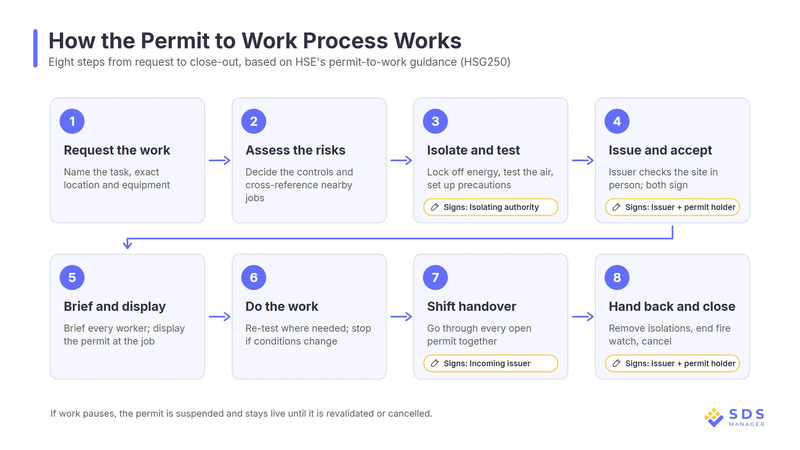
Step 1: Request the Work and Define the Job
The process starts with a request from the person who needs the job done, often called the originator. A good request names the task, the exact location and the equipment involved.
For example, "Repair the pump" gives the issuer nothing to check, while "replace the seal on cooling water pump 3 in the basement plant room" tells them exactly where to look and what to isolate.
Step 2: Assess the Risks and Plan the Controls
Before anyone writes the permit, someone assesses the hazards of this specific job and decides the controls through a task risk assessment. The controls it sets are the ones the permit will list.
The risk assessment is also the point to check what else is happening nearby. Two jobs that are each safe alone can be dangerous together, such as grinding on one side of a wall while another crew drains a fuel line on the other.
Where jobs affect each other, their permits are cross-referenced, so each issuer knows about the other work.
Step 3: Isolate, Test and Prepare the Work Area
Next, make the work area safe. Isolate and lock out energy and substances such as electricity, steam, or process fluids so nobody can turn them back on while people work.
The person who makes the isolations, the isolating authority, records them on the permit or on a separate isolation certificate that is cross-referenced to it.
Where flammable or toxic air is possible, a trained gas tester checks the atmosphere. Any other precautions written on the permit go in place before the permit is issued.
Step 4: Issue and Accept the Permit
The issuer, the trained and authorized person who approves the permit, visits the site in person, checks that the precautions are in place, and signs. The permit holder, the person in charge of the work crew, reads the permit, confirms they understand the hazards and precautions, and signs to accept it. Both signatures carry the date and time.
Timing affects how well this check is done. Many permits are issued at the start of a shift, and safety guidance tells sites to plan for permit overload at that point. An issuer facing a queue has less time to check each site, so busy periods such as shutdowns need extra issuers or fewer live permits.
Step 5: Brief the Team and Display the Permit
Everyone working under the permit is briefed on the hazards and precautions before work starts, not just the permit holder. The holder's acceptance signature confirms that this briefing has happened.
The permit is then displayed at the job site, where the crew and anyone checking the work can see it, rather than kept in a pocket or an office.
Step 6: Do the Work and Stop if Conditions Change
During the work, the permit holder watches for changes, and gas tests are repeated wherever the atmosphere can change. If conditions change, for example, a leak starts, the weather turns or the job grows beyond what the permit describes, work stops.
The permit is then revalidated (checked again and re-signed) or reissued, never stretched to cover work it doesn't describe.
Repeat testing matters because the air in and around equipment can change quickly.
If work has to pause, the permit is suspended. A suspended permit stays live until it is cancelled, so isolations may still be in place. Before work restarts, the issuer re-checks the site and revalidates the permit or issues a new one.
Step 7: Hand Over the Permit at Shift Change
When a job runs into the next shift, the outgoing and incoming issuers go through every open permit together, along with the status of each job and the state of the equipment.
A simple example shows what a missed handover can cause. Say the day shift isolates a conveyor and removes a guard to clear a jam, but the job isn't finished when the shift ends.
If the handover doesn't mention the open permit, the night shift could restart the line with the guard still off. Walking through every open permit before signing is how the incoming issuer prevents that.
Step 8: Complete the Job, Hand Back and Close the Permit
When the work is done, the permit holder confirms the job is complete and the area is left safe. The issuer checks that tools and materials are cleared and isolations are removed, then signs the hand-back. The permit is cancelled once the equipment has been tested and returned to the people who run it.
After hot work, the permit closes only when the fire watch ends, because smoldering material can catch fire after the welding stops. The closed permit is then kept as a record.
The sequence follows the stages used in regulator and industry permit guidance, from planning to hand-back. It is a practical order rather than an official count, and many sites use their own names for each stage.
Who Can Issue a Permit to Work?
A trained person who is authorized for that type of permit should issue a permit to work, and that person should never be the one doing the work. Permit guidance also says that for high-hazard work a second person, the permit authorizer, should check the permit before it's issued.
Sites use different titles for these roles, such as issuing authority, PTW Authority or issuer, but the jobs are the same.
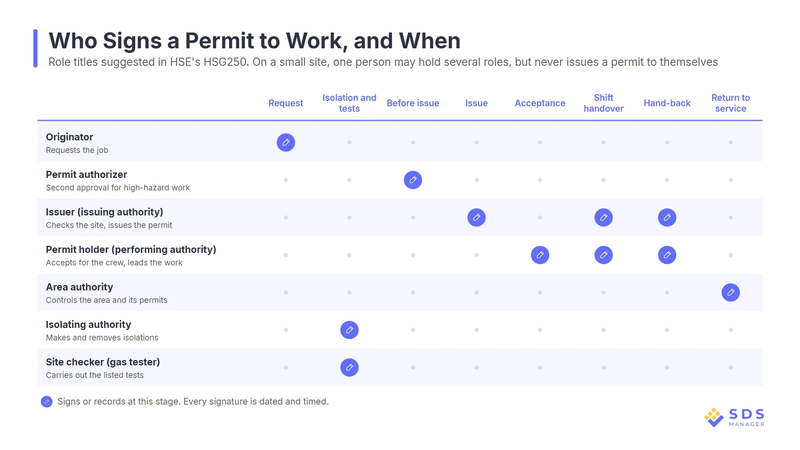
On a small site, one person may hold several roles at once, such as controlling the area, authorizing permits and issuing them. Combining roles works as long as the same person never issues a permit for work they will do.
Everyone who signs needs training first. Issuers, permit holders and everyone working under a permit, contractors included, need to know their duties and be able to carry them out. Permit to work training covers this, and a site should let someone issue a permit type only after they're trained in it.
Contractors work inside the host site's permit system, not their own. Their managers should understand that system and make sure their supervisors and workers follow it. The host site still checks that a contractor is competent before any permit goes to their crew.
Contractor management software records that approval and tracks documents with expiry dates, so no permit goes to a crew whose paperwork has run out.
How Long Is a Permit to Work Valid?
A permit to work is valid only for the period written on it, and each country sets its own rules on how long that can be and when the permit is checked again.
| Country | How long a permit lasts | When it must be renewed or re-checked |
|---|---|---|
| UK | HSE sets no fixed maximum. The permit must state when it starts and how long it lasts | A permit that runs past one shift needs a formal handover |
| US | A confined space entry permit can’t last longer than the job takes | OSHA requires a check whenever responsibility passes to someone new, such as at a shift change. In construction, a permit can be suspended only for a temporary problem that adds no new hazard; otherwise it is cancelled |
| Singapore | A construction permit lasts only for the period stated on it. An extended work-at-height permit can run up to 7 days | Unfinished construction work needs a fresh application. An extended work-at-height permit needs a daily review |
| Canada | In British Columbia, until the expiry time written on the permit. Ontario requires a separate permit each time work is done in the space | British Columbia requires the supervisor to re-sign after each shift, crew or supervisor change. Ontario requires a competent person to check the permit before each shift |
| Australia | The period of work written on the permit | Re-validate after a break in the work, a change of the person in charge, or new hazards or controls |
A common site rule goes further and limits every permit to a single shift, so each shift starts with a fresh check of the site. Permits written "for the day" skip that check.
How Long Should You Keep Permit to Work Records?
How long you keep permit to work records depends on the regulator where you work, and the rules range from 30 days on site to two years after a reportable incident:
- UK: HSE guidance says to keep permits at the site for at least 30 days after the work ends, then store them for a set period so the system can be checked and audited.
- US: OSHA requires cancelled confined space entry permits to be kept for at least one year.
- Canada: British Columbia sets the same one-year minimum for confined space permits.
- Australia: keep a confined space entry permit until the work ends, or for at least two years if a notifiable incident (one the law says you must report) happened.
If more than one of these rules applies to your site, keep records for the longest period any of them sets.
Is a Permit to Work a Legal Requirement?
A permit to work is a legal requirement for some high-risk jobs, but no single law requires one for all high-risk work.
ISO 45001, the international standard for managing workplace health and safety, does not legally require a permit to work. It mentions permits only as an example in an annex that gives guidance, not rules.
What it does require is that you pick controls in the order of the hierarchy of controls, starting with removing the hazard and ending with protective equipment. A permit then lists the controls chosen for each job.
Several laws do require a written permit for certain jobs, and regulators expect permits for high-risk, non-routine work. What you must do depends on where you work.
| Country | When you must use a written permit | Law or guidance |
|---|---|---|
| UK | Keep a safe system of work for high-risk tasks. HSE expects permits for work such as hot work, confined space entry and breaking into lines that hold hazardous substances | Health and Safety at Work etc. Act 1974; HSE permit-to-work guidance |
| US | Get a written permit before anyone enters a permit-required confined space, and before hot work on or near a process covered by OSHA's process safety rules. For other hot work, OSHA prefers a written permit. Lockout needs written procedures, not a permit | OSHA general industry standards |
| Australia | Get a written permit from a competent person before each entry into a confined space | Model Work Health and Safety Regulations |
| Canada | Use a confined space entry permit where your province or territory requires one. Alberta, British Columbia and Ontario all do | Provincial and territorial OHS laws, such as the Alberta OHS Code and BC OHS Regulation |
| Singapore | Use a permit for confined space entry, some work at height, and high-risk construction work: demolition, excavation deeper than 1.5 m, crane lifting, piling and tunnelling | Workplace Safety and Health regulations |
| New Zealand | Give workers a written entry authority (entry permit) before they enter a confined space | WorkSafe New Zealand, which accepts the Australian confined spaces standard AS 2865 |
International guidance points the same way. The International Labour Organization's code of practice for shipbuilding and ship repair says no high-risk work, such as confined space entry, hot work or work at height, should start without a permit.
How Do You Audit a Permit to Work System?
You audit a permit to work system by sampling closed permits and checking them against what happened on site, watching live permits at the job, and confirming that the people who issue and hold permits are trained and authorized. Permit guidance warns managers not to rely on checking forms alone, and to carry out extra checks on a sample of permits.
Answer these questions for each permit you sample:
- Was the right permit type used for the job?
- Were the hazards written for this job, not copied from an old permit?
- Was the gas test done right before the work started?
- Were other jobs in the same area cross-referenced?
- Are the shift handover signatures present?
- Were all isolations removed at hand-back?
- Was the issuer authorized for that permit type?
- Are any permits past their expiry time but still open?
A "no" to any question is a finding, and every finding needs someone to fix it.
Schedule Your Permit Audits and Track Every Finding
A permit audit only protects people if it happens on schedule and its findings get fixed. On a busy site, an audit kept in someone's diary slips, and a finding written on a paper checklist has no owner and no deadline.
This week, put your first permit audit in the calendar, name the person who runs it, and decide who owns the fixes it turns up.
Then turn that checklist into a scheduled inspection in EHS Solutions by SDS Manager. Upload the checklist you already use and it becomes a working template. Set how often the audit repeats, and the assignee gets a reminder, an overdue audit goes to their manager, and a missed one stays on record.
Answers and photos are recorded on a phone, even without signal. A failed check raises a corrective action with an owner and a due date, and a second person signs it off before it closes.
Frequently Asked Questions
Is a Permit to Work the Same as a Work Permit?
No, a permit to work is not the same as a work permit. A permit to work is a safety form that approves one high-risk job. A work permit is usually a government document that lets a person take a job, such as a visa or, in some US states, a permit for workers under 18.
What Is the Difference Between a Risk Assessment and a Permit to Work?
A risk assessment and a permit to work do different jobs. The risk assessment identifies a task's hazards and decides the controls, while the permit authorizes one job and confirms those controls are in place before it starts. A risk assessment can show that a job needs a permit, but a permit never replaces the assessment.
What Is a General Permit to Work?
A general permit to work covers higher-risk work that no specialist permit, such as a hot work or confined space permit, covers. Some sites also fill in a general permit first for every job, to work out which specialist permits that job needs.
What Colour Is a Hot Work Permit?
A hot work permit is usually red or red-edged under HSE's suggested colour scheme. The same scheme uses blue for cold work, green for confined space entry and yellow for high-voltage isolation. Colours are a site convention that helps workers tell permit types apart at a glance, and no law requires them.
Should You Use a Paper or Electronic Permit to Work?
Yes, you can use either a paper or an electronic permit to work, as long as the system makes people do the same checks. HSE's guidance sets conditions for electronic permits, including a site visit before every issue, no copying hazards from other permits, and a backup if the software or power fails.

Arysha Alif Khan

Arysha Alif Khan is an EHS and chemical safety specialist with a background in biochemistry, biotechnology, and public health. She works closely with the product and regulatory teams to turn complex chemical regulations, SDS requirements, and workplace safety standards into clear, practical guidance for people.