
When two or more employers work on the same site, one party, called the prime contractor, has to coordinate safety for all of them. In most provinces, if nobody accepts that role in writing, the owner of the site holds it by default.
Prime contractor responsibilities are the legal duties the prime contractor holds on a shared work site. There are two:
- Make sure the crews' safety activities do not clash or leave gaps
- Run a system that keeps the whole site compliant with safety law
In this article, you'll learn what a prime contractor is responsible for and when your site needs one in different provinces. You'll also see what the agreement should say and what subcontractors still owe.
Key Takeaways
- In BC, a site needs a prime contractor once workers of two or more employers work there at the same time.
- A BC homeowner who hires several trades with nothing in writing becomes the prime contractor.
- A verbal agreement does not transfer the prime contractor role; only a written agreement does.
- When the work ends, get the owner's written confirmation that the role has ended, or the role can fall back to the owner.
- In Alberta, a work site has one prime contractor, not one per trade.
- Prime contractor responsibilities add to, not replace, each subcontractor's own duties to protect, train and supervise its workers.
Who Is a Prime Contractor?
In Canadian workplace safety law, the prime contractor is the party that coordinates safety on a shared site. It is the contractor, employer or other person named in a written agreement with the owner, or the owner if there is no agreement. On site, people often shorten it to "the prime".
The term means something different in US federal contracting, where it names the company holding the main contract.
In BC, naming a prime contractor doesn't end the owner's duties. The owner must still keep the land and buildings safe for anyone at or near the site, and give the prime contractor the hazard information it knows about.
The role exists only at a multiple-employer workplace. In BC, that means workers of two or more employers working at the same time. Alberta's definition is wider: it counts employers involved in work at the site even when they are not there at the same time.
One employer's work can create a hazard for another employer's crew, which is why someone has to coordinate.
Picture a business owner renovating a commercial unit with an electrician, a drywall crew and a plumber. The drywall crew's dust and the electrician's open panel both affect workers who do not answer to either of them.
The role’s name changes by jurisdiction. Ontario uses “constructor,” Quebec uses “maître d’œuvre,” and Newfoundland and Labrador uses “principal contractor.” Alberta, British Columbia, Saskatchewan and Manitoba use “prime contractor.”
What Are a Prime Contractor's Responsibilities?
A prime contractor has two duties: coordinate the safety activities of every employer and worker on site, and set up and keep a system that keeps the whole site compliant. Every province that uses the role builds on those two duties, though BC and Alberta word them differently.
The prime must do what is reasonably practicable to run that system. In safety law, reasonably practicable means doing what is possible and sensible given the risk and the cost, not everything imaginable.
In practice, these responsibilities become tasks at three points in the job: before work starts, each working day and at close-out.
| When | Task | What it looks like on site |
|---|---|---|
| Before work starts | Sign the written agreement | Owner and prime sign, naming the site and its boundaries |
| Collect each employer's supervisor name | A current list with how to reach each supervisor | |
| Get the owner's hazard information | Known hazards on the property shared with every employer | |
| Set one emergency and first aid plan | Alarms, muster point, first aid and rescue sized for everyone on the site, not crew by crew | |
| Orient every crew | Site hazards, rules, exits and who the prime contractor is, before anyone starts | |
| Post the prime contractor's name and file any required notice | Where your province requires it | |
| Each working day | Walk the site and assign fixes | Each hazard assigned to the employer who must fix it, with a date |
| Share new hazards between crews | Including chemicals one crew brings in, with WHMIS labels and safety data sheets available | |
| Check new workers were oriented | No one starts without the site orientation | |
| At close-out | Close every corrective action | Nothing left open when crews leave |
| Throughout | Keep records | The signed agreement, a photo of the posted name, orientations, inspections, meetings, incidents, near misses and fixes |
When one crew brings a chemical onto the site, its WHMIS labels and safety data sheets must be available to every crew that could be exposed.
When one crew works at height, the prime checks that the crew's fall protection does not leave a hazard for crews below. When equipment is shut down for repair, a shared lockout tagout procedure stops another crew from switching it back on.
A shared emergency plan only works if every crew has practised it, so plan safety drills that include all employers on site. Short toolbox talks at the start of a shift are a simple way to share new hazards between crews.
In the commercial-unit renovation, the prime collects three supervisor names on the first morning and tells the plumber that the electrician has a panel open in the next room.
When Is a Prime Contractor Required at a Work Site?
Whether a work site needs a prime contractor depends on the province, the type of work and how many employers or workers are there. In BC, any site where workers of two or more employers work at the same time needs one, while Alberta, Saskatchewan and Manitoba set narrower triggers.
| Jurisdiction | Term | When the role is required | If nobody is designated | Home exemption |
|---|---|---|---|---|
| British Columbia | Prime contractor | Workers of 2 or more employers working at the same time | The owner | None |
| Alberta | Prime contractor | Construction or oil and gas site with 2 or more employers or self-employed persons | The person in control of the work site | The person in control's own occupied private dwelling |
| Saskatchewan | Prime contractor | 10 or more workers or self-employed people, under 2 or more employers, in construction, forestry or oil and gas | The owner | Homes of fewer than 4 units are not "construction" |
| Manitoba | Prime contractor | Construction project with more than one employer or self-employed person at the same time | The owner | The occupant of a private residence is not the "owner", unless they run a business there |
| Yukon | Prime contractor | More than one employer at the same time | The owner | Check local rules |
| Ontario | Constructor | Any construction project (one constructor per project) | The owner, if it runs the project itself or hires more than one employer | Work by an owner or occupant on their own private residence is generally outside the Act |
| Quebec, NL, NWT and Nunavut | Principal contractor | Construction sites or shared workplaces; rules differ | Generally the owner | Check local rules |
In Saskatchewan, the prime must also put its coordination plan in writing and share it before work starts. Rules in Yukon, Quebec, Newfoundland and Labrador, and the northern territories differ in detail, so check the current law in those places before you plan a project there.
If you are a homeowner who hires several trades with nothing in writing, you can become the prime contractor without realizing it. In BC, that happens as soon as workers of two or more employers are on the site at the same time.
The maximum penalties in BC and Alberta show what is at stake:
- British Columbia: an administrative penalty of up to $816,148.69, as at January 2026. The cap is indexed every January, with the next change due in January 2027.
- Alberta: for a first offence, a court fine of up to $500,000, up to 6 months in jail, or both, plus up to $30,000 a day while the offence continues. Later offences carry up to $1,000,000, up to 12 months in jail, or both, plus up to $60,000 a day (Act consolidation current to June 2025).
In 2025, WorkSafeBC imposed 410 penalties on employers, totalling $13.7 million.
What Are the Responsibilities of a Prime Contractor in BC?
In BC, the prime contractor must make sure the safety activities of every employer, worker and other person on the site are coordinated, and must do everything reasonably practicable to set up and keep a system that keeps the site compliant with the Workers Compensation Act and WorkSafeBC's regulations.
BC also sets its own construction rules. A qualified coordinator is required where overlapping work creates hazards and the combined workforce is more than five.
Projects that meet set triggers, such as a cost over $100,000 or an excavation deeper than 1.2 metres, need a notice of project that reaches WorkSafeBC at least 24 hours before work starts, with a copy posted on site.
Before any demolition or renovation starts, the owner and employers must have a qualified person check for hazardous materials such as asbestos and write a report. Work that could disturb these materials can't start until they are safely contained or removed.
In BC forestry, an owner who names a prime contractor must make sure that company is qualified and has the authority to do the job, and only one prime contractor is allowed at a time.
What Are the Responsibilities of a Prime Contractor in Alberta?
In Alberta, the prime contractor has three duties under the Occupational Health and Safety Act:
- Set up and keep a system or process that keeps the site compliant.
- Name a person in writing to make that system work and to make sure employers and workers cooperate on health and safety.
- Do its own work so that no one is exposed to hazards.
The person in control of the work site either designates the prime contractor in writing or is the prime contractor itself, and the prime contractor's name must be posted at the site.
The prime also takes on employer duties for any equipment, infrastructure and excavations it provides to others on site, and must tell the employers and workers there about the hazards it knows of.
A work site has one prime contractor, not one per trade. In a 2024 safety appeal, the Alberta Labour Relations Board upheld a stop-work order at a plant that had named a roofer as prime contractor for the roofer's own task only.
A large site can be split into separately coordinated sites only where the parts are physically separate. If you run a plant with several contractors on site, plan for one prime across the whole site.
What Should a Prime Contractor Agreement Include?
A prime contractor agreement should be in writing, signed by the owner and the contractor, and name the site and its boundaries, the start date, the work covered and how the role ends.
A verbal agreement does not transfer the role. In BC, the owner who signs can be a tenant, property manager or agent, as a WorkSafeBC information sheet explains.
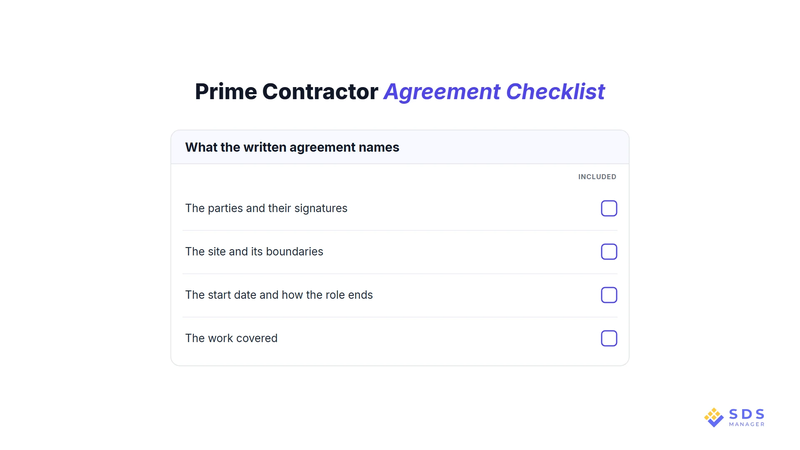
When the work under the agreement is finished, get the owner's confirmation in writing that the role has ended, or the role can fall back to the owner.
Check that each contractor pays its workers' compensation premiums. If a contractor you hire doesn't pay its WorkSafeBC premiums, you could have to pay them for the work it did for you. Get a clearance letter before work starts and again before final payment; WCB Alberta issues clearance letters as well.
Not every contractor on the job is the right choice for the prime contractor role. Industry guidance from BC's forestry sector looks for three things:
- Knowledge: of the work and its hazards
- Capacity: people and time on site
- Control: authority over the site and the crews
Hiring a general contractor doesn't make it the prime contractor on its own. It's usually the right choice for the role, because it directs the work and is on site most days, but it holds the prime contractor's duties only if the written agreement names it. Without that agreement, the owner holds them.
In the commercial-unit renovation, the business owner signs an agreement with the electrical contractor, which is on site more days than the other two crews.
What Are a Subcontractor's Responsibilities Under a Prime Contractor?
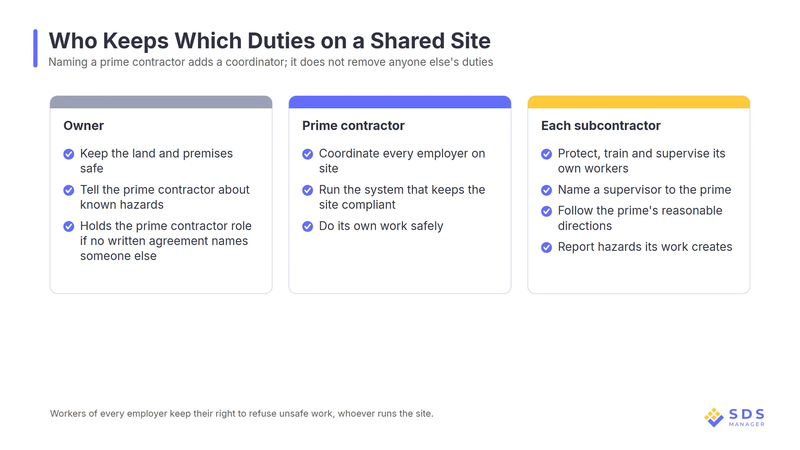
A subcontractor working under a prime contractor keeps its own duties to its own workers. It must follow the prime's reasonable directions and report hazards its work creates. The owner keeps its duties for the land and premises.
In Manitoba, each contractor also gives the prime contractor the names of its own subcontractors, so the prime knows who is on site.
Each subcontractor still carries out a hazard assessment for its own tasks. On site, crews usually record their assessment with a field level hazard assessment before each task. The prime contractor coordinates those assessments; it does not replace them.
Each employer also sets the safe work practices for its own tasks.
Workers of every employer keep their right to refuse unsafe work, whoever runs the site.
Bring Every Site Employer Into One Safety Record
On a shared site, supervisor names, contractor documents and hazard and incident reports come from different employers by text, email and paper. When a safety officer asks for proof, the prime contractor struggles to show that its system works.
A simple first step is a list of every employer on site, with its supervisor's name and number and the date its crew was last oriented.
Run your shared site from one register in EHS Solutions by SDS Manager, free to try. You get every contractor company, its verified documents and its people in one place. Crews report hazards and incidents through a QR poster that needs no app or login.
Frequently Asked Questions
What Is the Difference Between a Prime Contractor and a General Contractor?
The difference between a prime contractor and a general contractor is the duty each holds: a general contractor is hired to manage a project's work, while a prime contractor is legally responsible for coordinating safety across employers. When it comes to prime contractor vs general contractor, one company can hold both roles, or each role can sit with a different company. In US federal contracting, "prime contractor" means the holder of the main contract, which is a different idea.
What Is the Difference Between a Prime Contractor and a Construction Manager?
A construction manager is hired to manage the project for the owner, and it becomes the prime contractor only if the written agreement names it. The law lets a contractor, employer or other person take the role this way.
Is There an Official Prime Contractor Designation Form?
No province has an official prime contractor designation form, because the law asks only for a written agreement. Some BC municipalities, such as Surrey, ask for their own prime contractor designation form with a permit, and industry templates are available.
Can the Prime Contractor Change Partway Through a Project?
The prime contractor can change partway through a project if a new written agreement is signed before the handover. Make sure only one company holds the role at any time. These steps are good contract practice, but the law doesn't set them out.
Does a Prime Contractor Need Special Training or Certification?
A prime contractor needs no certificate in any province, but the law does ask for competence. BC needs a qualified coordinator on construction projects where overlapping work creates hazards and the combined workforce is more than five, and Saskatchewan needs a competent person to oversee the work. Courses are optional.

Arysha Alif Khan

Arysha Alif Khan is an EHS and chemical safety specialist with a background in biochemistry, biotechnology, and public health. She works closely with the product and regulatory teams to turn complex chemical regulations, SDS requirements, and workplace safety standards into clear, practical guidance for people.