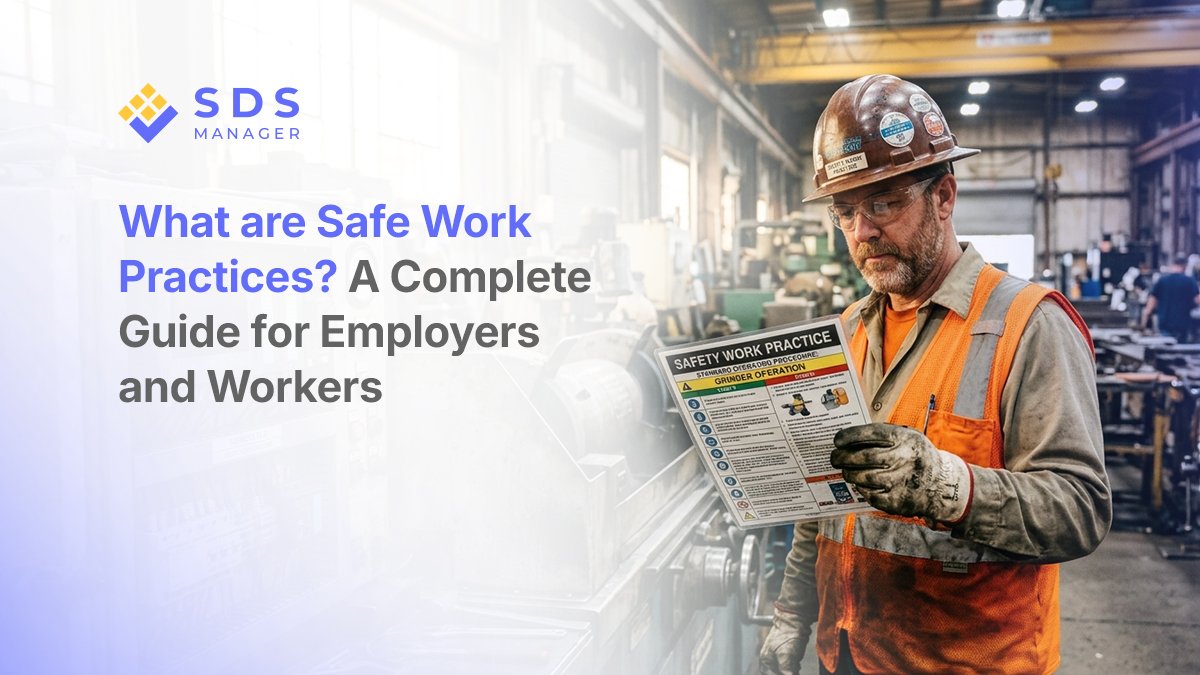
Safe work practices are written guidelines for performing a task with the lowest practical risk to workers and equipment. A safe work practice does no good if workers skip it on the shift floor. Canada accepted 348,747 lost-time injury claims in 2022, per AWCBC data cited by the Public Health Agency of Canada.
This guide separates safe work practices from safe job procedures and shows how Canadian employers build effective programs.
Key takeaways
- Safe work practices are written guidelines for performing a task with the lowest practical risk to workers and equipment.
- Safe work practices operate under one of fourteen OHS jurisdictions in Canada: one federal, covering about 8 percent of workers, and thirteen provincial or territorial.
- Safe work practices are generic and apply to a category of tasks, while safe job procedures are step-by-step instructions for one specific task.
- Saskatchewan's decline followed a province-wide strategy combining more inspections, employer education, and targeted prevention work, of which documented safe work practices are one piece.
- Building a safe work practice takes five steps: hazard assessment, drafting, worker review, management approval, and training with periodic review.
- Provincial safety associations, such as Alberta's Construction Safety Association (ACSA), publish safe work practice templates that employers can adapt to their own hazards.
What are safe work practices?
Safe work practices are written instructions that describe how to perform a task with minimal risk to workers, equipment, and materials. For example, a safe work practice for using a ladder shows what that looks like. It might specify a three-point-contact rule, a maximum weight limit, and a pre-use inspection check. However, it does not cover every way a worker might use a ladder, just the hazards most likely to cause injury.
Safeopedia's definition frames them as guidelines rather than rigid scripts. They set out the do's and don'ts for a category of tasks without dictating every motion a worker makes. Some workplaces phrase this the same way as "safe working practices and procedures," though the underlying idea does not change.
Safe work practices apply to hazards that show up across many jobs rather than one specific task. For example, a practice covering safe use of hand tools applies whether a worker is on a construction site or in a maintenance shop.
Safe work practices are typically developed from a hazard assessment. Once a workplace identifies a recurring risk, a practice is written to address it and then reviewed as conditions or regulations change. Workers practise safe work by following the guidelines that apply to their task, not by memorizing every practice in the program.
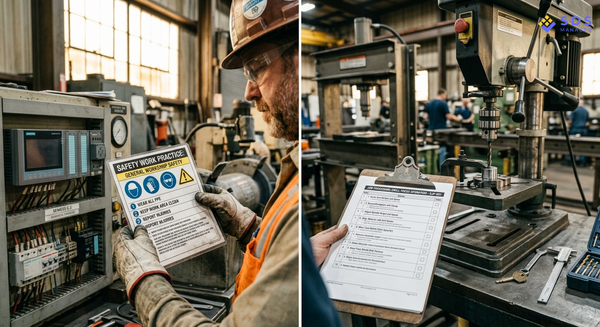
Where do safe work practices fit in Canadian OHS law?
Safe work practices sit inside one of 14 occupational health and safety jurisdictions in Canada. One is federal; thirteen are provincial or territorial, each with its own legislation. This matters because there is no single national safe work practices law.
An employer's specific obligations come from whichever jurisdiction covers their workplace, not a general Canada-wide standard.
About 1.3 million workers fall under federal jurisdiction through Part II of the Canada Labour Code. That is roughly 8% of the Canadian workforce, per Canada's Labour Program. For most employers, provincial or territorial legislation is the rule that actually applies. Only a narrow slice of workplaces need to look to the federal Labour Program instead.
Federal jurisdiction covers sectors such as banking, telecommunications, and interprovincial transportation. The remaining workers fall under their province or territory's occupational health and safety act instead. Which regime applies depends on the type of work, not the province where a business is located. A federally regulated sector stays federally regulated no matter which province it operates in.
Both regimes require employers to control recognized workplace hazards, though the specific act and enforcement body differ by jurisdiction. An employer covered by one act cannot assume it automatically satisfies another. Certificate of Recognition, or COR, is a voluntary safety certification that credits employers with a documented safe work practice program. Gaps between the two acts only tend to surface once an inspector or COR auditor gets involved.
A construction firm in Alberta, for example, answers to Alberta's OHS legislation. An interprovincial trucking company answers to the Canada Labour Code instead, even if both operate from the same city. COR audits, run through provincial certifying partners such as ACSA, sit on top of this legislative baseline. They check specifically for documented safe work practices as part of a broader audit standard. That applies regardless of which jurisdiction an employer falls under.
What is the cost of skipping safe work practices?
A safe work practice exists to reduce one task's specific hazards, such as a fall, cut, or chemical exposure. Skipping it removes that protection and raises the odds of the exact injury it was written to prevent.
Canada accepted more than 2.8 million lost-time injury claims between 2012 and 2022, or roughly 287,000 a year on average, per AWCBC data cited by the Public Health Agency of Canada.
Provincial data shows what happens when a program actively works to reduce that number. Saskatchewan's 2024 results illustrate the pattern:
- Saskatchewan's time-loss injury rate fell to 1.72 per 100 workers in 2024, a 3.37 percent drop from 2023, according to WCB Saskatchewan figures reported through AWCBC.
- Ninety percent of Saskatchewan workplaces reported zero injuries and zero fatalities in 2024, for the fifth consecutive year, per the same WCB Saskatchewan data.
- A documented practice like this gives supervisors a standard to train against, which supports compliance with provincial occupational health and safety legislation.
Incidents cluster around a narrow, recurring set of tasks across industries, such as lifting, machine operation, and confined space entry. A written practice targets that recurring risk directly. It gives workers a documented standard before an incident occurs, not a policy drafted after one.
Saskatchewan's own numbers show this playing out at a provincial scale. Its time-loss injury rate did not fall on its own; it tracked a specific, sustained prevention effort. Saskatchewan's multi-year decline in time-loss injuries followed a dedicated fatalities-and-serious-injuries strategy the province launched in 2023. These guidelines, backed by inspection and training, are part of what moves that number.
Safe work practices vs. Safe job procedures: What's the difference?
Safe work practices are generic guidelines that apply across many similar tasks. Safe job procedures are step-by-step instructions built for one task, from start to finish. The table below lines up both tools by scope, format, and review cycle.
| Attribute | Safe work practice | Safe job procedure |
|---|---|---|
| Scope | Generic, applies to a category of tasks | Specific, applies to one task only |
| Format | Do's and don'ts, general guidance | Sequential, numbered steps |
| Typical use | Recurring hazards across the workplace | Nonroutine or high-risk tasks, such as confined space entry or lockout/tagout |
| Review trigger | Regulatory change or new hazard type | Task, equipment, or process change |
Both trace back to the same hazard assessment. A general lifting risk becomes a safe work practice. A single high-risk lift, such as a crane operation, becomes a safe job procedure instead.
What does a safe work practice program cover?
A safe work practice program covers six recurring hazard categories. These span personal protective equipment, tool and machinery use, housekeeping, ergonomics, hazardous material handling, and emergency response. The wording varies by industry, but the categories themselves repeat across nearly every program.
| Coverage area | What it includes | Example |
|---|---|---|
| Personal protective equipment | Selection, proper use, and disposal, matched to task hazards | Cut-resistant gloves for blade work |
| Safe tool and machinery use | Pre-use inspection, guarding, and lockout/tagout points | Blade guard required on a table saw |
| Housekeeping | Walkway and exit clearance, spill cleanup, storage limits | Absorbent material specified for spill containment |
| Ergonomics | Workstation setup, lifting technique, task rotation | Bending at the knees instead of the back |
| Hazardous material handling | Labeling, compatible storage groups, and transfer PPE | Keeping oxidizers separated from flammables |
| Emergency response | Who calls for help, extinguisher and shutoff locations, evacuation routes | Naming the correct extinguisher type for each hazard area |
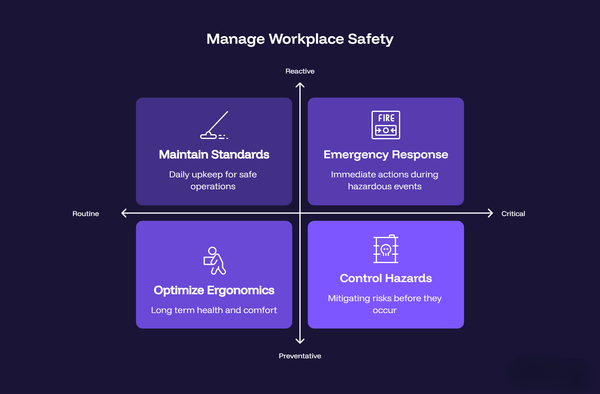
Personal Protective Equipment
PPE practices cover selection, proper use, and disposal for the hazards present in a task. A practice specifies which PPE a task requires, such as cut-resistant gloves for blade work. Hearing protection near loud equipment is another common example. It also sets inspection intervals and when to retire damaged gear.
Requirements typically span six categories: head, eye and face, hearing, hand, foot, and respiratory protection. A single task can call for more than one category at once.
A welder, for example, needs eye, hand, and respiratory protection together. The practice ties each requirement back to the hazard assessment that identified it, not a general safety policy.
PPE selection also accounts for fit and class, not just type. A dust mask and a certified respirator both cover the face, but only one is rated for airborne chemical exposure. Choosing the wrong class is one of the most common gaps auditors find during a COR review.
Safe Tool and Machinery Use
Tool and machinery practices set out pre-use inspection steps and when to remove defective equipment from service. A pre-use check typically covers cracked housings, frayed cords, and missing guards before a tool is used. Equipment that fails inspection gets tagged and removed from service, not repaired on the spot.
They also cover guarding requirements on power tools and lockout points on machinery. A table saw needs a blade guard in place before operation. Machinery with stored energy, such as a conveyor or press, needs a lockout/tagout point identified before maintenance begins.
Skipping the inspection step is the most common way this practice gets bypassed. A worker under time pressure may skip the pre-use check and assume a tool is fine because it worked yesterday. That assumption is exactly the gap a written practice is meant to close.
Housekeeping
Housekeeping practices keep walkways, exits, and work areas clear of slip and trip hazards. A practice typically sets minimum aisle widths, exit clearance distances, and cleaning frequency. Blocked exits are treated as a standalone violation in most jurisdictions, separate from general clutter.
They also set expectations for spill cleanup, cord management, and material storage. A spill practice specifies the absorbent material to use and how quickly a spill must be contained once noticed. Cords get routed along walls or taped down rather than run across a walking path. Stored materials stay below a set stacking height to prevent tipping over.
Clutter is one of the most frequent findings in workplace inspections, which is why housekeeping gets its own category. A cluttered aisle rarely causes an incident on its own. It turns a minor trip into a fall or blocks the exit route during an emergency.
Ergonomics
Ergonomics practices address workstation setup and repetitive tasks that cause strain injuries. A workstation practice sets monitor height, chair adjustment, and reach zones so a worker isn't twisting or overreaching repeatedly. These adjustments cost little to implement but prevent injuries that build up over months.
They also cover lifting techniques, such as bending at the knees instead of the back. A weight threshold is set when a lift needs a second person or mechanical aid. Task rotation splits repetitive motions across different muscle groups during a shift. That is better than having one worker repeat the same motion for eight hours straight.
Musculoskeletal injuries build up over months, so these practices focus on prevention rather than reacting after pain starts. A worker who reports wrist strain after years of repetitive motion often can't point to a single cause. That gradual onset is exactly why ergonomics needs its own documented practice, not just general safety awareness.
Hazardous Material Handling
Hazardous material practices cover labeling, storage, and safe transfer of chemicals. A workplace label carries the product name, pictogram, and a short hazard statement. That's distinct from the more detailed supplier label it's copied from. Materials without a label are typically treated as fully hazardous by default until identified.
They tie directly to a workplace's safety data sheets and Workplace Hazardous Materials Information System (WHMIS) requirements. A practice specifies compatible storage groups, such as keeping oxidizers away from flammables. Mixing incompatible classes is what turns a leak into a reaction. Storage location also depends on ventilation and proximity to an ignition source.
A practice also specifies the PPE required for transfer or cleanup. That PPE comes from the chemical's own safety data sheet, not a general PPE list. A spill kit matched to the specific hazard class sits near the storage area. That beats a central supply closet a worker has to search during an active spill.
Emergency Response Procedures
Emergency response practices cover fires, spills, and equipment failure. Each practice names who calls for help first. That might be a supervisor, a designated first responder, or emergency services directly. Naming this in advance means the decision isn't made on the spot during an actual event. The response also differs by hazard type, since a chemical spill and an electrical fire need different first actions.
They specify where extinguishers and shutoffs are located, and the evacuation route for each work area. A fire extinguisher rated for one hazard class can make an electrical fire worse if it's the wrong type. That's why the practice names the specific extinguisher type for each area. Evacuation routes include a primary and backup path. Each route ends at a named assembly point where a supervisor can account for everyone.
These practices are tested through drills, not just written and filed. A drill exposes gaps a written plan can't catch, such as a blocked exit or an unfamiliar assembly point. A plan that has never been drilled is really just an assumption. That same principle applies across all six categories covered here, not just emergency response. Each one sits within the broader safe work procedures element. CCOHS lists this as a core part of any occupational health and safety program
How are safe work practice programs developed?
A written practice moves through six steps: hazard assessment, drafting with workers, committee review, management approval, training and posting, and a scheduled review.
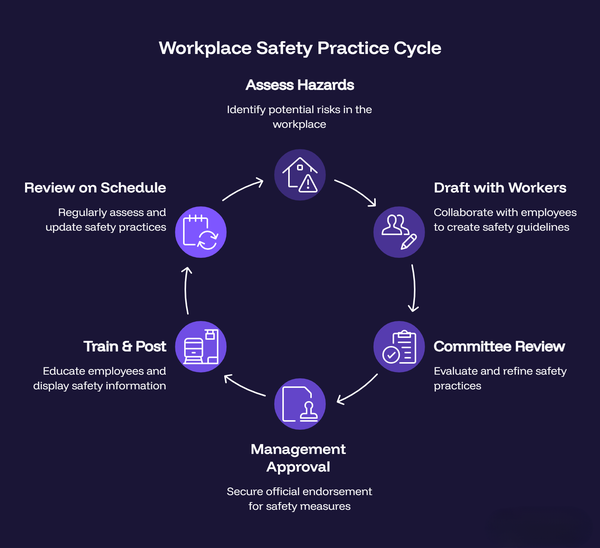
1. Assess hazards. Identify which recurring tasks expose workers to injury, using near-miss reporting, incident history, or a formal risk assessment. No workplace writes practices for every task at once. Programs typically start with high-risk, high-frequency tasks, then expand to cover new, modified, or rarely performed jobs.
2. Draft the practice with workers. Build it by observing the job as performed or drafting it through discussion, not by writing rules from a desk. A job safety analysis is the standard method for this, per CCOHS. Break the task into its basic steps. Identify the hazard at each step, then set a control for it. If a hazard can be eliminated or engineered out entirely, that beats writing a rule around it.
3. Route it through the joint health and safety committee. Most Canadian jurisdictions require a joint health and safety committee at workplaces over a set size. A draft practice typically goes through that committee before final sign-off. Their review catches gaps a single drafter might miss.
4. Get management approval. Route the practice to a safety manager for final sign-off before it becomes an official standard.
5. Train and post. Deliver the practice through orientation or toolbox talks, then keep a copy at the point of work.
6. Review on a set schedule. Revisit the practice at least once a year, regardless of whether anything changed. Also revisit it right after an incident or a change in equipment, materials, or regulation. That trigger applies regardless of where the annual cycle currently stands.
Roles and responsibilities in implementation
Every Canadian jurisdiction builds its occupational health and safety legislation on the internal responsibility system, or IRS, per CCOHS. The IRS holds everyone in a workplace responsible for their own safety and the safety of others. That is why these four parties' duties interlock rather than sit in isolation. A supervisor cannot enforce a practice an employer never trained on. A worker cannot follow a practice they were never taught.
- Employers carry the largest share of responsibility: developing practices, providing training, and supplying the equipment a practice requires. They also carry the burden of due diligence: proving the program exists, was taught, and is enforced. Without that proof, an employer can lose the due diligence defence in an OHS prosecution. That holds even if the underlying practice itself was sound.
- On the shift floor, supervisors enforce practices and correct deviations before they become habits, often caught through routine safety inspections. A supervisor who lets a shortcut slide once makes it harder to enforce the same rule later. Workers notice which rules actually get checked, and adjust accordingly.
- Workers hold three rights under the IRS. These are the rights to know about hazards, the right to participate in safety decisions, and the right to refuse unsafe work. Following the practice that applies to their task still matters, but so does refusing work when a practice itself fails to protect them. They also report hazards that a practice does not yet cover. A worker who refuses unsafe work stays away from the task, not off the clock entirely, while the employer investigates.
- The joint health and safety committee monitors how practices hold up in use. It does this through workplace inspections and recommendations to the employer. Most jurisdictions require equal worker and management representation on the committee. That gives a recommendation weight from both sides of the floor.
Where can employers find examples of safe work practices?
Employers can find examples of safe work practices in resources published by government and industry safety organizations. Four worth knowing are CCOHS, ACSA, IHSA, and BCCSA. Each one offers a starting structure to adapt to a workplace's own hazards, not a rulebook to follow directly.
- CCOHS, the Canadian Centre for Occupational Health and Safety, publishes free OSH Answers fact sheets covering specific workplace hazards, from electrical safety to hazardous product handling.
- Alberta's Construction Safety Association, known as ACSA, publishes a library of sample safe work practices for construction tasks, including fall protection and cleaning solvent use, free for non-commercial use.
- Ontario's Infrastructure Health and Safety Association, known as IHSA, publishes sample templates and checklists to help build a program. It covers construction, aggregates, electrical utilities, and transportation sectors.
- British Columbia's Construction Safety Alliance, known as BCCSA, offers a library of safe work practice resources. It also connects employers with a regional safety advisor for hands-on help developing one.
Frequently Asked Questions
What happens if a workplace doesn't have safe work practices?
A workplace without documented safe work practices still must control recognized hazards under OHS legislation. Without a written record, proving compliance during an inspection is harder, and liability rises if an incident occurs.
How often should safe work practices be reviewed?
Safe work practices should be reviewed whenever equipment, materials, or the process changes, and on a set cycle otherwise, often annually. A review should also follow any incident or near miss tied to the task.
What is ACSA and does it provide safe work practice templates?
ACSA is the Alberta Construction Safety Association, a nonprofit that publishes free safe work practice templates for construction tasks. Its templates are designed for adaptation to a specific worksite, not direct use as written.
Do small businesses need written safe work practices?
Small businesses face the same hazard-control duty as larger employers under provincial occupational health and safety legislation, though specific reporting thresholds vary by jurisdiction. A written practice still helps a small business train new hires consistently.
What's the difference between a safe work practice and a safety policy?
A safety policy states an employer's overall commitment and goals. A safe work practice gives task-level instructions for performing work safely, sitting below the policy that sets the goal.
Written guidance only works when it reaches the shift floor
A safe work practice is only as good as its last review. Hazards change when equipment, materials, or crews change. A practice written five years ago may no longer match the task it describes. Employers that treat these documents as living guidance get the injury reduction the data shows.
That means reviewing them on a set cycle and checking them against real incidents. Keeping the underlying hazard assessments current is easier when a risk assessment tool keeps that data in one place instead of scattered binders. Employers that file practices away after the first training session do not see the same result.

Arysha Alif Khan

Arysha Alif Khan is an EHS and chemical safety specialist with a background in biochemistry, biotechnology, and public health. She works closely with the product and regulatory teams to turn complex chemical regulations, SDS requirements, and workplace safety standards into clear, practical guidance for people.