
Somewhere in your occupational health and safety legislation, the law tells you to protect workers "as far as is reasonably practicable" and then stops.
It does not say how far that is. It does not give you a number, a budget ceiling, or a list of controls that count.
For a supervisor who has just been handed responsibility for a safety program, that gap is the whole problem.
You are being measured against a standard nobody has defined for you, and you will only find out where the line sat if an inspector or a court draws it after something goes wrong.
Read on, and you will know which standard binds you, how to decide when you have done enough, and what a regulator will ask you to produce if they disagree.
Key Takeaways
- "As far as is reasonably practicable" requires every control that is physically possible with current knowledge and technology, unless its cost in money, time, and trouble is grossly out of proportion to the risk it removes.
- Five of Canada's 14 OHS jurisdictions use the phrase in the employer's general duty: Alberta, Saskatchewan, Manitoba, Newfoundland and Labrador, and Yukon. Each words it differently.
- Nova Scotia and Saskatchewan are the only jurisdictions that define the term in their OHS statute, both as practicable unless the duty-holder can show gross disproportion between the benefit and the cost.
- Cost is weighed against the size of the risk, not against what an employer can afford. An inability to pay does not lower the standard.
- Alberta, Manitoba and Saskatchewan write the hierarchy of controls into law, so reaching for personal protective equipment before cheaper engineering fixes is a breach, not a shortcut.
- "As soon as reasonably practicable" sets a deadline. "As far as is reasonably practicable" sets a level of effort. Alberta's OHS Code uses both, in the same Part.
- An occupational exposure limit is a ceiling, not a target. Meeting the number does not end the duty where further reduction is still “reasonably practicable”.
- Maximum OHSA fines in Ontario reach $2 million per charge for a corporation and $1.5 million for a director or officer.
- "Reasonably practicable" is a duty that applies before an incident. Due diligence is a defence raised after one, and Alberta's guidance states they are not the same thing.
What Does "As Far As Is Reasonably Practicable" Mean?
"As far as is reasonably practicable" is a safety principle. It means you must take every safety measure that is possible given current knowledge and technology.
The only exception is when a measure's cost in money, time, and trouble would be grossly out of proportion to the risk it removes. It sits between doing everything conceivable and doing whatever happens to be convenient.

For example, a guardrail along an open loading dock edge is practicable and cheap against a fall risk that is both likely and serious, so it is reasonably practicable, and you install it.
Rebuilding the dock two metres lower to remove the fall entirely is also practicable, but the cost is wildly out of scale with the additional protection over a guardrail, so it is not.
That gap between the guardrail and the rebuild has a name in the legislation: gross disproportion. It means the imbalance has to be obvious rather than marginal.
A control costing somewhat more than the risk seems to justify is still required. If you find yourself building a careful argument that the numbers are close, you have answered the question, because close means you install the control.
One asymmetry is worth knowing. Nova Scotia gives the phrase its cleanest statutory definition in the country, yet does not use the term in its own employer general duty, which relies on "every precaution that is reasonable in the circumstances" instead. The defined term does its work elsewhere in the Act.
Is "Reasonably Practicable" the Same as "Possible"?
No, "reasonably practicable" is not the same as "possible". "Possible" asks whether something can be done. "Reasonably practicable" asks whether it should be, given what it costs against what it achieves. The second is the lower standard of the two, because it permits you to stop short of a technically achievable control.
Nova Scotia writes both definitions into its OHS Act, and the contrast is clearer there than anywhere else in Canadian law. "Practicable" is defined in s. 3 as "possible, given current knowledge, technology and invention."
Strip the qualifier "reasonably" out of a duty, and you are left with an obligation to do everything technology allows, whatever it costs.
Federal guidance draws the same line. The Labour Program's interpretation policy IPG-055 (2009) states that "reasonably practicable" imposes a less stringent standard than "practicable," because there are measures that are practicable but not reasonably so.
Which Canadian Provinces and Territories Use the Phrase?
Five of Canada's fourteen OHS jurisdictions use "reasonably practicable" in the employer's general duty clause, and no two of them word it identically. Alberta, Saskatchewan, Manitoba, Newfoundland and Labrador, and Yukon carry the phrase. The other nine use something else.
| Jurisdiction | Statute | Section | Wording of the general duty | Standard |
|---|---|---|---|---|
| Federal | Canada Labour Code, Part II | s. 124 | "ensure that the health and safety at work of every person employed by the employer is protected" | Unqualified "ensure" |
| Alberta | OHS Act, S.A. 2020, c. O-2.2 | s. 3(1) | "ensure, as far as it is reasonably practicable for the employer to do so" | Reasonably practicable |
| British Columbia | Workers Compensation Act, Part 2 | s. 21(1) | "ensure the health and safety of all workers working for that employer" | Unqualified "ensure" |
| Saskatchewan | The Saskatchewan Employment Act | s. 3-8(a) | "ensure, insofar as is reasonably practicable, the health, safety and welfare at work of all of the employer's workers" | Reasonably practicable |
| Manitoba | Workplace Safety and Health Act, C.C.S.M. c. W210 | s. 4(1)(a) | "ensure, so far as is reasonably practicable, the safety, health and welfare at work of all their workers" | Reasonably practicable |
| Ontario | OHSA, R.S.O. 1990, c. O.1 | s. 25(1); s. 25(2)(h) | s. 25(1) is a strict duty; s. 25(2)(h) requires the employer to "take every precaution reasonable in the circumstances for the protection of a worker" | Strict, plus reasonable precaution |
| Quebec | Act respecting occupational health and safety, CQLR c. S-2.1 | s. 51 | "take the necessary measures to protect the health and ensure the safety and physical and mental well-being of his worker" | Necessary measures |
| New Brunswick | OHS Act, R.S.N.B. 1973, c. O-0.2 | s. 9(1)(a) | "take every reasonable precaution to ensure the health and safety of its employees" | Reasonable precaution |
| Nova Scotia | OHS Act, S.N.S. 1996, c. 7 | s. 13(1) | "take every precaution that is reasonable in the circumstances" | Reasonable precaution |
| Prince Edward Island | OHS Act, R.S.P.E.I. 1988, c. O-1.01 | s. 12(1)(a) | "ensure … that every reasonable precaution is taken to protect the occupational health and safety of persons at or near the workplace" | Reasonable precaution |
| Newfoundland and Labrador | OHS Act, R.S.N.L. 1990, c. O-3 | s. 4 | "ensure, where it is reasonably practicable, the health, safety and welfare of the employer's workers" | Reasonably practicable |
| Yukon | OHS Act, R.S.Y. 2002, c. 159 | s. 3(1) | "ensure, so far as is reasonably practicable" that the workplace, equipment and processes are safe | Reasonably practicable |
| Northwest Territories | Safety Act, R.S.N.W.T. 1988, c. S-1 | s. 4(1)(b) | "take all reasonable precautions and adopt and carry out all reasonable techniques and procedures" | Reasonable precaution |
| Nunavut | Safety Act, R.S.N.W.T. (Nu) 1988, c. S-1 | s. 4(1)(b) | "take all reasonable precautions and adopt and carry out all reasonable techniques and procedures" | Reasonable precaution |
Three details behind the table are easy to miss:
- Federal duty is absolute at the statute level, practicable at the regulation level: s. 124 is unqualified, but "reasonably practicable" runs throughout the federal regulations, which is why the Labour Program publishes interpretation guidance on the phrase at all.
- The duty reaches past the employer: Workers, supervisors, suppliers, prime contractors and owners carry their own "reasonably practicable" obligations in several jurisdictions, worded to match their control over the work. Yukon's s. 27 sits in a Division that assigns duties role by role.
- Only two jurisdictions define the phrase in the Act: Nova Scotia and Saskatchewan use the same sentence: practicable unless the duty-holder can show a gross disproportion between the benefit of the duty and the cost, in time, trouble and money, of the measures needed to meet it.
- PEI uses that same definition, but in its fall protection regulations rather than its Act.
- BC defines only the bare word "practicable" which is "reasonably capable of being done."
This is not a balancing test. The default is that you must do it. The only exit is gross disproportion, and the word "show" puts the evidence on you.
What Standard Applies If Your Province Does Not Use It?
If your province does not use "as far as is reasonably practicable," take every precaution that is reasonable in the circumstances instead, and treat that as the working standard for every decision you document.
In practice, that means the same sequence the practicability provinces require: find the hazards, rank them, control the serious ones first, and write down what you did and why.
Nine jurisdictions fall into this group. Ontario, Nova Scotia, New Brunswick, Prince Edward Island, the Northwest Territories and Nunavut all use a reasonable-precaution formula.
British Columbia, the federal regime and Ontario's s. 25(1) impose an unqualified duty to ensure health and safety, with no cost allowance written into the wording at all. Quebec stands alone, requiring the "necessary measures."
On the shop floor, the difference between these matters much less than the wording suggests. An employer working properly in Halifax and one working properly in Regina would take recognisably similar steps.
In a courtroom, the wording matters a great deal, because it decides who has to prove what a charge is laid after an incident. A duty qualified by "reasonably practicable" invites an argument about proportion that a bare duty to "ensure" does not, and in Alberta it shifts part of the burden onto the Crown.
Quoting the wrong province's phrase back to an inspector will not help you. Knowing which of the six formulas governs your site is the first thing to get right.
How Do You Decide How Far Is Far Enough?
Canadian regulators answer this with a reasonable person test rather than a formula.
Alberta's guidance defines "reasonably practicable" as an obligation met in a way that is feasible given the circumstances and would be considered appropriate by most reasonable people in similar circumstances. The practical version of that question is what a dozen of your peers would consider reasonable in the same situation.
Three habits make the test answerable instead of philosophical:
- Find the published industry standard for the task,
- Look at how comparable operations handle the same hazard, and
- Bring in someone who knows the field when the answer is not obvious.
Each of those produces evidence of what "reasonable" looked like at the time you decided, which is the thing you will be asked for later.
Federally, IPG-055 splits the assessment into two parts: the technical and economic limb.
- The technical part asks whether compliance is physically possible and whether it would introduce a new hazard.
- The economic part asks whether the cost of compliance would significantly outweigh the benefit. It weighs hazard severity, likelihood of exposure, whether the measure produces a noticeable improvement, and whether the fix is permanent or temporary.
All of this flows from your hazard assessment, because you cannot weigh a risk you have not sized.
Can You Skip a Control Because It Costs Too Much?
No, you cannot skip a control because it costs too much for you to afford. You can only skip one when its cost is grossly disproportionate to the risk it removes.
Cost is weighed against the size of the risk, not against your budget. An employer who cannot afford a necessary control has an affordability problem, not a lower legal duty.
For example, a $4,000 local exhaust system on a bench where a worker degreases parts with a solvent every shift is proportionate to a daily inhalation risk, and the fact that $4,000 is painful this quarter changes nothing.
On the other hand, a $400,000 enclosure to address an occasional faint odour from a sealed tank, where no exposure limit is approached, is the kind of spend a regulator would call grossly disproportionate.
What you cannot do is start with the budget and shrink the risk to fit.
This comes from English case law, the same line of cases that produced the gross-disproportion test. No Canadian court has put it in those words, but Canadian regulators apply it in substance: the question is cost against benefit, never cost against what you can afford.
What Factors Should You Weigh When Deciding What Is Reasonably Practicable?
When deciding what is reasonably practicable, weigh five factors:
- The likelihood of the hazard or risk occurring.
- The degree of harm that might result.
- What the person knows, or ought reasonably to know, about the hazard and ways to eliminate or minimize it.
- The availability and suitability of ways to eliminate or minimise the risk.
- The cost of those ways, including whether it is grossly disproportionate to the risk.
No Canadian OHS statute enumerates the factors, and the guidance that exists is narrower. Section 18 of the Work Health and Safety Act 2011 (Cth) sets out all five.
The phrase is not originally Canadian. It reaches Canada, Australia, and the UK from the same English case law, and Australia is the only jurisdiction in that lineage that wrote the factors into statute rather than leaving them to guidance. Section 18 has no force in Canada, but it remains the most usable articulation of the same test.
Note the order. Cost sits last, after you have assessed the risk and identified the available controls, so the budget does not shape the risk assessment it is supposed to justify.
The Hierarchy of Controls Is How AFARP Gets Applied
The hierarchy of controls converts the reasonably practicable test into an order of operations:
- Remove the hazard first,
- Reduce it if you cannot remove it, and
- Reach for personal protective equipment last.
That order is written into Canadian law, not merely recommended. Section 122.2 of the Canada Labour Code states that preventive measures should consist first of eliminating hazards, then reducing hazards, and finally providing personal protective equipment.
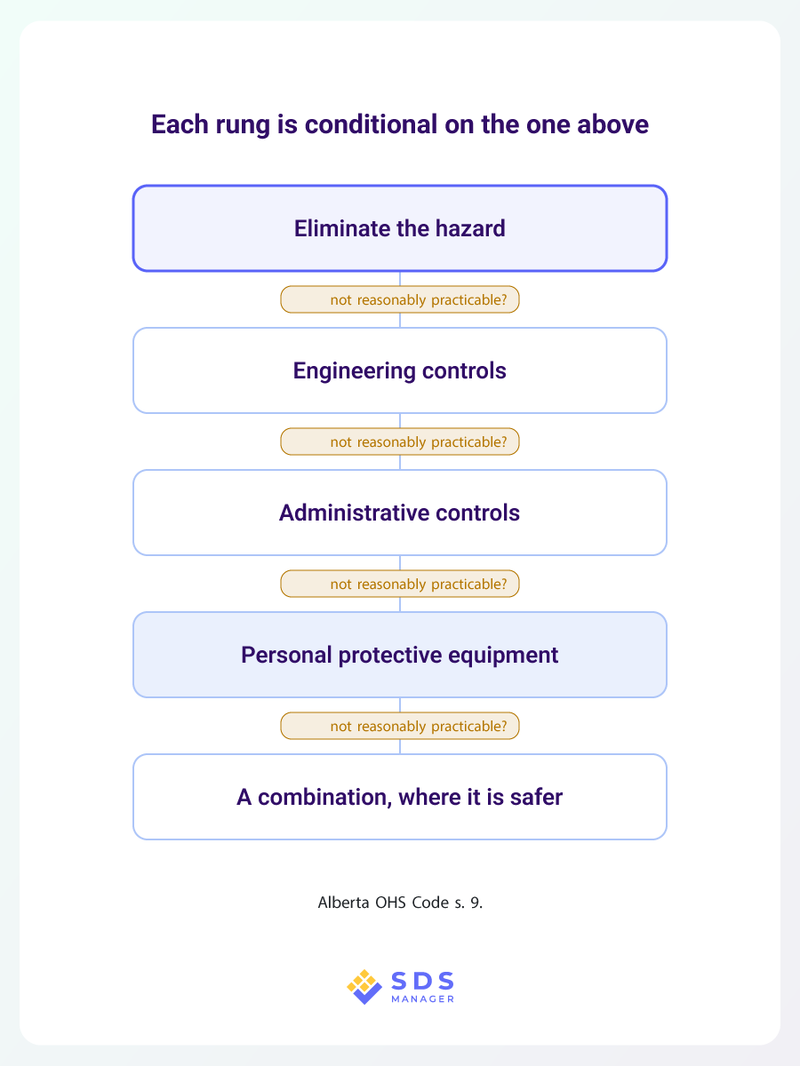
Alberta goes further and makes each rung conditional on practicability. Under s. 9 of its OHS Code, an employer must eliminate a hazard, or control it if elimination is not reasonably practicable.
Engineering controls come next where reasonably practicable, then administrative controls that bring the hazard "as low as reasonably achievable," then personal protective equipment, then a combination where a combination is safer.
Manitoba makes the consequence unmistakable. Under s. 36.9(1) of its Workplace Safety and Health Regulation, control measures for airborne chemical or biological exposure may not require a worker to wear PPE "unless no other measure is reasonably practicable."
Handing out respirators while a feasible ventilation fix sits unpriced is a breach in Manitoba, however diligently those respirators are worn.
"As Soon As Reasonably Practicable" vs "As Far As Is Reasonably Practicable"
"As soon as reasonably practicable" sets a deadline, whereas "As far as is reasonably practicable" sets a level of effort. The two constructions share three words and ask completely different questions, and treating them as interchangeable is the fastest way to miss a duty.
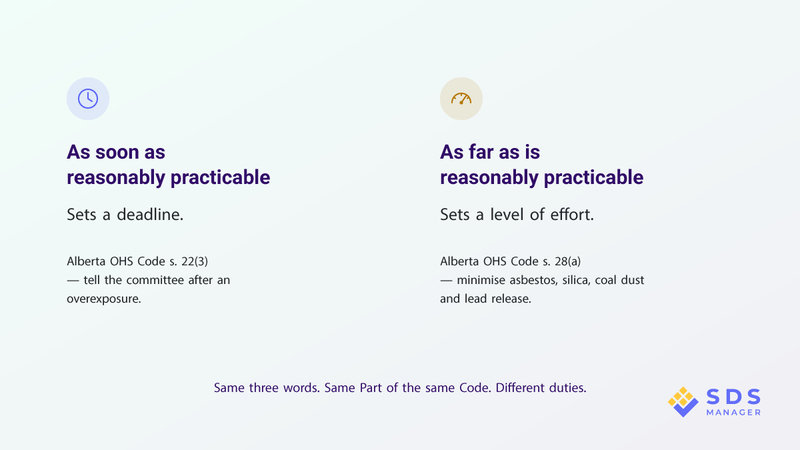
Alberta proves the point inside a single Part of a single instrument. Section 22(3) of the OHS Code requires an employer to inform the joint health and safety committee in writing "as soon as reasonably practicable" after a worker is exposed above an occupational exposure limit. That is a clock.
Section 28(a) of the same Part requires the employer to minimize the release of asbestos, silica, coal dust and lead "as far as is reasonably practicable." That is a threshold of effort with no clock attached.
Federal drafting convention treats them separately too. Justice Canada's Legistics guidance lists "as soon as reasonably practicable" among the expressions used to describe time periods, alongside "without delay" and "forthwith," and does not deal with the "as far as" family there at all.
No Canadian regulator or commentator appears to have set the two constructions side by side and explained the difference. The evidence for it comes from the statutes themselves, where the same words are demonstrably doing two jobs.
Where Does 'Reasonably Practicable' Apply in Chemical Safety?
Two chemical safety duties carry the qualifier where you are most likely to meet it: WHMIS training and exposure control.
Why Is WHMIS Training Qualified by "Reasonably Practicable"?
WHMIS training is qualified by "reasonably practicable" because you cannot verify with certainty what a worker has actually learned. Ontario's guidance says so outright: the qualifier is there "because it is recognized the employer may have difficulty at times determining with certainty what workers have learned, due either to language or literacy problems."
Comprehension sits inside someone's head. The law cannot demand proof of it, so it demands a reasonable effort to confirm it instead.
That effort is the duty. Delivering the session is not enough on its own. The obligation runs to whether the training worked, and you are measured on how far you went to find out.
Five jurisdictions word it the same way. Ontario's WHMIS Regulation s. 7(3) requires an employer to ensure, "so far as is reasonably practicable," that the worker instruction program "results in the workers being able to use the information to protect their health and safety."
New Brunswick's Regulation 2016-6 s. 7(3), PEI s. 5(4), Nova Scotia s. 3.5(4) and Yukon s. 5(3) all say substantially the same thing.
How Far Do You Have to Reduce Chemical Exposure?
You have to reduce chemical exposure as far as is reasonably practicable, and then keep it below the numeric limit as well. The limit is a ceiling, not a target. Meeting it does not end the duty where further reduction is still practicable.
Two provinces apply a true ALARP-style test to chemical exposure, and both put it underneath a hard numeric limit rather than in place of one. Newfoundland and Labrador's OHS Regulations s. 42(7) requires that atmospheric contamination be "kept as low as is reasonably practicable" and that worker exposure be "as minimal as is reasonably practicable," while separately forbidding exposure above the ACGIH threshold limit value.
Saskatchewan builds the hierarchy into the duty itself. Section 21-1(1) of its OHS Regulations, 2020 requires substitution of a less hazardous substance "if reasonably practicable," reduction of contamination "to the extent that is reasonably practicable," and work procedures that are "as safe as is reasonably practicable."
Elsewhere, the drafting diverges. British Columbia uses "as low as reasonably achievable" and defines ALARA in s. 5.1 of its OHS Regulation. The federal regulations require asbestos exposure to be "as close to zero as possible." Ontario's exposure regulation, R.R.O. 1990, Reg. 833, uses no practicability qualifier at all. Same policy goal, four different legal tests.
What Happens If a Regulator Decides You Fell Short
Most employers meet the standard long before a courtroom. An inspector who finds a problem issues a compliance order with a deadline, and can order the work stopped or the area cleared on the spot where the danger is immediate. Ontario's inspectors do this under OHSA s. 57, Alberta's under OHS Act ss. 38 and 39. Workers can trigger the same attention themselves through the right to refuse unsafe work.
British Columbia adds a rung that bypasses court entirely. WorkSafeBC can levy an administrative penalty under s. 95 of the Workers Compensation Act without prosecuting anyone, and the 2026 statutory maximum for one of those is $816,148.69.
Prosecution is the end of the ladder, not the start of it. Fines are set by statute and vary widely.
| Jurisdiction | Maximum fine, corporation | Maximum for an individual | Imprisonment |
|---|---|---|---|
| Ontario (OHSA s. 66) | $2,000,000 per charge | $1,500,000 for a director or officer; $500,000 for anyone else | Up to 12 months |
| Saskatchewan (SEA s. 3-79) | $1,500,000 | $500,000 | Not stated in the penalty provision |
| Federal (Canada Labour Code s. 148) | $1,000,000 on indictment | Same scale | Up to 2 years |
| Alberta (OHS Act s. 48) | $500,000 first offence, $1,000,000 subsequent, plus daily amounts for a continuing offence | Same scale | 6 months first, 12 months subsequent |
| Manitoba (WSH Act) | $500,000 first offence, $1,000,000 subsequent | Same figures | Not confirmed |
| New Brunswick (OHS Act s. 47) | $250,000 | $250,000 | Up to 6 months |
| Newfoundland and Labrador (OHS Act s. 67) | $250,000, plus $25,000 a day for a continuing offence | $250,000 | Up to 12 months |
None of these numbers is the thing you can control. What you can control is the record. Once a charge is laid, an employer's answer is almost always the same one: that it did everything it reasonably could. Courts call that a due diligence defence, and it is not the same thing as the duty you were under beforehand.
What Is the Difference Between Reasonably Practicable and Due Diligence?
Due diligence is a defence to a charge. It comes from R v Sault Ste. Marie, [1978] 2 S.C.R. 1299, which lets an accused escape a strict liability offence by proving it took all reasonable steps. Reasonably practicable is the standard your duty is measured against while the work is going on.
The difference is timing and who carries the burden. Reasonably practicable applies today, before anything has happened, and shapes what you must actually do. Due diligence applies afterwards, in a courtroom, and the proof is on you, assembled from whatever you happened to document while the work was going on.
Alberta's own bulletin says the two are not the same thing, and confusing them is how employers end up building the wrong record. Alberta also shows how much the wording changes this.
In R v Precision Diversified Oilfield Services Corp, 2018 ABCA 273, the Court of Appeal split on its reasoning but held that "reasonably practicable" is part of the offence itself. The Crown must prove the employer could have fixed the unsafe condition and did not.
An accident alone no longer proves the breach there, which is the practical consequence of the burden shift the wording creates.
One place the defence does not reach at all is Criminal Code s. 217.1, added by the Westray amendments in 2004. It requires anyone who directs how another person does work to take reasonable steps to prevent bodily harm, and no due diligence defence is available against a criminal negligence charge built on it.
How to Show You Met the Standard
Work through these six steps, in order, and keep the output of each one.
- Assess the hazard and write it down. Record what the hazard is, who is exposed, how often, and how badly it could hurt someone. Date the record.
- List every control that could work. Include the ones you expect to reject. A list with one option on it proves nothing.
- Price each option. Put real numbers against money, downtime and disruption, not adjectives.
- Record the decision and the reason for it. Name the control you chose. For each one you rejected, write the sentence explaining why the cost was grossly out of proportion to the risk it would have removed.
- Train the people affected and keep proof they understood. A sign-in sheet shows attendance. A short test or a practical demonstration shows comprehension, which is what the WHMIS provisions actually ask for.
- Set a review date and honour it. Revisit the decision when the work changes, when new data arrives, or on a fixed cycle. Records that stop three years ago read as a program that stopped three years ago.
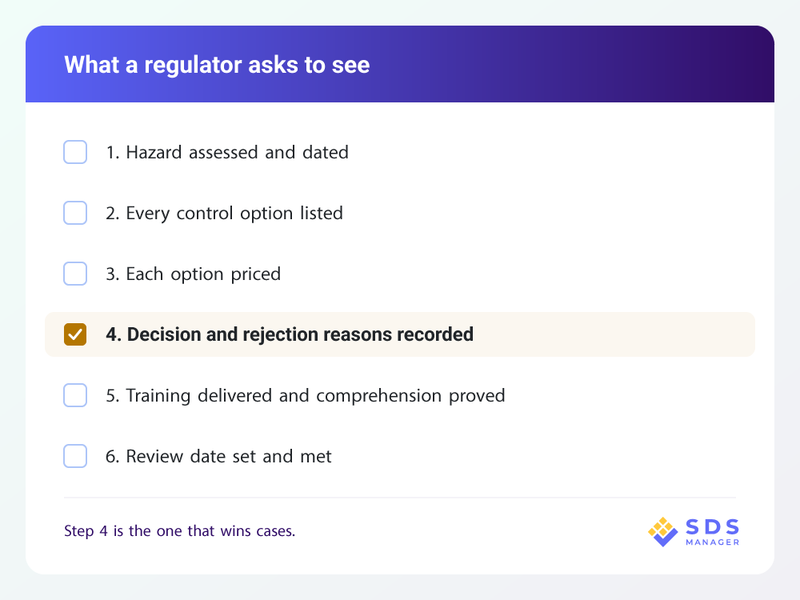
Step 4 is the one that wins cases. A hazard assessment listing three options, pricing them, and recording that the third was rejected as grossly disproportionate is a defence. The same decision made in a hallway conversation is not, because nothing survives to show the comparison happened.
Keep that reasoning attached to the safe work practices that came out of it, so the control and the justification for it are never separated.
Stop Relying on Memory to Prove You Met the Standard
"As far as is reasonably practicable" is a comparison, and you are judged on whether you can show you met it.
Two things decide that:
- You need to know which standard binds each site you run, because a Winnipeg plant and a Mississauga plant answer to differently worded duties.
- You need a dated record of the hazards you found, the controls you priced, and why you rejected the ones you rejected, written at the time rather than reconstructed after an incident.
EHS Solution by SDS Manager was built for exactly that record.
Everything sits in one place: hazards, the controls considered against them, and the reasoning for the option you chose and the ones you didn't. Each decision carries a review date that keeps it current, tagged to the site and jurisdiction it belongs to. When a regulator asks what you knew and when you decided, the answer prints.
Book a demo and see how your next inspection could start with a printout instead of a search.
Frequently Asked Questions
Does Canada use ALARP?
Canada uses ALARP in part. Newfoundland and Labrador applies an ALARP-style test to chemical exposure, requiring atmospheric contamination to be kept as low as is reasonably practicable, and Saskatchewan uses similar language for contamination reduction. British Columbia uses ALARA (as low as reasonably achievable) instead, and so does federal radiation law: s. 4(a) of the Radiation Protection Regulations requires licensees to keep doses "as low as reasonably achievable, taking into account social and economic factors."
What is the difference between ALARP and AFAIRP?
In everyday safety practice, there is no meaningful difference between ALARP and AFAIRP. ALARP means as low as reasonably practicable, AFAIRP means as far as is reasonably practicable, and both describe reducing risk until further reduction would be grossly disproportionate. AFAIRP is the phrasing that tends to appear in legislation, while ALARP is more common among risk specialists.
Does the standard apply to psychological hazards?
Yes, in a growing number of jurisdictions. Quebec's s. 51 duty expressly covers a worker's mental well-being, federally regulated workplaces are governed by the Work Place Harassment and Violence Prevention Regulations, and every province now regulates workplace harassment in some form. The test itself does not change: identify the hazard, control it as far as the wording of your duty requires, and document the reasoning.
Who can be charged for failing to comply with OHS legislation in Canada?
Employers, supervisors, workers, suppliers and, in several provinces, prime contractors and project owners can all be charged under provincial OHS statutes, depending on which duty was breached. Criminal Code s. 217.1 reaches further, covering anyone who directs how another person does work, including individual managers.
Does "reasonably practicable" mean you have to eliminate every risk?
No, "reasonably practicable" does not mean you have to eliminate every risk. It requires you to eliminate risk wherever doing so is proportionate, and to reduce what remains as far as proportionality allows. A residual risk that could only be removed at a cost grossly out of scale with the harm it poses is one the law permits you to accept.
What are the French terms for these standards?
Quebec, New Brunswick and federally regulated workplaces operate in both official languages. The key equivalents are dans la mesure du possible for "so far as is reasonably practicable," les mesures nécessaires for Quebec's "necessary measures" under s. 51, diligence raisonnable for due diligence, and fiche de données de sécurité (FDS) for a safety data sheet.

Arysha Alif Khan

Arysha Alif Khan is an EHS and chemical safety specialist with a background in biochemistry, biotechnology, and public health. She works closely with the product and regulatory teams to turn complex chemical regulations, SDS requirements, and workplace safety standards into clear, practical guidance for people.