
Most construction site emergency plans fail for the same reason: nobody tests them until a real emergency forces the issue. A written plan tells workers what should happen. A drill is the only way to find out whether it actually will.
This guide sets out how to plan safety drills on a construction site. It covers picking realistic scenarios, running the drill itself, and turning what goes wrong into something that actually gets fixed before the next one.
Key takeaways
- Effective drill planning starts with the specific hazards a site actually faces, not a generic template borrowed from another project.
- Drills follow a four-tier progression: tabletop, drill, functional, and full-scale. It isn't a binary choice between tabletop and live.
- Emergency response plans are legally required across Canadian jurisdictions, but a specific drill mandate is not universal. Among the jurisdictions covered here, only BC (annual emergency drills under OHS Reg. 4.14(3) and annual first aid drills under s. 3.17(4)) and the federal COHSR (s. 17.10) set fixed minimums.
- A drill that isn't debriefed and documented provides no evidence it happened, which matters for both compliance and COR audits.
- Site conditions change fast on construction projects, so a drill plan needs revisiting far more often than a static office fire drill.
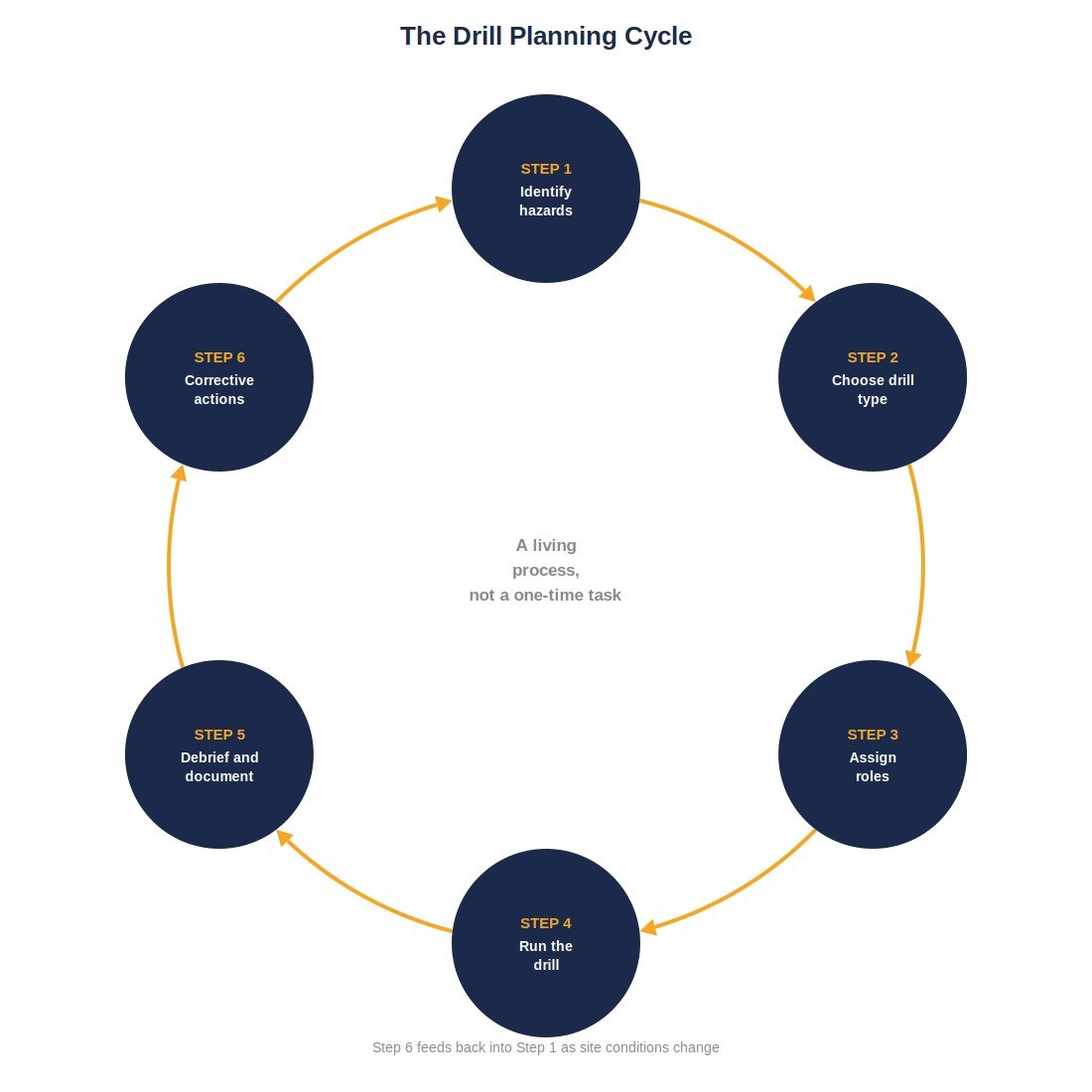
Step 1: Identify the Hazards Your Site Could Actually Face
Start with the hazards specific to the project, not a generic template borrowed from another site. IHSA's B030 (Emergency Response Planning for Construction Projects) makes this the starting point for a reason. Planning has to begin before any work commences, and the degree of planning needed depends on the project's size, complexity, access, and location.
A high-rise build, a trenching project, and a site next to a rail corridor each carry different realistic emergencies. Walk the site and list scenarios genuinely possible given the equipment, terrain, and surrounding environment. B030 also flags practical questions worth asking directly: is 911 coverage available in the area? Is a high-reach rescue team accessible, and what's the expected response time if it isn't?
Step 2: Choose the Right Drill Type for the Scenario
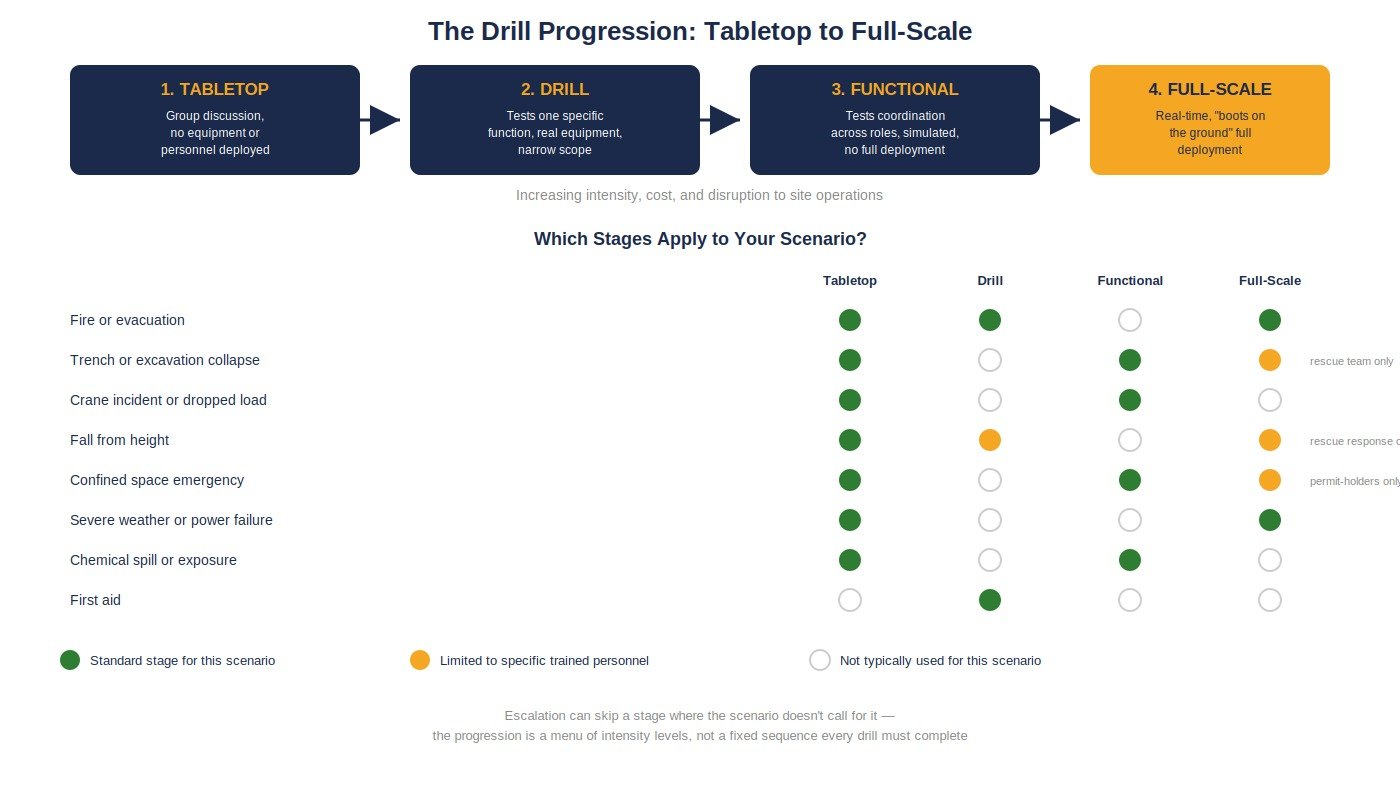
Not every scenario needs the same intensity of drill. Treating this as a binary choice between "tabletop" and "live" skips the levels in between that actually build readiness.
The recognized progression, drawn from the same methodology FEMA's HSEEP uses, runs through four stages: tabletop, drill, functional, and full-scale.
Tabletop exercise
An informal group discussion walking through a simulated scenario, with no equipment or personnel deployed. This is the right starting point for any new scenario, since it surfaces gaps in roles and communication before anyone puts on a hard hat.
Drill
A supervised activity testing one specific operation or function, using real equipment and personnel but narrow in scope, such as practicing a single rescue technique or testing the alarm system in isolation.
Functional Exercise
Tests coordination between roles and functions using a simulated event, without full physical deployment, such as running the communication chain from site discovery through to calling emergency services, without actually staging a physical rescue.
Full-scale Exercise
The highest-intensity level: real-time, "boots on the ground" response involving actual deployment of people and equipment as if the emergency were real, sometimes coordinated with external agencies like fire or paramedic services.
A mature drill program moves through these stages for major hazards rather than jumping straight to full-scale. It also revisits earlier stages whenever a scenario, crew, or site condition changes enough that the last exercise no longer reflects it.
Rescue Drills
A rescue drill tests something different from a general evacuation or tabletop scenario: whether the site can actually extract someone once a hazard has already trapped or incapacitated them. IHSA's B030 requires a fall emergency plan for rescuing a suspended worker as one of its core planning elements. The same logic applies to trench and confined space hazards, where a rescue plan needs to exist and be tested before anyone actually needs it.
Trench and excavation rescue
Trench and excavation rescue is where untrained intervention does the most damage. That’s why Ontario's guidance for firefighters is that even responders untrained in trench rescue should never enter a collapsed trench. The priority is rapid non-entry extrication.
A trench rescue drill needs to test whether the crew recognizes cave-in warning signs and calls a qualified rescue response instead of attempting an unprotected entry. It also needs to test whether the crew manages the excavation's edges and spoil pile throughout the response.
Confined space rescue
Confined space rescue carries a similar trap: sending an untrained second worker into the space to retrieve the first is how single-casualty incidents become double fatalities. This drill needs to test non-entry rescue using retrieval lines first, atmospheric monitoring, and permit procedures, not just the evacuation itself.
Fall-from-height rescue
Fall-from-height rescue tests suspension trauma response time specifically. A worker suspended in a harness after an arrested fall can develop suspension trauma within minutes. The drill needs to test fall clearance and pendulum effect, and how fast the site's actual rescue equipment, whether an elevated work platform, rescue kit, or self-rescue device, can retrieve someone. Confirming the harness caught the fall isn't enough on its own.
| Rescue type | Primary hazard | What the drill must test | Who's typically involved |
|---|---|---|---|
| Trench/excavation | Cave-in, entrapment | Recognition of warning signs, no unprotected entry, spoil pile management | Trained rescue team only, full crew for recognition |
| Confined space | Atmospheric hazard, entrapment | Non-entry retrieval, atmospheric monitoring, permit compliance | Attendant, entry team, trained rescue team |
| Fall-from-height | Suspension trauma | Fall clearance, pendulum effect, rescue speed | Trained rescue team, using the site's actual anchor points |
First Aid Drills
A first aid drill tests a different question than a rescue drill: not whether the crew can reach someone, but whether the response after that point actually works.
In BC, these are two distinct legal duties, not one. Section 3.17(4) covers the first aid drill: at least annually, and again whenever first aid procedures substantively change. Section 4.14(3) is separate and covers the general emergency drill, testing exit routes and emergency procedures at least once each year, with a record kept. Running one does not discharge the other.
Simulate an injury, then test whether workers know how to call for help, whether the communication system works, and whether the trained first aid attendant responds correctly and within a reasonable time.
It doesn't need to be elaborate. A short, unannounced simulation of a single injury, timed and debriefed, exposes more real gaps than a scripted walkthrough where everyone already knows what's coming.
| Scenario | Recommended progression | |
|---|---|---|
| Fire or evacuation | Tabletop, then a drill to test the alarm and alert system, escalating to full-scale | |
| Trench or excavation collapse | Tabletop, escalating to functional and full-scale for the trained rescue team only | |
| Crane incident or dropped load | Tabletop, escalating to functional | |
| Fall from height | Tabletop for the wider scenario, drill or full-scale specifically for the rescue response | |
| Confined space emergency | Tabletop, then functional; full-scale limited to permit-holders and the rescue team | |
| Severe weather or power failure | Tabletop, escalating to full-scale | |
| Chemical spill or exposure | Tabletop, escalating to functional for containment response | |
| First aid | Drill, testing communication and attendant response at least annually |
Step 3: Assign and Communicate Roles Before the Drill
A drill without assigned roles just produces confusion with extra steps. Name who leads the response, who accounts for headcount, who contacts emergency services, and who manages the muster point. Confirm each person actually knows their role before the drill starts.
Headcount only works if the site tracks who's actually present, which means the muster process needs to account for more than the main contractor's own crew:
- Sign-in/sign-out logs, checked against the muster point headcount, not just assumed accurate.
- Subcontractor manifests, updated as crews rotate, since a manifest from last week won't reflect who's actually on site today.
- Visitors and delivery drivers, who won't know the site's procedures unless someone is specifically assigned to account for them.
- A secondary muster point, in case the primary one sits in the path of the hazard itself, such as downwind of a chemical release.
- Wind direction, checked and communicated as part of any drill involving an airborne release, since the correct muster point for a chemical spill depends on which way the site is actually blowing that day.
On a site with frequent subcontractor turnover, this step needs repeating more often than it would on a stable crew. The person who knew their role last month may not be on site today.
Role-based access in a system like EHS Solution by SDS Manager keeps this current automatically. It updates who's assigned to which emergency role as workers rotate on and off site, rather than relying on someone remembering to update a paper list.
Step 4: Run the Drill
Run the drill as close to the real scenario as safety allows, using the actual alarm system, radios, or signage the workers would use in a genuine emergency.
Alarm audibility is a legal requirement, not just good practice. Fire Code s.5.6.1.17 requires the evacuation alert to be capable of being heard throughout the building or facility. That standard is genuinely difficult to meet on an active construction site running hoe rams, saws, and generators, especially with workers wearing hearing protection. Testing this during the drill, not assuming it, is often the single biggest gap a live drill exposes.
CCOHS's guidance adds a related rule worth following directly: only one type of signal should ever mean "evacuate." This avoids the confusion of multiple overlapping tones. In a noisy environment where an alarm genuinely can't be heard, word-of-mouth becomes an acceptable and sometimes necessary substitute.
Avoid coaching people through the drill in real time. The point of the exercise is to see what actually happens, not to demonstrate what's supposed to happen.
If the drill scenario involves a real injury during the exercise itself, the response needs to follow the same scene-preservation and notification logic a genuine critical injury would trigger. Isolate the accident area first. If the injury would qualify as a reportable critical injury or fatality, notify the Ministry of Labour, Immigration, Training and Skills Development (MLITSD) before anyone alters the scene.
The area stays guarded until the Ministry gives permission to eliminate the hazard or releases the scene. Only then does the investigation proceed to statements, the accident report form, and the notification chain to the health and safety department. Crews that never rehearse this sequence tend to instinctively clean up first and report second, which is the exact reverse of what's legally required.
Step 5: Debrief and Document What Happened
Hold the debrief immediately after the drill, while details are still fresh. In BC, keeping a record isn't optional; s. 4.14(3) requires a record of each emergency drill. WorkSafeBC's first aid drill guidance sets out what a useful record contains, and it works as a template anywhere:
- Date and time of the drill
- Participant names and roles, including which subcontractors were involved
- Scenario summary, including which drill type (tabletop, drill, functional, or full-scale) was run
- Observations and outcomes, specifically what worked and what didn't
- Resulting procedure changes, tied back to what the debrief actually found
A drill record that isn't documented to this level leaves no real evidence it happened. That becomes a problem the moment an auditor, inspector, or insurer asks for proof.
Step 6: Turn Findings Into Corrective Actions
Every gap the debrief surfaces needs an owner and a deadline, not just a note in a file. A few metrics make it possible to actually track whether the drill program is improving rather than repeating the same gaps:
- Time to full muster, tracked drill over drill, not just pass/fail
- Percentage of assigned roles correctly executed, since a drill can "succeed" on paper while individual roles still fail
- Number of corrective actions closed before the next drill, versus carried over unresolved
- Subcontractor participation rate, since a declining rate is often the first sign the program is losing buy-in
A drill program that never changes anything based on what it finds is running the same test for no reason.
Are Safety Drills Legally Required in Canada?
Not exactly. Emergency response plans are legally required across Canadian jurisdictions, but a specific drill mandate is not universal. Some provinces require drills outright. Others require a plan and leave drill frequency to the employer's judgment.
| Jurisdiction | Drill legally mandated? | Basis |
|---|---|---|
| Federal | Yes, evacuation/emergency drills mandatory for employees in the building | Canada Occupational Health and Safety Regulations, s. 17.10 |
| British Columbia | Yes, annual emergency drills, plus annual first aid drills | OHS Regulation s. 4.14(3) (emergency drills, records required); s. 3.17(4) (first aid drills) |
| Alberta | Plan required; drill frequency not fixed in legislation | OHS Code, Part 7, ss. 115–118 |
| Ontario | Plan required; drill frequency not fixed in OHS law | O. Reg. 213/91, s. 17, detailed in IHSA's B030 (Emergency Response Planning for Construction Projects) |
| Other provinces and territories | Varies | Broadly equivalent planning duties, drill specifics left to employer or sector-specific code |
What the Fire Code Adds: Plan for the Responders, Not Just Your Crew
OHS regulations make you plan for your own workers. The fire code makes you plan for the people coming to help.
In provinces that adopt the National Fire Code, Section 5.6 covers construction and demolition sites. Before construction or demolition begins, a fire safety plan must be prepared for the site, designating who holds fire safety and fire watch duties and how the fire department gets notified.
Section 5.6.1.4 requires unobstructed access to hydrants, extinguishers, and fire department connections, firefighter access on all levels, access routes for their vehicles, and provision for fire department access if the site is fenced.
In this case, two clarifications matter:
- Section 5.6 does not require fire drills; it requires a plan. The fire drill schedule people are usually thinking of is Section 2.8, generally once every 12 months, and it applies to listed building occupancies rather than construction sites.
- And Ontario never adopted Section 5.6. In the Ontario Fire Code, 5.6 is Compressed Gas Cylinders.
The drill implication is straightforward: your evacuation drill should test whether responders can actually get in. Run it with the gate closed as it normally is, and time how long a truck would wait.
How Often Should You Run Safety Drills on a Construction Site?
| Jurisdiction | Drill legally required? | Frequency specified? | Source |
|---|---|---|---|
| Federal | Yes, evacuation/emergency drills mandatory | Not fixed in the regulation itself, but records must be kept for 2 years | COHSR, s. 17.10 |
| British Columbia | Yes, emergency drills and first aid drills | At least annually for both; first aid also whenever procedures change | OHS Regulation, s. 4.14(3) (emergency drills, record required); s. 3.17(4) (first aid drills |
| Alberta | Plan required; drill not separately mandated | Not fixed | OHS Code, Part 7, ss. 115–118 |
| Ontario | Plan required; drill not separately mandated in OHS law | Fire drills specifically: generally annual under fire code | O. Reg. 213/91, s. 17; National Fire Code s. 5.6 |
| Other provinces and territories | Varies | Generally not fixed | Provincial OHS Acts |
Annual is the practical floor worth defaulting to, and in some jurisdictions it's the legal one. BC fixes it in regulation: emergency drills at least once each year under s. 4.14(3), and first aid drills at least annually under s. 3.17(4).
The federal COHSR sets the same interval under s. 17.10. Elsewhere, annual is a recommendation rather than a mandate, such as CCOHS's general guidance and the baseline in most fire codes for the building occupancies they cover.
A fixed schedule also undersells how fast construction sites actually change. A site that adds a crane, opens a new excavation, or brings on a new subcontractor crew has effectively changed its risk profile. The drill plan should be revisited at that point, rather than waiting for the calendar.
What Makes Construction Site Drills Different From Office Drills?
A construction site rarely stays the same for two consecutive weeks. Access routes shift, subcontractors rotate in and out, and hazards like open excavations, active lifts, and temporary power connections can appear and disappear within days.
An office fire drill can be planned once a year and stay relevant for the whole year. A construction site drill plan drafted in January may already be out of date by March. That's why revisiting the plan has to be tied to site conditions, not just a calendar reminder.
How Does Drill Planning Connect to a COR Audit?
Emergency response is a scored element in Certificate of Recognition (COR) audits, used across most provinces to certify a company's safety program. The small-employer equivalent varies by province rather than existing everywhere under the same name. SECOR exists in Alberta, Saskatchewan, and Manitoba. British Columbia runs its own version called Small COR. Ontario runs COR at every company size with no separate small-employer program at all.
Auditors specifically look for evidence a drill actually took place, not just a plan sitting in a binder. They want dated drill records, debrief notes tied to corrective actions, and proof that subcontractors were included, not just the main contractor's own crew.
Auditors expect the plan to reflect the worksite in front of them. IHSA's own guidance allows a generic plan as a starting point, but only on the basis that it gets adapted to each site's size, complexity, access, and location, which is exactly what Step 1 produces. A plan with no drill history behind it has no evidence it was ever adapted at all.
Common Mistakes That Make a Drill Worthless
- Treating 911 as the whole plan: Ontario's confined space guideline is explicit: "calling 911 as your rescue plan is not considered to be an 'on-site rescue procedure' which can be 'ready for immediate implementation.'" A real plan accounts for what happens in the gap before responders arrive. That includes who takes charge, how injured workers get moved to where responders can reach them, and what access routes those responders will actually need.
- Running the same scenario every time: A drill that only ever tests fire evacuation leaves every other hazard on the plan completely untested.
- Skipping the debrief: Without it, whatever went wrong during the drill just happens again next time.
- Treating the plan as finished once it's written: A plan that never gets revisited against changing site conditions stops matching the actual site within weeks.
- Leaving subcontractors out: A drill that only involves the main contractor's own crew doesn't test whether the whole site actually responds together.
- Coaching people through the drill in real time: This tests what the plan says, not what people would actually do.
Drill Planning Checklist
- Site walked and hazards matched to realistic scenarios, not copied from a generic template
- Drill progression selected for each hazard: tabletop, drill, functional, or full-scale
- Rescue drills (trench, confined space, fall-from-height) scoped to trained personnel where full-scale isn't appropriate for the whole crew
- First aid drill scheduled at least annually, testing communication and attendant response specifically
- Roles assigned and confirmed with the people currently holding them, including subcontractors
- Sign-in/sign-out logs and subcontractor manifests current before the drill starts
- Secondary muster point identified and wind direction considered for any airborne-release scenario
- Alarm audibility tested against actual site noise, not assumed
- Debrief scheduled immediately following the drill, not deferred to "later"
- Drill record captures date, participants, scenario, observations, and resulting changes
- Each corrective action assigned a named owner and a deadline
- Records kept accessible for COR audit or regulatory inspection
Planning Safety Drills Comes Down to One Habit
A drill program works when it stays tied to the site as it actually is right now, not the site as it looked when the plan was first written. Identifying real hazards, running the right type of drill for each one, and actually fixing what the debrief finds turns a document into something workers can rely on.
The sites that treat this as a one-time box to check are the ones an inspector, or a real emergency, eventually catches out.
Frequently Asked Questions
Is a Tabletop Drill a Substitute for a Live Drill?
No, a tabletop drill is not a substitute for a live drill. It tests whether the plan makes sense on paper, while only a live drill tests whether people can execute it under real conditions.
Who Is Responsible for Running Safety Drills on a Construction Site?
The employer or constructor is responsible for running safety drills on a construction site. Though it's usually delegated to a site supervisor in practice. The duty doesn't transfer to workers or subcontractors simply because they participate.
How Long Should a Construction Site Drill Take?
A construction site drill should run long enough to genuinely test the response, not just confirm the alarm works. A rushed drill that ends at the muster point skips the parts, like headcount and communication, that actually tend to fail.
Do Subcontractors Need to Participate in Site Drills?
Yes, subcontractors need to participate whenever they're working on site at the time. A drill testing only the main contractor's crew doesn't reflect who's actually present.
Should You Announce a Drill in Advance?
Yes, you should usually announce a drill in advance on an active site, though announcing it isn't the same as coaching people through it once it starts. A surprise evacuation near a moving crane or open excavation can create the exact hazard the drill is meant to prevent, but once the drill begins, participants should still respond based on what they actually know, not real-time direction.
Do You Have to Shut the Site Down to Run a Drill?
No, you do not have to shut down the site to run a drill. However, high-risk activities like crane lifts or excavation work are typically paused. The scope depends on the scenario being tested and what's active on site at the time.
How Long Do You Keep Drill Records?
Keep drill records for at least two years. That covers the longest minimum in Canadian law; the federal COHSR's two-year requirement and clears Ontario's Fire Code minimum of 12 months, which in any case applies to the building occupancies under Section 2.8 rather than construction sites.
Do we have to run a first aid drill?
In BC, yes, at least once a year under OHS Regulation s.3.17(4). Elsewhere, it's best practice rather than a fixed legal requirement, though CCOHS recommends regular emergency drills regardless of jurisdiction, and a first aid simulation is one of the cheapest to run.
What's the difference between a drill, a tabletop exercise and a full-scale exercise?
The difference between a drill, a tabletop exercise, and a full-scale exercise is that a tabletop exercise is a discussion with no equipment or personnel deployed, a drill tests one specific function using real equipment on a small scale, and a full-scale exercise is a real-time deployment of people and equipment as if the emergency were actually happening. They sit on the same progression, moving from least to most intensive.
What happens if you fail the emergency response element in a COR audit?
A failed element typically means an overall COR audit failure, since most provincial audit instruments require a minimum score on every individual element, not just an overall passing average. The employer generally has to address the gap and undergo a re-audit before certification is granted.

Mehreen Iqbal

Started with a Bachelors in Microbiology, then a Masters in Public Health; Currently a Workplace Safety Expert.