
Running out of fresh toolbox talk topics is a common problem on Canadian job sites. Repeating the same five talks all year wears thin fast, and crews stop paying attention once a topic feels predictable.
This list groups 150 toolbox talk topics by category, each with a short explanation of why it earns a spot. A supervisor can use it to pick something that actually matches the day's work, rather than defaulting to whatever topic comes to mind first.
Key takeaways
- A good toolbox talk topic matches the actual work happening that day, not a random pick from a master list.
- Winter and summer both bring their own hazard categories, so seasonal rotation matters as much as variety.
- Documented toolbox talks, including sign-in sheets and topics covered, are expected evidence in COR and SECOR audits across most provinces.
- Manitoba's Workplace Safety and Health Act sets an actual legal minimum: 30 minutes every two weeks for sites with five or more workers. Splitting that into 15 minutes weekly is common industry practice, not a separate legal option.
- Office-based and remote crews need toolbox talks too, a category most lists skip entirely.
Are Toolbox Talks Required by Law in Canada?
Not by that specific name. Every Canadian province and the federal government requires employers to provide workers with information, instruction, and supervision under their respective OHS legislation, and toolbox talks are the industry-standard way of meeting that duty. Manitoba is the exception worth knowing: it's the only jurisdiction that sets an actual numeric requirement, rather than a general instruction duty.
| Jurisdiction | Legal basis | What it actually requires |
|---|---|---|
| Federal | Canada Labour Code Part II | General duty to inform and instruct employees on hazards; no toolbox-talk-specific mandate |
| Manitoba | Workplace Safety and Health Act, s.44(3) | Legal minimum: 30 minutes every two weeks for construction sites with 5+ workers. Splitting it to 15 minutes weekly is industry practice, not a separate legal requirement. |
| Ontario | OHSA, s.25(2)(a) | General duty to "provide information, instruction and supervision to a worker to protect the health or safety of the worker"; no fixed frequency |
| Alberta | OHS Act and OHS Code | General duty to ensure workers are trained in hazard identification and control; no fixed frequency |
| British Columbia | OHS Regulation | General duty to provide information and instruction to workers; no fixed frequency |
| Saskatchewan | Saskatchewan Employment Act, Part III | General duty to inform and instruct workers on hazards; no fixed frequency |
| Other provinces and territories | Their own OHS Acts | Broadly equivalent general instruction duties, no fixed frequency specified |
Hazard Communication and WHMIS
WHMIS 2015 has applied across Canada since the Hazardous Products Regulations came into force in February 2015, and it was updated again in December 2022 with a transition period that closed in December 2025. That makes this category the most consistently legally grounded on the list, and a natural starting point for any rotation.
WHMIS 2015 Pictograms
A pictogram is designed to communicate a hazard before anyone has time to read the accompanying text. Quick recognition matters most in the exact situations where there isn't time for a careful read. A centralized safety data sheet system keeps the pictograms tied to the correct current classification, since the December 2022 amendment changed some labeling requirements that suppliers are still transitioning through.
Reading a Safety Data Sheet
Most workers skim past an SDS without knowing which sections actually matter in an emergency. Walking through a real SDS together, section by section, makes the document useful rather than theoretical.
Chemical Labeling On-Site
A decanted container loses its warning the moment the original label doesn't transfer with it. Relabeling every transferred container should happen automatically, not as a step someone remembers to do later.
Controlling Exposure to Hazardous Substances
Ventilation and PPE work as two separate layers of the same control strategy. Relying on PPE alone while ignoring ventilation leaves a real gap most workers don't realize exists.
Asbestos Awareness in Older Structures
Buildings constructed before the 1990s carry a meaningfully higher chance of containing asbestos. Renovation work disturbs materials that demolition planning would otherwise identify and contain in advance.
Silica Dust Exposure
Cutting, grinding, or drilling concrete generates respirable silica dust that causes lung damage well after the exposure itself is forgotten. Dust suppression and respiratory protection both need to be in place before the cutting starts.
Chemical Inventory Management
An outdated inventory means workers may be handling substances nobody has properly assessed for the current job. Keeping the list current should be routine, and it's a lot easier when chemical inventory and SDS records live in one searchable system instead of a folder nobody's updated since the last project.
Transporting Hazardous Materials On-Site
A spill during internal transport between areas is still a reportable spill, regardless of how short the distance was. Using proper containers for internal moves matters just as much as it does for external shipping.
Chemical Handling and Spill Response

Spill Response Procedures
Knowing exactly where the spill kit is stored matters far more once a spill has already happened. A fast, practiced response limits both the physical size of the spill and its environmental impact.
Refuelling Safety
Ignition sources and fuel vapour need very little distance between them to become genuinely dangerous. Shutting equipment down before refuelling removes nearly all of that risk.
Compressed Gas Cylinder Storage
An unsecured cylinder becomes a projectile hazard if it falls and the valve shears off. Storing cylinders upright and chained prevents this specific and serious failure mode.
Inert Gas Hazards
Inert gases carry no warning smell, which is exactly what makes them dangerous in enclosed spaces. They can displace breathable oxygen with no obvious sign anything is wrong, so detection equipment, not smell, is the only reliable check.
Chemical Incompatibility Awareness
Some chemicals are perfectly safe on their own and become dangerous only once mixed. Poor storage segregation is the most common way incompatible chemicals end up in accidental contact.
Secondary Containment for Chemical Storage
Containment is what stops a small leak from spreading into a full site spill. Checking that containment trays or bunding are actually in place, not just planned on paper, is worth a regular look during routine inspections.
General Safety Practices, Culture, and Compliance
Emergency response, incident tracking, and audit readiness fall under this category, which is also where most COR and SECOR audit evidence actually gets built.
Hazard Identification Walkarounds
Most hazards are visible to anyone who takes the time to actually look for them. Turning that general awareness into a structured, repeated walkaround catches problems while they're still minor.
Job Hazard Analysis Basics
Breaking a task into individual steps often reveals a risk hidden inside an otherwise routine action. Involving the workers who actually perform the task tends to improve the accuracy of the analysis considerably.
Near-Miss Reporting
The same near miss rarely stays a near miss the second time around. A culture that welcomes these reports, rather than treating them as an admission of fault, ends up hearing about far more of them.
Accident and Incident Reporting
An unreported incident teaches the rest of the site nothing about how to prevent a repeat. Incident management software that timestamps a report the moment it's logged makes it easier to prove exactly when it happened, which matters for both compliance and audit evidence.
Building a Genuine Safety Culture
Safety culture is best defined by what people actually do when nobody's specifically watching. Consistent leadership example, more than any single policy document, is what turns stated values into daily behaviour.
The Right to Refuse Unsafe Work
Every Canadian jurisdiction protects this right in some form, though the exact grounds and process vary by province. Understanding how it actually works matters before the moment it's needed, not after.
Permits to Work
A permit process exists to catch exactly what a rushed start would otherwise miss. Skipping it to save a few minutes removes the one check specifically designed for that purpose.
Orientation for Young and New Workers
New and young workers are statistically overrepresented in workplace injury data, largely because unfamiliarity with a site is itself a hazard. Thorough orientation and closer early supervision measurably reduce that elevated risk.
Workplace Complacency
Familiarity is exactly what makes a routine task start to feel less risky than it actually still is. It tends to develop in experienced workers more than inexperienced ones, which makes it easy to overlook.
Rights and Responsibilities Under Provincial OHS Law
Every Canadian province requires employers to provide workers with information, instruction, and supervision, under wording like Ontario's OHSA s.25(2)(a). Knowing the specifics changes what a worker is actually willing to raise on site.
Safety Committee Roles and Responsibilities
Confusion about what a joint health and safety committee can and can't do limits how effective it actually is. Meeting frequency itself varies by province: monthly in Alberta and BC, quarterly in Ontario, and at least nine times a year federally under the Canada Labour Code.
Documenting Toolbox Talks Properly
An undocumented talk provides no evidence it ever took place, no matter how thorough the discussion actually was. A system that logs safety communications alongside inspection and audit records turns a sign-in sheet into evidence that holds up when a COR auditor asks for it.
Fall Protection and Working at Heights
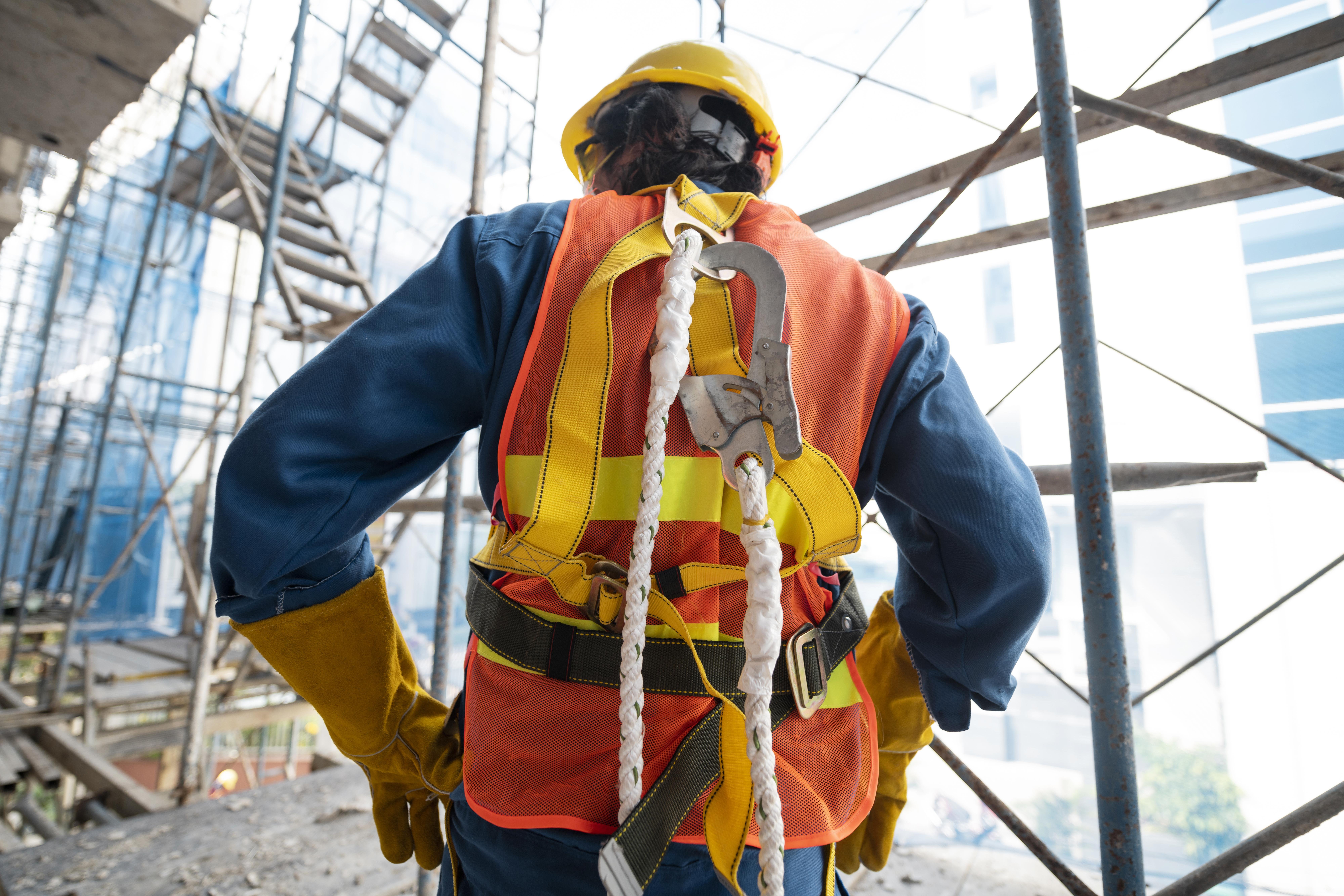
CCOHS sets out the general distinction between the two systems most Canadian fall protection programs are built around.
Guardrail Systems
Guardrails are often the simplest fall protection option available, but only when installed at the correct height and load rating. A rail that fails under load offers no protection at all.
Anchor Point Selection
A fall arrest system is only as reliable as the anchor point it's clipped to. Inspecting the anchor deserves the same attention most crews already give the harness.
Fall Arrest vs. Fall Restraint
Restraint is designed to prevent a fall entirely, while arrest is designed to stop one already in progress. Using the wrong system for the situation leaves a real gap in protection that isn't always obvious until it's too late.
Scaffold Safety and Inspection Tags
Most scaffold-related falls trace back to a skipped inspection rather than a design flaw. A missing or expired tag takes seconds to check and shouldn't be ignored.
Ladder Safety and Three-Point Contact
Ladder falls remain one of the most common injury causes on any job site. Three-point contact is the simplest available control, and it's also the one most frequently skipped under time pressure.
Roof Work and Edge Protection
The edge of a roof is rarely as far away as it looks from the middle of the work area. Edge protection removes that misjudgment from the equation entirely.
Suspended Access Equipment
Swing stages and boatswain's chairs carry failure points specific enough to warrant their own discussion, separate from general fall protection. Riggers and operators both need to understand what those specific risks look like.
Temporary Stairs and Handrails
Calling something temporary shouldn't mean building it to a lower standard. These structures see the same traffic as permanent ones, often under worse conditions.
Suspension Trauma and Rescue Timing
A caught fall isn't a resolved fall. A worker left suspended can develop suspension trauma within minutes, so the rescue plan needs to exist before anyone starts working at height, not after.
Fall Protection Plans for Low-Slope Roofs
Even a flat roof still requires a written fall protection plan before work starts. The perceived lower risk of a flat surface is exactly what leads crews to skip this step.
Horizontal Lifeline Systems
Shared anchor systems change the fall clearance calculation for every worker connected to the same line. A single miscalculation can affect several people at once, not just one.
Working Near Skylights and Roof Openings
Many skylights aren't rated to support a worker's weight, despite looking solid from above. Marking and covering these openings need to happen before work starts.
Excavation and Trenching
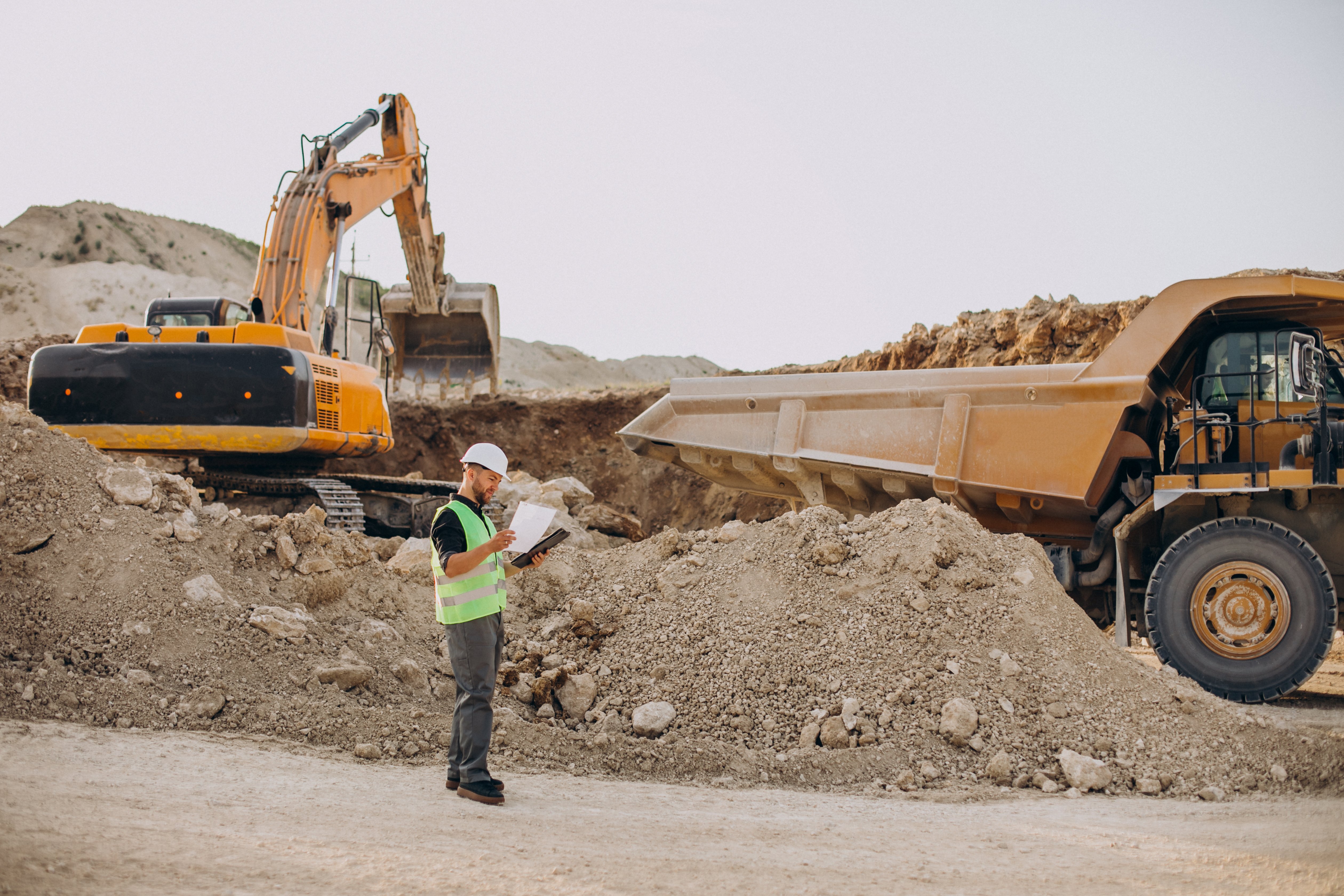
Cave-In Warning Signs
Cracking soil, water seepage, and small slumps are the trench warning signs before a full collapse. These signs are easy to miss when attention is focused elsewhere.
Trench Boxes and Shoring Systems
The protective system used has to match the actual soil conditions on site, not a general assumption of what's typically safe. Using the wrong system can create false confidence that's worse than using none.
Locating Underground Utilities
A locate call before digging costs nothing next to the consequences of an unexpected utility strike. Gas lines and electrical conduit don't always come with visible surface markers.
Spoil Pile Placement
Piling excavated material too close to the edge adds weight exactly where the trench wall is already weakest. Keeping a safe setback distance should be standard, not an afterthought.
Access and Egress in Excavations
A ladder within 8 metres of every worker isn't optional. Workers need a fast way out if conditions change suddenly, and climbing the trench wall itself isn't an acceptable substitute.
Atmospheric Testing in Deep Excavations
Depth alone can create an oxygen-deficient pocket without any obvious contamination source. Testing before entry catches what visual inspection alone would miss entirely.
Trench Rescue Planning
Untrained rescue attempts are a leading cause of one casualty becoming two. A rescue plan has to exist before it's ever actually needed.
Vibration and Adjacent Structure Monitoring
Nearby equipment or traffic can destabilize a trench wall well after the excavation looked stable. Vibration travels further through soil than most people expect.
Confined Space
CSA Z1006, Management of Work in Confined Spaces, is the current national standard covering this category, most recently updated in 2023.
Permit-Required Entry
The permit process exists precisely because a confined space won't warn anyone about a hazard building up inside. Skipping it removes the built-in checks that catch problems before entry.
Atmospheric Testing Before Entry
An invisible, odourless atmosphere can still be immediately dangerous. Assuming a space is safe because it was fine last time is a common and serious mistake.
Non-Entry Rescue With Retrieval Lines
The safest rescue is the one that doesn't require sending a second person inside. Practicing the technique before an emergency is what makes it actually work when it counts.
Ventilation Requirements
Fresh air doesn't circulate on its own inside a sealed or partially sealed space. Relying on natural airflow alone can leave dangerous conditions undetected.
Hydrogen Sulfide Recognition
The smell of hydrogen sulfide disappears at concentrations well below the point where it becomes dangerous. Detection equipment, not the nose, is the only reliable warning.
Attendant Responsibilities
Someone monitoring the entrance isn't an optional precaution; it's a core part of the permit system. Leaving the post, even briefly, defeats the entire purpose of the role.
Confined Space Classification
Not every tight space legally qualifies as a confined space, and that classification changes which rules apply. Assuming a space is exempt because it looks small is a mistake worth correcting early.
Communication Methods Inside Confined Spaces
Radios don't always transmit reliably through steel tanks or underground structures. Testing communication before entry avoids discovering the gap during an actual emergency.
Electrical Safety

CSA Z460 governs lockout and hazardous energy control in Canada, and CSA Z462 sets the national best-practice benchmark for arc flash and workplace electrical safety. Z462 itself is non-mandatory, not part of federal or provincial legislation, but it's the standard most Canadian employers rely on to meet their general duty to control electrical hazards.
Lockout/Tagout Procedures
A breaker someone else can still switch back on isn't actually locked out. CSA Z460 sets out the framework most Canadian lockout programs are built around, and proper lockout requires a personal lock and a clearly identified tag.
Overhead Power Line Awareness
Equipment height combined with boom reach closes the gap to a power line faster than most workers expect. Contact doesn't always require touching the line directly, since electricity can arc across a gap.
Electrical Tool Inspection
A frayed cord takes seconds to spot during a pre-use check. That same cord can cause a serious shock if it goes unnoticed.
Arc Flash Hazard Awareness
CSA Z462 defines the approach boundaries and PPE categories most Canadian employers reference for arc flash protection. The blast radius is often larger than workers assume, extending well beyond the panel itself.
Extension Cord and Temporary Wiring
Temporary power still needs the same physical protection as permanent wiring. Cords run through water or across sharp edges degrade faster than most people realize.
GFCI Protection
Wet job site conditions and standard outlets are a dangerous combination without ground fault protection. Verifying the GFCI is actually active matters as much as having the device installed.
Working Near Energized Equipment
Equipment that's "probably off" isn't the same as equipment verified de-energized through proper testing. Testing before touching should be a non-negotiable step, not a courtesy.
Static Electricity Hazards
Static discharge is a real ignition source around flammable vapours, even without an obvious spark. Bonding and grounding procedures exist specifically to control this risk.
Fire Safety
Fire Extinguisher Types and Use
Grabbing the wrong extinguisher type can make certain fires worse instead of putting them out. Knowing which class matches which extinguisher needs to happen before an emergency, not during one.
Hot Work Permits and Fire Watch
Sparks travel further than the area most fire watches actively monitor. A permit system ensures the surrounding zone gets checked and cleared before hot work starts.
Combustible Material Storage
How materials are stacked matters as much as what's being stored. Poor stacking can block escape routes or accelerate fire spread if ignition occurs.
Evacuation Procedures and Muster Points
An unfamiliar exit route costs time nobody has during an actual fire. Practicing the route occasionally keeps it familiar rather than theoretical.
Temporary Heating Hazards
Carbon monoxide builds up fastest in the exact spaces workers seal up to stay warm. Ventilation and carbon monoxide detection are both necessary, not optional extras.
Welding and Cutting Fire Prevention
Welding slag travels further than the sparks most fire watches are actively looking for. Clearing a wider radius than feels necessary is what prevents delayed ignition.
Fire Alarm Testing on Active Sites
Construction dust and vibration both affect alarm reliability over time. A system nobody has tested is a system nobody can actually trust.
Flammable Storage Cabinets
Proper storage buys critical time if ignition does occur nearby. Storing flammables outside a rated cabinet removes that protective margin entirely.
Equipment and Machine Safety
Machine Guarding Basics
A removed guard is usually a deliberate decision made to save time, not an oversight. Guards need to go back on immediately after any maintenance that required removing them.
Hand Tool Inspection
A cracked handle tends to fail at the worst possible moment. A quick pre-use check catches this kind of damage before it causes an injury.
Power Tool Safety
A power tool doesn't distinguish between the material it's cutting and a hand that strays into its path. Complacency around familiar tools is often what leads to serious injuries.
Angle Grinder Kickback
The direction a grinding disc spins determines exactly which way it kicks back if it binds. A moment's inattention during kickback can cause a serious laceration.
Hoisting Hand Signals
One misread signal is all it takes to cause an incident near a suspended load. Reviewing signals periodically keeps the whole crew aligned, especially as new workers join.
Rigging Hardware and Wire Rope Inspection
A wire rope can look sound on the outside while already compromised internally. Regular inspection catches deterioration before the rope fails under load.
Lockout During Equipment Maintenance
Maintenance is statistically when equipment is most likely to move unexpectedly. Skipping lockout for a "quick fix" is how serious incidents happen.
Equipment Pre-Use Inspection
Five minutes spent inspecting before a shift beats discovering a fault during it. Treating this as routine, not optional, keeps small problems from becoming incidents.
Compressed Air Tool Hazards
Compressed air can enter the body through the skin without leaving a visible wound. Using it to clean clothing or skin is a common but genuinely dangerous practice.
Vehicles and Mobile Equipment
Forklift Blind Spots
An operator's seat doesn't provide the visibility a pedestrian on foot assumes it does. Making eye contact with the operator before assuming you've been seen is a habit worth building.
Defensive Driving Fundamentals
Most site vehicle incidents involve someone who technically had the right of way. Defensive driving means anticipating other people's mistakes, not just avoiding your own.
Distracted Driving
A glance at a phone covers more distance travelled blind than most drivers realize. Removing the temptation entirely is more reliable than trusting willpower in the moment.
Winter Driving Conditions
Stopping distance changes well before a driver notices the road surface has become slippery. Adjusting speed and following distance proactively beats reacting after the fact.
Trailer Towing Training
Hauling capacity and trailer handling require a different skill set than driving the tow vehicle alone. Formal training matters even for drivers who feel experienced.
Backing Up and Spotter Procedures
Reversing combines the least visibility with the highest incident rate on most sites. A properly positioned spotter closes that gap effectively.
Tire Inspection Basics
Tread depth and pressure checks are the cheapest insurance a site vehicle has. A quick check before use catches most tire-related issues early.
Mobile Equipment Swing Radius
The rear of an excavator swings just as far as the front does. Marking the full swing radius, not just the visible arm, prevents struck-by incidents.
Seatbelt Use in Site Vehicles
A rollover without a seatbelt changes the entire outcome of an otherwise survivable incident. Wearing it regardless of trip length removes that added risk entirely.
PPE

Hard Hat Fit and Inspection
A cracked shell has already failed at its one job, even if the crack looks minor. UV exposure weakens a hard hat over time in ways that aren't always visible.
Eye Protection Selection
The specific hazard should determine the lens type, not personal preference. Wearing the wrong type can create a false sense of protection.
Hearing Protection and Noise Thresholds
Noise-induced hearing loss doesn't announce itself until the damage is already permanent. Exposure builds cumulatively, not just during a single loud event.
Glove Selection for the Task
The wrong glove can fail exactly when protection is needed most. Matching selection to the specific task closes that gap.
Footwear Suited to Site Hazards
Steel toes don't help against a puncture hazard coming from below. Reviewing what a task actually exposes the feet to guides better footwear choices.
Respirator Fit and Maintenance
A poor seal means effectively no protection, regardless of filter rating. Facial hair and damaged straps both compromise that seal.
High-Visibility Clothing Standards
Hi-vis gear only works when it's clean and worn correctly. Fading reduces reflectivity significantly, especially in low light.
PPE Inspection Before Each Use
Damaged PPE creates a false sense of protection, arguably worse than none at all. A quick check before use catches wear that develops gradually.
Housekeeping and Slips, Trips, and Falls
General Site Housekeeping
Most slip and trip incidents trace back to something that should have already been cleared away. A clean site is consistently a safer one.
Keeping Access Routes Clear
A blocked exit matters most in the moment it's actually needed. Regular checks keep these paths functional when it counts.
Lighting Conditions
Hazards concentrate in the areas nobody thought to properly light. Reviewing coverage periodically catches gaps as work areas shift.
Cord and Hose Management
A cord across a walkway becomes a trip hazard the moment attention is elsewhere. Proper routing removes the risk without restricting access to power or air.
Spill Cleanup Response Time
A spill left for "just a minute" is usually the spill someone walks through. Knowing where cleanup supplies are stored speeds up the response.
Material Staging and Storage
Staged materials often end up blocking the same routes people need to clear in an emergency. Reviewing staging areas catches drift from the original plan.
Winter Walkway Maintenance
Ice forms fastest in the areas people walk most often, due to compaction and refreezing. Checking walkways at the start of each shift catches overnight changes.
Lifting and Ergonomics
Safe Manual Lifting Technique
The back absorbs most of the damage in a bad lift, not necessarily the load's actual weight. A brief reminder before heavy tasks reinforces habits that fatigue tends to erode.
Workstation Ergonomics
Small adjustments prevent injuries that would otherwise build up gradually. Reviewing setups periodically catches problems before they become chronic.
Repetitive Motion Injury Prevention
These injuries typically show up well after the motion that caused them. Rotating tasks and taking regular breaks both reduce cumulative strain.
Stretching Before Physically Demanding Work
A cold, unstretched muscle is more likely to strain under sudden load. Making stretching a habit, not an afterthought, is what makes it effective.
Team Lifting for Oversized Loads
Uncoordinated lifting concentrates weight on whoever moves slowest. A shared count before lifting keeps the load distributed evenly.
Tool and Equipment Weight Awareness
The tool itself can be the ergonomic hazard, not just the material being worked on. Choosing lighter alternatives where available reduces cumulative load.
Weather and Seasonal Hazards
Heat Stress Recognition
By the time a worker feels genuinely unwell, the exposure is often already significant. Recognizing early signs allows intervention before it becomes an emergency.
Cold Stress and Frostbite
Frostbite can begin before the affected area even feels numb. Regular breaks in warm areas prevent this progression from going unnoticed.
Hypothermia Symptoms
Confusion is often the first sign of hypothermia, not the cold itself. Coworkers checking on each other catches it earlier than self-reporting alone.
Ice and Snow Removal Safety
The removal task itself carries its own slip risk, separate from the hazard being cleared. Proper footwear and technique reduce that specific risk.
Wildlife Encounters on Remote Sites
A startled animal is typically more dangerous than one simply approaching. Knowing the appropriate response for local species prevents a routine encounter from becoming an incident.
Insect and Pest Hazards
A disturbed wasp nest can disrupt a task faster than almost any other hazard on site. Checking work areas for nests before starting avoids an unpleasant surprise mid-task.
Severe Weather Response
Knowing the shelter plan matters before a storm arrives, not while it's happening. Reviewing the plan periodically keeps it functional rather than forgotten.
UV Exposure and Sun Safety
Cumulative exposure adds up across an entire outdoor season, not just one sunny day. Sunscreen and appropriate clothing are simple controls against a genuinely long-term risk.
Lightning Safety on Elevated Work
Height combined with metal equipment is exactly what lightning is drawn to. A clear threshold for stopping work keeps the decision objective, not reactive.
Mental Health and Fatigue
The Canadian Centre for Occupational Health and Safety's mental health resources are a starting point for building this talk out further.
Fatigue Management
Impaired judgment from fatigue tends to feel normal to the person experiencing it. Recognizing warning signs in others helps catch what self-assessment often misses.
Workplace Stress and Safety
Stress narrows attention at precisely the moment full attention is needed. Addressing it openly reduces its impact on day-to-day performance.
Mental Health Awareness
A struggling worker is often a safety risk before it becomes visible to others. Creating space to talk about it openly helps catch problems earlier.
Presenteeism
Showing up unfit doesn't help the crew; it adds risk to everyone alongside that person. Supporting workers in staying home when needed protects the whole team.
Work-Life Balance for Shift Workers
Recovery time is part of the safety equation, not something separate from it. Scheduling that respects it reduces fatigue-related incidents.
Substance Use and Workplace Safety
Impairment rarely announces itself clearly before an incident. Clear policy combined with genuine support addresses this more effectively than punishment alone.
Recognizing Burnout in Long-Term Crews
Burnout builds slowly enough to go unnoticed until it's already serious. Regular check-ins catch the shift from tired to genuinely burned out.
Working Alone and Workplace Violence
Lone Worker Check-In Procedures
Nobody knows something's wrong until a scheduled check-in is missed. Workers need to know exactly what happens if that check-in doesn't come.
Workplace Violence Prevention
De-escalation has to start before a situation has already escalated. Training on this specifically makes a measurable difference over assuming it's intuitive.
Protecting the Public Near Active Work
The public didn't choose to be near the hazard; the site's location made that choice. Barriers and clear signage reduce risk to people simply passing by.
Personal Safety Planning for Isolated Tasks
Isolation changes how quickly help can respond if something goes wrong. Planning for it specifically closes that response gap.
Domestic Violence Awareness and Workplace Impact
Safety at home can directly affect focus and safety on site. Supporting workers dealing with this, without judgment, benefits everyone.
Office and Remote Workers
Display Screen Equipment Setup
Posture problems build up long before they start to hurt. A quick setup review prevents issues that are harder to resolve once they've developed.
Home Office Ergonomics
A kitchen chair wasn't designed to support an 8-hour workday. Simple adjustments, even without specialized furniture, meaningfully reduce strain.
Remote Worker Check-Ins
Physical isolation changes how quickly a developing problem gets noticed. Regular, genuine check-ins close that gap.
Office Fire Evacuation Routes
Familiarity with an office can lead to overconfidence about evacuation procedures. A periodic reminder keeps routes and muster points fresh in everyone's mind.
Screen Time and Eye Strain
The fix is usually simpler than people assume: the 20-20-20 rule reduces strain significantly. Proper lighting and brightness also help.
Slips and Falls in Office Environments
An office isn't automatically hazard-free just because it feels safe. Cables and clutter still create real slip and trip risks indoors.
New Technology and Site Innovation
Drone Use on Active Job Sites
Airspace awareness is a genuinely new hazard category most crews haven't discussed before. Clear rules for drone use prevent confusion and potential incidents.
Wearable Safety Technology
A wearable device only helps if the crew understands what it's actually monitoring. Clear communication about its purpose improves adoption and effectiveness.
GPS and Equipment Tracking Systems
Tracking data only becomes useful once it actually changes behaviour. Reviewing the data regularly, not just collecting it, is what makes it worthwhile.
Site Cameras and Worker Privacy
Being transparent about monitoring builds trust rather than eroding it. Clear policies about what's monitored prevent it from feeling like surveillance.
Digital Permit and Inspection Systems
A digital record is only as reliable as the person entering it. Training the crew properly on the new system matters as much as the technology itself.
Return to Work and Recovery
Return-to-Work Program Basics
A clear plan matters as much for recovery as for the project schedule. Both the worker and their supervisor need to understand its specific steps.
Modified Duties After Injury
Modified work still requires its own hazard assessment, not an assumption it's automatically safer. A poorly matched role can strain an already-recovering injury.
Communicating With an Injured Worker's Team
Silence around an absence breeds more rumour than reassurance. Clear communication that respects privacy supports both morale and accuracy.
Preventing Re-Injury During Recovery
Rushing a return often costs more time than a properly paced one. A gradual, monitored return protects the investment already made in that recovery.
Subcontractor and Multi-Employer Sites
Subcontractor Safety Orientation
A subcontractor's own training doesn't automatically cover this specific site's hazards. Skipping site-specific orientation assumes a familiarity that doesn't exist yet.
Coordinating Hazards Between Employers
One employer's task can create a hazard for a different employer's crew nearby. Regular communication between employers closes this gap.
Shared Equipment Safety Checks
Equipment nobody specifically owns tends to become equipment nobody specifically inspects. Assigning clear ownership prevents it from falling through the cracks.
Communication Across Language Barriers
A safety message that isn't understood doesn't function as one, however clearly it was delivered. Visual aids and translated materials help close this gap on multilingual crews.
Visitor and Delivery Driver Safety
People unfamiliar with a site carry a genuinely different risk profile than the regular crew. A brief orientation for anyone entering reduces that unfamiliarity-driven risk.
Toolbox Talks Work Best as a Rotation, Not a Repeat
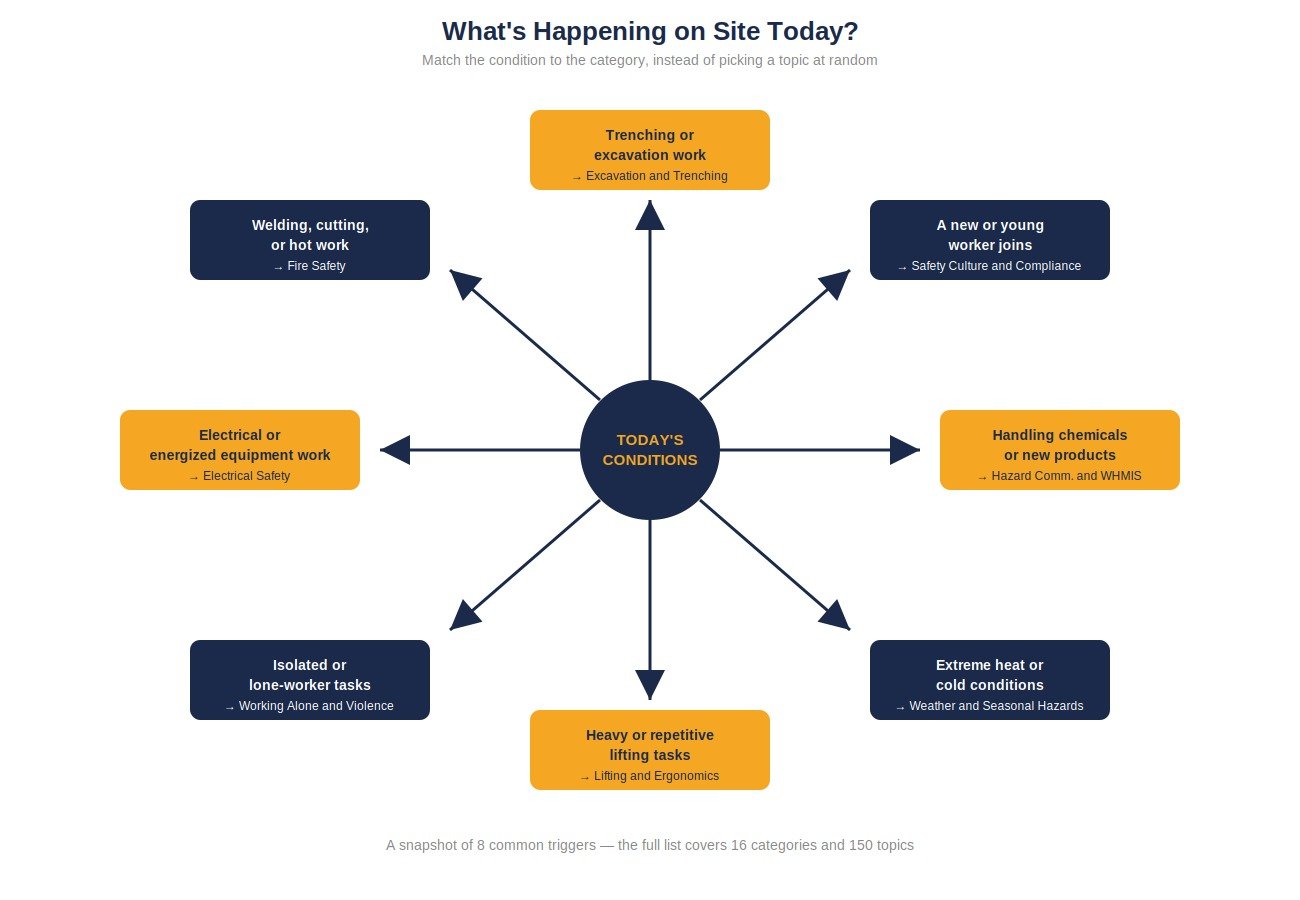
Running through 150 topics beats cycling the same five all year, but the real value comes from matching the topic to the actual work happening that day rather than picking randomly. A trenching crew needs the excavation section this week, not a repeat of PPE basics they've heard a dozen times already.
The categories that tend to get skipped – hazard communication, chemical handling, and documentation – are usually the ones that matter most once an inspector or COR auditor actually asks for evidence.
Keeping safety data sheets and chemical inventories centralized makes the WHMIS-related talks easier to deliver accurately, and logging each talk through incident and audit tracking software turns a stack of sign-in sheets into evidence that actually holds up when it's requested.
Frequently Asked Questions
How Long Should a Toolbox Talk Last?
Most run 5 to 15 minutes. Manitoba's Workplace Safety and Health Act sets an actual legal minimum for larger sites: 30 minutes every two weeks for construction sites with five or more workers. Running 15 minutes weekly instead is common industry practice for meeting that same requirement, not a separate legal option.
How Often Should Toolbox Talks Happen?
Daily is standard on active construction sites, while weekly is more typical in manufacturing and general industry. The right frequency also depends on what's changing: new tasks, new equipment, or a new hazard on site all justify an extra talk outside the regular schedule.
Who Should Lead a Toolbox Talk?
A site supervisor, foreman, or safety coordinator typically leads the talk, though any competent worker familiar with the topic can run one. The person leading doesn't need a formal safety title, just genuine knowledge of the hazard being discussed.
Do You Need a Sign-In Sheet for Toolbox Talks?
Yes, a sign-in sheet is standard practice and expected evidence in COR and SECOR audits. Recording the topic, date, and attendee names turns a talk into documented proof of ongoing safety communication.
Is a Tailgate Meeting the Same as a Toolbox Talk?
Yes, a tailgate meeting is the same thing as a toolbox talk, just a regional naming difference. The term is more common in western Canada and construction generally, while "toolbox talk" is the standard term elsewhere.

Mehreen Iqbal

Started with a Bachelors in Microbiology, then a Masters in Public Health; Currently a Workplace Safety Expert.