Every Canadian employer, from a two-person auto shop to a national airline, carries a legal duty to assess workplace hazards before anyone gets hurt by them. The exact wording of that duty changes depending on whether the Canada Labour Code or a provincial OHS Act governs the workplace, and the paperwork it demands varies just as much between British Columbia and Nova Scotia.
What stays constant across every Canadian hazard assessment requirement is the same three-step logic: identify what could hurt someone, work out how likely and how serious that harm is, and put a control in place before the work starts.
Meeting that requirement means knowing which law applies to your workplace, who is on the hook for it, how often it needs revisiting, and what happens if it doesn't get done.
Key Takeaways
- Canadian hazard assessment requirements exist in every jurisdiction: employers must identify hazards, assess the risk each one poses, and put controls in place, whether federal or provincial law governs the workplace.
- About 6 percent of Canadian employees work under the Canada Labour Code; everyone else falls under their own province or territory's OHS Act instead of one national law.
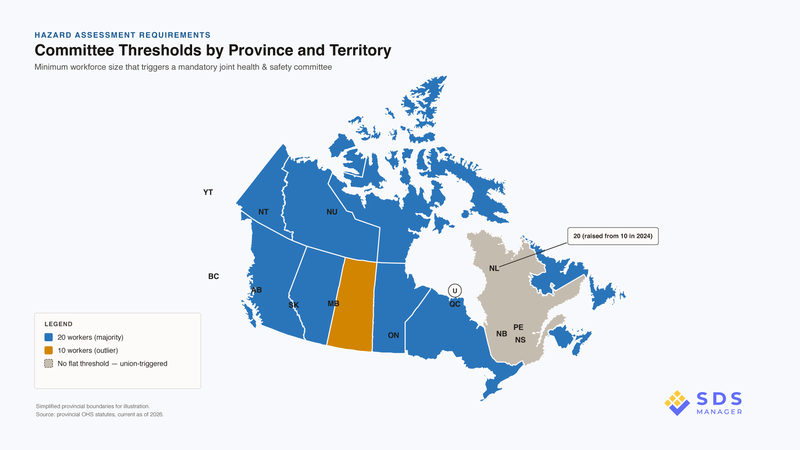
- Saskatchewan requires an occupational health committee at 10 or more workers, most other provinces set that threshold at 20, and Newfoundland and Labrador raised its own threshold from 10 to 20 workers in March 2024.
- Alberta's OHS Code requires the hazard assessment report to be in writing and available to workers, a requirement that isn't universal across every province.
- A hazard assessment needs updating whenever the work, the equipment, or the regulation changes, not on a fixed calendar unless a specific jurisdiction says otherwise.
- CSA Z1002 is a voluntary national standard, not a law on its own, built around six parts: preparation, risk assessment, risk control, monitoring and review, emergency circumstances, and documentation.
- Skipping a hazard assessment can bring a stop-work order, a monetary penalty, or prosecution, and a written, dated assessment is usually the strongest evidence of due diligence an employer has.
What Does a Hazard Assessment Require Under Canadian OHS Law?
A hazard assessment requires three things under Canadian OHS law:
- Identifying what could cause harm at a workplace,
- Assessing how likely and how severe that harm could be, and
- Putting a control in place before it causes an injury.
Every jurisdiction in Canada, federal or provincial, builds its own version of this three-step duty into its occupational health and safety legislation.
The exact wording differs by province, but the underlying logic doesn't. CCOHS, the federal agency that answers Canada's occupational health questions, frames it the same way: hazard identification comes first, then risk assessment ranks what was found, then risk control removes or reduces it.
A hazard assessment isn't quite the same thing as a risk assessment, even though the two terms get used interchangeably in casual conversation.
The distinction between a hazard and a risk matters here: a hazard is anything that could cause harm, and a risk measures how likely that harm actually is and how bad it would be if it happened.
Written into that three-step process, most Canadian OHS regulations expect a hazard assessment to name a few specific things:
- every hazard category present at the workplace: physical, chemical, biological, ergonomic, and psychosocial.
- the method used to identify and rank each hazard.
- a process for workers to report a new hazard once someone spots it.
- a written record of the assessment itself, since an unwritten one is difficult to prove ever happened.
- where the identified hazards call for it, which personal protective equipment gets used.
Hazard Assessment Requirements by Province and Territory
Every Canadian jurisdiction imposes some version of the hazard assessment duty, but the specific law, the paperwork it demands, and the headcount that triggers a formal program all vary by province and territory:
| Jurisdiction | Governing Law | Core Requirement | Committee/Program Threshold |
|---|---|---|---|
| Federal | Canada Labour Code, s.135(1); Canada Occupational Health and Safety Regulations, Part XIX (Hazard Prevention Program), ss.19.3 to 19.5 | Employer must develop a hazard identification and assessment methodology and act on it | 20 or more employees |
| Alberta | OHS Act, Part 2, s.13(1); OHS Code, Part 2 | A written hazard assessment report, dated and available to workers, completed before work begins | 20 or more workers |
| British Columbia | Workers Compensation Act, ss.31 to 46; OHS Regulation | Hazard identification and risk assessment required as part of the OHS program | 20 or more workers (10 to 19 need a worker representative) |
| Manitoba | Workplace Safety and Health Act, s.40; Workplace Safety and Health Regulation, Part 3 | Hazard identification duty on the employer | 20 or more employees |
| New Brunswick | Occupational Health and Safety Act, ss.14 to 18 | Hazard identification and assessment duty on the employer | 20 or more employees (10 to 19 needs a representative) |
| Newfoundland and Labrador | Occupational Health and Safety Act, ss.37 to 44 | Hazard identification and assessment duty; committee threshold raised from 10 to 20 workers by Bill 41, effective March 1, 2024 | 20 workers (previously 10) |
| Nova Scotia | Occupational Health and Safety Act, ss.29 to 32 | Hazard identification and assessment duty on the employer | 20 or more employees working 4 or more consecutive weeks |
| Ontario | Occupational Health and Safety Act, s.9(2); general duty clauses (ss.25 and 26) rather than one dedicated hazard assessment section | Hazard assessment sits inside the general duty clauses and sector-specific regulations rather than a standalone section | 20 or more workers |
| Prince Edward Island | Occupational Health and Safety Act, s.25 | Documented OHS program including a hazard assessment process | 20 or more workers |
| Quebec | Act respecting occupational health and safety, committee provisions ss.68 to 86 | General employer duty to identify and correct hazards | No flat headcount; a committee is triggered by union request or by 10 percent of workers (minimum 4) where the workplace has fewer than 40 |
| Saskatchewan | Saskatchewan Employment Act, ss.3-22 to 3-27 | Hazard identification and assessment duty; occupational health committee required | 10 or more workers |
| Northwest Territories | Safety Act, s.7.1; OHS Regulations (R-039-2015), Part 4 | Hazard identification and assessment duty on the employer | 20 or more workers |
| Nunavut | Safety Act, s.7 | Hazard identification and assessment duty on the employer | 20 or more workers |
| Yukon | Occupational Health and Safety Act, ss.12 and 13 | Hazard identification and assessment duty on the employer | 20 or more workers |
Federal vs. Provincial Jurisdiction: Which Rules Apply to You
About 6 percent of Canadian employees fell under the Canada Labour Code instead of their province's OHS Act, per the federal Labour Program's 2022 survey data.
That narrow slice covers banks, airlines, interprovincial and international transportation, telecommunications and broadcasting, and a handful of other federally regulated industries.
Everyone else, the large majority of Canadian workers, falls under the OHS Act of whichever province or territory they work in instead.
Who Is Responsible for Conducting a Hazard Assessment?
The employer is legally responsible for making sure a hazard assessment happens, even when the actual walk-through gets delegated to a supervisor, a safety coordinator, or an outside consultant. That responsibility doesn't transfer just because someone else does the physical work of identifying hazards.
On a construction site with more than one employer working the same location, a second party carries part of that duty too. Prime contractor responsibilities under most provincial acts include coordinating hazard assessment across every trade on site, not only the prime contractor's own crew.
Ontario has since layered a specific piece of equipment onto that duty for large projects. Since January 1, 2026, a rule under the Working for Workers Seven Act applies to multi-employer construction sites with 20 or more workers running longer than three months. These sites must have an automated external defibrillator on site.
This requirement sits on top of the underlying hazard assessment duty. It doesn't replace it.
Even a workplace far below any committee threshold still carries the underlying duty. Formal, written programs are what kick in above a headcount; the basic requirement to assess hazards applies from the first worker on.
Worker Rights and Involvement in the Process

Workers have a legal right to be consulted while a hazard assessment gets built, not only informed of the result afterward. Most provincial acts require the employer to involve workers, often through a joint health and safety committee or a safety representative, in identifying and assessing hazards wherever doing so is reasonably practicable.
That involvement runs alongside a second, separate right. The right to refuse unsafe work applies once a hazard assessment, or the lack of one, leaves a worker facing a danger nobody has addressed. A worker who refuses in good faith is protected from reprisal while the concern gets investigated.
When Must You Review or Redo a Hazard Assessment?
A hazard assessment needs a review whenever something changes that could introduce a new hazard. Like new equipment, a new process, a change to an existing one, an incident or near miss, or a change to the regulation itself.
Most Canadian OHS laws describe these trigger events rather than fixing a calendar date, so an annual review is common practice, not a universal legal minimum.
The Alberta Construction Safety Association spells out these trigger events about as plainly as any source in this area does: reassess at reasonably practicable intervals, whenever a new work process starts, whenever an existing one changes, and before any significant addition or alteration to the work site.
That framing works just as well outside construction, since the underlying logic (reassess when something material changes) doesn't depend on the industry.
What the CSA Z1002 Standard Adds to the Legal Minimum
CSA Z1002 is a voluntary Canadian standard for hazard identification, risk assessment, and risk control, not a law in its own right, though many employers and regulators treat it as the accepted methodology for meeting the legal minimum.
CSA Z1002’s own structure runs to six parts:
- Preparation, setting the scope of the assessment and gathering the information it will need.
- Risk assessment, ranking each hazard by how likely it is and how severe the resulting harm would be.
- Risk control, applying the hierarchy of controls to eliminate or reduce what was identified.
- Monitoring and review, the same review-cycle logic covered above, built directly into the standard.
- Emergency circumstances, a clause most casual summaries skip, covering how the assessment holds up when something goes wrong unexpectedly. Federally regulated employers are about to see this clause tested directly: the Regulations Amending Certain Regulations Made Under the Canada Labour Code (SOR/2026-10) have already been registered to add engineered nanomaterials, thermal stress, non-solar UV radiation, and a stricter radon exposure limit to federal hazard prevention rules, though the amendments are not yet in force as of this writing.
- Documentation, the paper trail a due diligence defence eventually depends on.
Tools Canadian Employers Use to Meet the Requirement
Four tools do most of the practical work of meeting Canada's hazard assessment requirements, and most workplaces end up using more than one.
- A field-level hazard assessment(FLHA), a short, task-specific check a crew completes right before work starts, common on construction sites and in oil and gas.
- A job hazard analysis, breaking one specific task into its individual steps and identifying what could go wrong at each one.
- A scheduled workplace inspection, a broader walk-through of the whole site rather than one task.
- A risk matrix, a simple grid for ranking how likely and how severe a hazard is once it has been identified.
Because a field-level hazard assessment gets redone before each new task, it is usually treated as a per-job-site or per-task document rather than a single company-wide record covering every location at once.
What Happens If You Don't Conduct a Hazard Assessment
Skipping a required hazard assessment exposes an employer to the same enforcement tools used for any other OHS violation. A compliance order requiring the work to stop until:
- the hazard gets assessed,
- an administrative monetary penalty, or
- in a serious case, prosecution under the applicable act.
Which specific penalty applies, and how large it can get, differs by jurisdiction and by how serious the resulting harm was.
Several provinces frame the underlying duty using the same legal standard: doing what is as far as is reasonably practicable to identify and control a hazard, not achieving a theoretically perfect assessment. That standard matters most after something goes wrong, when an inspector or a court asks what the employer actually did before the incident.
Due Diligence: Why Documentation Is Your Best Defence
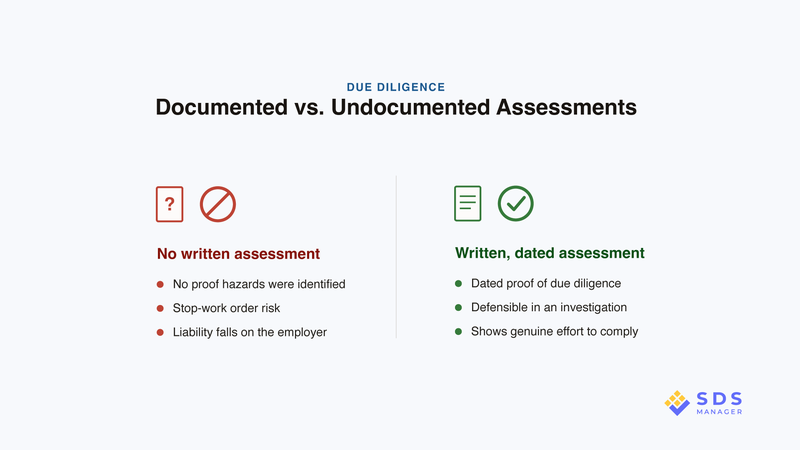
A written, dated hazard assessment is usually the strongest evidence an employer has that it met its legal duty. That’s because due diligence gets judged on what was actually done before an incident, not on good intentions after one.
An employer that can produce the assessment, show who was consulted, and point to the controls it put in place is in a materially different position than one that cannot produce anything at all.
Centralizing that documentation in a risk management platform that keeps assessments, controls, and review dates in one place is what turns due diligence from a scramble after the fact into evidence already on hand.
Building a Hazard Assessment Process You Can Actually Keep Up With
The employers who stay on top of hazard assessment requirements without it becoming a scramble tend to do one simple thing: they tie the review triggers (a new piece of equipment, a process change, an incident) to a schedule they already keep.
An existing joint health and safety committee meeting or an equipment maintenance calendar works better than inventing a separate hazard assessment calendar from scratch.
Safe work practices built once and applied consistently make that easier across every site a company operates, especially once it spans more than one province.
EHS Solutions by SDS Manager can help centralize these triggers, records, and safe work practices in one place, so nothing gets missed as the company grows.
Frequently Asked Questions
Is a hazard assessment legally required in every Canadian province?
Yes, every Canadian province and territory requires some form of hazard assessment under its own occupational health and safety law, and federally regulated workplaces carry the same duty under the Canada Labour Code. The specific wording and paperwork differ by jurisdiction, but the underlying duty to identify, assess, and control workplace hazards does not.
What's the difference between a hazard assessment and a risk assessment?
A hazard assessment identifies what could cause harm at a workplace, while a risk assessment measures how likely that harm is and how severe it would be if it happened. In practice, Canadian employers usually run both as one connected process rather than two separate documents.
Who is responsible for hazard assessments at a federally regulated workplace?
The employer is responsible for hazard assessments at a federally regulated workplace, the same as under provincial law, but the specific requirements come from the Canada Occupational Health and Safety Regulations rather than a provincial act. A federally regulated employer, a bank or an airline, still has to involve its workplace health and safety committee in the process.
Does WHMIS training satisfy the hazard assessment requirement?
No, WHMIS training on its own does not satisfy a hazard assessment requirement. WHMIS teaches workers to read and understand hazard information already on a label or safety data sheet, while a hazard assessment is the employer's separate duty to evaluate the workplace itself and decide what controls it needs.
What is a field level hazard assessment (FLHA)?
A field-level hazard assessment is a short, task-specific check a worker or crew completes immediately before starting a job, common in construction, oil and gas, and other field-based industries. It covers the hazards of that specific task at that specific location rather than the whole workplace over a longer period.
How long do hazard assessment records need to be kept?
There is no single retention period that applies across Canada, and most jurisdictions do not specify one for the general hazard assessment record itself. The federal government requires 10 years for hazardous occurrence investigation records specifically, and a common practice elsewhere is to keep the current assessment plus at least the previous version for several years, checked against your own jurisdiction's rule where one exists.
Do small workplaces need a hazard assessment too?
Yes, the underlying duty to assess hazards applies regardless of workplace size; what changes with headcount is whether a formal written program or committee kicks in. Saskatchewan sets that formal threshold at 10 or more workers, most other provinces set it at 20, and a workplace below either number still has to identify and control its hazards.
Do remote or work-from-home employees need a hazard assessment?
Generally yes: an employer's duty to assess hazards extends to any location where work actually happens, home offices included, though how that gets applied in practice is less settled than for a traditional worksite. Most guidance treats a home-office assessment as a lighter version focused on ergonomics and basic safety rather than the full process used for a physical worksite.
Do I need a separate hazard assessment for each job site?
For task-specific tools like a field-level hazard assessment, yes, a new one gets completed for each job site or task rather than reused from a different location. A broader workplace-level hazard assessment can cover a fixed site over a longer period, but a construction crew moving between sites typically needs a fresh assessment at each one.
Can I use a generic hazard assessment template?
A generic template can be a reasonable starting point, but the hazards it lists have to match what is actually present at your specific workplace before it satisfies the legal requirement. An unmodified, generic form that does not reflect the real hazards on site is unlikely to hold up as evidence of due diligence if it is ever reviewed.

Arysha Alif Khan

Arysha Alif Khan is an EHS and chemical safety specialist with a background in biochemistry, biotechnology, and public health. She works closely with the product and regulatory teams to turn complex chemical regulations, SDS requirements, and workplace safety standards into clear, practical guidance for people.