
A workplace hazard is anything at work that could hurt someone or make them ill. Knowing the different types tells you what to look for before a hazard causes harm.
In this article, we walk you through each type of workplace hazard with everyday examples. Then cover the hazards common in different workplaces, how to spot hazards on the job and what to do when you see one.
Key Takeaways
- The eight main types of workplace hazards are safety, electrical, fire and explosion, physical, chemical, biological, ergonomic and psychosocial hazards, each named for what causes the harm.
- Most workplaces face several types of hazard at once: an office faces mainly ergonomic and psychosocial hazards, while a construction site or a farm faces nearly all eight.
- To spot hazards at work, check your work area before each task, watch for changes such as a new machine or chemical, and treat near misses as warnings.
- To prevent workplace hazards, follow the hierarchy of controls: remove the hazard, swap it for something safer, add guards, change how the work is done, and use protective equipment last.
- Employers fix the riskiest hazards first, rating each one by how likely the harm is and how bad it would be.
- If you see a hazard, keep people away from it, tell your supervisor, report it in writing and confirm it was fixed.
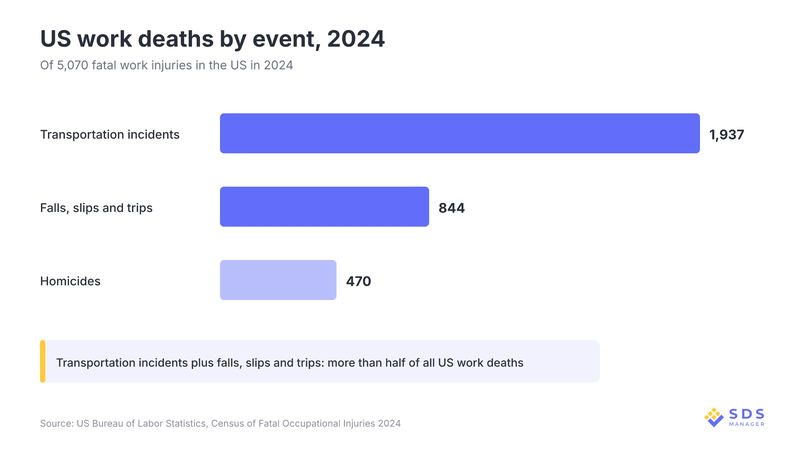
- Safety hazards such as vehicles and falls caused more than half of the 5,070 US work deaths in 2024, according to the US Bureau of Labor Statistics.
What Are the Main Types of Workplace Hazards?
The Occupational Safety and Health Administration (OSHA), the US workplace safety regulator, groups workplace hazards into two broad categories: safety hazards and health hazards. Each category has four types, which makes eight in total.
Safety hazards cause immediate injury and can usually be spotted during a walk-around inspection. They fall into four types:
- Slips, trips and falls: wet floors, cluttered walkways, unprotected edges and unsecured ladders
- Electrical: exposed wiring, damaged cords, overloaded circuits and missing grounding
- Machinery and equipment: unguarded moving parts, pinch points and faulty tools
- Fire: flammable materials, ignition sources and blocked exits
Health hazards cause illness, often over time. They fall into four types:
- Chemical: solvents, dusts, gases and vapors
- Physical: noise, vibration, radiation and extreme heat or cold
- Biological: bacteria, viruses, mold and bloodborne pathogens
- Ergonomic: repetitive motion, awkward postures and heavy lifting
Health hazards are harder to spot than safety hazards. Many gases and vapors are invisible, and the harm may not appear for months or years.
Some hazards belong to more than one type. A can of solvent is a chemical hazard because its fumes are toxic, and a fire hazard because it is flammable. It needs good ventilation to control the fumes and storage away from heat to prevent fire.
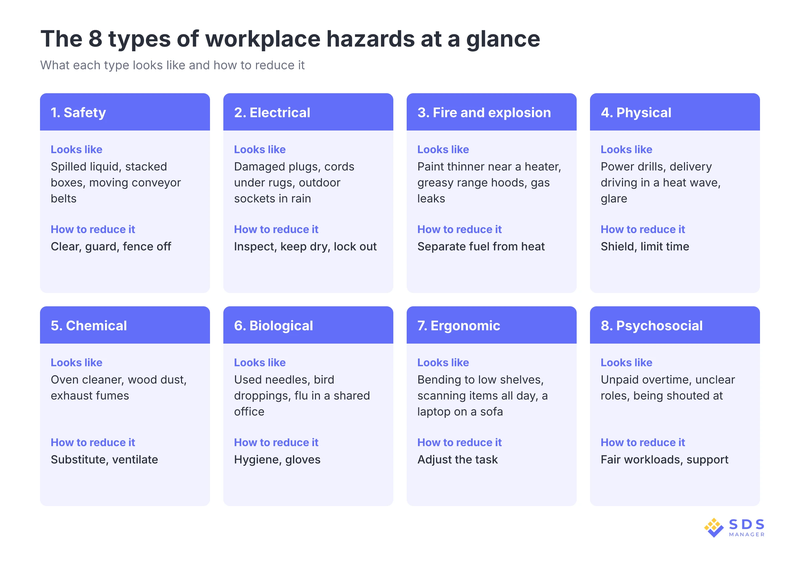
| Type | What causes the harm | Everyday examples | How to reduce it |
|---|---|---|---|
| Safety | Surfaces, heights, machines, vehicles and objects | Spilled liquid, stacked boxes, moving conveyor belts | Clear, guard, fence off |
| Electrical | Electric current | Damaged plugs, cords under rugs, outdoor sockets in rain | Inspect, keep dry, lock out |
| Fire and explosion | Fuel meeting heat, sparks or flame | Paint thinner near a heater, greasy range hoods, gas leaks | Separate fuel from heat |
| Physical | Noise, vibration, heat, cold, radiation, pressure | Power drills, delivery driving in a heat wave, glare | Shield, limit time |
| Chemical | Substances breathed in, touched or swallowed | Oven cleaner, wood dust, exhaust fumes | Substitute, ventilate |
| Biological | Living things and what they carry | Used needles, bird droppings, flu in a shared office | Hygiene, gloves |
| Ergonomic | How the body moves or holds still | Bending to low shelves, scanning items all day, a laptop on a sofa | Adjust the task |
| Psychosocial | How work is organized and how people are treated | Unpaid overtime, unclear roles, being shouted at | Fair workloads, support |
1. Safety Hazards
Safety hazards are unsafe conditions involving floors, heights, machines, vehicles and objects that can injure someone in an instant. OSHA's group of safety hazards also includes electrical and fire hazards.
Common safety hazards include:
- wet or cluttered floors and walkways
- trailing cables
- ladders, roofs and open edges
- moving machine parts with no guard
- forklifts and delivery vehicles
- objects falling from high shelves
In 2024, the US Bureau of Labor Statistics (BLS) counted 5,070 fatal work injuries in its Census of Fatal Occupational Injuries. Transportation incidents caused 1,937 of them, and falls, slips and trips caused 844, so these two safety hazards caused more than half of all US work deaths that year.
How to Reduce Safety Hazards
To reduce safety hazards, keep floors dry and walkways clear, keep guards on moving parts, and put rails or other fall protection around open edges.
2. Electrical Hazards
Electrical hazards are conditions that let electricity reach a person's body or start a fire. They can cause shocks, burns and electrocution (a fatal electric shock).
The most common electrical hazards in the workplace come from equipment people use every day:
- frayed or damaged cords
- overloaded outlets and power strips
- exposed wiring
- wet hands or wet floors near equipment
- overhead power lines
- machines left powered while someone repairs them.
How to Reduce Electrical Hazards
To reduce electrical hazards, check cords and plugs before each use, keep water away from equipment, and never work on a machine until it has been switched off and locked out under a lockout/tagout procedure, which stops it from restarting.
3. Fire and Explosion Hazards
Fire and explosion hazards appear wherever something flammable meets heat, a spark or a flame. Look out for:
- flammable liquids and gas cylinders
- cardboard piled next to a heater
- cooking oil
- combustible dust from wood, flour or metal
- sparks from welding or grinding
- flammables stored in the wrong place
Blocked exits and missing or empty extinguishers do not start fires, but they make any fire more dangerous.
How to Reduce Fire and Explosion Hazards
To reduce fire and explosion hazards, store flammables away from heat, keep exits clear, and know where the extinguishers and alarms are.
4. Physical Hazards
Physical hazards are forms of energy and working conditions that harm your body without hitting or cutting you, and for outdoor work they include the weather. They include noise, vibration, heat, cold, radiation and pressure.
Everyday sources include:
- loud machinery
- vibrating hand tools
- hot kitchens and summer work outdoors
- cold storage rooms
- strong sun
- X-rays and welding arcs
- poor lighting
- compressed air and pressurized equipment
The harm includes hearing loss, heat stroke, burns, eye damage and numb fingers, and some of it, such as hearing loss or numbness from years of vibration, builds slowly.
How to Reduce Physical Hazards
To reduce physical hazards:
- wear hearing protection near loud equipment
- in the heat, rest in the shade, drink water and take breaks
- keep shielding in place around radiation
- limit time with vibrating tools
- dress warmly for cold rooms.
5. Chemical Hazards
Chemical hazards are substances that can harm you when you breathe them in, touch them or swallow them. Examples include:
- cleaning supplies and solvents
- paints and glues
- fuels
- dust such as silica from cutting stone
- welding fumes
- toxic or low-oxygen air in confined spaces such as tanks, pits and sewers
Unlabeled containers and poor ventilation make any chemical more dangerous.
The harm ranges from burns and breathing problems to long-term illness.
Hazardous chemicals supplied for work come with a safety data sheet (SDS) that lists their hazards, how to handle them and what first aid to give. A workplace with dozens of products needs SDS management so anyone can find the right sheet quickly.
How to Reduce Chemical Hazards
To reduce chemical hazards, read the label and the SDS before you use a product, keep the area ventilated, and wear the gloves or goggles the SDS lists. Ask your supervisor where the SDSs are kept.
6. Biological Hazards
Biological hazards are living things, or substances from them, that can cause infection, allergy or illness. Typical sources are:
- bacteria and viruses
- mold
- blood and other bodily fluids
- sewage and waste
- insect and animal bites
Biological hazards spread through the air you breathe, through touch, through what you swallow, or through a cut, bite or needle stick.
How to Reduce Biological Hazards
To reduce biological hazards, block the way they spread. Handwashing and gloves stop germs spreading by touch, safe waste disposal keeps waste out of reach, and vaccination, where it is offered, protects you whichever way a germ reaches you.
7. Ergonomic Hazards
Ergonomic hazards come from the way a job makes your body move or hold still. The strain builds up over weeks or months and injures muscles, joints and backs.
In the UK, these hazards are often called manual handling when they involve lifting and carrying. Watch for:
- heavy or awkward lifting
- repetitive motions
- awkward postures and reaching
- poorly set-up desks and screens
- long periods of standing or sitting
According to the BLS survey of workplace injuries and illnesses, overexertion, repetitive motion and bodily conditions caused 946,290 injuries and illnesses among US private-industry workers in 2023 and 2024 that kept people off work, put them on restricted duty or moved them to another job, more than any other cause. Contact incidents, such as being struck by or caught in something, caused fewer, at 860,050.
How to Reduce Ergonomic Hazards
To reduce ergonomic hazards, adjust your chair and screen, use carts and lifting aids, and ask to rotate tasks when a job involves the same movement all day.
8. Psychosocial Hazards
Psychosocial hazards come from how work is organized and how people are treated at work, and they can harm mental or physical health. The best-known examples are harassment and violence, and the most common harm is stress. Common sources include:
- heavy workloads and tight deadlines
- long hours and shift work
- working alone
- bullying and harassment
- violence or threats from customers
- little support from managers
Stress leaves no visible injury, so people often treat it as a personal matter rather than a safety issue. The National Institute for Occupational Safety and Health (NIOSH) still counts psychosocial hazards among the workplace health hazards it evaluates, alongside chemical and physical ones.
Violence, by contrast, causes visible harm: BLS counted 470 workplace homicides (deaths from violence by others) in the US in 2024.
How to Reduce Psychosocial Hazards
To reduce psychosocial hazards, speak up about workloads you cannot manage, report harassment and threats, and avoid working alone on high-risk tasks.
What Are the Common Hazards in Different Workplaces?
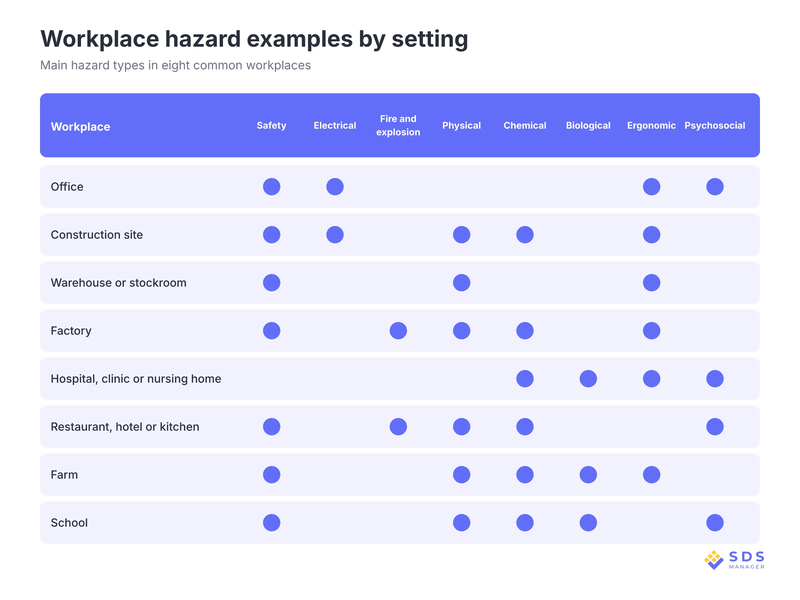
Every workplace has several types of hazard at once. An office faces mainly ergonomic and psychosocial hazards, while a construction site or a farm faces nearly all eight.
| Workplace | Main hazard types | Examples |
|---|---|---|
| Office | Ergonomic, psychosocial, safety, electrical | A badly set-up desk and screen, long hours at a screen, heavy workloads, overloaded power strips, cluttered floors and storage areas |
| Construction site | Safety, ergonomic, electrical, physical, chemical | Heavy lifting, overhead power lines, loud equipment, silica dust |
| Warehouse or stockroom | Safety, ergonomic, physical | Forklifts and delivery vehicles, stock falling from racks, constant lifting, cold storage |
| Factory | Safety, ergonomic, physical, chemical, fire and explosion | Unguarded machines, loud equipment, solvents, combustible dust |
| Hospital, clinic or nursing home | Psychosocial, biological, chemical, ergonomic | Difficult or aggressive patients, infections, lifting patients, shift work, disinfectants |
| Restaurant, hotel or kitchen | Fire and explosion, physical, safety, chemical, psychosocial | Hot cooking oil and hot surfaces, wet floors, knives, cleaning products, long or irregular hours |
| Farm | Safety, ergonomic, physical, chemical, biological | Tractors and machinery, vehicles, lifting, sun and heat, pesticides, animals |
| School | Psychosocial, physical, biological, safety, chemical | Difficult students, classroom noise, illness spreading between people, slips, lab and cleaning chemicals |
On construction sites, OSHA's Focus Four hazards are falls, being struck by moving objects, being caught in or crushed between objects, and electrocution. They are taught in OSHA's Outreach Training Program, a set of basic safety courses for workers run by OSHA-authorized trainers.
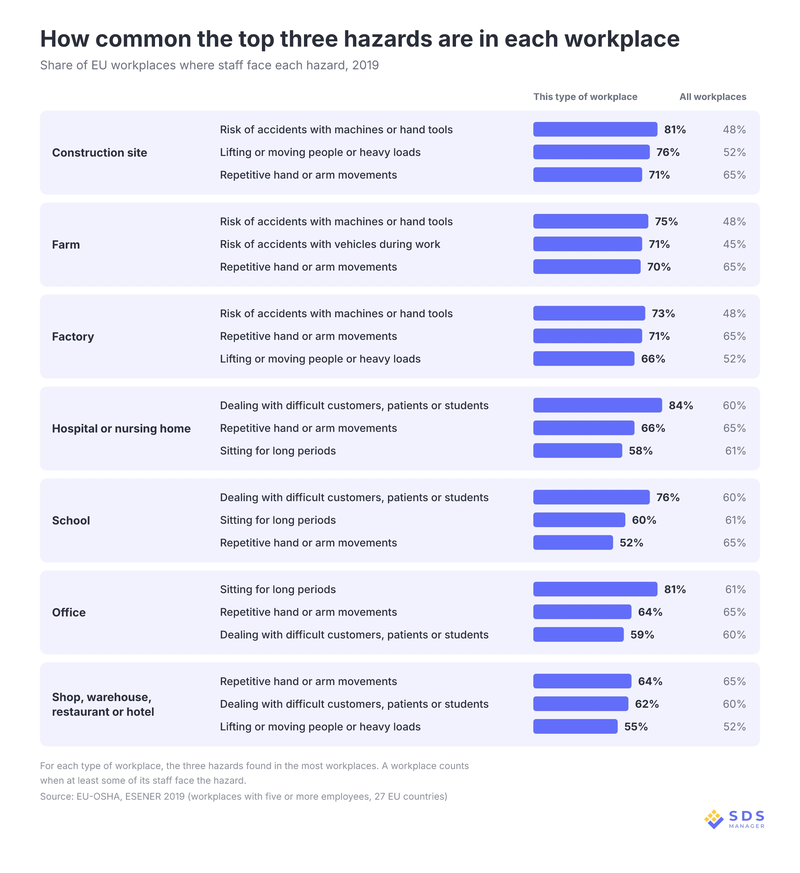
ESENER, a 2019 survey by the European Agency for Safety and Health at Work (EU-OSHA) of workplaces with five or more employees in 27 EU countries, counted a workplace as reporting a hazard when at least some of its staff faced it.
The International Labour Organization (ILO) estimated how many fatal work injuries happened in each industry worldwide in the same year.
How Common the Top Three Hazards Are in Each Type of Workplace
The ILO estimates that farm work accounts for about 1 in 3 fatal work injuries worldwide, and that farm, construction, forestry and fishing, and factory work together account for about 200,000 a year, roughly 6 in 10 of all fatal work injuries.
How Do You Spot Hazards at Work?
You spot hazards at work by checking your work area with the eight types in mind before you start, and by watching for anything that has changed since you last did the job. Supervisors carry out a more formal hazard identification process, but every worker should:
- Inspect your work area before you start a task.
- Watch for changes, such as a new machine, a new chemical or a new route through the site.
- Pay extra attention during work you do less often, such as cleaning, repairs and night shifts.
- Read warning signs and the hazard pictograms (the small red-bordered symbols) on product labels.
- Notice near misses (close calls where nobody was hurt), because each one shows a hazard before it causes harm.

How Do You Prevent Workplace Hazards?
You prevent workplace hazards by following the hierarchy of controls, the set order for choosing fixes:
- remove the hazard,
- swap it for something safer,
- add guards,
- change how the work is done, and
- use protective equipment last.
Removing, replacing or guarding a hazard protects everyone at once. Switching a harsh cleaning chemical for a milder product does more than handing out gloves, which protect only the person wearing them.
Employers decide which hazards to fix first by rating the risk of each one, meaning how likely the harm is and how bad it would be. Likelihood and severity mark the difference between a hazard and a risk. A frayed cord across a busy walkway poses more risk than the same cord in a locked storeroom.
A written risk assessment records how each hazard was rated and which control was chosen.
Your part is to use the guards, procedures and protective equipment your employer provides and never remove or bypass them. When you see a hazard, take these steps:
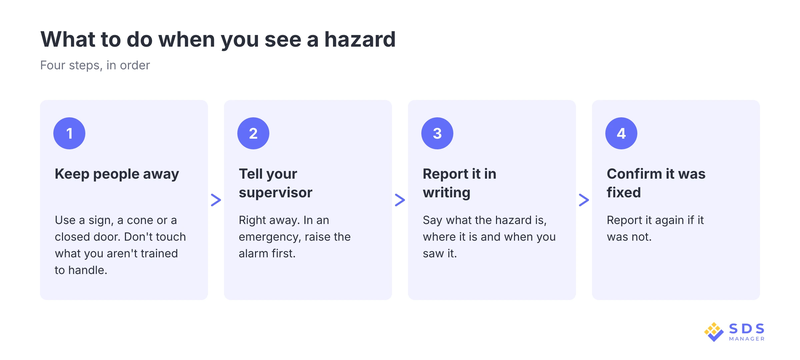
If your workplace has a safety representative (a worker chosen to raise safety issues with management), you can also take the report to them.
Take Ownership of Every Hazard Report
A hazard that is only mentioned out loud is easy to forget. Without a named person to fix it, a frayed cord or a blocked exit can go unrepaired for weeks.
Set up one simple way for anyone to report a hazard, assign a reviewer and close each report.
EHS Solutions by SDS Manager logs hazard reports in its Incident Management module and assigns each fix an owner and a due date through CAPA (corrective and preventive action) Management.
Start a free trial and see every hazard report through to a confirmed fix.
Frequently Asked Questions
What Is the Difference Between a Hazard and a Risk?
The difference between a hazard and a risk is that a hazard is the thing that can cause harm, while a risk is how likely that harm is and how serious it would be. OSHA describes risk as hazard multiplied by exposure, so a hazard that nobody comes near poses little risk.
Who Is Responsible for Identifying Workplace Hazards?
Employers are responsible for identifying workplace hazards. The US Occupational Safety and Health Act of 1970 requires every employer to provide a workplace free from recognized hazards that cause or are likely to cause death or serious harm, and OSHA lists “find and correct safety and health hazards” among employer duties.
What Is Management’s Role in Controlling Workplace Hazards?
Management’s role in controlling workplace hazards is to pay for and put in place the fixes the work needs, from guards and safer products to training and protective equipment. Managers also act on every hazard report and check that each fix works.
What Are the Effects of Workplace Hazards?
The effects of workplace hazards are injuries, illnesses and lost working time for workers, and costs and disruption for employers. In 2024, BLS counted 2.5 million nonfatal work injuries and illnesses in US private industry.
Does OSHA List 6 Types of Workplace Hazards?
No, OSHA does not list 6 types of workplace hazards. The six-type list (safety, biological, physical, ergonomic, chemical and work organization hazards) is often credited to OSHA, but OSHA’s own guidance, the Recommended Practices for Safety and Health Programs, doesn’t use it. That guidance divides hazards into safety hazards and health hazards.

Arysha Alif Khan

Arysha Alif Khan is an EHS and chemical safety specialist with a background in biochemistry, biotechnology, and public health. She works closely with the product and regulatory teams to turn complex chemical regulations, SDS requirements, and workplace safety standards into clear, practical guidance for people.