Most workplace incidents trace back to a hazard nobody flagged in time. It's rarely a hazard nobody could have seen.
Hazard identification means finding a source of potential harm before it actually causes one. This article covers the main hazard types, the methods used to find them, and a step-by-step guide to doing it properly. It also covers how the whole process connects to what happens next.
Key takeaways
- Hazard identification is the first step in any safety process. It’s the process of finding, recognizing, and describing a source that has the potential to cause harm.
- Hazards generally fall into six categories: safety, physical, chemical, biological, ergonomic, and psychosocial.
- Common hazard identification methods include workplace inspections, job hazard analysis, employee reporting, near-miss reporting, and structured techniques like HAZOP.
- No single method catches everything. Workplace inspections, job hazard analysis, employee reporting, and near-miss reporting each fill different gaps.
- Section 2 of every SDS is literally titled "Hazard(s) Identification." This is a specific, regulated use of the same term that covers a single chemical rather than a whole workplace.
- OSHA doesn't have one blanket hazard identification standard. The requirement comes from a combination of the General Duty Clause and specific standards like Hazard Communication (1910.1200), which apply to different hazard types.
What Is Hazard Identification?
Hazard identification is the process of finding, recognizing, and describing a source that has the potential to cause harm. That harm could affect people, property, or the environment.
CCOHS defines a hazard simply as any source of potential damage, harm, or adverse health effect on someone or something. A hazard doesn't have to have caused an injury yet to count. The defining feature is potential, not history.
This process sits at the very start of any safety program. Everything downstream, such as risk assessment, control selection, and training, depends on a hazard actually being spotted first. A hazard that never gets identified never gets controlled, no matter how good the rest of the safety system is.
What Are the Main Types of Hazards?
Hazards are generally grouped into six categories, though the exact split varies slightly by source.
| Category | Definition | Examples | Common Industries |
|---|---|---|---|
| Safety | Conditions or actions that can cause immediate injury | Slips, trips, falls, machine guarding failures, equipment malfunctions | Construction, manufacturing, warehousing |
| Physical | Environmental factors that can cause harm without direct contact | Noise, extreme temperature, radiation, poor lighting, vibration | Manufacturing, construction, mining |
| Chemical | Exposure to a hazardous substance in solid, liquid, or gas form | Solvents, acids, fumes, dust, flammable liquids | Manufacturing, laboratories, agriculture |
| Biological | Exposure to living organisms or their byproducts | Bacteria, viruses, mould, bloodborne pathogens | Healthcare, agriculture, waste management |
| Ergonomic | Physical strain from posture, repetition, or force | Repetitive motion, poor workstation setup, manual handling | Manufacturing, warehousing, office work |
| Psychosocial | Factors affecting mental health and wellbeing | Excessive workload, workplace violence, harassment, isolation | Healthcare, retail, emergency services |
Different regulations and frameworks categorize hazards differently, depending on what they're actually trying to communicate. The six-category framework used above is a general workplace hazard identification model, not a legal classification system.
Under OSHA's Hazard Communication Standard and the GHS it's based on, chemical hazards specifically get sorted into just two broad groups instead: physical hazards (like flammability or explosivity) and health hazards (like toxicity or carcinogenicity). This narrower, two-part system exists for chemical labeling purposes, not general workplace hazard identification, which is why it doesn't map directly onto the six categories above.
This distinction matters in practice. A chemical spill might get logged as a "chemical hazard" under the six-category workplace model, while the same substance's SDS classifies it more specifically as a physical hazard, a health hazard, or both, under GHS. Neither framework is wrong. They're just built for different purposes.
What Are Common Hazard Identification Methods?
No single technique catches every hazard. A layered approach, combining several methods, closes the gaps any one method leaves open.
Workplace Inspections
A structured walkthrough of the workplace, looking for hazards an observer can see firsthand. Inspections typically follow a checklist covering common risk areas: housekeeping, equipment condition, PPE availability, and emergency access. This structure is what makes inspections repeatable and comparable over time, rather than relying on whatever an individual inspector happens to notice that day.
Inspections are the starting point for most hazard identification programs. They only capture what's visible at the specific moment the inspection happens, though, so a hazard that only appears during a specific task, or only at certain times of day, can slip through even a thorough walkthrough.
Job Hazard Analysis (JHA)
A JHA breaks a specific task into its individual steps and identifies the hazards at each one. Rather than assessing a work area as a whole, it isolates one job and asks what could go wrong at each stage, from setup through to cleanup. Job safety analysis covers this task-based approach in more depth.
It catches hazards a general walkthrough tends to miss, since it forces a closer look at exactly how a job actually gets done, not just what the work area looks like from the outside. This makes JHA especially useful for non-routine or high-risk tasks, where a single missed step carries real consequences.
Employee Reporting and Observation
Workers performing a task daily often notice hazards long before a formal inspection would, since they experience the work area under real conditions, not a scheduled walkthrough. A reporting system needs to be genuinely easy to use, and it shouldn't punish the person reporting, since fear of blame is one of the fastest ways to shut a reporting culture down.
Done well, this method surfaces hazards no outside observer could catch, including ones tied to a specific worker's routine, equipment quirks, or a task's real-world execution.
Safety Audits
A safety audit is broader and more formal than a routine inspection, typically reviewing an entire safety program rather than a single work area. It examines whether policies, training records, and documented procedures actually match what's happening on the ground, not just whether physical conditions look safe.
Audits are usually conducted less frequently than inspections, often annually or after a significant change, and sometimes by someone outside the immediate team to reduce blind spots that come from over-familiarity with a site.
Near-Miss Reporting
A near miss is an event that could have caused harm but didn't. Reporting these systematically, rather than treating them as a lucky escape to forget about, gives a workplace a second chance to catch a hazard before it actually hurts someone.
Incident management software that captures near misses alongside actual incidents keeps that reporting habit consistent, rather than relying on someone remembering to file a separate report for the ones where nobody got hurt. Over time, a pattern of near misses in the same area is often a stronger warning sign than any single inspection finding.
Incident Investigation
Investigating an incident after it happens identifies the hazard that caused it, along with any contributing hazards that hadn't been flagged before. This is hazard identification working in reverse: instead of looking for a hazard before harm occurs, an investigation traces backward from harm that already happened to find what should have been caught earlier.
A thorough investigation often surfaces hazards affecting more than just the immediate area involved, since the same root cause, a training gap or a missing guard, frequently exists elsewhere in the workplace too.
HAZOP and Advanced Techniques
HAZOP and similar structured techniques examine a process for deviations from its intended design, using guide words like "more of," "less of," and "none" to systematically work through what could go wrong. This catches hazards embedded in how a system operates, not just a single visible condition a walkthrough could spot.
These methods demand more time and expertise than the others on this list, typically involving a multidisciplinary team working through a process step by step. They're covered in more depth in this PHA guide.
How to Identify Hazards in the Workplace
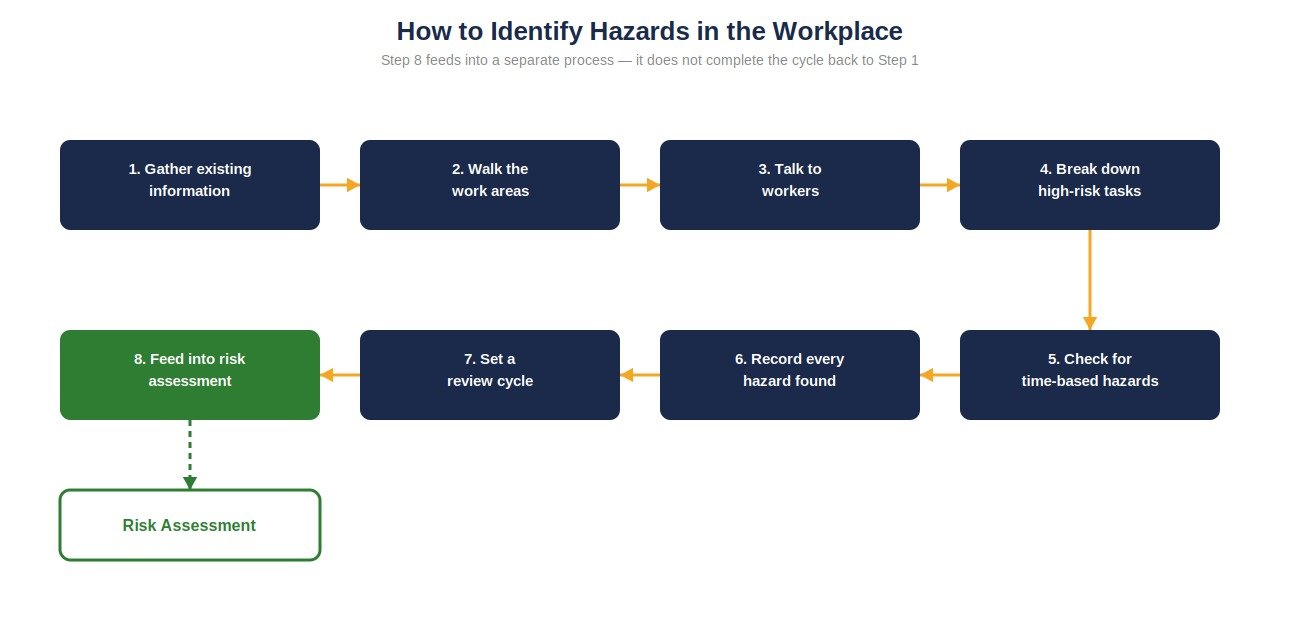
- Gather existing information first. Review past incident reports, near-miss logs, and any prior inspection records before walking the site, so the process builds on what's already known rather than starting from zero.
- Walk the actual work areas. Observe tasks as they're genuinely performed, not as a procedure describes them, since the gap between the two is often where hazards live.
- Talk to the workers doing the job. The person performing a task daily usually knows its real hazards better than anyone reviewing it from outside.
- Break high-risk tasks into individual steps. For anything non-routine or high-consequence, a full job hazard analysis catches what a general walkthrough would miss.
- Check for hazards that develop over time, not just ones visible in a single moment, including ergonomic strain and cumulative chemical exposure.
- Record every hazard found, including ones that seem minor, since severity gets assessed at the risk assessment stage, not during identification itself.
- Set a review cycle. Hazards change as equipment, processes, and staff change, so a one-time identification exercise goes stale quickly. Revisit it on a schedule, and immediately after any significant change to the work.
- Feed findings into risk assessment. Once a hazard is identified, it moves to a separate process: evaluating how likely it is to cause harm and how severe that harm would be. That evaluation decides what control actually gets applied. How to conduct a risk assessment covers that next step in full.
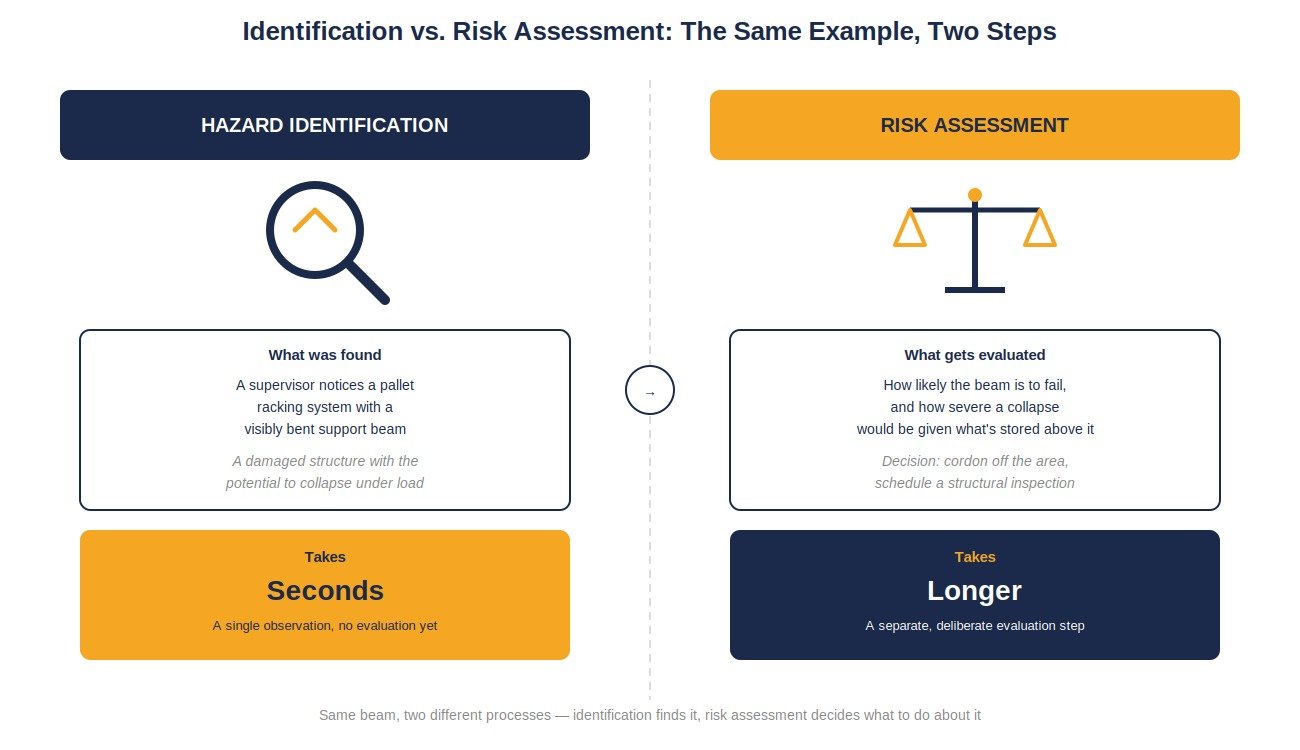
This last step is worth being explicit about: identification and risk assessment are two different processes, even though they're closely linked. Identification asks "what could go wrong?" Risk assessment asks "how likely is that, and how bad would it be?" A hazard that's identified but never risk-assessed sits on a list without ever getting prioritized or controlled.
Hazard Identification Example
Hazard identification looks different depending on what kind of hazard is involved. A few examples across different categories show the range.
A damaged structure: A warehouse supervisor notices a pallet racking system with a visibly bent support beam. That observation alone is the hazard identification: a damaged structure with the potential to collapse under load. What happens next, evaluating how likely it is to fail and deciding on a control, is a separate step, risk assessment, not identification itself.
A new chemical entering the workplace: Introducing a chemical nobody has handled before means identifying more than just "this is hazardous." It means understanding the substance's specific properties, how it might react with what's already stored nearby, and what protective measures its handling actually requires, information the SDS provides as a starting point.
PPE that doesn't match the task: A worker wearing standard safety glasses while grinding metal is still exposed to a hazard, since the task calls for a higher level of eye protection than what's provided. Identifying this hazard means looking at the task itself, not just confirming that PPE is present.
A pattern of workplace stress: A team consistently working unsustainable overtime carries a psychosocial hazard, even though nothing about it looks unsafe in the way a wet floor does. Identifying it requires paying attention to workload and culture, not just physical conditions.
Each of these examples ends the same way: a hazard gets found and recorded. What happens with that finding, evaluating it, controlling it, is the next process, not part of identification itself.
What Is Hazard Identification in an SDS?
Section 2 of every Safety Data Sheet is titled "Hazard(s) Identification," a specific, regulated use of the same term that covers one chemical rather than an entire workplace. Under OSHA's Hazard Communication Standard and the GHS framework it's based on, this section is required to include:
| Element | What It Communicates | |
|---|---|---|
| Hazard classification | The GHS category the chemical falls into (e.g., flammable liquid, category 1) | |
| Signal word | "Danger" for more severe hazards, "Warning" for less severe ones | |
| Hazard statements | Standardized phrases describing the specific hazard (e.g., "Causes skin irritation") | |
| Pictograms | Standardized red-bordered symbols giving a visual hazard warning | |
| Precautionary statements | Standardized guidance on prevention, response, storage, and disposal | |
| Unclassified hazards | Any known hazard that doesn't fit a formal GHS category | |
| Unknown toxicity statement | For mixtures, the percentage of unknown-toxicity ingredients, where applicable |
This is a narrower, chemical-specific application of the same underlying concept covered throughout the rest of this article: recognizing a potential source of harm before it causes one. SDS management that keeps Section 2 data current and searchable makes this specific form of hazard identification far faster than digging through binders whenever a new chemical enters the workplace.
How Often Should You Reassess Workplace Hazards?
Workplace hazards should be reassessed whenever a process, piece of equipment, or material changes.
It should also be reassessed on a regular schedule, at least annually, even when nothing obvious has changed, since gradual drift is easy to miss without a deliberate check. An incident or near miss should trigger an immediate reassessment of the area involved, rather than waiting for the next scheduled review.
What Happens After You Identify a Hazard?
Once a hazard is identified, it moves into risk assessment, where it gets evaluated for likelihood and severity. That evaluation determines what control gets applied, following the hierarchy of controls from elimination through to PPE as a last resort.
The hazard also gets recorded. An identified hazard with no record is functionally the same as one that was never found at all the next time someone needs to check.
Why Is Hazard Identification Important?
Hazard identification matters because every later step in a safety program depends on it. A risk assessment can't evaluate a hazard nobody identified. A control can't be selected for a hazard nobody flagged.
Getting this first step wrong, or skipping it under time pressure, means the rest of the safety process is working from an incomplete picture. That's true no matter how rigorous everything after it is.
What Are the Most Common Hazard Identification Mistakes?
- Relying on a single method. Inspections alone miss hazards only visible during actual task performance; worker reports alone miss hazards workers have become desensitized to.
- Treating it as a one-time exercise. A hazard list from a year ago rarely reflects a workplace that's changed equipment, staff, or processes since.
- Ignoring near misses. Treating a close call as luck rather than a warning sign means the same hazard gets a second chance to cause real harm.
- Skipping documentation. An identified hazard that's never recorded provides no evidence it was found, and no way to track whether it was ever controlled.
- Confusing identification with assessment. Stopping at "this could be a problem" without moving to "how likely and how severe" leaves hazards sitting on a list with no priority attached.
Hazard Identification Comes Down to Looking Before Something Goes Wrong
Every method covered here, inspections, JHA, employee reporting, near-miss tracking, exists to answer the same basic question: what could hurt someone here, before it actually does.
No single method answers that question completely on its own. That's why the strongest programs layer several together rather than relying on one. EHS software that centralizes hazard records, SDS data, and inspection findings in one place makes that layering easier to sustain, since nothing depends on one person remembering to check one specific source.
Frequently Asked Questions
Who Is Responsible for Hazard Identification?
The employer is responsible for hazard identification and must ensure hazards are identified even when the actual task is delegated to a safety officer or supervisor. Workers also carry a practical role, since they're often the first to notice a hazard developing in their own work area.
When Should a Formal Hazard Assessment or Inspection Be Performed?
A formal assessment should happen on a regular schedule, at least annually and before a new process or piece of equipment is introduced, and immediately after any incident or near miss. Waiting for a scheduled review after a significant change leaves a gap where a new hazard can go unaddressed.
What Is the Main Purpose of Hazard Identification?
The main purpose is to find a potential source of harm before it actually causes one, giving a workplace the chance to control it rather than react to it after the fact. Every later step in a safety program depends on this first step happening accurately.
How Can Software Improve Workplace Hazard Identification?
Software improves hazard identification by centralizing records that would otherwise live in scattered inspection sheets, SDS binders, and individual memory. Audit and inspection software that ties hazard data to chemical inventory makes it easier to spot a hazard that's already been flagged elsewhere, rather than rediscovering it from scratch.
What's the Difference Between Hazard Identification and Risk Assessment?
Hazard identification finds a potential source of harm. Risk assessment evaluates how likely that hazard is to actually cause harm and how severe the consequence would be. Identification always comes first, since risk can't be assessed for a hazard that hasn't been found yet. Difference between hazard and risk and types of risk assessment both cover this distinction in more depth.
Does OSHA Require Hazard Identification?
Yes, though not through one single named standard. The General Duty Clause (Section 5(a)(1)) requires a workplace free from recognized hazards likely to cause death or serious harm, and specific standards like Hazard Communication (1910.1200) require identification and classification for particular hazard types, such as chemicals.

Mehreen Iqbal

Started with a Bachelors in Microbiology, then a Masters in Public Health; Currently a Workplace Safety Expert.