An incident report comes back with one box ticked, "unsafe act," and one corrective action: "retrain employee." Most report forms force a choice between two causes: something a person did, or something wrong with the workplace.
The two options are the classic unsafe acts vs unsafe conditions pair.
Unsafe acts are things people do, or fail to do, that raise the chance of harm.
Unsafe conditions are hazards in the workplace itself, such as a missing guard or a damaged ladder.
That either-or thinking still rests on a 1931 claim that 88% of accidents come from unsafe acts, a figure researchers now call unsupportable. Studies that allowed more than one cause found both in most accidents, so a report that stops at the worker usually misses half the problem.
By the end of this article, you'll be able to classify what you see on site and fix the cause behind it, not only the symptom.
Key Takeaways
- The difference between unsafe acts and unsafe conditions is that an unsafe act is something a person does or fails to do that raises the risk of harm and lasts only while it happens, while an unsafe condition is a hazard in the workplace, equipment or environment that stays until someone fixes it.
- Unsafe acts and unsafe conditions feed each other: an act can leave a hazard behind, such as a delivery stacked in front of a fire exit, and a hazard can lead a worker to take a shortcut.
- Later research found that most accidents have several causes at once: a 2005 Applied Ergonomics study of 100 construction accidents found risk management shortcomings more common than problems with workers or work teams.
- Investigators treat an unsafe act as a starting point, not a root cause: OSHA warns that blaming carelessness or a missed procedure alone is often misleading, and HSE reports that most violations are not malicious and come from poor design, unworkable rules or pressure to get the job done.
- An unsafe condition is usually fixed before an unsafe act, because NIOSH ranks elimination, substitution and engineering controls above administrative controls and PPE, which need ongoing effort from workers and supervisors; an act that puts someone in immediate danger is stopped first.
- Not wearing PPE counts as an unsafe act only when the employer provided suitable PPE and trained the worker to use it; when the PPE was missing or unsuitable, the root problem is an unsafe condition.
What Is the Difference Between Unsafe Acts and Unsafe Conditions?
The difference between unsafe acts and unsafe conditions is where the risk comes from. An unsafe act comes from what a person does at a particular moment, so it starts and stops with that behavior. An unsafe condition comes from the state of the workplace, so it stays in place, exposing everyone nearby, until someone fixes it.
That difference changes how you find each one and how you fix it. You spot unsafe acts by watching work being done, and you spot unsafe conditions by inspecting the place, the equipment and the materials.
| Attribute | Unsafe act | Unsafe condition |
|---|---|---|
| Source of risk | A person's action or failure to act | The state of the workplace, equipment or environment |
| How you find it | Observing tasks, talking with workers | Inspections, walkthroughs, pre-use checks |
| How long it lasts | Usually only while the act is happening | Until someone repairs or removes it |
| Who is exposed | Mainly the person acting and those nearby | Anyone who works in or passes through the area |
| Typical fix | Change the task, tools, workload or training behind the act | Repair, redesign, replace or remove the hazard |
| Place in the hierarchy of controls | Often handled with administrative controls (procedures, training, supervision) and PPE, though many can be designed out with interlocks or task changes | Elimination, substitution and engineering controls |
An unsafe condition is a hazard, and the difference between a hazard and a risk helps decide how urgently to fix it. A loose stair tread on a rarely used fire stair and the same tread in a busy corridor are the same hazard, but the busy corridor carries far more risk.
The two categories also overlap. A worker's choice can leave a hazard behind, and a hazard in the workplace can lead a worker to take a shortcut.
What Is an Unsafe Act?
An unsafe act is any action, or failure to act, by a person that makes harm more likely. Skipping a step in a procedure counts. So does removing a guard, using the wrong tool, working while impaired, or skipping the PPE requirements for the task.
The word "act" describes what someone did, not whether they meant to cause harm, and most unsafe acts happen without any intent to get hurt.
Unsafe acts are often small, everyday choices, and a commercial kitchen is full of them. A cook who carries a knife with the blade pointing out, or reaches over a lit burner instead of walking around it, is committing an unsafe act. Nothing about the kitchen changed in that moment. The risk came from what the person did.
That is why you can usually stop an unsafe act on the spot. Preventing it from happening again is harder, because that depends on knowing why the person acted that way.
What Are Common Examples of Unsafe Acts?
Common examples of unsafe acts include bypassing a machine guard, skipping lockout before servicing equipment and working at height without fall protection. Acts that turn up in almost every industry include:
- Removing or bypassing a machine guard or interlock (the switch that stops a machine when its guard is opened)
- Servicing equipment without locking out and tagging out the energy source
- Not wearing the PPE the task requires
- Using a damaged tool, or the wrong tool for the job
- Working at height without fall protection
- Lifting a load that is too heavy, or lifting with poor technique
- Operating a forklift or machine without training or authorization
- Driving or moving equipment too fast for the conditions
- Horseplay near machinery or vehicles
- Working while impaired by alcohol, drugs or medication
What Is an Unsafe Condition?
An unsafe condition is a hazardous state of the workplace, equipment, materials or environment that can cause harm whether or not anyone does something wrong in that moment. A hazard counts as an unsafe condition when it is already there before anyone walks in and stays until someone fixes it. A loose stair tread, poor lighting, a blocked fire exit and an unguarded belt drive are all unsafe conditions.
The same commercial kitchen shows the contrast. A floor slick with grease, a fryer with a faulty thermostat and a walk-in freezer door that cannot be opened from the inside are unsafe conditions. A careful cook can still slip on that floor, because the hazard is part of the place and anyone who works there is exposed to it.
Unsafe conditions are what hazard identification is built to find. Walkthroughs, inspections and pre-use checks look for conditions that need fixing, and one found on a walkthrough costs far less than one an injury finds first.
What Are Common Examples of Unsafe Conditions?
Common examples of unsafe conditions include missing machine guards, exposed wiring, slippery floors and blocked exits. Conditions a walkthrough should check for include:
- Missing or damaged machine guards
- Exposed live wiring or overloaded outlets
- Wet, oily or uneven floors
- Blocked exits, aisles or emergency equipment
- Poor lighting in work areas or on stairs
- Unlabeled or leaking chemical containers
- Damaged ladders, scaffolds or pallet racking
- Poor ventilation where fumes or dust build up
- Excessive noise without engineering controls
- Clutter and poor housekeeping
Unsafe Act vs Unsafe Condition Examples by Workplace
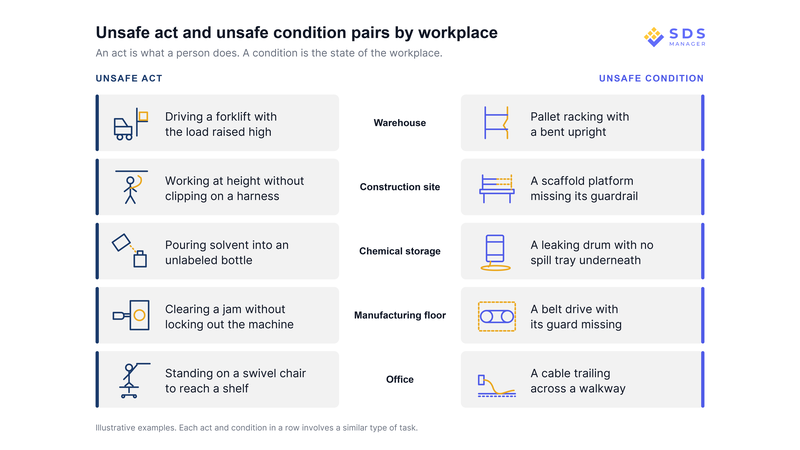
Seeing an unsafe act and an unsafe condition from the same type of workplace side by side makes the difference easier to see. These five common settings each pair an act and a condition from a similar type of task.
| Workplace | Unsafe act | Unsafe condition |
|---|---|---|
| Warehouse | Driving a forklift with the load raised high | Pallet racking with a bent upright |
| Construction site | Working at height without clipping on a harness | A scaffold platform missing its guardrail |
| Chemical storage area | Pouring solvent into an unlabeled bottle | A leaking drum with no spill tray underneath |
| Manufacturing floor | Clearing a jam without locking out the machine | A belt drive with its guard missing |
| Office | Standing on a swivel chair to reach a shelf | A cable trailing across a walkway |
Acts and conditions often cause each other. A forklift driver who travels with a raised load is more likely to strike racking, and the struck upright becomes bent racking. Breaking that kind of chain is part of warehouse safety, because the damage from one shift's shortcut becomes the hazard the next shift inherits.
Do Unsafe Acts Create Unsafe Conditions?
Yes, unsafe acts create unsafe conditions whenever a person's action leaves a hazard behind after they walk away. The act lasts a moment. The condition it creates stays until someone notices and fixes it, and the next person to come along may never know how it got there.
In a retail stockroom, a worker stacks a delivery in front of a fire exit to finish unloading faster, intending to move it later. The stacking was the unsafe act. The blocked exit is now an unsafe condition for everyone in the building, including people who were never in the stockroom.
Equipment works the same way. A painter in a spray booth who notices a split in a respirator facepiece and keeps working is committing an unsafe act. If the respirator goes back on the shelf unreported, it becomes an unsafe condition for the next person who picks it up. Clear rules for handling damaged or defective PPE prevent that by making it simple to tag and remove the item.
This overlap is why so many accidents trace back to both kinds of cause at once, and it is where the most famous statistic on the subject goes wrong.
What Do Unsafe Acts vs Unsafe Conditions Statistics Really Show?
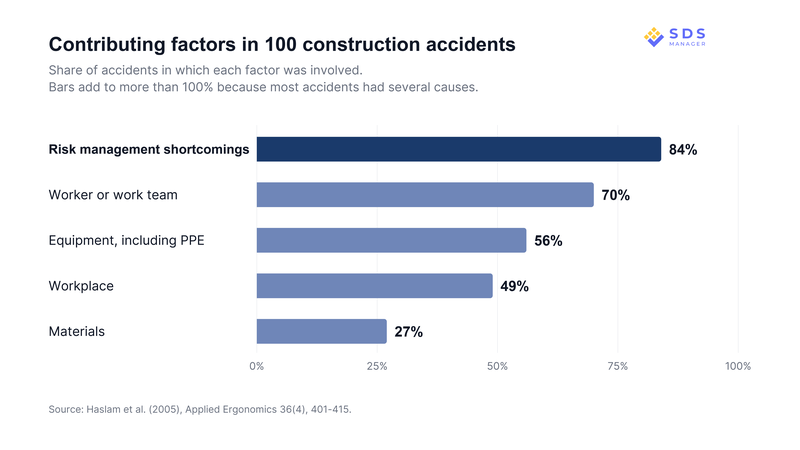
Accident research that looks at every contributing factor, not a single cause, finds that the factors behind the person often matter most. A 2005 study published in Applied Ergonomics examined 100 construction accidents in depth, using interviews, site inspections and reviews with designers and suppliers.
Problems arising from workers or the work team were involved in 70% of accidents. Equipment shortcomings, including PPE, were involved in 56%, workplace issues in 49% and problems with materials in 27%. Shortcomings in risk management were involved in 84%. The percentages add up to far more than 100 because most accidents had several causes at once.
For a supervisor, the 84% figure matters most. It means decisions about planning, equipment and supervision usually shaped the conditions that made a worker's action dangerous. Recording "unsafe act" and stopping there would have missed the most common contributing factor in the study.
Unsafe Acts Are Usually a Symptom, Not a Root Cause
An unsafe act is usually where an investigation should start, not where it should end. OSHA's incident investigation guidance warns that concluding carelessness or a missed procedure alone caused an incident is easy and often misleading. It tells investigators to focus on root causes rather than fault, and to ask whether production pressure played a part.
The Canadian Centre for Occupational Health and Safety (CCOHS) makes the same point in different terms. It treats unsafe acts and unsafe conditions as direct causes, and the factors behind them as the indirect causes an investigation has to reach.
CCOHS also warns about investigator bias: if you believe accidents come from unsafe conditions, you will tend to find conditions, and if you believe they come from people, you will tend to find unsafe acts.
A bottling line shows what that bias costs. Suppose an operator bypasses an interlock to clear a jam, and the line jams about once an hour. If you write up the bypass as an unsafe act and retrain the operator, the hourly jam is still there, and so is the pressure to bypass the interlock again. The jam is the condition that made the act predictable.
Why Do Workers Commit Unsafe Acts?
Workers commit unsafe acts for different reasons, and each reason needs a different fix. The UK Health and Safety Executive (HSE) sorts human failure into errors, which are unintended, and violations, which are deliberate. Its HSG48 publication breaks the violations down further.
- Slips: a familiar action done wrong, such as pressing the wrong button on a panel the worker uses every day.
- Lapses: a step forgotten or a place in a task lost, often after an interruption.
- Mistakes: doing the wrong thing while believing it is right, either by applying the wrong rule or by reasoning through an unfamiliar situation incorrectly.
- Routine violations: breaking a rule as the normal way the job gets done, often because the rule does not fit the work.
- Situational violations: breaking a rule because of time pressure, staffing, equipment or conditions on the day.
- Exceptional violations: breaking a rule in a rare, unexpected situation to solve a problem.
HSE notes that most violations are not malicious. They usually come from poor design, unworkable rules or pressure to get the job done. The bottling-line operator who bypasses an interlock every hour is committing a situational violation that is becoming a routine one. A job safety analysis walks through the jam-clearing task step by step, and it would show that the safe method takes too long to be realistic, which is the real problem to fix.
What About Behavior-Based Safety Programs?
Behavior-based safety programs help only when they look past the unsafe act to the conditions behind it. According to HSE's behavioural safety guidance, these programs follow three steps:
- define safe and unsafe behaviors,
- have trained observers watch work, and
- give feedback.
HSE also warns that a focus on individual workers ignores the hidden weaknesses behind incidents, and implies that incidents can be prevented if people simply take more care. It adds that behavioral programs only work when engineering, technical and systems controls are already in place and well managed.
An observation program that only counts unsafe acts will keep counting the same ones, because nothing changes the conditions that produce them.
How to Respond to, Classify and Report Unsafe Acts and Unsafe Conditions
Responding well to an unsafe act or condition means doing three jobs: stop the immediate danger, record what you saw accurately, and get the cause fixed. Reporting ties them together, because hazards nobody reports never reach the person who can fix them.
Who Is Responsible for Reporting Unsafe Conditions?
Everyone on site is expected to report unsafe conditions, but the employer is responsible for fixing them.
In the US, the General Duty Clause of the Occupational Safety and Health Act (OSH Act) requires employers to keep the workplace free from recognized hazards likely to cause death or serious physical harm.
OSHA tells workers that reporting to a supervisor is often the fastest way to get a hazard fixed, and the OSH Act bars employers from retaliating against workers who file a complaint or use other OSHA rights.
Some countries make reporting a legal duty for workers too. In Great Britain, regulation 14 of the Management of Health and Safety at Work Regulations 1999 sets out that duty: employees must tell their employer about serious and immediate dangers, and must also report shortcomings in the employer's protection arrangements. Whatever the law where you work, reports only keep coming if workers see that reporting leads to fixes rather than blame.
What Should a Supervisor Do After Spotting an Unsafe Act?
As a supervisor, here’s what you should do after spotting and unsafe act:
- Stop the work safely: Interrupt the task without startling the worker into a worse position, for example by waiting until a load is set down. Make sure your crews know that anyone, not only a supervisor, can stop work that looks immediately dangerous.
- Make the area safe: Put a guard back, isolate the machine or tape off the area so no one else is exposed while you talk.
- Ask what made the shortcut seem reasonable: Common answers are time pressure, a missing tool or a rule that does not fit the job. Each one points to a condition.
- Record both the act and any linked condition: Note what was done and what about the task, tools or workplace made it likely.
- Fix the cause and follow up: Assign the correction, set a date and check back with the worker once it is done.
CCOHS advises investigators to avoid recommending discipline, because it works against the purpose of an investigation and discourages people from sharing information in later ones. It points corrective actions toward helping the worker avoid repeating the act, such as additional training and supervision.
How to Tell Whether a Hazard Is an Unsafe Act or an Unsafe Condition
A hazard is an unsafe condition if it would still be there when everyone stopped moving. For example, a wet floor near a hotel ice machine is a condition.
A hazard that exists only because of what someone is doing right now is an act, such as a housekeeper carrying linens stacked so high they block the view. To classify a hazard on an observation card or inspection form, ask:
- Would the hazard still exist if no one were working? If yes, record an unsafe condition.
- Is the hazard something a person is doing, or failing to do, right now? If yes, record an unsafe act.
- Did an earlier act create the condition, such as a leak left unreported? Record both and link them.
- Did a condition make the act more likely, such as a missing tool that led to an improvised one? Record both and note which one caused the other.
Linked records are what make trends visible. Logging each observation in incident management software instead of on paper cards shows when the same unsafe act keeps appearing at the same machine, and a repeat like that usually means the machine is the problem.
How to Prevent Unsafe Acts and Unsafe Conditions
Preventing unsafe acts and unsafe conditions takes five steps: find the hazards, rank them, fix the conditions, remove the reasons behind unsafe acts, and check that the fixes work. Each step uses what the one before it found, so jumping ahead to training leaves the workplace hazards in place.
- Find the hazards and the shortcuts. Inspections and pre-use checks turn up unsafe conditions, and watching tasks being done turns up unsafe acts. Asking workers where the job is slow, awkward or missing a tool shows which shortcuts are likely before anyone takes them.
- Rank what you find by risk. A hazard that could seriously harm many people goes ahead of one that is unlikely to hurt anyone, even when the lower-risk hazard is easier to fix.
- Fix the condition with the strongest control available. Remove the hazard if you can, swap in something safer, or add a guard or interlock, and rely on procedures and PPE only for the risk that remains. The hierarchy of controls ranks these options in that order.
- Remove the reason behind each unsafe act. The right fix depends on the type of failure, which HSE classifies as slips, lapses, mistakes and three kinds of violation. Slips and lapses respond to a task redesigned so the error is hard to make, such as with an interlock or a checklist. Mistakes respond to training on a sound procedure, and routine violations to a rule rewritten to fit the job. Situational violations need realistic schedules, staffing and equipment, and exceptional violations need emergency procedures that people have practiced.
- Check that the fixes work. After a fix, re-inspect where it was made and talk to the workers who do the task. If the same act or condition comes back, the fix treated the symptom.
Which Should You Fix First, Unsafe Acts or Unsafe Conditions?
You should usually fix unsafe conditions first, because a physical fix protects every worker without depending on anyone's behavior. NIOSH notes that elimination, substitution and engineering controls work without significant human interaction, while administrative controls and PPE need ongoing effort from workers and supervisors.
The exception is an unsafe act that puts someone in immediate danger. Stop that act first, then fix the condition behind it so the act has no reason to come back.
Fix the System Behind the Unsafe Act
Sorting what you see on site into acts and conditions is useful, but it was never a reliable way to assign blame. The research behind the 88% figure counted one cause per accident, and the studies that counted more found both kinds of cause almost every time.
When you record an unsafe act, treat it as a question about the task, tools and pressures behind it. Finding those conditions before they lead someone to a shortcut takes a risk assessment of each task, and risk management software keeps each assessment, its controls and the incidents tied to it in one record, so a repeated shortcut shows up as a condition to fix.
Frequently Asked Questions
Is Not Wearing PPE an Unsafe Act or an Unsafe Condition?
Not wearing PPE is an unsafe act when the employer provided suitable PPE and trained the worker to use it. When the PPE was missing, the wrong size or unsuitable for the task, the root problem is an unsafe condition.
Is Horseplay an Unsafe Act?
Horseplay is an unsafe act, because it is a deliberate behavior that raises the risk of injury. Throwing tools and pushing a coworker near moving equipment are common examples. Repeated horseplay in one area can also point to weak supervision, which is worth looking at alongside the behavior.
Is a Near Miss an Unsafe Act or an Unsafe Condition?
A near miss is neither an unsafe act nor an unsafe condition, because it is an event rather than a cause. A case study developed through the OSHA and National Safety Council Alliance defines a near miss as an unplanned event that did not result in injury, illness or damage but had the potential to. Most near misses have an unsafe act, an unsafe condition, or both behind them, so each report is a chance to find them before someone gets hurt.
Is an Unsafe Condition the Same as a Hazard?
An unsafe condition is one type of hazard, but not every hazard is an unsafe condition. CCOHS defines a hazard as any source of potential damage, harm or adverse health effects. A properly stored and labeled chemical is still a hazard, and it becomes an unsafe condition only when something about its storage, labeling or handling equipment is wrong.
Can an Unsafe Condition Exist Without an Unsafe Act?
An unsafe condition can exist without any unsafe act behind it. Wear, corrosion, weather damage, aging equipment and poor original design all create hazards without anyone doing something wrong. That is why regular inspections matter even on sites where everyone follows the rules.
Is Bad Weather an Unsafe Act or an Unsafe Condition?
Bad weather is an unsafe condition, because it creates hazards whether or not anyone does something wrong. Ice on a walkway, high wind near a crane and heat on a roof are all conditions. Carrying on with the same work plan without adjusting for the weather is the unsafe act, and the absence of a weather plan is the problem to fix.
Is Fatigue an Unsafe Act or an Unsafe Condition?
Fatigue is usually a sign of an unsafe condition in how the work is organized, such as long shifts, back-to-back nights or short breaks between shifts. Operating equipment while too tired to do it safely is an unsafe act. The schedule that produced the fatigue is the cause to fix, because retraining a tired worker does not make them less tired.

Arysha Alif Khan

Arysha Alif Khan is an EHS and chemical safety specialist with a background in biochemistry, biotechnology, and public health. She works closely with the product and regulatory teams to turn complex chemical regulations, SDS requirements, and workplace safety standards into clear, practical guidance for people.