NFPA70E ELECTRICAL SAFETY PROGRAM TEMPLATE A National Fire Protection Association (NFPA) 70E Electrical Safety Program (ESP) is a documented set of policies, procedures, and controls required under NFPA 70E, Standard for Electrical Safety in the Workplace. Consistent with OSHA 29 CFR 1910.303-399, it protects workers from arc flash, electric shock, and electrocution. This template walks through each required component of an NFPA 70E-compliant ESP, from awareness and safety planning to program evaluation, so you can build, document, and maintain a program that keeps workers safe and satisfies OSHA requirements. 01 NFPA 70E ELECTRICAL SAFETY PROGRAM An NFPA 70E ESP provides a clear framework for managing electrical risk by: Meeting OSHA's requirement for a written, documented electrical safety program Giving workers step-by-step procedures before approaching energized equipment Reducing arc flash and shock incidents through defined, repeatable controls Keeping your facility ready for OSHA inspections and incident investigations Establishing consistent safe-work practices across every electrical task and crew Building shared accountability for safety between employers and employees This Template Is Suitable For EHS managers and safety officers building or updating an electrical safety program Plant electricians and maintenance workers who need documented, task-specific procedures Facility managers responsible for electrical compliance and equipment inspection Safety directors at industrial, manufacturing, construction, or commercial facilities Contractors and contract employees performing electrical work on-site Organizations required to comply with NFPA 70E and OSHA 29 CFR 1910 Subpart S Note: The templates/guides in our Content Library were created by the SDS Manager Team to help you manage site operations effectively. They are provided as reference tools and should be tailored to match your specific project needs, company policies, and industry standards. SDS Manager does not guarantee that these templates meet legal, regulatory, or contractual requirements. Users are responsible for reviewing and adapting each template to ensure compliance with their operational and legal obligations. 02 NFPA 70E ELECTRICAL SAFETY PROGRAM TEMPLATE Field Response SECTION 1: PROGRAM ADMINISTRATION AND SCOPE Organization name Program title Program owner / administrator Backup contact Effective date Review cycle Facilities and locations covered Equipment types covered Personnel covered OSHA standard reference OSHA 29 CFR 1910.303-399 Complete the fields below to establish ownership, document scope, and set your program review schedule. NFPA requires periodic reviews at least annually. List all facilities, equipment categories, and worker types within scope. Complete each field in the Response column. Your review cycle should be annual at minimum. List all facilities, equipment categories, and worker types within scope. The OSHA Standard Reference row confirms alignment with OSHA 29 CFR 1910.303-399. NFPA 70E defines how to meet those performance-based requirements. 03 # Principle Statement SECTION 2: ELECTRICAL SAFETY PRINCIPLES 1 Every electrical conductor or circuit part is considered energized until proved otherwise. 2 Plan every job before work begins. Complete a job briefing and job safety plan. 3 De-energize all conductors and circuit parts before working on them. This is always the first priority. 4 Identify, isolate, and lock out every energy source before work begins. 5 Use only the right tools and PPE for every task. Don't improvise. 6 Work only within your qualified training and authorized scope. 7 Inspect electrical equipment before use. Report defects immediately. 8 Never bypass or defeat electrical safety devices, guards, or interlocks. 9 10 Principles are the broad guiding statements for how electrical safety is managed at your facility. NFPA 70E Informative Annex E lists 10 typical principles. Edit or add below to match your site. Review the eight principles below, which are based on NFPA 70E Informative Annex E. Edit any principle to reflect your facility's practices. Add site-specific principles in rows 9 and 10.
100%
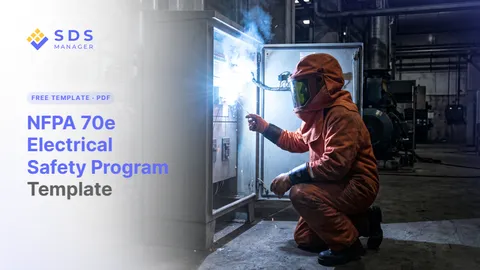
NFPA 70e Electrical Safety Program Template — cover

That’s the end of the preview

Download the PDF to read the full report.

Template · Free PDF

NFPA 70e Electrical Safety Program Template

3 downloads

13 pages · PDF

Free NFPA 70E electrical safety program template (PDF). Write a program that covers lockout/tagout, risk assessment, PPE and training, consistent with OSHA 29 CFR 1910 Subpart S.

What's inside

  • Program administration and scope: owner, review cycle, facilities, equipment and personnel covered
  • The electrical safety principles from NFPA 70E Informative Annex E
  • Sections for the program's required components, including lockout/tagout, risk assessment and PPE
  • Procedures to follow before approaching energized equipment
  • Training and qualified person requirements
  • Program review, with an annual review at minimum

Who it's for

  • EHS managers and safety officers
  • Plant electricians and maintenance workers
  • Facility managers and safety directors
  • Contractors and contract employees doing electrical work
  • Organizations that must comply with NFPA 70E and OSHA 29 CFR 1910 Subpart S

What is NFPA 70E?

NFPA 70E, Standard for Electrical Safety in the Workplace, is published by the National Fire Protection Association. It sets out safe work practices to protect workers from electric shock, electrocution, arc flash and arc blast. It covers when equipment must be put in an electrically safe work condition, how to assess shock and arc flash risk, and which PPE to wear.

How often is NFPA 70E updated?

Every three years. The current edition is 2024, and the next is due in 2027. Check your program against the latest edition when it's published.

What is the relationship between OSHA and NFPA 70E?

OSHA hasn't adopted NFPA 70E into its regulations. OSHA's electrical standards, mainly 29 CFR 1910 Subpart S, say what employers must achieve: protect workers from electrical hazards, train qualified persons, use lockout/tagout and provide suitable PPE. NFPA 70E describes how to achieve it.

Does OSHA enforce NFPA 70E? Not directly. OSHA can, however, use it as evidence that a hazard was recognized and that feasible ways to protect workers existed. In practice, following NFPA 70E is the most widely accepted way to show you meet OSHA's electrical requirements.

What an electrical safety program includes

NFPA 70E requires employers to have a documented electrical safety program (ESP). A complete program covers:

Scope and responsibilities

Name the program owner, the sites and equipment covered, and the duties of managers, qualified persons and unqualified workers.

Risk assessment procedures

Describe how you'll assess shock and arc flash risk before any work on or near exposed energized parts, including how you determine approach boundaries and PPE.

Electrically safe work condition

Set out the lockout/tagout steps used to de-energize equipment, including testing for absence of voltage. De-energizing is the default. Energized work needs a written justification and an energized electrical work permit, with limited exceptions such as testing and troubleshooting.

PPE and equipment

Specify arc-rated clothing, insulated gloves and tools, and how they're inspected and maintained.

Training and qualification

Define who counts as a qualified person and what training they need. NFPA 70E requires retraining at intervals of no more than three years.

Audits

Audit the program at intervals of no more than three years, and audit field work at least once a year to check that procedures are being followed.

Example: deciding whether to work energized

A maintenance team needs to replace a faulty breaker in a 480-volt panel during production.

  • Default: Shut down and lock out the panel during a planned stop.
  • If energized work is proposed: Write a justification for why de-energizing isn't feasible and complete an energized work permit, approved by a manager.
  • Before work: Carry out a shock and arc flash risk assessment, set the approach boundaries and select arc-rated PPE.

In most cases, scheduling the work for a planned stop is safer and simpler.

Keeping the program current

Review the program at least once a year and after any electrical incident, near miss or change to equipment.

Download the free NFPA 70E electrical safety program template to start or update your program. To track the gaps you find during a program review, use it with the Corrective Action Plan Template.