
Most tasks at work have a safe way to do them, but the safe way and the way people work are not always the same.
Say a business has a written rule to switch off a packing machine before anyone clears a jam. If the people on the line reach in while it is still running, because that is how they were shown, the written rule is not the system they use.
A safe system of work is a set way of doing a task that controls its hazards, puts the steps in a safe order, and makes clear who can do the work and what they need to do it safely. In the UK, every employer has a legal duty to provide one. By the end of this article, you'll know what the law requires, what to put in a safe system of work, and how to create one that people follow.
Key Takeaways
- A safe system of work (SSOW) is an agreed method for doing a task that keeps the hazards found in a risk assessment under control every time the task is done.
- UK employers must provide systems of work that are safe so far as is reasonably practicable, under section 2(2)(a) of the Health and Safety at Work etc. Act 1974.
- A safe system of work does not always have to be written down, but higher-risk work is expected to have a written system, and the most dangerous jobs also need a permit to work.
- A safe system of work should cover the people doing the task, the equipment and materials they use, the place where the work happens, the method in order, and what to do in an emergency.
- You create a safe system of work in five steps: assess the task and its hazards, decide how to control each hazard, write down the method, train and supervise the people doing the work, then monitor and review it.
- HSE prosecutions in 2026 show that a written safe system of work does not protect a business if workers do not follow it and managers do not enforce it.
What Is a Safe System of Work?
A safe system of work is the agreed, step-by-step way of doing a task so that the hazards found in your risk assessment are controlled every time the task is done. It is often shortened to SSOW.
The risk assessment decides which controls a task needs. The system then makes those controls part of the job itself: who does it, in what order, with which equipment, and what to do if something goes wrong.
Cleaning a meat slicer on a supermarket deli counter is a useful example, because it is a familiar task with a serious hazard. HSE's catering guidance says most machinery accidents in catering are caused by incorrect cleaning and reassembly of slicing machines, or by poorly maintained guards. The system for cleaning the slicer could be as simple as this:
- Only staff who have been trained on the slicer clean it.
- Switch the slicer off and unplug it before cleaning starts.
- Keep the blade guard fitted while cleaning.
- Clean the parts in the same order every time, wearing cut-resistant gloves.
- Refit the guards and check them before the slicer is used again.
None of those steps is complicated. What makes them a system is that everyone who cleans the slicer does it the same way, every time.
Is a Safe System of Work a Legal Requirement in the UK?
Yes, a safe system of work is a legal requirement in the UK. Section 2(2)(a) of the Health and Safety at Work etc. Act 1974 requires every employer to provide and maintain "plant and systems of work that are, so far as is reasonably practicable, safe and without risks to health".
"So far as is reasonably practicable" means you weigh the risk against the time, cost and effort it takes to reduce it. The duty is not absolute, but cost alone cannot justify leaving a serious risk in place. The same test is the basis of keeping risks as low as reasonably practicable, usually shortened to ALARP.
Other parts of UK law shape what your system has to contain:
- Section 2(2)(c) of the 1974 Act: give your employees the information, instruction, training and supervision they need.
- Section 3 of the 1974 Act: protect people who are not your employees, such as contractors and visitors.
- Section 7 of the 1974 Act: employees must take reasonable care of themselves and others, and co-operate with you.
- Regulation 3 of the Management of Health and Safety at Work Regulations 1999 (MHSWR): carry out the risk assessment your system is built on.
- MHSWR regulation 13: train people when a system of work is introduced or changed.
- MHSWR regulation 14: employees must report serious dangers and gaps in the protection you provide.
- Task-specific regulations: for example, the Confined Spaces Regulations 1997 require a system of work that makes confined-space entry safe.
Does a Safe System of Work Have to Be Written Down?
No, a safe system of work does not have to be written down for every task, because there is no general legal duty to write one. In practice, two legal rules and HSE's guidance lead most businesses to write down their higher-risk systems.
However, if you employ five or more people, you must record the significant findings of your risk assessment and your health and safety arrangements, under regulations 3(6) and 5(2) of MHSWR.
For confined spaces, HSE's Approved Code of Practice (L101) says the safe system of work "should be in writing".
A written system is also your evidence that the work was planned. In September 2026, Samworth Brothers Ltd was fined £594,000 after two workers were scalded while replacing a valve gasket. HSE said the company had failed to document a safe system of work for the job.
So, if an incident does happen, a documented safe system of work shows you assessed the risks and planned the job before anyone picked up a tool.
What Should a Safe System of Work Include?
A safe system of work should cover six things:
- People: who is allowed to do the task, what training they need, and how closely they are supervised. A new starter may need someone with them until they have done the task correctly several times.
- Equipment: the tools, guards and lock-off devices the task needs. PPE (personal protective equipment, such as gloves or goggles) comes last, because it protects only the person wearing it and only when it is worn properly.
- Materials and substances: the chemicals and materials involved and how to handle them. For a chemical, the safety data sheet gives you most of what you need. Section 7 covers handling and storage, section 8 covers exposure controls and personal protection, and section 10 covers stability and reactivity. A chemical risk assessment then turns that information into controls for your task.
- Place: access, lighting, ventilation, space to work, and anyone nearby who could be affected.
- Method: the steps in the order they are done, including any point where work must stop. A common stop point is checking that a machine is isolated, meaning switched off and disconnected from its power, before anyone reaches in.
- Emergencies: what to do if something goes wrong, who to tell, and where the first aid kit, spill kit or emergency stop is.
Training courses group these into four, five or seven parts, but those groupings are memory aids, not legal lists.
For a low-risk task, each of these might be one sentence. For a task that could seriously injure someone, each one needs enough detail that a new worker could follow it without guessing.
How to Create a Safe System of Work in 5 Steps
You create a safe system of work in five steps:
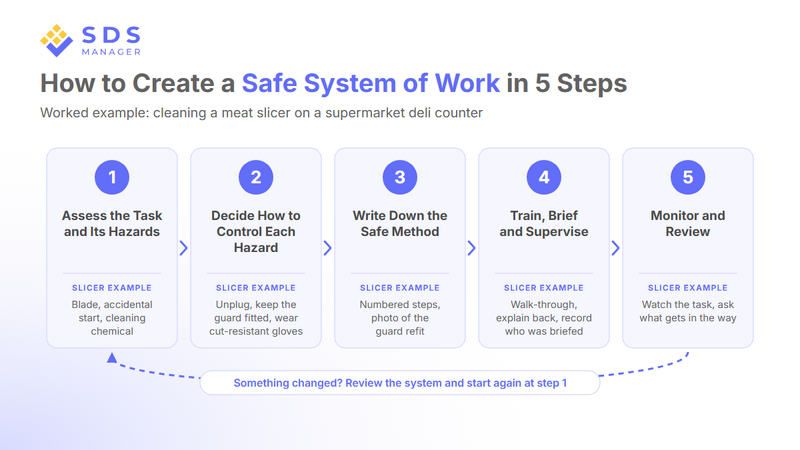
Step 1: Assess the Task and Its Hazards
Start by breaking the task into stages and asking what could go wrong at each one. For the slicer, the stages are switching it off, taking it apart, cleaning it, and putting it back together. The hazards include the blade, the slicer starting while someone's hand is near it, and the cleaning chemical.
Ask the people who clean the slicer every day. They know which part is awkward to reach and which shortcut people are tempted to take, and a system written without them tends to miss both. This step is finished when every stage has its hazards listed and you know who could be hurt.
Step 2: Decide How to Control Each Hazard
Once you know the hazards, decide how to control each one. Work through the hierarchy of controls in order: remove the hazard if you can, replace it with something less dangerous, guard or isolate it, change how the work is done, and use PPE only for the risk that is left.
Here’s an example of controls for cleaning a deli slicer:
| Hazard | Control | Type of control |
|---|---|---|
| Slicer starting during cleaning | Switch off and unplug before cleaning starts | Isolation |
| Cuts from the blade edge | Keep the blade guard fitted while cleaning | Guarding |
| Cuts while cleaning near the blade | Clean in a fixed order that keeps hands away from the blade edge | Safe method |
| Cuts from the risk that remains | Cut-resistant gloves | PPE |
| Skin irritation from the cleaning chemical | Dilute and handle the chemical as its safety data sheet says | Safe method and PPE |
Step 3: Write Down the Safe Method
Write the method as a numbered list in the order the work is done. Use plain words, and put each warning at the step it applies to rather than in a block at the top. Where a step is hard to describe, such as refitting the blade guard, add a photo or diagram.
Then test the safe method. Give it to someone who has not done the task and watch them follow it. Every place they hesitate or ask a question is a step that needs rewriting.
Step 4: Train, Brief and Supervise the People Doing the Work
A method only protects people who know it. Walk each person through it before they do the task, show them the steps on the equipment itself, and ask them to explain the controls back to you. Keep a record of who was briefed and when, so you can see who still needs a briefing when the method changes.
New starters, young workers and agency staff need closer supervision until they have done the task correctly several times. This step is finished when the people doing the task can explain the main controls without reading them.
Step 5: Monitor and Review the System
Watch the task being done and ask the people who do it what gets in their way. If they are skipping a step, find out why. The step may be impractical, or the equipment it needs may be missing, and either problem means the system needs to change before someone works around it again.
When Do You Need a Verbal, Written, or Permit-to-Work System?
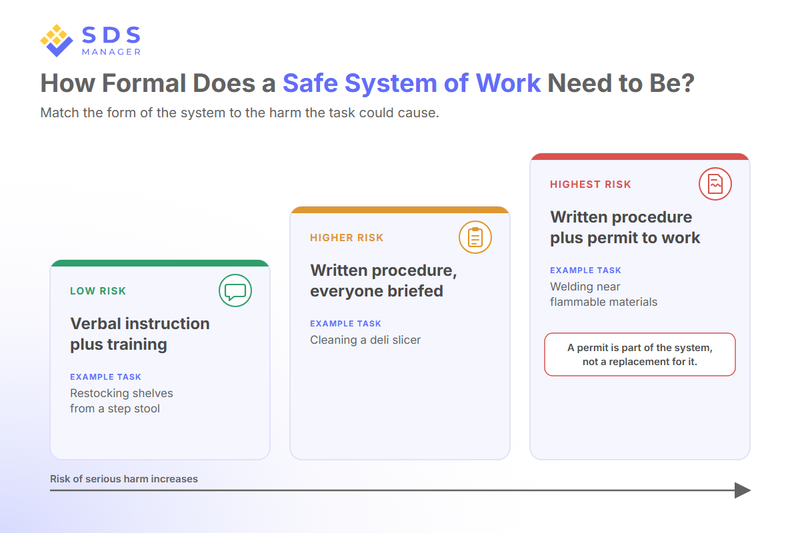
Use a verbal system for simple, low-risk tasks, a written procedure for most higher-risk work, and a permit-to-work system for the most dangerous jobs.
A permit to work is one part of a safe system of work, not a replacement for it. It's reserved for the most dangerous jobs, where the extra control of formal sign-off is needed.
A permit names the job, its hazards, the controls that must be in place before work starts, who is authorised to do it, and how long the permit lasts. Someone with authority signs it before work begins, and again when the work is finished, and the area is safe. The signature does not make the job safe. Following the controls listed on the permit does.
| Level of risk | Usual form | Example task |
|---|---|---|
| Low | Spoken instruction backed by training | Restocking shelves from a step stool |
| Higher | Written procedure that everyone is briefed on | Cleaning a deli slicer |
| Highest | Written procedure plus a permit to work | Welding or cutting near flammable materials (hot work) |
HSE's permit-to-work guidance (HSG250) calls it "an integral part of a safe system of work" and describes it as a formal, recorded way to control work that could be dangerous.
How Is a Safe System of Work Different From a Risk Assessment, Method Statement or RAMS?
A risk assessment works out what could go wrong and which controls a task needs, while a safe system of work is the way the task is done with those controls in place. A method statement is a written form of that system, and RAMS combines a risk assessment and a method statement in one document.
Safe System of Work vs Risk Assessment
A risk assessment and a safe system of work are linked, but they do different jobs. The risk assessment comes first. It looks at an activity as a whole, decides which risks need controlling, and is kept on record and reviewed.
The system takes those decisions and turns them into the steps one task follows on the day. A single risk assessment for a deli counter might lead to several separate systems: one for cleaning the slicer, one for changing fryer oil and one for unloading deliveries. A risk assessment that never becomes a working method protects nobody, because its controls stay on paper.
Safe System of Work vs Method Statement
A method statement is a written safe system of work. It sets out, step by step, how a particular job will be done safely, and the term is most common in construction and in paperwork from contractors. RAMS (risk assessment and method statement) puts the risk assessment and the method statement in one document.
The name on the document matters less than what is in it. Any document that sets out the steps, the controls and who does what for a specific job is a safe system of work in everything but name.
Safe System of Work Examples
The four tasks below show how the form of the system changes with the level of risk, from a written procedure for loading a lorry to a permit for entering a tank.
| Task | Main hazards | Main controls | Form of system |
|---|---|---|---|
| Loading a lorry with a forklift truck | Hitting people on foot, the load falling, the truck overturning | Trained operators only, separate routes for people on foot, checks before each shift | Written procedure |
| Replacing a high-level light in a warehouse from a mobile elevating work platform (MEWP) | Falls, the platform tipping over, people walking underneath | Trained operator, check of the ground, area closed off below, rescue plan | Written procedure |
| Decanting a corrosive cleaning chemical into a smaller container | Splashes to skin and eyes, fumes, using the wrong container | Controls from the safety data sheet, a labelled container, eye protection, a spill kit | Written procedure |
| Entering a confined space such as a tank | Toxic gas, lack of oxygen, difficulty getting someone out | Avoid entry if the work can be done from outside, test the air, set up rescue arrangements before entry | Written procedure plus a permit to work |
The first three tasks need a written procedure that everyone doing the work is briefed on. The confined space also needs a permit to work. The Confined Spaces Regulations 1997 do not allow anyone to enter until rescue arrangements are in place, and HSE expects the air to be tested first.
Who Is Responsible for a Safe System of Work?
The employer is legally responsible for providing a safe system of work, and that responsibility stays with the employer even when someone else writes the system or does the work
The UK Supreme Court made this point in Woodland v Essex County Council (2013). In that judgment, Lady Hale described an employer's duty to provide a safe system of working as the prime example of a duty that cannot be handed to someone else.
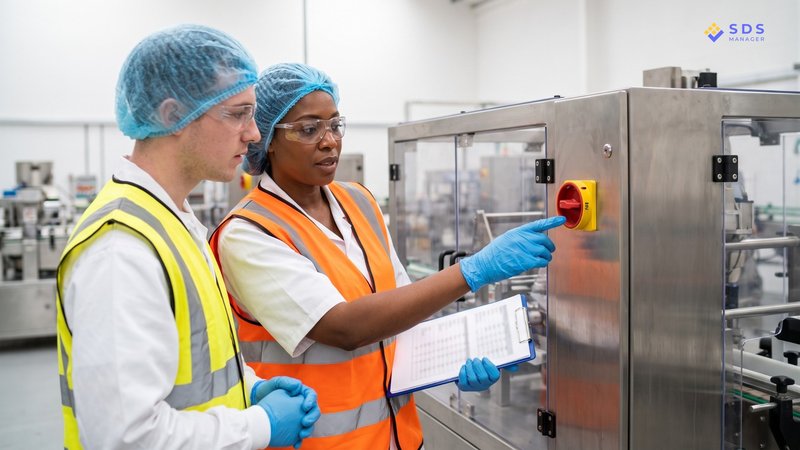
The legal duty stays with the employer, but the day-to-day jobs are shared out like this:
- Employers provide the system, the equipment, and the training, and stay responsible for all three.
- Managers and supervisors brief people, watch the work being done, and stop it when the system is not being followed.
- A competent person writes or checks the system. Under the competent person rule, which is a legal requirement for risk assessment, that can be anyone with enough training, experience or knowledge of the work, and a formal qualification is not required.
- Workers follow the system, use equipment the way they were trained, and report anything that makes the system unsafe.
How Are Safe Systems of Work Reviewed?
Safe systems of work are reviewed after an incident or near miss, whenever the task, equipment, people, substances or law change, and at a regular interval the employer sets, such as once a year. No UK law fixes the interval, so you choose it based on the risk.
The risk assessment behind the system has its own legal trigger. Under regulation 3(3) of MHSWR, you must review it when there is reason to think it is no longer valid, or when there has been a significant change in the work it covers. Review the safe system of work at the same time, because the system is only as current as the assessment it is built on.
The review is best done by the competent person who wrote the system, together with the people who do the task. Check four things:
- Whether people are following the system as written.
- Whether the controls still match the risk assessment.
- Whether anything about the task, equipment, substances or team has changed.
- Whether monitoring, near misses or complaints have shown a problem.
When the review changes the system, give the new version a date, remove the old copies, and brief everyone who does the task on what changed.
Why Safe Systems of Work Fail
Most safe systems of work fail because people do not follow them in practice, not because nobody wrote one. The usual reasons are:
- People were never briefed, or were briefed once when they started and not again.
- The task, equipment, or team changed, and the system stayed the same.
- Nobody checks whether the method is being followed.
- A shortcut saves time, and after it works a few times without anyone getting hurt, it becomes the normal way of doing the job.
HSE prosecutions from 2026 show both kinds of failure: a system that existed but was not followed, and no system at all. In September 2026, Factory Services UK Ltd was fined £160,000 after a maintenance engineer working alone on a night shift reached into a running conveyor and suffered serious injuries to his forearm.
HSE found that the company "had risk assessments and safe systems of work, but they were not followed or enforced". In October 2026, GMK Ltd was fined £800,000 after a worker was burned while using a waste disposal method that had no safe system of work at all.
In England and Wales, courts set fines for health and safety offences using the Sentencing Council's guidelines. The fine depends on the company's turnover and how serious the offence was, and the ranges reach £10 million.
The way to catch these failures early is to check systems while they are in use. Leading indicators, such as how many high-risk tasks were observed against their written method this month, show you whether a system is being followed, so you can correct it before someone is hurt.
Make Sure Your Safe System of Work Reaches the People Doing the Task
A written system protects only the people who know the current version, and that is the point where many businesses fall short. In many businesses, the written system is kept in a folder or on a shared drive, briefings are not recorded, and new starters or agency staff begin work without seeing it. When the method changes, the people trained on the old version often keep using it.
This week, pick your highest-risk task and ask the last two or three people who did it to describe its main controls. Compare their answers with the written system, and brief again anyone whose answer does not match.
EHS Solution by SDS Manager gets the current version of each procedure to the people who do the work through its Safety Training module. The module assigns training by role and site and shows when certifications are about to lapse.
Frequently Asked Questions
Do Lone Workers Need a Safe System of Work?
Yes, lone workers need a safe system of work that covers the extra risk of having no one nearby to help. HSE's guidance on lone working says the risks must be dealt with before anyone works alone, which usually means agreed check-in times, a way to raise the alarm, and a list of tasks that must not be done alone.
Can You Refuse to Work if There Is No Safe System of Work?
Yes, you can refuse to work, or leave your place of work, if you reasonably believe you face serious and imminent danger that you cannot avoid. Sections 44 and 100 of the Employment Rights Act 1996 protect you from dismissal or unfair treatment for doing so. A missing written system does not meet that test on its own, so raise the problem with your employer or safety representative first.
Do Contractors Have to Follow Your Safe System of Work?
Yes, contractors working on your site have to follow your site rules and safe systems of work, and they also need their own safe systems of work for the tasks they carry out. Your duty under section 3 of the Health and Safety at Work etc. Act 1974 covers contractors on your site, while a contractor that employs people owes those workers the same duty as any other employer.
Where Are Safe Systems of Work Used?
Safe systems of work are used in every type of workplace, including shops, care homes, offices, warehouses, laboratories, factories and building sites. What changes from one workplace to another is how formal the system is, and that goes up with the risk of the task.
Are Safe System of Work Rules the Same in Scotland and Northern Ireland?
Safe system of work rules are the same in England, Scotland and Wales, because the Health and Safety at Work etc. Act 1974 covers all three. Northern Ireland has the same duty in Article 4(2)(a) of the Health and Safety at Work (Northern Ireland) Order 1978, and the Sentencing Council's fine guideline applies only in England and Wales.
Are Handrails Safe Systems of Work?
No, handrails are not safe systems of work on their own, because a handrail is a physical control, while a system of work is the method people follow. The Health and Safety at Work etc. Act 1974 lists plant and systems of work separately, and a safe system of work for a task on a raised platform would rely on the handrail being in place and checked.

Arysha Alif Khan

Arysha Alif Khan is an EHS and chemical safety specialist with a background in biochemistry, biotechnology, and public health. She works closely with the product and regulatory teams to turn complex chemical regulations, SDS requirements, and workplace safety standards into clear, practical guidance for people.