Every WHS duty in Australia comes with the same qualifier attached: so far as is reasonably practicable. It sounds like a get-out clause. It isn't.
188 workers died from traumatic injuries at work in Australia in 2024, according to Safe Work Australia's Key Work Health and Safety Statistics Australia 2025 report. Every one of those incidents traces back to a control decision that either held up under SFAIRP or didn't, starting with whether the underlying hazard was properly identified in the first place. Hazard identification is the process that determines what a duty holder even knew to weigh under section 18's test.
SFAIRP is a legal test with a specific structure, five defined factors, and a genuine standard courts apply after the fact. This article covers what it actually means, where it comes from, how it compares to ALARP, and how to actually demonstrate it rather than just assume you're meeting it.
Key takeaways
- SFAIRP requires weighing five specific matters, not a general judgment call, with cost appearing last in the list rather than first.
- The WHS Act never actually uses the acronym "SFAIRP" anywhere in the legislation. It's an industry shorthand for a phrase that appears throughout the duty provisions of the Act.
- SFAIRP and ALARP share an origin in Edwards v National Coal Board (1949), and ALARP is used in Australian offshore petroleum and rail regulation, not only in the UK. In a WHS prosecution, the test applied is section 18.
- Victoria is the one Australian jurisdiction that hasn't adopted the model WHS Act, running its own OHS Act 2004 with a similar but separately worded standard instead.
- Cost only excuses inaction when it's grossly disproportionate to the risk, not simply higher than a business would prefer to spend.
What Does SFAIRP Mean Under AU WHS Law?

SFAIRP means "so far as is reasonably practicable." Under the WHS Act, it defines how far a duty holder must go to eliminate or minimise a risk to health and safety.
Section 19 imposes the primary duty of care: a PCBU must ensure, so far as is reasonably practicable, the health and safety of its workers.
Section 17 then sets out how that duty, and every other duty under the Act, must be discharged. For example, eliminate risks so far as is reasonably practicable, and where eliminating the risk isn't reasonably practicable, minimise it so far as is reasonably practicable instead.
Section 18 then defines what "reasonably practicable" actually means.
Safe Work Australia's own guidance splits the definition into two parts. First, a duty holder must first consider what can be done, meaning what is possible in the circumstances for ensuring health and safety. Then consider whether it is reasonable to do all that is possible.
This two-part structure matters. A duty holder can't argue a control was unreasonable without first establishing what was actually possible. The test starts with feasibility, not convenience.
The standard isn't self-assessed. Safe Work Australia's interpretive guideline states it's determined objectively: "a duty-holder must meet the standard of behaviour expected of a reasonable person in the duty-holder's position," not whatever that business itself considered reasonable.
WorkSafe Victoria goes further, describing that reasonable person as one who is proactive about safety. This objective standard is also why section 18(c)'s "knows, or ought reasonably to know" defeats a simple "we didn't know" defence.
One detail catches most people off guard: the WHS Act never actually uses the word "SFAIRP" anywhere in its text. The Act consistently spells out "so far as is reasonably practicable" in full. SFAIRP, and its close cousin SFARP, are both industry shorthand that grew up around the phrase, not statutory terms themselves.
SFAIRP Is Judged on What Was Known at the Time
After an accident, the control that would have prevented it looks obvious. That's exactly the trap the test is designed to avoid: you can't start from the accident and work backwards to prove a breach.
In SKM Services Pty Ltd v Magistrates' Court of Victoria [2019] VSC 460, the Victorian Supreme Court overturned an employer's conviction after finding the original magistrate had "impermissibly reasoned backward."
The case involved a worker who suffered an amputation injury from a baling machine, and the magistrate's judgment had repeatedly asked what the employer could have done to prevent it, rather than what it should have foreseen beforehand. Associate Justice Lansdowne found that reliance on the word "could" rather than "should" throughout the judgment was itself evidence the wrong test had been applied.
The distinction matters because "could" is nearly always yes. In hindsight, almost any control can be shown to have been technically possible. If that were the actual test, every accident would automatically prove a breach, regardless of what the duty holder reasonably knew or could have foreseen at the time.
SFAIRP asks the second question, not the first: what a duty holder should have foreseen and done before the incident, based on what they knew or ought reasonably to have known then, not what a court can identify afterward with the benefit of hindsight.
The Five Matters That Determine What's Reasonably Practicable
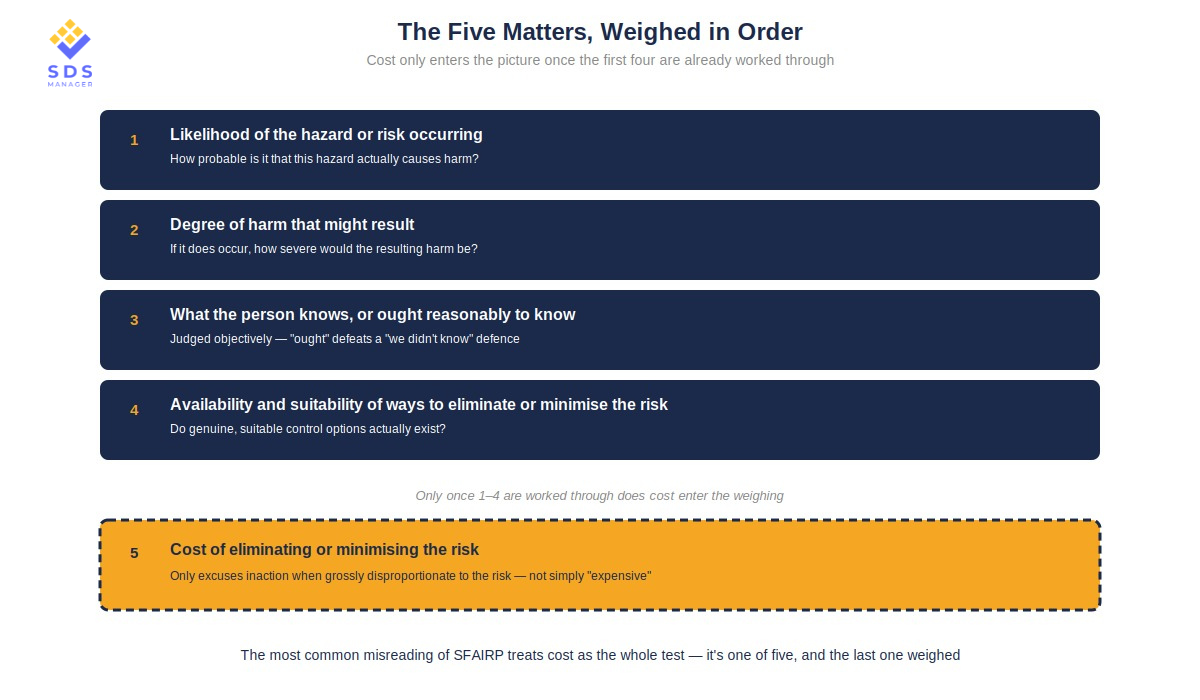
What's reasonably practicable comes down to weighing five specific matters set out in section 18, not a general sense of what feels reasonable, as SafeWork NSW's guidance sets out clearly.
| Matter | What It Asks | |
|---|---|---|
| Likelihood of the hazard or risk occurring | How probable is it that this hazard actually causes harm? | |
| Degree of harm that might result | If it does occur, how severe would the resulting harm be? | |
| What the person knows or ought reasonably to know | What does the duty holder actually know, or should know, about the hazard and how to control it? | |
| Availability and suitability of ways to eliminate or minimise the risk | Do genuine control options exist, and are they actually suitable for this specific risk? | |
| Cost of eliminating or minimising the risk | Is the cost of the control grossly disproportionate to the risk it addresses? |
Cost sits deliberately last on this list, not first. A duty holder has to work through likelihood, severity, knowledge, and control availability before cost even enters the picture. Cost only becomes a legitimate factor once a genuine control has been identified, and even then, it only excuses inaction when the cost is grossly disproportionate to the risk being addressed, not simply higher than a business would prefer to spend.
SFAIRP vs. ALARP: Are They the Same Thing?
Not exactly, though they share the same origin. Australia's WHS Act built SFAIRP directly from UK case law, tracing back to Edwards v. National Coal Board (1949), the same ruling that produced the ALARP standard (As Low As Reasonably Practicable), the term risk and engineering practitioners still use today.
That English case isn't the only authority worth citing in an Australian context, though. The High Court settled how Australian courts read "reasonably practicable" in Slivak v Lurgi (Australia) Pty Ltd (2001) 205 CLR 304, where Justice Gaudron held that the words "are ordinary words bearing their ordinary meaning," and that the question of whether a measure is reasonably practicable "requires no more than the making of a value judgment in the light of all the facts." This is the domestic authority Australian courts and regulators actually apply, not the 1949 UK ruling on its own.
ALARP isn't a UK-only term in Australia either. NOPSEMA, the regulator for offshore petroleum safety, requires operators to demonstrate that major accident event risks are reduced to a level that is ALARP, citing Slivak v Lurgi directly in its own guidance on the standard. ALARP is also standard terminology in the rail sector. Both frameworks exist alongside SFAIRP within Australian law, not as an import used only informally.
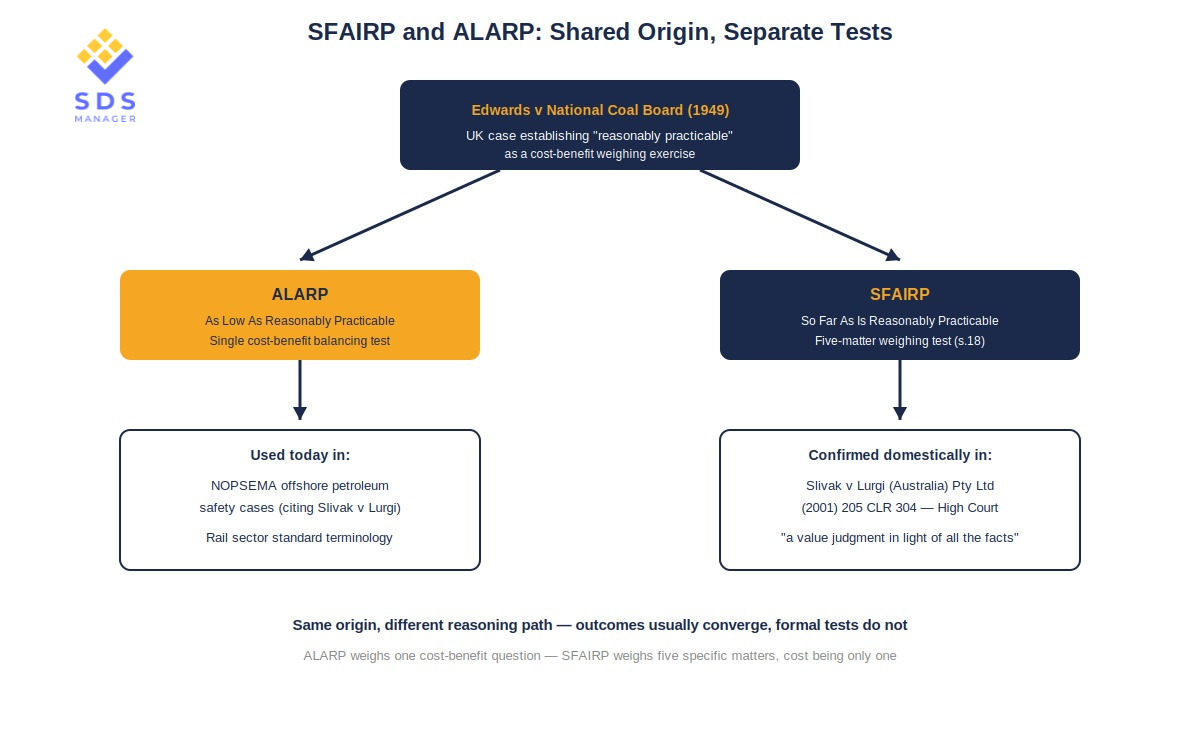
The two concepts still overlap heavily in practice. Some industries and practitioners use SFAIRP and ALARP interchangeably. Others treat them as genuinely distinct legal tests, since ALARP traditionally centers on a single cost-benefit balancing question, weighing risk reduction against the sacrifice required to achieve it, while SFAIRP's section 18 sets out five specific factors to weigh, cost being only one of them. In practice, the outcome the two standards produce is usually similar, but the formal reasoning path to get there differs.
How Do You Demonstrate SFAIRP in Practice?
Demonstrating SFAIRP means being able to show the reasoning, not just the outcome. A duty holder needs a documented record of the process, not simply a claim that safety was considered.
- Identify the hazard and assess its likelihood and severity first, before considering any control options at all.
- Establish what you know, or ought to know, about the hazard, drawing on industry guidance, codes of practice, and any relevant expertise available.
- Identify every available and suitable control, not just the first or cheapest option that comes to mind.
- Weigh the cost of each control against the risk it addresses, applying the gross disproportion test rather than a simple cost comparison.
- Select and implement the control that genuinely reflects this weighing, not the one that was easiest to justify after the fact.
- Document the reasoning at each step. A record showing how the five matters were actually considered is what separates a genuine SFAIRP process from an assumption that one occurred.
How Does the Standard Work With the Hierarchy of Controls?
SFAIRP and the hierarchy of controls work together directly. The hierarchy provides the order controls should be considered in: elimination, substitution, isolation, engineering controls, administrative controls, and PPE last. SFAIRP provides the test for how far down that hierarchy a duty holder actually has to go for a specific hazard.
A higher-tier control that's available and suitable generally has to be preferred over a lower-tier one, unless the cost of implementing it is genuinely disproportionate to the risk involved. This is also where the two frameworks correct a common misreading of each other: SFAIRP doesn't let a duty holder pick PPE simply because it's cheaper, and the hierarchy doesn't mean every hazard has to be run through all six named measures regardless of what SFAIRP's own five-matter weighing actually calls for.
Does "So Far As Is Reasonably Practicable" Mean the Same Thing in Every State?
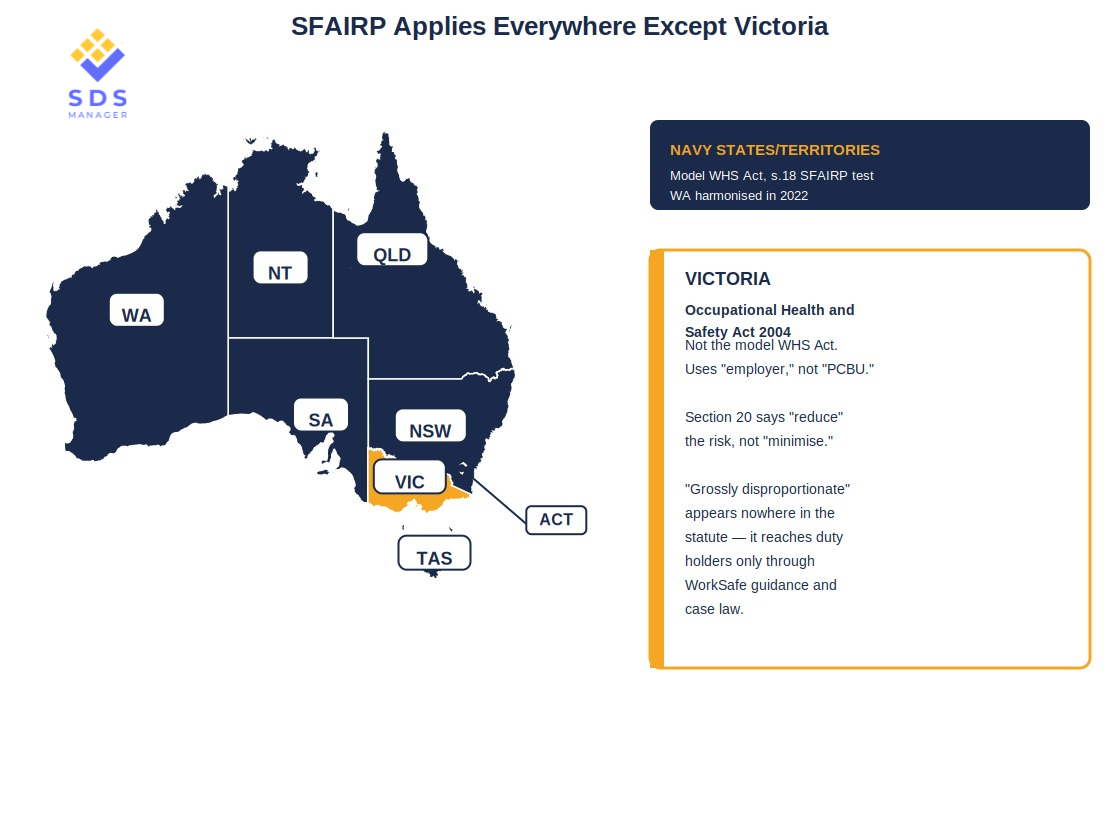
Almost, but not entirely. Every Australian state and territory except Victoria has adopted the model WHS Act, including Western Australia, which harmonised in 2022. Across all of these jurisdictions, SFAIRP works the same way, built on the same section 18 definition and the same five matters.
Victoria is the exception. It runs its own Occupational Health and Safety Act 2004 rather than the model WHS Act, using "employer" instead of "PCBU" and its own separately worded reasonably practicable standard.
The five matters themselves are almost identical. Section 20 of the Victorian Act lists the same considerations in nearly the same words. The wording diverges in two places that matter.
Victoria says "reduce" the risk where the model Act says "minimise". And the phrase "grossly disproportionate" appears nowhere in section 20, even though it is written into the model Act at section 18(e). Victorian duty holders still face that threshold, but it reaches them through WorkSafe guidance and case law rather than the statute itself.
SFAIRP Comes Down to Weighing Risk Against What Can Genuinely Be Done
SFAIRP isn't a loophole, and it isn't a fixed checklist either. It's a structured weighing process: how likely is the harm, how severe would it be, what's actually known, what controls genuinely exist, and does the cost of implementing one hold up against the risk it addresses.
Getting this right depends on being able to show the reasoning behind a control decision, not just the decision itself. Risk management software that records why a specific control was chosen, not just which one was, makes that reasoning something a business can actually produce when it's asked for, rather than something that only lived in one person's memory at the time.
Frequently Asked Questions
Who Decides What's Reasonably Practicable?
The duty holder decides in the first instance whether that is a PCBU, an employer or an officer. But they don't set the standard they are judged against. Safe Work Australia's guideline states that what is reasonably practicable "is determined objectively", meaning the duty holder "must meet the standard of behaviour expected of a reasonable person in the duty-holder's position."
Does Cost Ever Excuse a Safety Failure Under SFAIRP?
Only in narrow circumstances. Cost can excuse not implementing a specific control, but only where that cost is grossly disproportionate to the risk it would address, not simply because a cheaper option exists or the preferred control is expensive.
What Happens If You Get SFAIRP Wrong?
Getting SFAIRP wrong exposes a duty holder to prosecution under the relevant WHS Act, with penalties scaling by category. Under the model WHS laws that apply in every state and territory, a Category 1 offence carries up to $11,839,000 for a body corporate and $2,368,000 for an individual PCBU or officer, as at 1 July 2025. The Commonwealth jurisdiction sets its Category 1 penalty higher, at $17.034 million for a body corporate from 3 July 2025.

Mehreen Iqbal

Started with a Bachelors in Microbiology, then a Masters in Public Health; Currently a Workplace Safety Expert.