Even the most careful workplace can't remove every risk it faces. UK law expects something different: a risk reduced as far as it reasonably can be, with a clear record showing the work was actually done.
ALARP, short for "as low as reasonably practicable," is the name for that standard, and the test that decides whether a workplace actually met its legal duty rather than simply claiming to. Meet it, and a risk assessment stays defensible the moment a regulator or a court asks how a decision got made.
In this guide, we walk you through what ALARP means, why UK law requires it, and how to put it into practice and prove you have.
Key Takeaways
- ALARP stands for "as low as reasonably practicable": the UK test that sets how far a workplace must reduce a risk before further improvement would cost more, in money, time, or effort, than the extra safety is worth.
- Reducing risk to ALARP is a legal duty in the UK, set out in Sections 2 and 3 of the Health and Safety at Work Act 1974.
- If a duty-holder is prosecuted, section 40 of the same Act puts the burden on them to prove that doing more was not reasonably practicable. The prosecution does not have to prove it was.
- Risk sits on a scale, not a switch: risk above roughly 1 in 1,000 a year of death for a worker can't be justified except in extraordinary circumstances; risk below 1 in 1,000,000 is broadly acceptable, and everything between must be brought down to ALARP.
- Most ALARP decisions are settled by applying relevant good practice, meaning standards HSE has already judged as satisfying the law. Cost weighing is for hazards good practice doesn't cover.
- The same reasoning applies whether the fix is cheap and obvious, like fitting a machine guard, or takes real judgment, like deciding how to ventilate a room used for cleaning chemicals.
- ALARP is a judgment call, not a fixed formula. It never means reducing risk to zero, and cost alone is never a valid reason to skip a control that's clearly practical.
What Does ALARP Mean?
ALARP stands for "as low as reasonably practicable," the standard UK health and safety law uses to judge whether a workplace has reduced a risk enough. A risk sits at ALARP once any further cut would take money, time, or effort that's grossly out of proportion to the safety gained.
ALARP acts on risk, not on the hazard that creates it. A chainsaw, a chemical, a wet floor: a hazard is simply the thing that could cause harm.
Risk is the chance that harm actually happens, and how severe it would be if it did. Grasping the difference between a hazard and a risk makes the rest of this guide easier to follow, since every step ahead reduces risk rather than removing the hazard behind it.
UK law treats ALARP as equivalent to a phrase you'll see in the same sentences, "so far as is reasonably practicable," or SFAIRP.
Is ALARP a Legal Requirement in the UK?
Yes, ALARP is a legal requirement in the UK. Section 2 of the Health and Safety at Work Act 1974 puts a duty on every employer for the health, safety, and welfare of their employees, so far as is reasonably practicable.
A version of the same duty extends under Section 3 to people who aren't employees but could still be affected by the work, contractors, visitors, members of the public near a site. ALARP comes directly from that phrase, "so far as is reasonably practicable": courts and regulators read it as requiring risk to be brought down to the ALARP standard, not to zero.
Employers and the self-employed both carry the duty, and it doesn't lift just because a task is routine, low-cost, or has never caused an injury before.
One more section decides what that duty means in a courtroom. Under section 40, a duty-holder prosecuted over a reasonably practicable duty has to prove that doing more was not reasonably practicable. The burden sits with the accused rather than the prosecution.
The reverse of what most people expect from criminal law. That single provision is why the record in step four below matters as much as the controls themselves.
It's only one part of a longer Act, and what the Health and Safety at Work Act covers beyond it is set out in a separate guide.
The ALARP Triangle: Three Zones of Risk
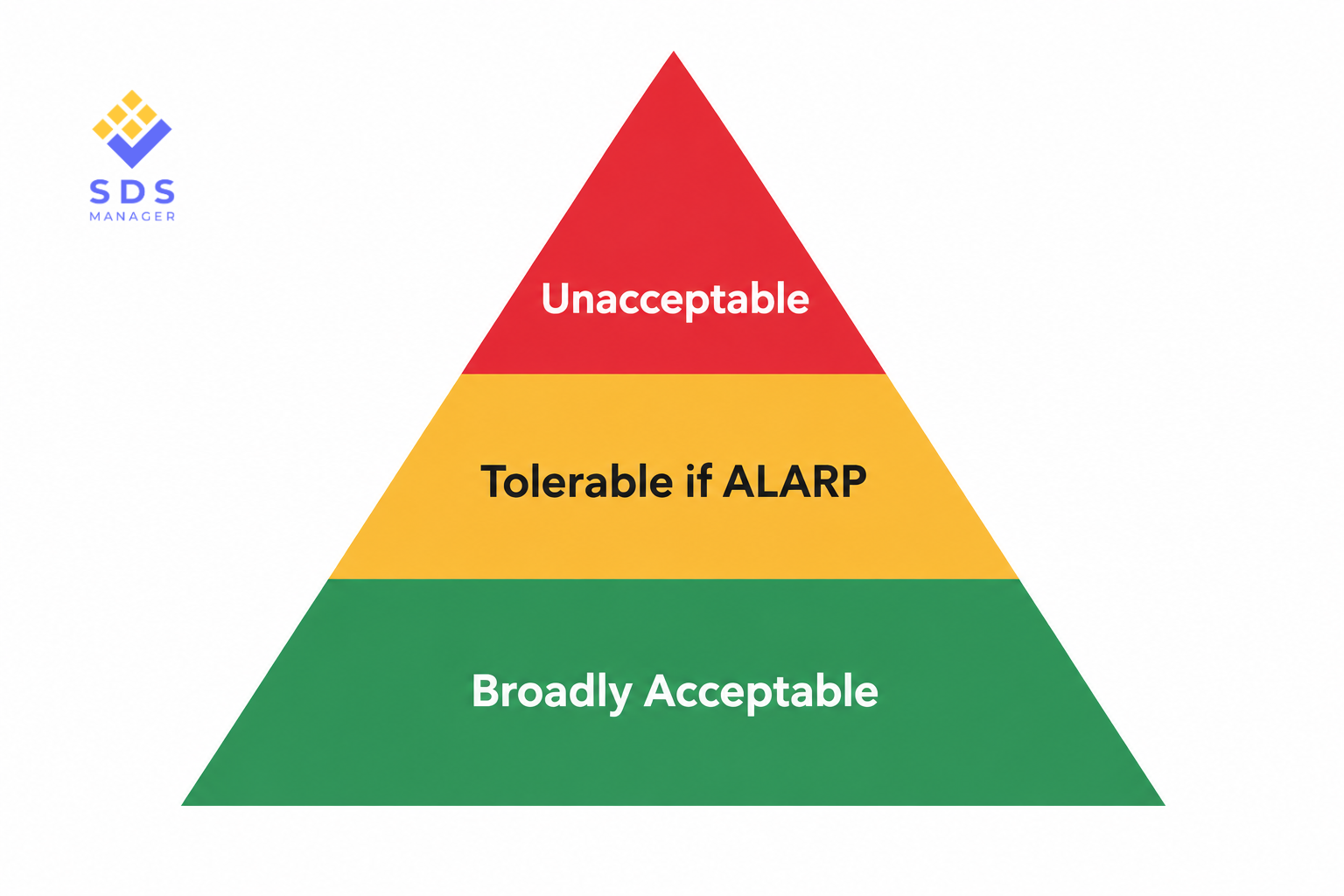
UK health and safety law doesn't judge risk as a simple yes-or-no. Regulators, including the HSE, split it into three bands instead, often drawn as a triangle that narrows from a wide unacceptable zone at the top to a small, broadly acceptable one at the bottom.
HSE puts figures on those boundaries in its guidance for major-hazard sites, expressed as an individual's chance of death per year.
| Risk Band | Individual Risk of Death per Year | What’s Expected |
|---|---|---|
| Unacceptable | Above about 1 in 1,000 for a worker, or 1 in 10,000 for a member of the public | Cannot be justified except in extraordinary circumstances. Reduce the risk or stop the activity, whatever it costs. |
| Tolerable if ALARP | Between those boundaries and about 1 in 1,000,000 | Continuing is acceptable only once the risk is reduced to ALARP (As Low As Reasonably Practicable) and the reasoning is recorded. |
| Broadly Acceptable | Below about 1 in 1,000,000 | No detailed ALARP demonstration is expected. Continue to ensure that the risk remains at this level. |
That middle band is where most of the risk you'll actually be assessing day-to-day sits, and it's exactly where the rest of this guide focuses.
How Do You Apply ALARP in Practice?
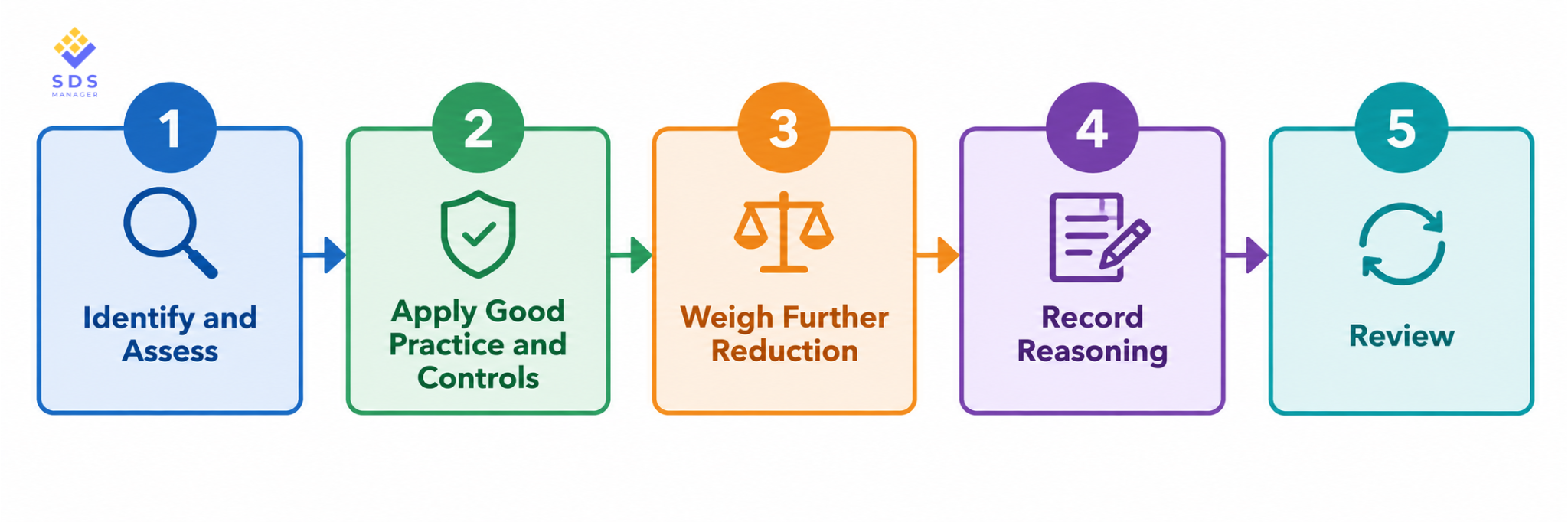
Five steps make up ALARP in practice: identify the hazard and assess the risk it creates, work through the hierarchy of controls, weigh any further reduction against its cost and effort, record that reasoning, then review it regularly. Each one calls for judgment rather than a calculation with a single right answer, which is exactly why the documentation in step four matters so much.
Step 1: Identify the Hazard and Assess the Risk
Start by naming whatever could cause harm: a machine, a chemical, a working-at-height task, a process. Then judge how likely it is to cause harm, and how severe that harm would be if it did.
That's what places the risk in one of the three bands from the triangle above: clearly unacceptable, sitting in the ALARP middle band, or already broadly acceptable.
Step 2: Start With Relevant Good Practice, Then the Hierarchy of Controls
Most ALARP decisions never reach a cost calculation. HSE's guidance to its own inspectors puts relevant good practice first, meaning standards of control HSE has already judged as satisfying the law.
Where recognised good practice covers what you're doing, following it is often enough on its own to show the risk is ALARP, and anything you substitute has to be shown at least as effective.
That good practice lives in Approved Codes of Practice, HSE guidance, British Standards and established sector standards. First-principles reasoning, and the cost weighing in the next step, are for the situations good practice doesn't reach, or hazards complex enough that meeting the standard isn't obviously the end of it.
Once you know what you're dealing with, the hierarchy of controls tells you the order to work through: eliminate the hazard if you can, substitute it for something safer, add engineering controls, then administrative controls, and treat personal protective equipment (PPE) as a last-resort backstop rather than a first move.
They're tried first because controls higher up the hierarchy tend to reduce risk further while relying less on people getting it right every time.
Step 3: Weigh Further Risk Reduction Against Cost, Time and Effort
ALARP earns its name at this step: weighing further risk reduction against cost. Once relevant good practice is in place, the question becomes whether reducing the risk any further is worth what it would cost, in money, time, or effort.
One thing the cost comparison can't do is argue good practice away. HSE won't accept a cost-benefit case against a recognised standard unless the alternative is demonstrated, unequivocally, to be at least as effective.
That comparison has a bar set by UK case law. In Edwards v National Coal Board (1949), the Court of Appeal held that a risk has to be reduced unless the cost, time, or trouble of doing so is grossly disproportionate to the safety gained, and "grossly disproportionate" sets a genuinely high bar. Before you're allowed to stop, the cost has to heavily outweigh the safety gained, not just exceed it.
HSE illustrates the gap with the same money spent two ways. A million pounds to prevent five bruised knees is grossly disproportionate. A million pounds to prevent an explosion that would kill 150 people is not.
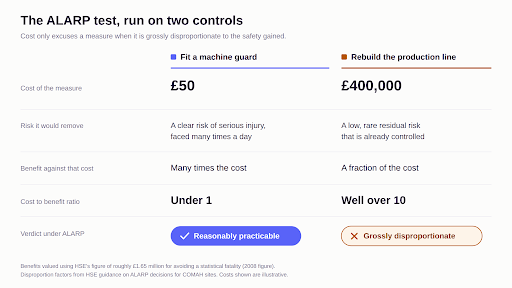
How far the scales have to tip is expressed as a disproportion factor, the ratio of cost to safety benefit a duty-holder is expected to accept before ruling a measure out. HSE's COMAH guidance starts that factor at 1 in the tolerable region and raises it as the risk grows, with an upper value of around 10 suggested for the highest hazards. The greater the risk, the less weight cost carries.
A short example makes the balance concrete. Almost every time, fitting a £50 guard that removes a clear risk of serious injury is reasonably practicable, since the cost is trivial next to the harm it prevents. At hundreds of thousands of pounds, rebuilding an entire production line to remove a risk that's already low and rare can tip the balance the other way, though that judgment still has to be made and recorded, never assumed.
What makes that arithmetic possible is a monetary value for the harm avoided. HSE's COMAH guidance takes the value of avoiding a statistical fatality at roughly £1.65 million, a 2008 figure. Then adds the costs an incident drags behind it: environmental clean-up, insurance, regulatory time. Set against a disproportion factor, that's what turns a judgment call into a comparison you can show somebody.
Step 4: Record Your Reasoning
Write down what you assessed, which controls you considered, why you chose the ones you did, and why you ruled anything out as not reasonably practicable.
This record is what shows the decision was reasoned rather than convenient, if a regulator or a court ever asks how a risk was managed. A document written at the time carries far more weight than any verbal explanation offered after the fact.
HSE frames a good ALARP demonstration as answering two questions. What more could I have done to reduce this risk? And why didn't I do it? Anything your record can't answer on those two points is a gap somebody else will find later.
The recording duty itself isn't in the Act. Regulation 3 of the Management of Health and Safety at Work Regulations 1999 requires a suitable and sufficient risk assessment, and regulation 3(6) requires employers with five or more employees to record its significant findings. Below five employees, the assessment is still required. Only the written record isn't.
Step 5: Review It Regularly
An ALARP assessment needs reviewing on a trigger, not filed away after a single pass: new equipment, an incident or near miss, a change in the law, or simply enough time passing that conditions may have shifted.
Once cheaper or safer alternatives exist, a control that was reasonably practicable five years ago can stop being adequate.
What Does ALARP Look Like in Real Workplaces?
Applied, the five steps above stop looking abstract. Three ordinary workplace situations below show how the same reasoning plays out at very different cost levels.
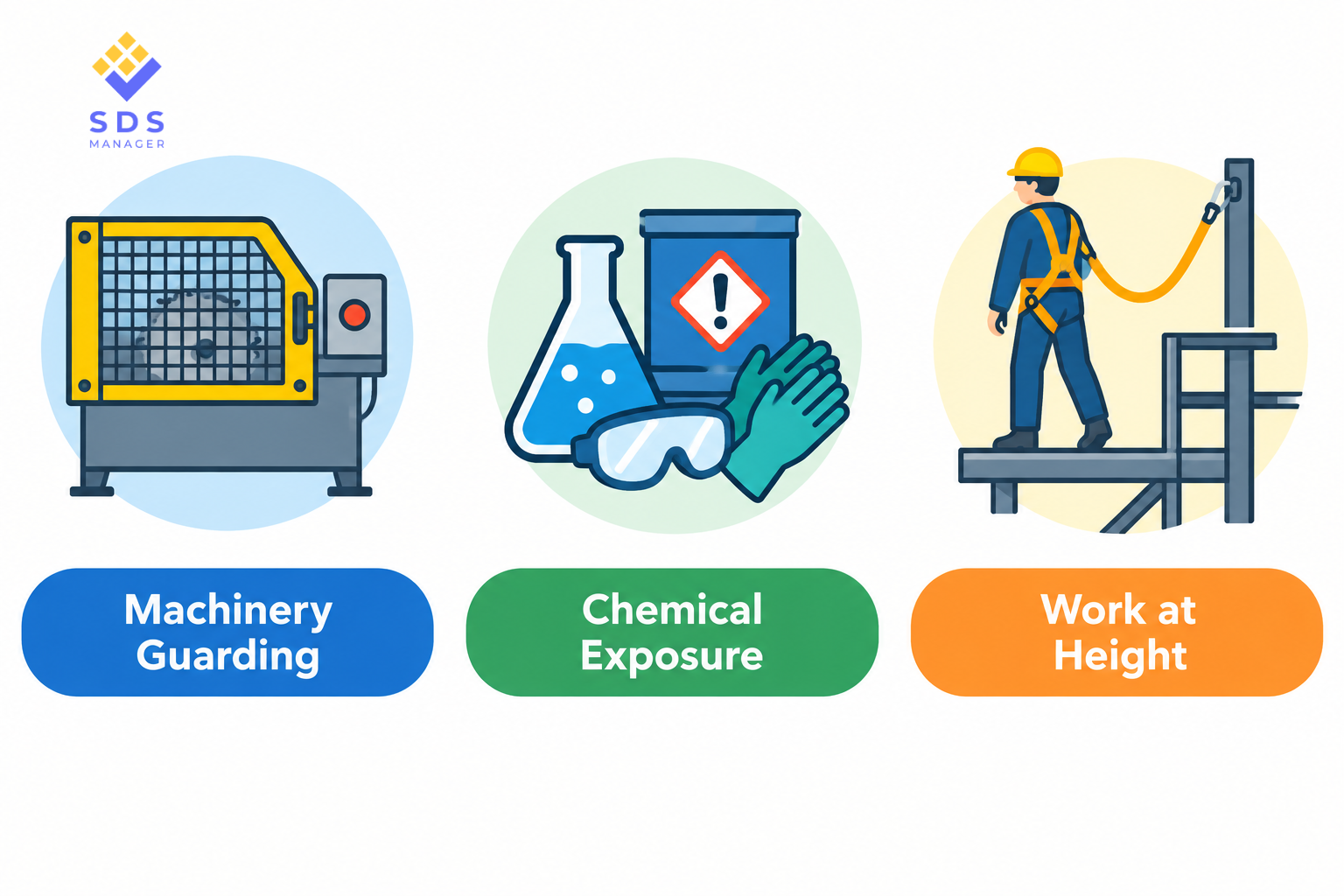
Example 1: Machinery Guarding
To save the few seconds it takes to lift and lower a blade guard between cuts, a small workshop runs its bench saw without one fitted.
That single missing guard creates several ways someone gets hurt:
- Direct contact with the moving blade
- Material kicking back toward the operator
- Loose clothing or hair caught in the mechanism
Hazard: the exposed blade.
Control considered: fitting a guard that only lifts when a cut is actually being made.
ALARP call: cheap, quick to fit, and barely slowing the job down, the guard has no credible case against it. Fitting it isn't disproportionate to the risk it removes, so it has to go on.
Regulation 11 of the Provision and Use of Work Equipment Regulations 1998 sets its own order for dangerous parts of machinery: fixed enclosing guards first, then other guards or protection devices, then jigs and holders, then information, instruction and training, each taken so far as is reasonably practicable.
Example 2: Chemical Exposure Under COSHH
Several times a shift, a cleaning contractor uses a strong solvent-based degreaser in a small, poorly ventilated room.
Working in that space carries its own set of risks:
- Breathing in fumes over the course of a shift
- Skin contact during mixing or application
- Vapour building up in an enclosed space with nowhere to go
Hazard: the solvent's fumes.
Control considered: switching to a water-based product, or adding basic ventilation such as an extractor fan.
ALARP call: against a real reduction in long-term health risk, either fix costs relatively little, exactly the kind of chemical risk assessment COSHH (the Control of Substances Hazardous to Health Regulations) requires an employer to carry out and document.
Regulation 7 of COSHH sets the order. Prevent exposure first, which in practice usually means substituting the substance for something that eliminates or reduces the risk.
Where prevention isn't reasonably practicable, control it adequately, working down from process design and engineering controls to control at source. Such as ventilation and organisational measures, and only then to PPE where adequate control can't be achieved by other means. Regulation 7(5) also requires applying the eight principles of good practice in Schedule 2A.
Example 3: Work at Height
Rather than fetching the right equipment from another room, someone in an office or stockroom stands on a chair to reach a high shelf.
That habit brings its own risks along with it:
- Losing balance on a surface that isn't designed to be stood on
- Falling while also carrying something
- The chair sliding out from underneath
Hazard: working above ground level on something not built for it.
Control considered: a proper step platform kept nearby.
ALARP call: costing very little while removing most of the risk, the platform clearly has to be provided. Higher costs and smaller risks, like the production-line example back in step three, are where the harder judgment calls come from.
Regulation 6 of the Work at Height Regulations 2005 runs the same sequence. Avoid work at height where it's reasonably practicable to do so, then prevent falls with suitable equipment, then minimise the distance and consequences of any fall that still happens.
Benefits and Challenges of ALARP
Against a fixed, one-size-fits-all safety rule, ALARP has real advantages. It's proportionate, directing resources toward the risks that matter most instead of spreading them evenly across problems of very different severity.
Properly applied and documented, it's also legally defensible, since it shows a reasoned process rather than a guess, and it flexes across industries and job types in a way a single numeric threshold never could.
That same flexibility creates real challenges. "Grossly disproportionate" has no fixed number attached to it, so different assessors can reach different conclusions from the same facts. Getting it right depends on judgment, not a formula you can look up.
The paper trail from step four matters for exactly this reason. Keep the reasoning behind every ALARP decision in a risk register rather than scattered across emails and memory, and you can show your work later, actually finding it again when a review comes around.
What Are the Most Common Misconceptions About ALARP?
The biggest misconception is that ALARP means picking the cheapest option available. Cost only overrides a control when it's grossly disproportionate to the risk, a high bar that rules out most "we didn't want to spend the money" arguments.
Eliminating risk completely is also often assumed to be what ALARP requires. Once reasonably practicable controls are in place, some residual risk almost always remains, and ALARP asks you to reduce risk to that point, not down to zero.
A third misconception treats ALARP as something judged with hindsight, after something has already gone wrong. What a reasonable employer would have known and done at the time, using the information available then, is the real standard, applied before any incident revealed the gap.
A fourth, quieter mistake confuses "reasonably practicable" with "practicable" alone. "Practicable" technically just means "capable of being done"; it's the word "reasonably" that brings cost, time, and effort into the comparison at all.
Getting to ALARP Is a Process You Repeat
A single number or a box you tick once was never what ALARP was meant to be. It's a discipline instead: identify the hazard, work through the hierarchy of controls, weigh what's left against its real cost, write the reasoning down, and revisit it as things change.
Get those five steps right, and what you have is worth more than a compliant-looking file: a genuine, defensible answer for why your workplace is as safe as it reasonably can be. Keep that reasoning inside a centralised risk management system rather than spread across spreadsheets and inboxes, and it stays easy to find again when a regulator, an auditor, or your own team needs it.
Frequently Asked Questions
What does ALARP stand for?
ALARP stands for "as low as reasonably practicable," the UK health and safety standard for how far a workplace risk has to be reduced before further action costs more than the extra safety is worth.
What is the difference between ALARP and SFAIRP?
For a UK duty-holder, there is no difference between ALARP and SFAIRP that matters. HSE's own guidance treats the two as essentially interchangeable, with SFAIRP being the wording written into the Health and Safety at Work Act 1974 and ALARP the term regulators and practitioners use for the same duty. The distinction is argued elsewhere. Australia's Work Health and Safety Act 2011 uses SFAIRP, and it's widely read there as ruling out the risk-based cost-benefit reasoning ALARP permits. In Great Britain, meeting one means meeting the other.
What is the difference between ALARP and ALARA?
ALARP is the term UK health and safety law uses. ALARA, "as low as reasonably achievable," comes from radiation protection, where the ICRP and IAEA define it as keeping doses as low as reasonably achievable with economic and social factors taken into account. It's the standard term in US radiation regulation, but it isn't US-only, and it isn't what UK radiation law uses: the Ionising Radiations Regulations 2017 keep the reasonably practicable wording. The two tests land in much the same place, differing mainly in emphasis.
What does "gross disproportion" mean?
"Gross disproportion" is the legal test for how far a risk must be reduced, established in the 1949 case Edwards v National Coal Board. Only when its cost, time, or trouble is heavily out of proportion to the safety it would deliver, not merely somewhat higher, is a control excused on cost grounds.
Does cost alone justify not reducing a risk further?
Only in the narrow case where the cost is grossly disproportionate to the safety gained, a high bar UK case law sets deliberately. Every other case still weighs cost against risk, rather than letting cost alone end the conversation.
Does ALARP mean a risk has to be reduced to zero?
No. ALARP stops where further reduction would cost more, in money, time, or effort, than the extra safety is worth, and some residual risk almost always remains past that point. Zero risk is a different, much rarer standard than the one ALARP sets.
Who has to prove a risk was reduced to ALARP?
The duty-holder has to prove a risk was reduced to ALARP. Section 40 of the Health and Safety at Work Act 1974 puts the burden on the accused to prove that doing more was not reasonably practicable, rather than on the prosecution to prove it was. An assessment written at the time is how that proof usually gets built.
Do I have to write down my ALARP decision?
Yes, you have to write down your own ALARP decision if you employ five or more people. Regulation 3(6) of the Management of Health and Safety at Work Regulations 1999 requires the significant findings of a risk assessment to be recorded. Below five employees, the assessment is still required, but the written record isn't.

Mehreen Iqbal

Started with a Bachelors in Microbiology, then a Masters in Public Health; Currently a Workplace Safety Expert.