Most workplace deaths in the UK come from a handful of familiar hazards: a fall from a ladder or roof, a vehicle reversing in a yard, a falling load. In 2025/26, 126 workers were killed in accidents at work, according to fatal injury statistics from the Health and Safety Executive (HSE). Falls from height caused more of these deaths than anything else, killing 31 people.
This article covers the main causes of workplace fatalities, how to prevent each one and which industries carry the highest risk. It also looks at the far larger number of deaths from work-related lung disease.
Key Takeaways
- Falls from height, moving vehicles, falling or moving objects, collapses and machinery cause about 80% of worker deaths in Great Britain, with falls from height the biggest single cause.
- HSE fatal injury statistics count 126 worker deaths from work-related accidents in 2025/26, a provisional figure for England, Scotland and Wales.
- Construction has the most worker deaths in Great Britain, but agriculture, forestry and fishing has the highest death rate, 21 times the all-industry rate over five years.
- Lung diseases linked to past work kill about 11,000 people a year in Great Britain, according to HSE estimates, and are counted separately from accident deaths.
What Are the Leading Causes of Workplace Deaths in the UK?
Falls from height are the biggest cause of workplace deaths in Great Britain (England, Scotland and Wales). In 2025/26, they caused 31 worker deaths, 25% of the total, against 28% on the five-year average.
Together with moving vehicles, falling or moving objects, collapses and machinery, they caused around 80% of worker deaths.
Five-year figures cover 2021/22 to 2025/26; figures may not add up because of rounding. Great Britain data from the HSE fatal injury data tables, July 2026.
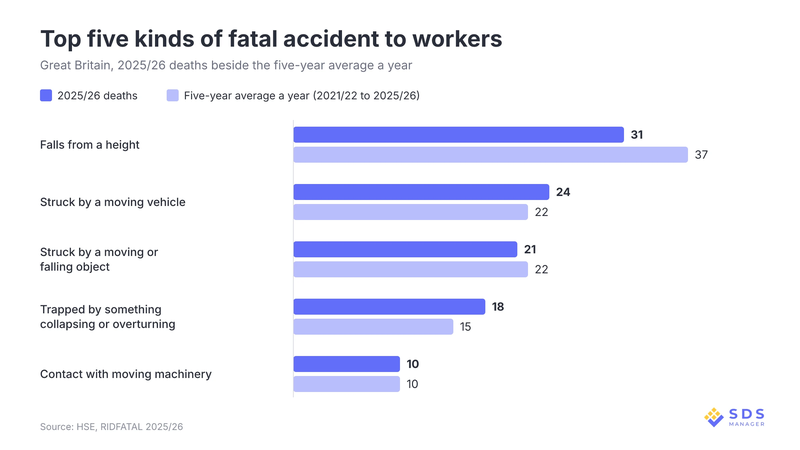
The next most common causes in 2025/26 were electrical hazards, with 5 deaths, and slips, trips or falls on the same level, with 4.
| Cause | What it looks like | How to prevent it |
|---|---|---|
| Falls from a height | A fall from a ladder, roof edge, fragile rooflight or scaffold | Avoid work at height; where you can't, use guard rails, scaffolds or work platforms |
| Being struck by a moving vehicle | A lorry reversing in a yard or loading bay | Keep people and vehicles apart; limit reversing |
| Being struck by a moving or falling object | A load slipping from a forklift; materials dropped from a scaffold | Secure loads; keep people clear of lifts and overhead work |
| Being trapped by something collapsing or overturning | An unsupported trench wall; an unstable stack of materials | Support or slope trench sides; store materials so they can't topple |
| Contact with moving machinery | Clearing a blockage from a conveyor that is still running | Keep guards fitted; cut the power at the main isolator first |
1. Falls From a Height
People fall from ladders, roof edges, fragile rooflights and scaffolds. Over the past five years these falls caused over half of all worker deaths in construction, an average of 19 a year.
Warehouses and farms have the same risk wherever someone climbs onto racking, stacked loads or a barn roof.
How to Prevent Falls from a Height
HSE's approach to preventing falls from height follows a set order. First, avoid working at height where you can, for example by fitting guard rails at ground level before a structure is lifted into place.
Where you cannot avoid it, prevent a fall with edge protection, scaffolds or work platforms with guard rails.
If neither is possible, reduce how far a person could fall and how badly they could be hurt, with nets, soft landing systems (such as air bags placed under the work) or a fall arrest harness.
2. Being Struck by a Moving Vehicle
Vehicle accidents happen in yards, loading bays, depots and farms, wherever people on foot share space with lorries, forklifts and tractors.
Over the past five years, being struck by a moving vehicle caused 48% of worker deaths in waste and recycling, 30% in transport and storage and 23% in agriculture.
How to Prevent Being Struck by a Moving Vehicle
Where possible, HSE advises keeping people and vehicles apart, with separate routes, barriers between them, a one-way system and no reversing. Where a vehicle has to reverse, use aids such as CCTV.
If you write separate routes, barriers, one-way systems and reversing rules into a safe system of work, drivers and people on foot know where each of them is allowed to be, and when.
3. Being Struck by a Moving or Falling Object
Moving or falling objects cause worker deaths when a load slips from a forklift, materials drop from a scaffold or a tree comes down during felling.
How to Prevent Being Struck by a Moving Vehicle
Secure a load before you lift it so it cannot slip or fall off. Keep other workers away from the area below overhead work, and set up exclusion zones so nobody stands under a load being lifted.
Toe boards, brick guards (panels fitted to the guard rails to hold back stacked bricks) and netting on scaffolds stop tools and materials falling onto people below. A toe board is a plank along the edge of the platform that stops material rolling or being kicked off, and it is part of basic scaffolding safety.
4. Being Trapped by Something Collapsing or Overturning
Collapses and overturns trap workers when a trench wall, a structure, a stack of materials or a vehicle comes down on them. In excavations, the danger comes from the soil walls themselves.
How to Prevent Being Struck by a Moving Vehicle
To prevent a trench collapse, support the sides or slope them back to a safe angle before anyone goes in. The weight of diggers, other heavy machinery and vehicles makes the sides more likely to collapse, so keep them back from the edge.
Above ground, before you alter or take down a structure, have a competent person (someone with the training and experience to judge it) check that it is stable. Have a suitably qualified engineer decide what temporary supports it needs.
Store materials so they cannot topple or roll over.
5. Contact With Moving Machinery
Machinery accidents happen when a hand, arm or clothing is caught, crushed or drawn into moving parts, for example while someone clears a blockage from a conveyor that is still running. Factories, farms and workshops all have machines with exposed moving parts.
How to Prevent Contact With Moving Machinery
Keep guards fitted and working, and do not rely on the stop button alone when you need to reach inside. HSE's guidance on safe maintenance is to cut the power at the main isolator (the switch that disconnects the machine from its power supply) before any maintenance, cleaning or adjustment, and to refit guards before the machine restarts.
Fitting guards and cutting the power are both covered by machinery guarding under PUWER. PUWER is the Provision and Use of Work Equipment Regulations 1998, which set the rules on keeping work equipment safe to use.
What Do the Latest HSE Fatal Injury Statistics Show?
According to the latest HSE fatal injury statistics, for 2025/26:
- 126 workers died in accidents at work, about one death every three days, or 0.37 deaths for every 100,000 people in work.
- England recorded 106 worker deaths, Scotland 10 and Wales 9, and 1 had no recorded country. England typically has a lower death rate than Scotland or Wales, and HSE notes that the mix of industries and jobs in each country strongly affects these rates.
- Men made up 93% of the workers who died (117 of 126).
- Work-related accidents also killed 104 members of the public, counted separately from the 126. Of these, 32 happened on railways and 59 in other service sector industries, including 23 in health and social work activities.
- Worker deaths have fallen from 495 in 1981 and 217 in 2005/06 to 126 in 2025/26. Apart from the coronavirus pandemic years of 2019/20 to 2021/22, this is the lowest count on record, though HSE says the fall in the death rate has slowed in recent years.
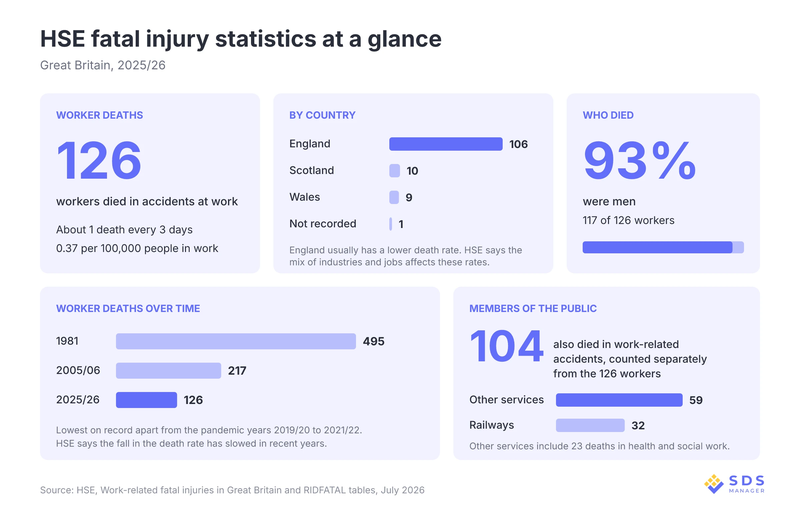
The count of 126 is provisional and may still change slightly. It counts only deaths that are reportable under RIDDOR, the Reporting of Injuries, Diseases and Dangerous Occurrences Regulations, which set the rules for reporting serious workplace incidents to HSE. It does not include deaths on the roads while working or commuting, deaths from natural causes such as heart attacks, deaths of members of the armed forces on duty, or deaths from work-related disease.
You cannot count on the national trend to make your own site safer. Your own guard rails, traffic routes and machine guards do that.
What Is the Most Dangerous Industry to Work In?
Agriculture, forestry and fishing is the most dangerous industry to work in by death rate, at 8.09 deaths per 100,000 workers in 2025/26. How the other main industries compared that year:
- Waste and recycling: the second-highest death rate, at 5.47 per 100,000.
- Construction: the most deaths, 25, because far more people work in it. That was below its five-year average of 37 a year.
- Construction and agriculture together: Over 33% of all worker deaths.
- Wholesale, retail and hospitality: a death rate of about half the average, 0.21 per 100,000.
A death rate per 100,000 workers compares industries of different sizes fairly and is the better guide to how likely you are to be harmed at work. If two industries each record 20 deaths in a year and one employs ten times as many people, each of its workers faces a tenth of the risk.
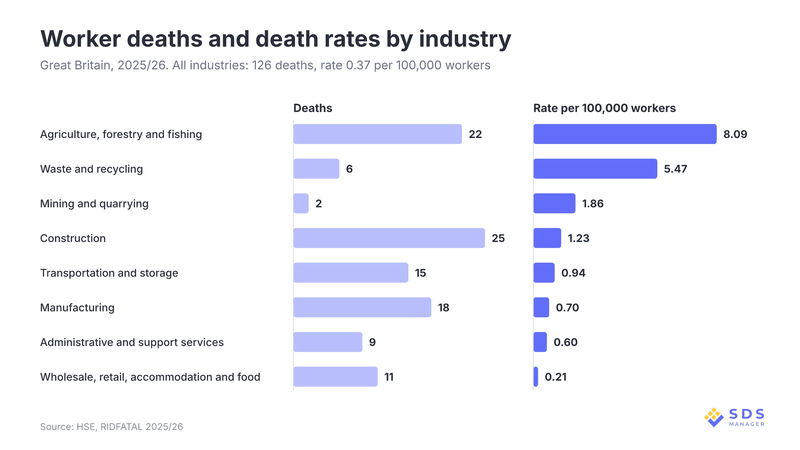
Agriculture excludes sea fishing. Five-year figures cover 2021/22 to 2025/26. Great Britain data from the HSE RIDFATAL tables, July 2026.
Shops, cafes and hotels still have delivery vehicles in yards and ladders in stockrooms. Your business still needs a risk assessment that looks for them.
How Many People Die From Work-Related Lung Disease and Asbestos?
HSE estimates that about 11,000 people die each year from lung diseases linked to past exposure at work. That is about 87 times the 126 worker deaths from accidents.
The largest share, 35%, comes from chronic obstructive pulmonary disease (COPD), a long-term lung condition that makes it hard to breathe. Lung cancer not linked to asbestos accounts for 23%, asbestos-related lung cancer for 20%, mesothelioma for 20% and other lung diseases for 3%.
Mesothelioma is an asbestos-related cancer that mainly affects the lining of the lungs or the abdomen. On its own, it killed 2,146 people in Great Britain in 2024, down from 2,255 in 2023.
These diseases develop many years after someone first breathes in the dust or chemicals that cause them, so workers need protection while they are exposed.
The hierarchy of controls puts removing or reducing dust at its source ahead of relying on masks.
Find and Fix Weak Safety Controls Early
Each of the five main causes of worker deaths has a known control. Edge protection stops falls from height, and separate routes keep vehicles and people on foot apart.
You can only tell whether a control works if you record near misses, events that could have hurt someone but did not.
A wobbly ladder, a vehicle that nearly hits someone in a loading bay or a load that shifts on a forklift often goes unrecorded, and the weak control can then stay unchanged for months.
Check the past year's incident and near-miss records against the five causes. If a cause has no records, treat that as a gap.
For every weak control, assign someone to fix it and set a due date.
Managing hazards with EHS Solutions by SDS Manager helps you record incidents and near misses and assign each corrective action an owner and a due date.
Start a free trial and apply control fixes while they are still near misses.
Frequently Asked Questions
How Many Workplace Deaths Were There in 2024/25?
There were 128 worker deaths in work-related accidents in Great Britain in 2024/25, the final figure HSE published in July 2026. HSE first reported the year as 124 deaths and revised the figure up when it was finalised.
What Are the Main Causes of Workplace Injuries?
The main causes of non-fatal workplace injuries are slips, trips and falls on the same level, making up 30% of the injuries to employees that employers reported in 2024/25. Handling, lifting or carrying came next at 17%, followed by being struck by a moving object and acts of violence, at 10% each.
How Do You Report a Death at Work?
You report a death at work under RIDDOR, the rules for reporting serious workplace incidents, and you must do so without delay. Because it is a fatal accident, you can report it online through HSE or by phone on 0345 300 9923. A report must be received within 10 days of the incident.
Are Older Workers More Likely to Die at Work?
Yes, older workers are more likely to die at work. Workers aged 60 and over made up 32% of worker deaths in 2025/26 but only about 12% of the workforce, and over the past five years workers aged 65 and over had a death rate four times the rate for all ages.
Are Self-Employed Workers More at Risk Than Employees?
Yes, self-employed workers are more at risk than employees. They made up around a third of worker deaths in 2025/26 but only about 15% of the workforce. Their death rate was 0.80 per 100,000 against 0.30 for employees, and on HSE's five-year figures the self-employed rate is about three times the employee rate.
When Does HSE Publish Its Fatal Injury Statistics?
HSE publishes its fatal injury statistics every year in early July. The final 2025/26 count is due in July 2027, and the next part-year count, for April to December 2026 and covering only cases where HSE, rather than a local council or the rail regulator, enforces the law, is due on 31 March 2027.

Arysha Alif Khan

Arysha Alif Khan is an EHS and chemical safety specialist with a background in biochemistry, biotechnology, and public health. She works closely with the product and regulatory teams to turn complex chemical regulations, SDS requirements, and workplace safety standards into clear, practical guidance for people.