A typical building job in Great Britain brings several firms onto one site, from the main builder to a one-person electrician. Each one, including subcontractors and self-employed tradespeople, has its own legal duties under CDM 2015.
Those duties stay with each firm even when a principal contractor runs the site, and HSE prosecutes contractors for their own failures: one roofing contractor was fined £160,000 in December 2025.
Under CDM 2015, the legal duties a contractor holds apply to every business that carries out or manages construction work. Each contractor must plan, manage and monitor its own work, use only competent workers, brief and supervise them, keep the site secure and provide welfare facilities.
By the end of this article, you'll know which CDM 2015 duties apply to contractors, what competence means for a contractor and its workers, and how to show it when a client or principal contractor asks.
Key Takeaways
- Subcontractors and self-employed tradespeople keep their own CDM 2015 contractor duties, even on a site run by a principal contractor.
- A principal contractor is needed when more than one contractor works on a project, whether or not the project is notifiable.
- No law requires an SSIP certificate or a CSCS card, and HSE says not to rely on cards alone as proof of competence.
- An apprentice can work on site while still gaining the training the task needs, as long as they are supervised.
- On a homeowner's job, the client's CDM duties pass to the contractor, or to the principal contractor if there are several.
- A project must be notified to HSE if it lasts over 30 working days with more than 20 workers at once, or exceeds 500 person-days.
What Are a Contractor's Duties Under CDM 2015?
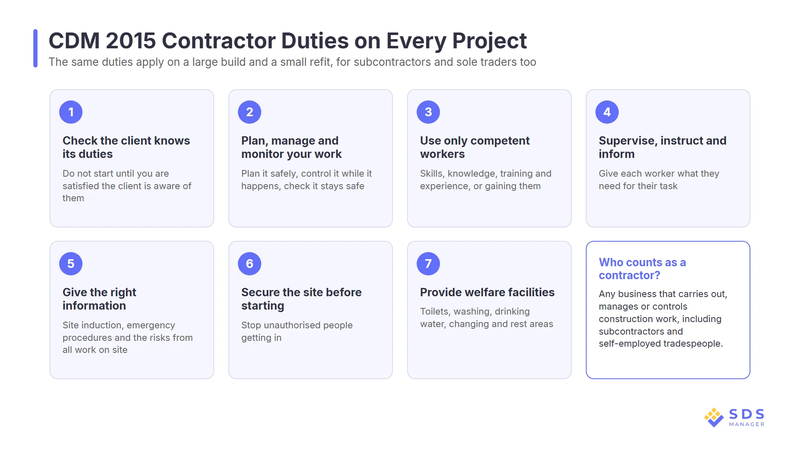
Under CDM 2015, every contractor must plan, manage and monitor its own work and use only competent workers. It must also check that the client knows its duties, supervise, instruct and inform its workers, secure the site before starting and provide welfare facilities.
These duties apply to every contractor on every project, whether you run the job or join it for one day.
Under CDM 2015, a contractor is any business that carries out, manages or controls construction work. That covers more people than the word suggests:
- Builders and main contractors
- Subcontractors and specialist trades
- Self-employed tradespeople
- Business clients that manage their own building work
A contractor that designs anything, such as temporary works, also has designer duties for that design.
CDM 2015 gives every contractor the same seven duties, on a large build or a small refit:
- Check the client knows its duties: don't start until you are satisfied the client is aware of its CDM duties.
- Plan, manage and monitor your work: plan how the work will be done safely, control it while it happens and check it stays safe.
- Use only competent workers: don't employ or appoint anyone who lacks, and is not gaining, the skills, knowledge, training and experience for their task.
- Supervise, instruct and inform: give each worker the supervision, instructions and information they need.
- Give the right information: a site induction (unless the principal contractor gave one), emergency procedures, and the risks from your work and from other contractors' work.
- Secure the site before starting: stop unauthorised people getting in before work begins.
- Provide welfare facilities: toilets, washing facilities, drinking water, changing rooms and rest areas for you and your workers.
Many contractors plan their own work with a risk assessment method statement (RAMS), which sets out the hazards of a task and the safe way to do it.
A RAMS builds on the risk assessment the law already requires of every employer.
For example, on a rear kitchen extension, the builder secures the side gate and the garden before the trench is dug. A common mistake on small jobs is starting before the client knows its own duties.
CDM 2015 also sets rules for the site itself and general duties for everyone on the project. You must meet the ones that apply to your work, most of them so far as is reasonably practicable, which means weighing the risk against the time, trouble and cost of controlling it.
- Site rules: safe places of work, including work at height, excavations, traffic routes, and fire and emergency routes
- General duties on every project: cooperate with others on the project, report anything likely to put people at risk, and give information people can understand in good time
These CDM duties add to the general duties every employer has under the Health and Safety at Work etc. Act 1974.
To use only competent workers, you need to know what CDM 2015 means by "competent".
What Is Contractor Competence Under CDM 2015?
A contractor is considered competent, under CDM 2015, when it has the skills, knowledge and experience to do the work safely.
A company also needs the policies, systems and resources to manage safety, which the law calls organisational capability. CDM 2015 checks competence twice: once for the contractor that takes the job and once for each worker it puts on site.
A contractor must not accept work it is not competent to do.
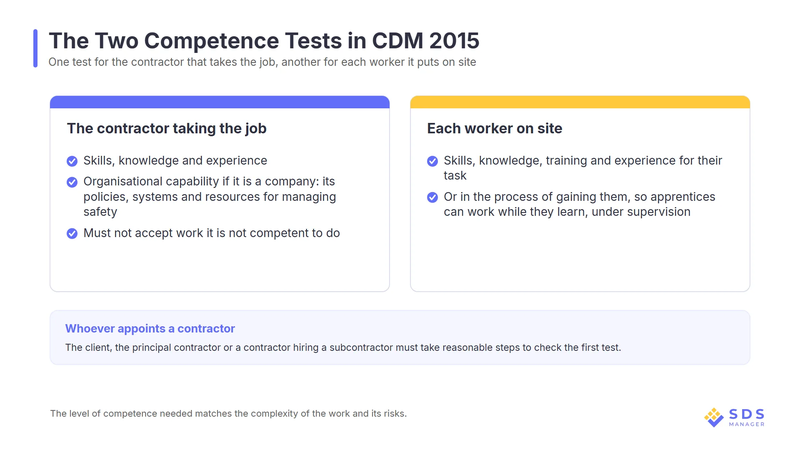
The two tests are worded differently: training is named only in the worker test, and "in the process of gaining" lets apprentices work while they learn, as long as they are supervised.
The level of competence you need matches the complexity of the work and its risks, so a small decorating job needs less proof than a complex structural one.
On the kitchen extension, the plasterer's apprentice works on the job while training, with the plasterer supervising.
How Is Contractor Competence Assessed Under CDM 2015?
Clients and principal contractors assess a contractor’s competence by checking records that match the job, such as training records, qualifications, references from similar work and, for a company, a pre-qualification assessment. CDM 2015 names no required qualification, scheme or card.
HSE's guidance for contractors gives examples of suitable evidence.
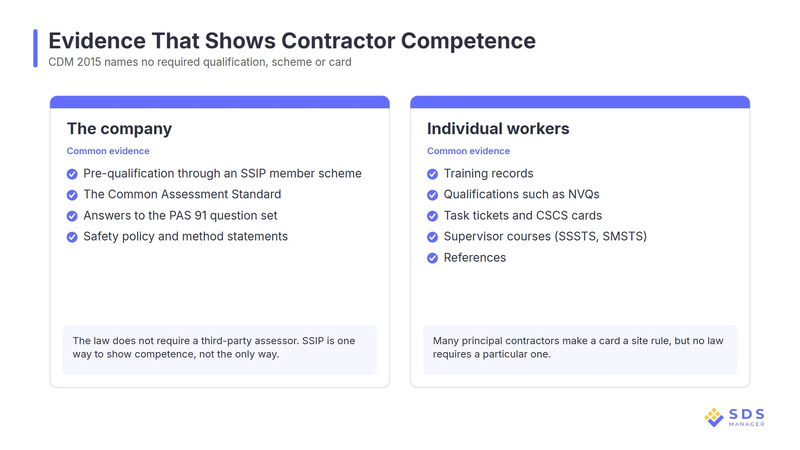
Member schemes of SSIP (Safety Schemes in Procurement) recognise each other's assessments, so you should not need to pass the same check twice.
HSE recommends using standard pre-qualification questions, such as PAS 91, to cut duplicate paperwork, then checking experience and track record on similar work. Track record is easier to judge with both leading and lagging indicators, such as inspection results alongside injury rates.
A pre-qualification certificate shows a company's systems once a year, not the crew on site today. So a certificate alone does not meet the appointer’s duty: they still check that your workers have the training and qualifications for the task, and HSE says not to rely on industry cards alone.
If you hire a subcontractor, you are the appointer, so the same checking duty applies to you.
On the kitchen extension, the builder asks the electrician for the electrical qualifications the work needs, not just a site card.
Does CDM 2015 Apply to Every Project?
Yes, CDM 2015 applies to all construction work in England, Scotland and Wales, whatever its size, and Northern Ireland has its own, very similar 2016 regulations. The extra duties you have depend on how many contractors there are, who the client is and where the work happens.
How CDM 2015 Applies in Three Common Situations
1. Several Contractors on One Project
A principal contractor is appointed in writing, and you follow its directions and its construction phase plan.
2. One Contractor on the Project
You draw up the construction phase plan yourself before setting up the site, and a plan for a small job can be short. No principal contractor is needed, even on a project that must be notified to HSE.
When it plans the work and its timing, the contractor must also apply the general principles of prevention. The law lists nine of these principles, starting with avoiding a risk before trying to control it.
3. Building Work in England or Wales
If you do building work in England or Wales, a second competence test applies under the building regulations. It has applied in England since 1 October 2023 and in Wales since 1 July 2026. It covers whether building work complies with the building regulations, not health and safety, and for individuals it adds "behaviours" to skills, knowledge and experience. Under the building regulations, a contractor must:
- Check the client knows its duties under the building regulations
- Keep its work compliant and its workers supervised
- Share information with others working on the project
- Report concerns about related work to the principal contractor
- Advise, when asked, whether the work is higher-risk building work
One firm can be the principal contractor under both CDM 2015 and the building regulations if the client confirms it in writing. PAS 8672 is a competence framework for principal contractors under the building regulations, not the CDM role, so it does not prove CDM competence.
Is a Principal Contractor Required Under CDM 2015?
Yes, a principal contractor is required under CDM 2015 when more than one contractor works on a project, or when the client can reasonably foresee more than one, for example when the job is planned with a builder plus separate electrical and plumbing contractors.
The client must appoint the principal contractor in writing before the construction phase starts. A client that appoints none must carry out the principal contractor's duties itself.
Whether a project must be notified to HSE is a separate test, so a small project with two contractors still needs a principal contractor.
The principal contractor manages the whole construction phase and draws up the construction phase plan, which sets out how health and safety will be managed during the building work. It also sets the site rules, which usually include a safe system of work for high-risk tasks.
You must follow the principal contractor's directions and the parts of the plan that cover your work, cooperate with it, and tell it about anything that could put people at risk. You also tell it which subcontractors you bring in.
A principal contractor doesn't take over your duties for your own work. In a December 2025 case, a roofing contractor was fined £160,000 for failing to plan, manage and monitor its own work, and the principal contractor on the same job was fined £640,000 for failing to manage and monitor that contractor.
If one of your workers has a reportable injury, you still report it under RIDDOR as their employer.
Does CDM 2015 Apply to Domestic Projects?
Yes, CDM 2015 applies to domestic projects. A domestic client is a homeowner having work done that is not part of their business. The homeowner's client duties pass to the contractor if there is only one, or to the principal contractor if there are several, unless the principal designer agrees in writing to take them on.
The client duties that pass to the contractor include:
- Arrange the project with enough time and resources
- Give designers and contractors pre-construction information
- Make sure a construction phase plan exists before work starts
- Notify HSE when the project is large enough
A project is large enough to notify when it will last longer than 30 working days with more than 20 workers on site at the same time, or will take more than 500 person-days of work.
For a sole contractor, HSE says taking on the client's duties should mean doing no more than you would normally do to comply with health and safety law.
If a homeowner with several contractors appoints no principal contractor, the contractor in control of the work becomes the principal contractor. DIY work that householders do themselves is not covered.
On the kitchen extension, the builder is the principal contractor, so it takes on the homeowner's client duties.
Put Competence Evidence on Record Before Work Starts
Competence evidence arrives from every trade by email, phone photo and paper: certificates, insurance, training records, cards and supervisor courses. HSE or a client may ask what reasonable steps you took before you appointed a contractor or put a worker on site, and too often that evidence is scattered or out of date.
Start with a list of every contractor and worker on your current job, the competence evidence you hold for each and when it expires.
With EHS Solutions by SDS Manager, each type of contractor gets a set list of documents to provide, a named person approves them before work starts, and every expiry date sits on one record. It's free to start.
Frequently Asked Questions
Who Are the Five Main Duty Holders Under CDM 2015?
The five main duty holders under CDM 2015 are the client, the principal designer, the designer, the principal contractor and the contractor, and workers have duties too. HSE's own summary lists seven headings, because it splits clients into commercial and domestic and adds workers. One organisation can hold more than one role.
What Is Considered Construction Work Under CDM 2015?
Construction work under CDM 2015 covers building, alteration, fitting out, repair, redecoration, maintenance and demolition, among other work. DIY work by a householder is not covered.
Can the Principal Contractor Also Be the Principal Designer?
The principal contractor can also be the principal designer. One company can hold both roles if it has the skills, knowledge, experience and organisational capability for each one.
Does the Principal Contractor Need to Be on Site at All Times?
The principal contractor does not need to be on site at all times. CDM 2015 gives it a duty to plan, manage, monitor and coordinate the construction phase, not a duty to be present. HSE says it does not have to supervise contractors' work in detail.
Is CDM 2015 Still Valid?
CDM 2015 is still valid: it has been in force since 6 April 2015 and has not been replaced. HSE's second review, published in March 2026, found that it remains fit for purpose, with no change to the regulations.
What Is a Contractor's Role in the Health and Safety File?
A contractor has no direct legal duty for the health and safety file. The principal designer puts the file together, and it goes to the client at the end of the job. The principal contractor will usually ask contractors for details such as as-built drawings, hidden services and materials used.
What Happens If a Contractor Breaks CDM 2015?
If a contractor breaks CDM 2015, for example by not following the principal contractor's directions or the construction phase plan, HSE can serve improvement or prohibition notices and prosecute. After a serious breach, the contractor also pays HSE's costs for its time. Courts can impose unlimited fines, and individuals can be sent to prison for some offences.

Arysha Alif Khan

Arysha Alif Khan is an EHS and chemical safety specialist with a background in biochemistry, biotechnology, and public health. She works closely with the product and regulatory teams to turn complex chemical regulations, SDS requirements, and workplace safety standards into clear, practical guidance for people.