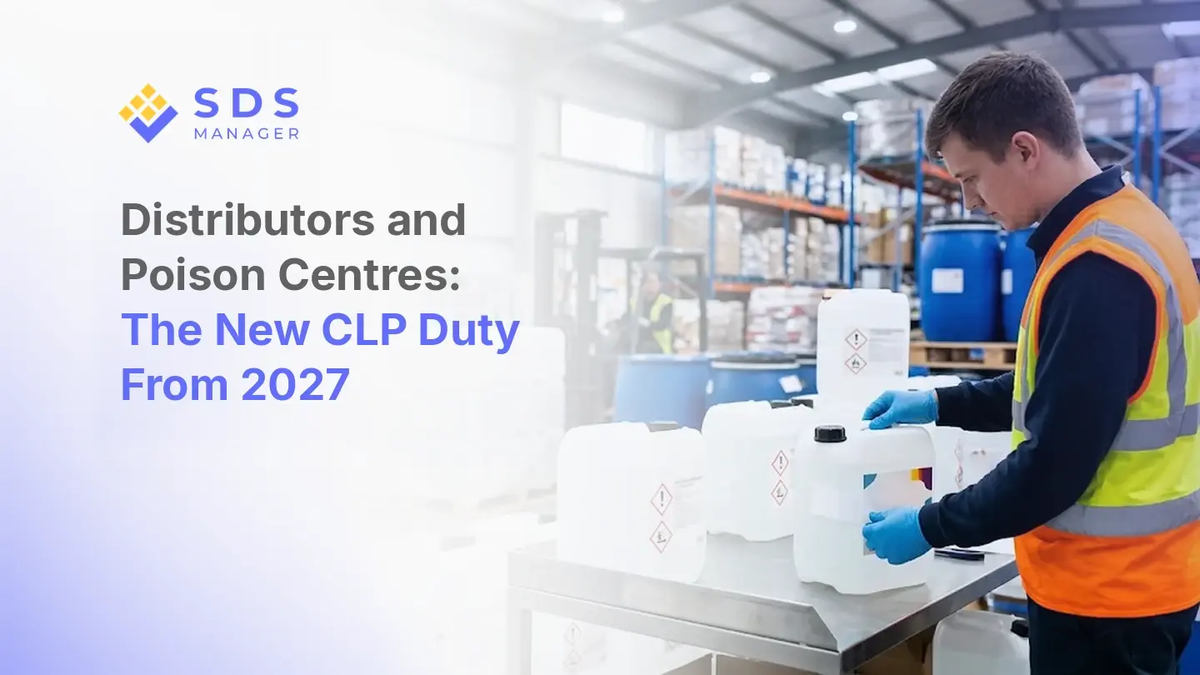
From 1 January 2027, distributors that sell mixtures classified as hazardous for health or physical effects in another EU country, or rename or relabel them, must send poison-centre information themselves. Until now, importers and downstream users (such as formulators and refillers) carried that duty. The new rule is Article 45(1c) of the CLP Regulation, added by the CLP revision, Regulation (EU) 2024/2865. The "stop the clock" amendment of November 2025 did not move this date.
In short:
- Who: distributors of mixtures classified as hazardous for health or physical effects.
- When: they distribute the mixture in other EU member states, or rename or relabel it.
- What: the CLP Annex VIII Part B information (the poison-centre notification, PCN).
- From: 1 January 2027.
- Exception: the distributor can show the appointed body already holds the same information from the importer or downstream user.
What applies from 1 January 2027
A distributor must notify in two situations:
- It sells the mixture in another member state. For example, a wholesaler in the Netherlands that also supplies customers in Belgium and Germany.
- It renames or relabels the mixture. For example, a retailer selling a cleaner under its own brand.
The notification goes to the appointed body of each country where the mixture is sold. Every EEA country accepts submissions through the ECHA Submission Portal, and some, including Germany, also accept them directly. The content is the same Annex VIII Part B dossier that importers and downstream users already submit: product identifier and UFI, hazards, composition and toxicological information. The CLP revision also updates Annex VIII itself, which from 1 January 2027 names distributors alongside importers and downstream users.
The exception, and what is still unclear
The duty does not apply if the distributor can show that the appointed body already received the same information from the importer or downstream user. A distributor reselling a supplier's product unchanged, under the supplier's trade name and UFI, would rely on this exception. The exception covers only the countries where an importer or downstream user has already notified that same information.
A distributor can also ask its supplier to update the supplier's own notification. A notification must list every trade name the mixture is sold under, and it names the countries where the mixture is marketed, so the supplier can add the distributor's brand names and countries to it.
What counts as proof is not defined. The regulation sets the exception but not the evidence a distributor needs to rely on it.
What changes for distributors
Until now, Article 45 has placed the notification duty on importers and downstream users only. Distributors are not named in it. Some national authorities read the old rules more broadly. Germany's Federal Institute for Risk Assessment (BfR), for example, already expects relabellers and rebranders to notify when they relabel, refill or change the outer packaging themselves.
From 2027, the distributor duty is set in EU law and applies the same way in every member state. That affects two groups:
- Rebranders and relabellers: their duty no longer depends on how each country reads the rules.
- Cross-border distributors: they are new to the duty. A distributor selling the same mixture in several member states must make sure the appointed body in each of those countries holds the notification.
"Stop the clock" kept the 2027 date
Regulation (EU) 2025/2439 of 26 November 2025 moved several CLP-revision items to 1 January 2028, mainly label-format rules and the rules on advertising and online offers. The distributor duty and the Annex VIII changes were not moved: they still apply from 1 January 2027.
The same act lets companies apply the new rules early, up to 31 December 2026. Distributors do not have to wait until 2027 to notify.
The Commission's chemicals simplification proposal, COM(2025)531 (the "omnibus"), is still pending. Its text does not touch Article 45 or Annex VIII, but it may change other CLP dates.
What distributors should do before 2027
- List your hazardous mixtures. Flag every product classified for health or physical hazards.
- Find the products that trigger the duty. Note which products you sell in more than one member state and which you sell under your own name or label.
- Collect supplier UFIs and confirmations. For each flagged product, check the UFI on the label or, where it is given, in section 1.1 of the safety data sheet, and ask the supplier which countries and trade names its notification covers.
- Close the gaps. Where no notification exists for a country or trade name, ask the supplier to add it, or prepare your own Annex VIII submission via the ECHA Submission Portal or the appointed body's own system.
- Keep the evidence. File supplier confirmations so you can rely on the exception if asked.
The UFI is the link between your product and its notification. SDS Manager reads the UFI from the supplier safety data sheets in your inventory and lets you search by it, so you can find products with no UFI on file and see which suppliers to ask.
Sources
- Regulation (EU) 2024/2865, Article 1 point 24(b) and Annex IV (EUR-Lex)
- CLP Regulation (EC) No 1272/2008, amendment record (EUR-Lex)
- BfR: notification of hazardous products (Germany's submission routes and its view on relabellers)
- HSA Ireland: CLP roles and obligations (national authority summary of the 2027 distributor duty)
- ECHA UFI Generator

Arysha Alif Khan

Arysha Alif Khan is an EHS and chemical safety specialist with a background in biochemistry, biotechnology, and public health. She works closely with the product and regulatory teams to turn complex chemical regulations, SDS requirements, and workplace safety standards into clear, practical guidance for people.