A risk assessment method statement (RAMS) covers one job in two parts. The risk assessment lists the hazards and how each one will be controlled, and the method statement sets out the safe order of work.
In the UK, clients, principal contractors and facilities teams often ask for a RAMS before they let a job start on their site. The request is common in construction, maintenance and building work. It usually comes with a deadline, because the work cannot begin until the RAMS is accepted.
Knowing what goes into each part decides whether your RAMS is accepted the first time. A vague or copied RAMS is often sent back, and the risk assessment inside it is a legal duty for every employer.
In this article, you'll learn what each part of a RAMS does, what to put in it, and how to write one for your own job. You'll also see a finished example and get a plain answer on what the law requires.
Key Takeaways
- A RAMS or risk assessment method statement is one document in two parts: a risk assessment that sets a control for each hazard, and a method statement that builds those controls into a step-by-step plan for the job.
- A RAMS should include the job and site details, hazards and risk ratings, control measures, the sequence of work, equipment and hazardous substances, emergency arrangements and a record of who was briefed.
- Writing a RAMS starts with the risk assessment and ends with briefing the workers and recording who was briefed on which version.
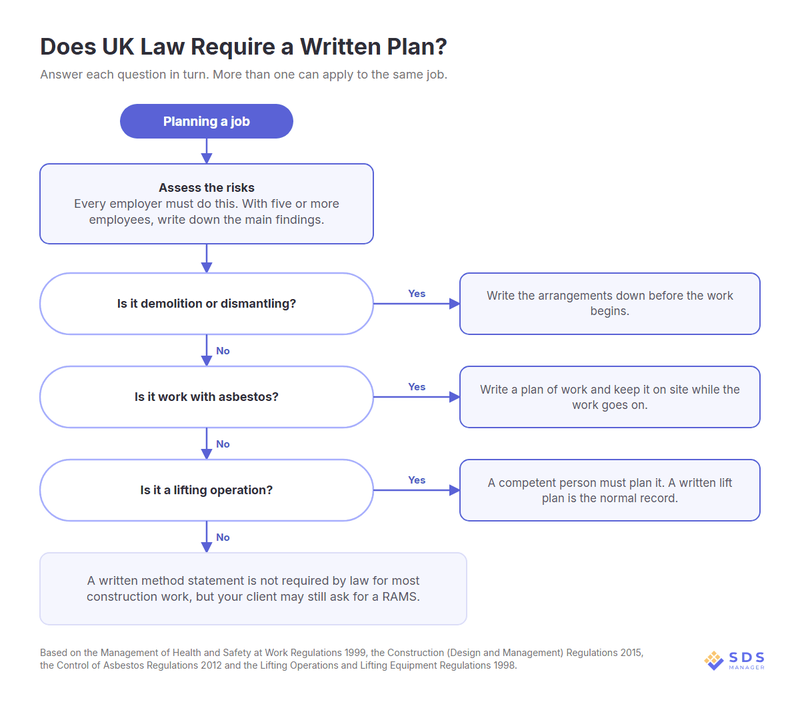
- UK law does not require a document called a RAMS, but every employer must assess risks, and employers with five or more employees must write down the main findings.
- UK law requires a written plan before demolition, dismantling or work with asbestos starts.
- A RAMS should be reviewed before each new job and whenever the site, method, team, equipment or substances change.
- A RAMS template or AI draft must be adapted to the specific site, because HSE says copying an example risk assessment does not meet the law.
Two Parts of a RAMS: Risk Assessment and Method Statement
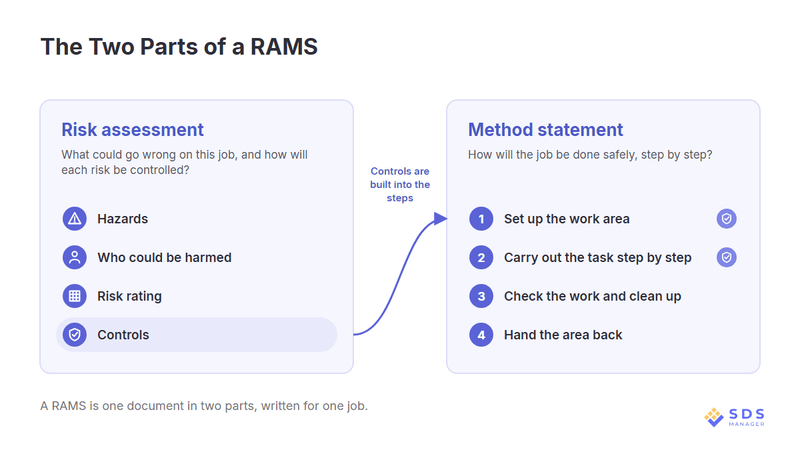
In a RAMS, the risk assessment comes first. It lists each hazard on the job, who could be harmed and how, how likely and how serious the harm would be, and the controls that will reduce the risk.
A hazard is something that could cause harm, such as a trailing cable, while the risk is how likely that harm is and how bad it would be. Keeping the difference between a hazard and a risk clear makes each rating easier to justify.
The method statement takes those controls and places them in the order the work will happen. It's written for the people doing the job. So, it covers who does what, the equipment they'll use, the checks before they start and what to do in an emergency. A worker should be able to follow it on site without the risk assessment open beside it.
The two parts depend on each other. The risk assessment decides which controls are needed, and the method statement shows the point in the work where each control is used.
A risk assessment on its own tells the crew what could go wrong but not how to do the job. A method statement without a risk assessment has no basis for the controls it lists.
Each part answers a different question:
What Should a RAMS Include?
A RAMS document should include:
- Job and site details: the client, site address, start and finish dates, working hours, who wrote the RAMS and its version number. The client or principal contractor checks these first.
- Scope of work: what the job includes and what it leaves out, so nobody assumes extra work is covered.
- Hazards and risk ratings: each hazard, who could be harmed and how serious the risk is before and after controls.
- Control measures: what will be done about each risk, written as actions rather than intentions.
- Sequence of work: the numbered steps of the job in the order they happen, with the controls built in.
- Plant, tools and equipment: what will be used, including plant (machinery such as mixers, hoists or access platforms), and the checks or inspections each item needs before use.
- Hazardous substances: each product used, with its hazards, controls and protective equipment taken from its safety data sheet (SDS) and your COSHH assessment, the assessment of hazardous substances that the Control of Substances Hazardous to Health Regulations 2002 require. Section 8 of an SDS, "Exposure controls/personal protection", is where the supplier lists ventilation and protective equipment.
- Personal protective equipment (PPE): named items, such as "nitrile gloves" instead of "suitable gloves".
- People, competence and supervision: who will do the work, the training or cards they hold and who supervises them.
- Permits: any permit to work the job needs, such as for hot work or entry into a confined space.
- Emergency and first aid arrangements: the first aiders, the nearest A&E, how to raise the alarm and a rescue plan for work at height.
- Briefing and sign-off record: the name of everyone briefed on the RAMS, the date and the version they were briefed on.
- Review and version log: when the RAMS was last checked and what changed.
A short, simple job can cover several of these items in a line each. What matters is that none of them are missing when the RAMS is checked.
How Do You Write a Risk Assessment Method Statement?
You write a risk assessment method statement by doing the risk assessment first and turning its controls into a safe order of work. Then you add the equipment and emergency details, get it checked and brief the crew.
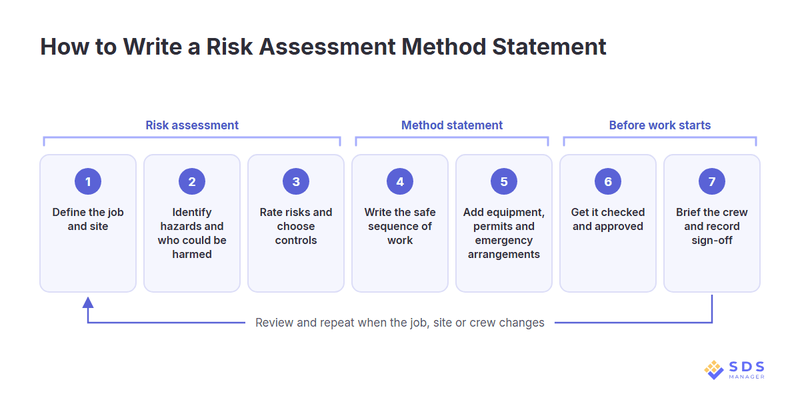
Step 1: Define the Job, the Site and What Is Out of Scope
Start by visiting the site, or by getting enough detail to picture it: the access route, the work area, and who else will be there and when. Write down the client, the address, the dates and the exact task. Then list what the job does not include, so a reviewer can see where your RAMS stops.
A RAMS reused from a previous job often still names the old site, the old client or hazards that are not there. Writing the site details first, from what you saw, stops that from happening.
Step 2: Identify the Hazards and Who Could Be Harmed
Walk through the task from arrival to hand-back and note every hazard you would meet, such as work at height, moving vehicles, electricity, dust, noise, heavy lifting and hazardous substances. For every product you'll use, read its SDS, because it lists the product's hazards and the protection needed.
Think beyond your own crew. Other trades, the client's staff and members of the public may pass the work area, and they belong in the assessment too. The people who will do the job often know about hazards that someone writing at a desk can miss, so ask them.
Step 3: Rate Each Risk and Choose Controls
For each hazard, rate how likely harm is and how serious it would be. Many teams use a matrix that scores both from 1 to 5 and multiplies them, so every risk gets a number that can be compared with the others.
Then choose controls by working down the hierarchy of controls. Remove the hazard if you can, replace it with something less dangerous, separate people from it, change the way the work is done, and use PPE last. Rate the risk again with the controls in place. If the score is still high, add or change controls before the work starts.
Step 4: Write the Safe Sequence of Work
Write the method as numbered steps in the order you will carry them out, from arrival and set-up to clean-up and hand-back. Put each control inside the step where it applies. "Switch off and lock off the supply before removing the light fitting" is clearer than a separate list of controls at the back of the document.
Use plain words and short steps that a worker can follow on site. The Health and Safety Executive (HSE) says the most effective method statements often include diagrams, so add a sketch or photo where the layout matters, such as barrier positions or access routes.
Step 5: Add Equipment, Permits and Emergency Arrangements
List the plant, tools and access equipment, with the checks each item needs before use, such as a pre-use check on a ladder or a current inspection record for a hoist. Note any permit the job needs and who issues it.
Then write the emergency arrangements for this site: who the first aiders are, where the first aid kit is kept, the nearest A&E and how to raise the alarm. For work at height, include how you would bring down someone who is stuck or injured.
Step 6: Get the RAMS Checked and Approved Before Work Starts
Send the RAMS for checking well before the start date. A competent person on your side should read it first, and then the client or the principal contractor (the contractor in charge of a site where more than one contractor works) reviews and accepts it.
A RAMS is often sent back for the same few reasons:
- generic text that could apply to any job,
- a missing or wrong site name,
- hazards with no matching controls, and
- vague PPE such as "wear suitable protection".
Fixing those before you send it saves a second round of checks.
Step 7: Brief the Workers and Record Their Sign-Off
Brief the RAMS to everyone doing the job before work starts, and again when someone new arrives or the method changes. On the day, check that the site still matches the RAMS, because the weather, access, other trades and the work area can all change between writing and starting.
A briefing is more than a signature. Walk through the steps, ask workers to explain the controls back to you and give them time to ask questions. Where English is not someone's first language, or reading is difficult, use pictures, a translated summary or a spoken walkthrough.
Briefing is also how employers meet a legal duty. The Management of Health and Safety at Work Regulations 1999 require employers to give workers clear, relevant information about the risks and the controls. Record who was briefed, when, and on which version of the RAMS.
Risk Assessment Method Statement Example
A good RAMS puts each control inside the step that needs it. Repainting an office stairwell while staff keep using the building is a typical job: it involves work at height on a podium step, solvent-based paint in a space with little airflow, people passing the work and heavy paint tins, so it touches most sections of a RAMS.
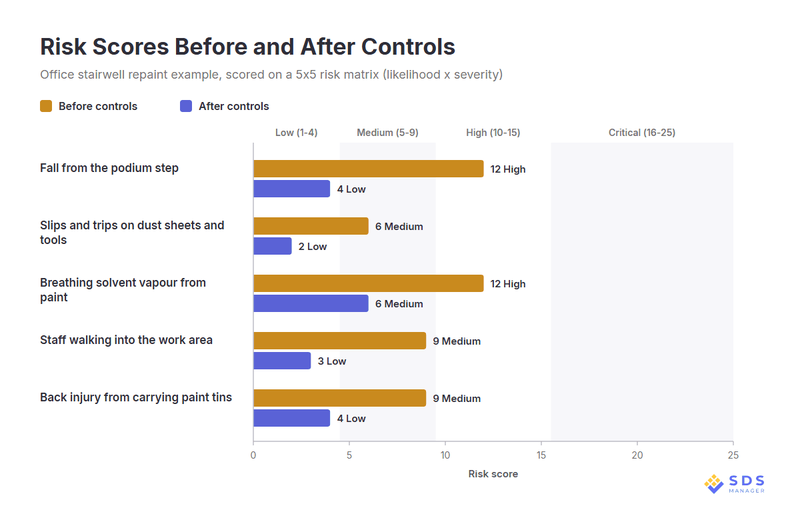
The risk assessment scores each risk on a 5x5 risk matrix, multiplying likelihood by severity and using common bands: 1 to 4 low, 5 to 9 medium, 10 to 15 high and 16 to 25 critical.
| Hazard | Who could be harmed | Controls | Risk before | Risk after |
|---|---|---|---|---|
| Fall from the podium step | Decorators | Podium step with guardrails, checked before use; wheels locked; move the podium instead of reaching beyond the guardrail | 3 x 4 = 12 (high) | 1 x 4 = 4 (low) |
| Slips and trips on dust sheets and tools | Decorators, office staff | Dust sheets taped down; tools and tins kept in a marked area on the landing | 3 x 2 = 6 (medium) | 1 x 2 = 2 (low) |
| Breathing solvent vapour from paint | Decorators, staff nearby | Water-based paint where the finish allows; windows and doors open and a fan running; gloves and other controls as listed in section 8 of each paint's SDS; breaks in fresh air | 4 x 3 = 12 (high) | 2 x 3 = 6 (medium) |
| Staff walking into the work area | Office staff, visitors | One flight closed at a time; barriers and signs at the top and bottom; second stair route signposted; busiest flights painted outside office hours | 3 x 3 = 9 (medium) | 1 x 3 = 3 (low) |
| Back injury from carrying paint tins | Decorators | Smaller tins; one tin carried at a time; the lift used to move stock between floors | 3 x 3 = 9 (medium) | 2 x 2 = 4 (low) |
The method statement then turns those controls into the order of work:
- Sign in at reception, confirm the stair closure times with the facilities manager and check that the second stair route is open.
- Brief the crew on this RAMS and record the names and the version briefed.
- Set up barriers and "Wet paint, please use the other stairs" signs at the top and bottom of the first flight.
- Check the podium step before use (guardrails in place, wheel locks working, no damage) and lock the wheels in position.
- Lay the dust sheets and tape them down, and keep tools and tins in the marked area on the landing.
- Open the windows and doors and switch on the fan before opening any paint, and wear the gloves listed in the SDS.
- Prepare and paint one flight at a time, moving the podium instead of reaching beyond the guardrail.
- Close tins after use, clean brushes in the agreed sink and bag the waste for removal.
- Remove the barriers only when the paint is touch-dry and the area is clear, then ask the facilities manager to check the flight before it reopens.
The facilities manager's check at the end is recorded on the sign-off sheet, so the client has a dated record that each flight was handed back safe to use.
Are RAMS a Legal Requirement in the UK?
No, UK law does not require a document called a RAMS, but it does require the risk assessment inside it, and a few kinds of work need a written plan by law. Clients and principal contractors often ask for a RAMS anyway, as a condition of starting the job.
Every employer must assess the risks to their workers and to anyone else affected by the work. If you employ five or more people, you must also write down the main findings. That record must include any group of workers who are especially at risk (Management of Health and Safety at Work Regulations 1999). Self-employed people doing construction work, and some other listed types of work, have the same duty to assess risks.
The method statement is treated differently. HSE says method statements are not required by law for most construction work, although they are an effective way to plan, manage and monitor it. You still have a general duty to provide safe ways of working (Health and Safety at Work etc. Act 1974), and a written method statement is the usual way to show how you have done that.
A few jobs need a written plan by law before work starts:
- Demolition or dismantling: the arrangements must be written down before the work begins (Construction (Design and Management) Regulations 2015, known as CDM).
- Work with asbestos: you need a written plan of work, kept on site while the work goes on (Control of Asbestos Regulations 2012).
Lifting operations must also be properly planned by a competent person (Lifting Operations and Lifting Equipment Regulations 1998). A written lift plan is the normal way to show that planning.
In Northern Ireland, the same risk assessment rules apply under Northern Ireland's own version of the 1999 regulations. The Health and Safety Executive for Northern Ireland (HSENI) enforces them.
When a client asks for a RAMS, the request is a contract term added to the legal requirements for risk assessment, not one of them. In practice the result is the same: without an accepted RAMS, you usually cannot start.
Which Jobs Need a RAMS?
Jobs with higher, complex or unusual risks usually need a RAMS, and so does any job where a client or principal contractor asks for one. RAMS in construction are the most common, but facilities, maintenance and events teams ask for them too. Typical jobs include:
- work at height, roofing and scaffolding
- demolition, digging and excavation
- hot work, such as welding or cutting
- work in confined spaces
- lifting with cranes or hoists
- electrical installation and repair
- work with hazardous substances or asbestos
- putting up stages, marquees and other temporary structures for events
- maintenance and refurbishment in buildings that people are still using
For these jobs, a RAMS turns the risk assessment into instructions the crew can follow, and it shows the client that the work has been planned.
A small, low-risk job needs a small RAMS. One or two pages is often enough for a short task. Even a short RAMS still needs the site and task, the main hazards and controls, the steps in order, an emergency contact and who was briefed. For routine low-risk work, your general risk assessment may be enough on its own. A construction risk assessment template gives that assessment a standard layout.
Who Can Write and Approve a RAMS?
A competent person who knows the job should write the RAMS, usually the supervisor or manager of the contractor doing the work. The client or principal contractor then checks and approves it before work starts.
HSE describes competence as the combination of training, skills, experience and knowledge that a person has and their ability to use them to do a task safely. In practice, the person writing the RAMS should understand the job well enough to spot its hazards, and know when to ask a safety adviser for help. If a consultant writes the RAMS for you, the duty to manage the risks stays with you as the employer.
On construction projects, CDM sets out who does what. Each contractor must plan, manage and monitor its own work, which is why the contractor writes the RAMS. The principal contractor usually checks each contractor's RAMS and keeps the site's construction phase plan up to date. HSE advises asking contractors for their risk assessments and method statements before you agree to the contract.
If you are the client collecting RAMS from several contractors, contractor management software can store each contractor's approval and documents, with expiry dates visible, before anyone arrives on site.
How Often Should a RAMS Be Reviewed?
Review a RAMS before each new job and whenever something changes: the site, the method, the team, the equipment or the substances used. Review it after an accident or near miss on the job, too.
The law sets similar triggers for the risk assessment inside it. You must review the assessment when there is reason to think it is no longer valid, or when something significant has changed, and make any changes the review shows are needed. HSE gives matching advice for the method statement, which should be revised for each job if the circumstances change markedly.
Keep each review on record. Save the old version, note what changed and why, update the version number and brief the crew again on the new version. If an injury or dangerous occurrence on the job is a reportable incident under the Reporting of Injuries, Diseases and Dangerous Occurrences Regulations 2013 (RIDDOR), review the RAMS as part of the investigation before the work restarts.
Can You Use a Template or AI to Write a RAMS?
Yes, you can start from a RAMS template or an AI draft from a tool such as ChatGPT, but you must adapt it to your job and site before you use it. HSE warns that copying an example and putting your company name on it does not meet the law and does not protect your workers.
A template is useful for structure. A RAMS template gives you every section a reviewer expects, so nothing is forgotten. What it cannot know is your site, your team, your equipment or the products you'll use, and those details are what a reviewer checks first. Clients who read many RAMS can often tell a filled-in template from a plan written for their site.
AI tools have the same limit. They can draft a list of common hazards and a first sequence of steps quickly, but they have not seen your site. Check every hazard and control, add the site details yourself, remove anything that does not apply, and never sign or brief a RAMS you have not read in full.
Keep Every RAMS Risk Assessment Up to Date
Every step in a method statement depends on a control chosen in the risk assessment. When the risk assessment is copied from the last job with the same scores, the method statement repeats the same out-of-date controls, and the crew is briefed on steps written for a different site.
Reviewing the risk assessment before each job keeps both parts accurate. A fresh look at the hazards shows which controls have changed, so you can update the steps that use them and brief the crew on the new version before work starts.
Review dates written on paper are easy to miss.
With EHS Solutions by SDS Manager, you get each risk assessment back for review on its set date, see overdue ones in a queue, and score every hazard on a risk matrix before and after controls have been set.
Frequently Asked Questions
What Is RAM in Risk Assessment?
RAM in risk assessment usually stands for risk assessment matrix, the grid that rates each risk by how likely it is and how serious it would be. A risk assessment matrix is a tool used inside the risk assessment part of a RAMS, not another name for a RAMS.
What Is the Difference Between a Generic and a Site-Specific RAMS?
The difference between a generic and a site-specific RAMS is how much of the real site each one covers. A generic RAMS describes a task done the same way everywhere, while a site-specific RAMS adds the site's own hazards, layout, people and emergency details. Most clients expect a site-specific RAMS before work starts.
What Qualifications Do You Need to Write a RAMS?
Writing a RAMS needs competence, not a specific qualification, because UK law does not name one. Courses such as the Site Supervision Safety Training Scheme (SSSTS), the Site Management Safety Training Scheme (SMSTS) and IOSH Managing Safely cover risk assessment, and some clients ask for them.
Do RAMS Need to Be Signed?
RAMS do not need to be signed by any general UK law. A signed or digitally confirmed briefing record is still the usual way to show that workers were briefed. Many clients and principal contractors ask for signatures from the author, the approver and each worker briefed.
Are RAMS a Legal Document?
A RAMS is a written record of how you planned to meet your legal duties for a job, rather than a legal document in itself. If something goes wrong, an HSE inspector can ask to see documents such as your RAMS as part of an investigation.
Do Sole Traders Need a RAMS?
Sole traders need a RAMS when a client asks for one. Sole traders doing construction work, gas work or work with asbestos must also assess the risks by law. Outside those and the other listed activities, the general risk assessment duty does not apply to self-employed people with no employees.
What Is a RAMS Checklist?
A RAMS checklist is a list used to check that a RAMS covers every required section before it is approved or reused. It usually covers the site details, hazards, controls, sequence of work, emergency arrangements and briefing record.

Arysha Alif Khan

Arysha Alif Khan is an EHS and chemical safety specialist with a background in biochemistry, biotechnology, and public health. She works closely with the product and regulatory teams to turn complex chemical regulations, SDS requirements, and workplace safety standards into clear, practical guidance for people.