Construction had 41 worker deaths in Australia in 2025, almost one in five of all work deaths.
Most building sites have several businesses working side by side, so on larger jobs the law puts one business in charge of safety for the whole site. If nobody else is appointed, the business that commissioned the work is in charge.
Principal contractor duties are the extra legal duties of the business in charge of a construction project according to WHS. They cover site signage, a WHS management plan, collecting safe work method statements (SWMS) before high-risk work, site security and site-wide risks such as traffic and waste.
In this article, we cover the principal contractor's duties, what the WHS management plan must include, when the role applies in each state and territory, and how to appoint one.
Key Takeaways
- A principal contractor is the business that manages health and safety across a construction project, with WHS duties on top of its own PCBU duties to plan, coordinate and secure the site for everyone working there.
- Outside Western Australia, the site sign must show the principal contractor’s name, an after-hours phone number and the site office location. (adds the WA exception)
- The principal contractor WHS management plan must be written before work starts and set out how SWMS are collected and reviewed.
- WHS duties of a principal contractor apply once a construction project costs $250,000 in most of Australia. However, Victoria, South Australia and the Northern Territory set higher triggers and Western Australia uses a head count.
- Below the trigger, there is no principal contractor, but high-risk construction work still needs a SWMS.
- Only the business that commissions a project can appoint a principal contractor, and it must authorise the appointed business to manage or control the site.
- Maximum WHS penalties differ between states and territories: for a body corporate, Category 1 ranges from $3,000,000 to $17,034,000, and only the ACT matches the model WHS Act figures.
Who Is a Principal Contractor?
A principal contractor is the person who is in charge of health and safety on a construction project.
By default, it is the business that commissions the project. That changes only if the commissioning business engages another business as principal contractor and authorises it to manage or control the site.
WHS law calls any business with safety duties a PCBU, short for person conducting a business or undertaking. A construction project is construction work at or above the cost or head-count trigger set in your state or territory.
When a homeowner engages a builder for work on their own home, the builder is the principal contractor if it manages or controls the site.
A developer that commissions a three-townhouse build is the principal contractor until it appoints its builder to the role.
The principal contractor's duties add to every PCBU's own duties. Each business on site must consult, cooperate and coordinate with the others, and no business can contract its duties away.
What Are a Principal Contractor's WHS Duties?
In addition to its duties as a PCBU, a principal contractor is responsible for health and safety across the whole construction project. Its WHS duties go beyond its own work to cover the site, the safety plan and every business working there.
It must also take reasonable steps to obtain SWMS before high-risk construction work starts, secure the site and manage site-wide risks. These principal contractor WHS duties apply for the whole project.
Several of these duties, including the SWMS duty, depend on high-risk construction work, a set list of tasks such as work where someone could fall more than 2 metres or work near live electrical installations.
In practice, the principal contractor must:
- Put up a site sign: show the principal contractor's details on a sign that can be seen from outside the site.
- Prepare a WHS management plan: write it before work on the project starts.
- Tell workers about the plan: make sure each worker knows what it says, and can see it, before they start.
- Keep the plan current: review it, revise it and tell workers about the changes.
- Keep the plan available: keep it until the project is finished, or for at least 2 years after a notifiable incident, and let workers and inspectors see it.
- Obtain a SWMS for high-risk construction work: take all reasonable steps to get a copy before that work starts.
- Arrange shared facilities: facilities, first aid and emergency plans.
- Control site-wide hazards: PPE, airborne contaminants, hazardous atmospheres, flammable storage, falling objects and falls, including the working at heights controls.
- Manage four site risks: the storage, movement and disposal of materials and waste; the storage of plant not in use; traffic near the site; and gas, power, water and other services at the site.
- Secure the site: stop unauthorised people getting in, so far as is reasonably practicable.
What Must a Principal Contractor's Site Sign Show?
A principal contractor's site sign must show three things, so anyone outside the site knows which business runs it and how to reach it:
- The principal contractor's name
- A phone number that works after hours
- Where the site office is
Western Australia's regulations do not include this signage rule.
On the townhouse site, the builder puts a sign with its 24-hour number on the front gate.
When Is a SWMS Needed by a Principal Contractor?
A safe work method statement (SWMS) is needed for every high-risk construction task, whether or not the project has a principal contractor. The business doing the task prepares it, and it sets out the hazards of the task and how they will be controlled. On a construction project, each subcontractor gives its SWMS to the principal contractor before it starts the high-risk task..
Some subcontractors hand in a job safety analysis (JSA) instead of a SWMS. Principal contractors often reject it because only a SWMS meets the legal requirement for high-risk construction work. Knowing how a JSA and a SWMS differ helps you spot the wrong document before work starts.
For tasks that are not high risk, many sites use a job safety and environmental analysis (JSEA) instead.
What Training Must The Principal Contractor Have?
Every PCBU on site, including the principal contractor, must also make sure no worker does construction work without general construction induction training, shown by the training card (the white card) or a statement of attainment issued in the last 60 days.
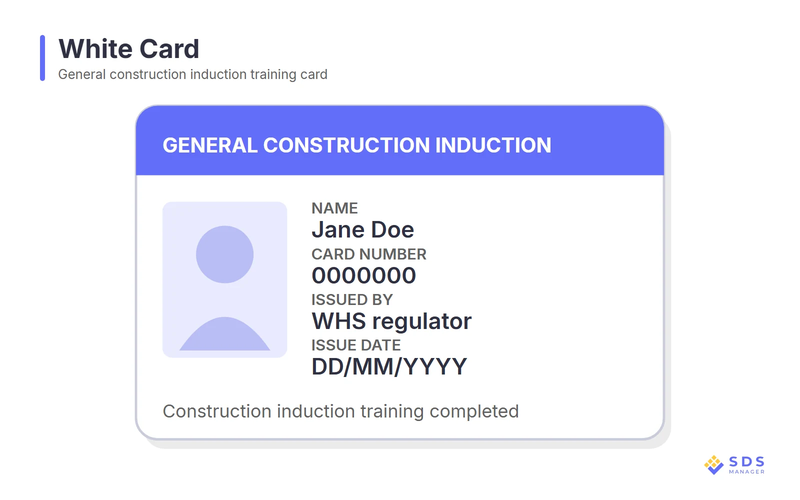
On top of the white card, workers need a site induction covering the site rules and the WHS management plan before they start. Site visitors, such as delivery drivers or clients inspecting progress, should be inducted or escorted, and regulators recommend keeping a record of who was inducted and when
Principal Contractor’s Duties on A WHS Management Plan
Four of the principal contractor's duties concern the WHS management plan: preparing it, telling workers about it, keeping it current and keeping it available. WHS management plan is the written safety plan for the whole construction project, prepared before work starts. It must set out five things:
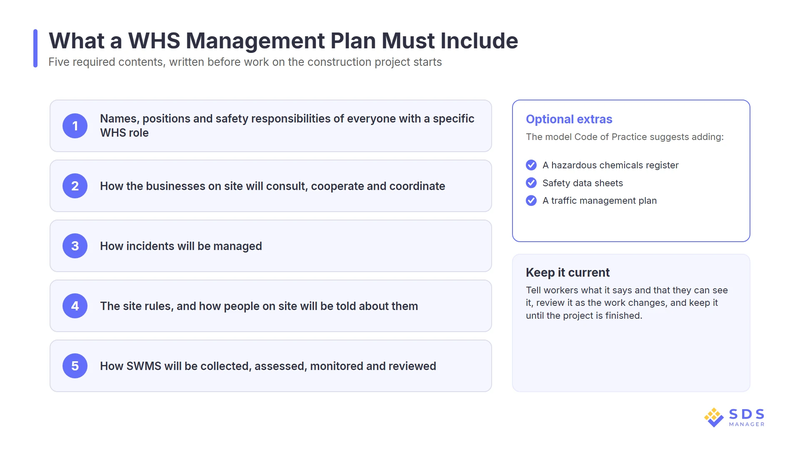
The model Code of Practice for construction work suggests some optional extras, such as a hazardous chemicals register, safety data sheets and a traffic management plan. These help, but the law does not require them.
Victoria's version is the health and safety co-ordination plan. It covers four of the same areas except SWMS.
The WHS management plan works alongside the risk management in building construction that every business on site must carry out for its own work.
When Is a Principal Contractor Required in Australia?
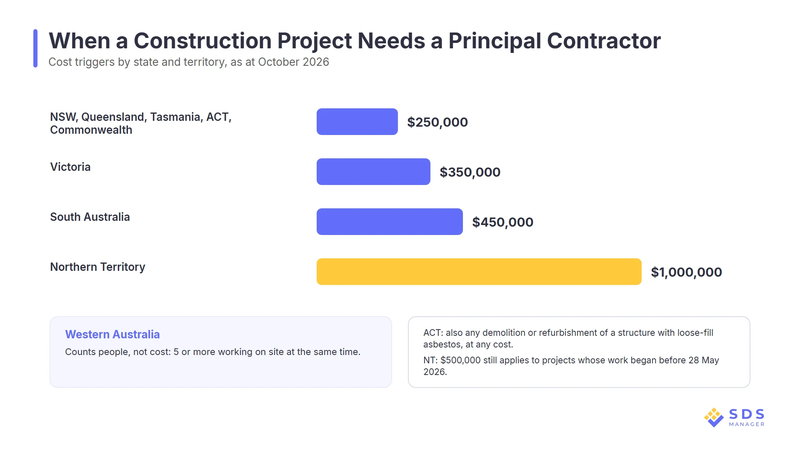
A principal contractor is required when construction work becomes a construction project. In most of Australia, that means work costing $250,000 or more under the model WHS Regulations. Victoria, South Australia and the Northern Territory set higher figures, and Western Australia counts people instead of cost.
Below the trigger there is no principal contractor, but every PCBU still has its own duties and high-risk construction work still needs a SWMS.
The trigger counts the cost of the construction work, including project management, fittings and taxes other than GST. The cost trigger leaves out the land, marketing, finance and legal costs.
In New South Wales, owners, corporations and building owners who commission repair work costing $250,000 or more can become the principal contractor without realising it.
Western Australia adopted the model WHS laws in 2022 and uses the same principal contractor duties, apart from the signage rule.
What Are Principal Contractor Obligations in Queensland?
In Queensland, the principal contractor has the model WHS duties, plus Queensland's own rules on site amenities and a separate set of rules on falling objects for construction work.
You do not need to notify the regulator when you appoint a principal contractor in Queensland. QLeave, Queensland's construction long service leave authority, collects a separate work health and safety levy on projects from $150,000.
Where the commissioning business appoints different principal contractors for separate projects, each must have a contract directly with it.
What Are Principal Contractor Obligations in Victoria?
In Victoria, the principal contractor prepares a health and safety co-ordination plan instead of a WHS management plan, and the owner is the principal contractor by default. Victoria has its own OHS laws.
Under the Victorian regulations:
- The co-ordination plan has four required contents and no SWMS item
- A sign with the principal contractor's name and phone numbers must be visible from outside the site
- If a homeowner engages someone to manage or control the site, that person is taken to be the principal contractor
The principal contractor must keep the plan, make it available and tell workers about it before they start.
Who Can Appoint a Principal Contractor?
Only the business that commissions a construction project can appoint a principal contractor. It must engage that business as principal contractor and authorise it to manage or control the site. Both steps are needed, and the appointment should be in writing.
Grant the authority to manage or control the site in the same signed document that makes the appointment.
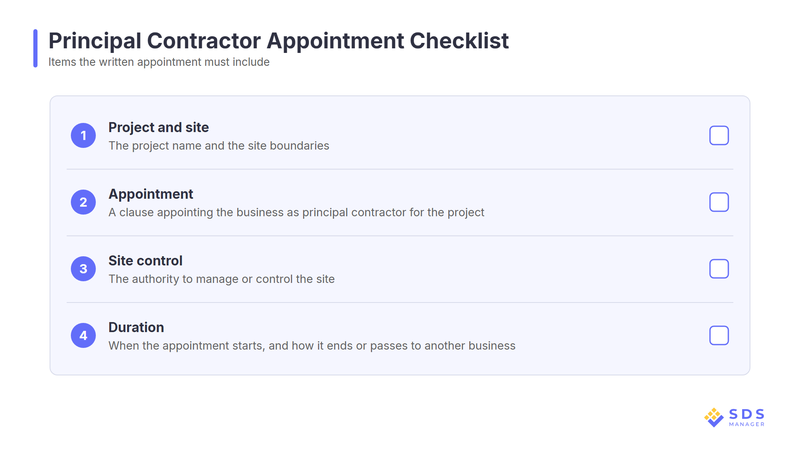
Three rules keep the appointment valid:
- A project has only one principal contractor at a time.
- Only the business that commissions the project can appoint a principal contractor, so an appointed principal contractor cannot appoint another one.
- When the role passes from one business to another, set a clear handover date.
Appointing a builder moves the principal contractor duties to the builder only if the appointment is valid. An invalid appointment leaves those duties with the commissioning business, and its own PCBU duties never transfer, as a Safe Work Australia fact sheet explains.
The commissioning business keeps its own PCBU duties, including passing on what it knows about hazards at or near the site. It must manage risks so far as is reasonably practicable, doing whatever is possible and sensible given the risk.
It manages those risks through the WHS risk management process: identify hazards, assess and control the risks, then review the controls.
On the townhouse project, the developer's contract names its builder as principal contractor for the site from the first day of works.
What Are the Penalties for Breaching Principal Contractor Duties?
Breaching a WHS duty is an offence, and the maximum penalty depends on how serious the breach is. Category 3 covers failing a health and safety duty. Category 2 covers failing a duty in a way that exposes someone to a risk of death or serious injury or illness. Category 1 covers doing that with gross negligence or recklessness. Every state and territory, and the Commonwealth, also has an industrial or workplace manslaughter offence for a breach that causes a death.
Each state and territory sets its own maximum amounts and indexes them every year, so they differ widely. Only the ACT matches the model WHS Act figures.
| Jurisdiction | Category 1 | Category 2 | Category 3 | Industrial manslaughter |
|---|---|---|---|---|
| ACT | $12,321,000 | $2,470,000 | $827,000 | $18 million |
| Commonwealth | $17,034,000 | $2,470,000 | $827,000 | $18 million |
| New South Wales | $11,606,824 | $2,326,910 | $779,145 | $20 million |
| Queensland | $3,000,000 | $1,500,000 | $500,000 | $10 million |
| Western Australia | $3,500,000 | $1,800,000 | $570,000 | $10 million |
| South Australia | $3,000,000 | $1,500,000 | $500,000 | $18 million |
| Tasmania | $3,000,000 | $1,500,000 | $500,000 | $18 million |
| Northern Territory | $3,000,000 | $1,500,000 | $500,000 | $12.61 million |
Victoria has no penalty categories. Under its OHS Act, a body corporate faces up to $1,881,900 for breaching a general duty, $4,182,000 for reckless endangerment and $20,910,000 for workplace manslaughter.
Keep Every Record Ready for Inspectors
No high-risk work begins until the subcontractor’s SWMS is in, and no worker starts until their white card has been checked.
Keeping one file per subcontractor makes the check quick, with no searching through emails and paper.
EHS Solutions by SDS Manager keeps every subcontractor’s SWMS and white cards in one place and approves each subcontractor in the Contractor Management module before work starts.
Start a free trial and have every subcontractor’s paperwork sorted before the next one arrives on site.
Frequently Asked Questions
What Is the Difference Between a Principal Contractor and a PCBU?
The difference between a principal contractor and a PCBU is scope. Every business with WHS duties is a PCBU, while the principal contractor is the one PCBU that takes on extra duties for a construction project. A principal contractor is still a PCBU.
What Is the Difference Between a Principal Contractor and a Head Contractor?
The difference between a principal contractor, and a head contractor is that a head contractor is a contract title, while a principal contractor is a legal WHS role. The head contractor is often appointed as principal contractor, but only the appointment makes it one.
Can There Be More Than One Principal Contractor on a Site?
No, a construction project can have only one principal contractor at any one time. Separate projects on neighbouring sites each have their own principal contractor and need clear boundaries, such as fences or signs.
Who Has Primary Responsibility for Workplace Safety?
Every PCBU has the primary duty of care for its own workers and for others affected by its work. On a construction project, the principal contractor also manages safety for the whole site. The duties overlap, and each business carries its share.

Arysha Alif Khan

Arysha Alif Khan is an EHS and chemical safety specialist with a background in biochemistry, biotechnology, and public health. She works closely with the product and regulatory teams to turn complex chemical regulations, SDS requirements, and workplace safety standards into clear, practical guidance for people.