Pre-job safety checks on Australian work sites tend to focus on risks to the crew, such as falls, burns and lifting injuries. A job that is safe for the crew can still spill fuel, send dirty wash water into drains or leave waste behind, and that harm can lead to fines from your state's environment protection authority (EPA).
A job safety and environmental analysis (JSEA) covers both kinds of risk. It is a written check, done before a job starts, that breaks the job into steps and lists the hazards, environmental impacts and controls for each one.
Doing one well protects your crew and the area around the job, and gives you a written record that you planned for both.
In this article, we walk you through what a JSEA covers, when you need one, how to complete one in seven steps, what the form should include, and a worked example.
Key Takeaways
- A job safety and environmental analysis (JSEA) is a written check, done before a job starts, that lists the hazards, environmental impacts and controls for each step of the job.
- A JSEA adds environmental risks, such as spills, wash water, waste, dust and noise, to a standard job safety analysis (JSA).
- No Australian workplace safety law names the JSEA, but the law requires businesses to find hazards and control risks, and a JSEA is a common way to do that for one job.
- You need a JSEA when your site, client or principal contractor requires one, and it is good practice for any new, changed or rarely done job, or any job near chemicals, fuel or drains.
- Completing a JSEA takes seven steps: choose the job, break it into steps, list hazards and impacts, rate the risks, choose controls, talk it through and sign on, and review it when things change.
- A JSEA does not replace a safe work method statement (SWMS), which the law requires before high risk construction work starts.
What Is the Purpose of a Job Safety and Environmental Analysis?
The purpose of a job safety and environmental analysis is to plan one job before it starts. A JSEA shows you and your crew what could hurt a person or harm the environment at each step, and what you will do to stop it.
Each part of the name tells you what the document covers.
- "Job" means one task, such as replacing a pump or pressure cleaning a driveway, not everything that happens on a site.
- "Safety" means harm to people, such as cuts, falls, burns, strains and chemical exposure.
- "Environmental" means harm beyond the crew, to land, water, air, plants, animals and neighbours. Putting safety and environmental risks on one form means the crew plans for both at once, instead of filling in two separate documents.
You will also see the same document called a "job safety and environment analysis" or a "job safety environmental analysis", depending on the company. JSEAs are common in high-risk industries such as construction, mining and manufacturing.
Whatever the name, every JSEA has the same core columns: the job step, the safety hazards and environmental impacts in that step, and the controls that deal with them.
The word "environment" can cause confusion on a JSEA.
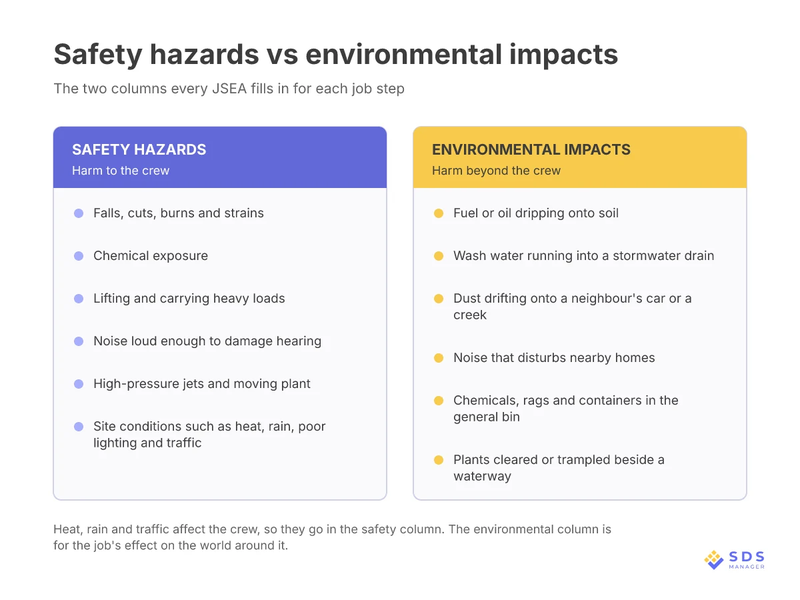
On site, people often talk about the "work environment", meaning heat, rain, poor lighting or traffic. Those conditions still go on the JSEA, but in the safety column, because they affect the crew. The environmental column is for the job's effect on the world around it.
Is a Job Safety and Environmental Analysis Legally Required in Australia?
No, Australian workplace safety law does not require a document called a job safety and environmental analysis. However, the law requires every business to find hazards and control risks before work starts, and a JSEA is a common way to do that for a single job.
Section 19 of the model Work Health and Safety (WHS) Act sets the main duty. The model WHS Act is the national template that every state and territory except Victoria has adopted, with local changes, as its own law.
A person conducting a business or undertaking (PCBU) must keep workers and others safe so far as is reasonably practicable. That means doing what can reasonably be done once you weigh how likely and how serious the harm is against what it takes to prevent it.
That duty includes safe systems of work (planned and agreed ways of doing each job safely). Regulations 34 to 38 of the model WHS Regulations then require the business to:
- identify hazards
- eliminate or minimise risks
- choose controls in a set order
- keep those controls working
- review them
Neither the model WHS Act nor the Regulations mention a JSA or a JSEA. Victoria has its own laws, the Occupational Health and Safety (OHS) Act 2004 and the OHS Regulations 2017, with similar risk duties.
When Do You Need a JSEA?
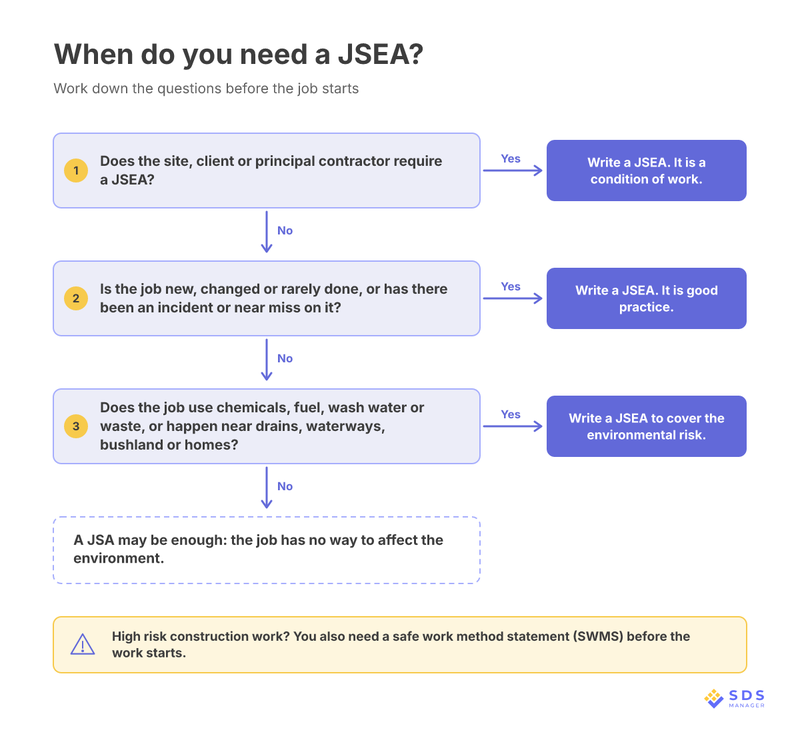
You need a JSEA mainly for the following reasons:
- the site, client or principal contractor makes it a condition of starting work
- your crew is doing the job for the first time, or has not done it for months
- the method, equipment, crew or site has changed since the last time
- there has been an incident or near miss (an event that could have hurt someone but did not) on the same kind of job
- the job uses chemicals, fuel or wash water
- the work is close to drains, waterways, bushland or homes
- your work creates a risk of harm from pollution or waste
The duty to manage risks under the WHS Regulations applies to every job, whether or not your site uses a JSEA, but not every job needs a written JSEA. In practice, write one when:
When your employer or the site makes a JSEA a condition of work, completing it is part of your job. Under section 28 of the model WHS Act, workers must follow reasonable instructions and co-operate with the business's health and safety procedures.
On building sites, a principal contractor can make the JSEA a condition of work as part of its risk management in building construction.
Environmental law gives you a second reason to write one. In Victoria, section 25 of the Environment Protection Act 2017 sets a general environmental duty. If your work creates a risk of harm from pollution or waste, you must remove or reduce that risk so far as reasonably practicable.
Other states and territories have their own environmental laws, and a JSEA gives you a written record that you planned for these risks.
What Should a JSEA Form Include?
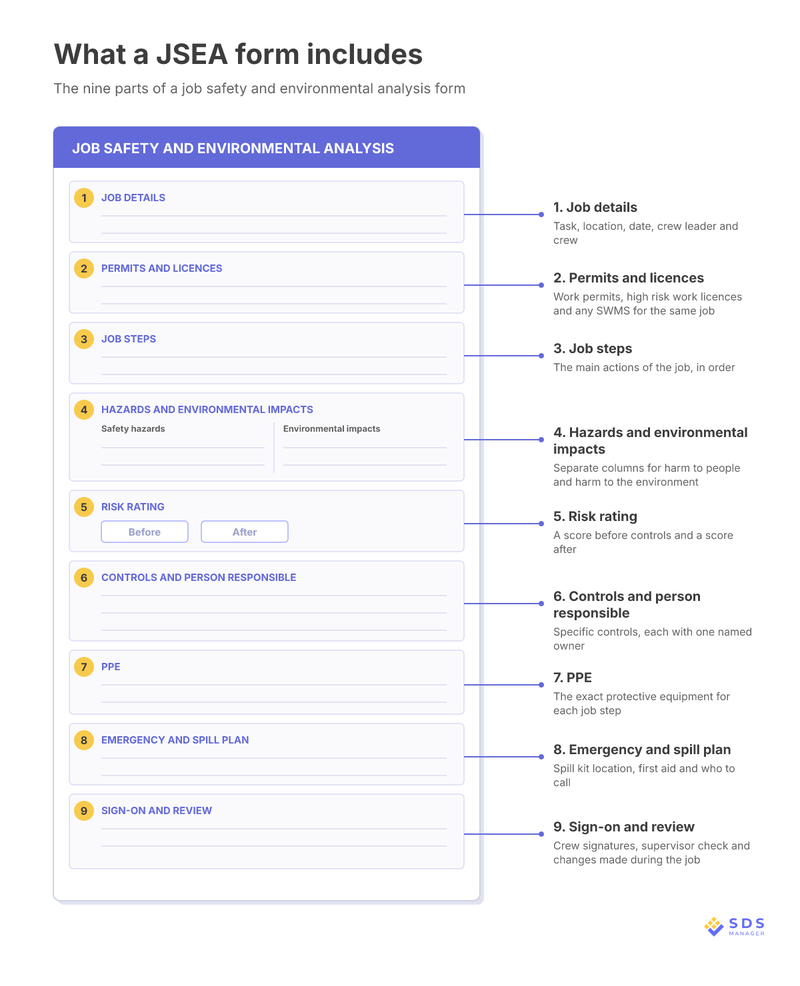
A JSEA form should include the job details, the job steps, and the safety hazards and environmental impacts for each step. It also needs risk ratings before and after controls, the controls and who is responsible for each, emergency and spill arrangements, and the signature of every worker.
Most templates set out the core of the form as a table with one row per job step.
| Section | What goes in it | When you fill it in |
|---|---|---|
| Job details | Task, location, date, crew leader and crew | When you choose the job |
| Permits and licences | Work permits, high risk work licences, and any SWMS for the same job | When you choose the job |
| Job steps | The main actions, in order | When you break the job down |
| Hazards and environmental impacts | Separate columns for harm to people and harm to the environment | When you list hazards |
| Risk rating | A score before controls and a score after | When you rate the risks |
| Controls and person responsible | Specific controls, each with one named owner | When you choose controls |
| PPE | The exact PPE for each job step | When you choose controls |
| Emergency and spill plan | Spill kit location, first aid and who to call | When you choose controls |
| Sign-on and review | Crew signatures, the supervisor's check and any changes made during the job | Before work starts and whenever conditions change |
A template gives you the layout, but the content has to come from the job in front of you.
How Do You Complete a JSEA?
You complete a JSEA with your crew at the job, before work starts, by breaking the job into steps and working through each step from hazards to controls.
A JSEA follows Safe Work Australia's four-step process for managing risk (identify hazards, assess risks, control risks, review controls). It adds a planning step at the start and a sign-on step before work begins, so the whole crew agrees on the plan before anyone starts.
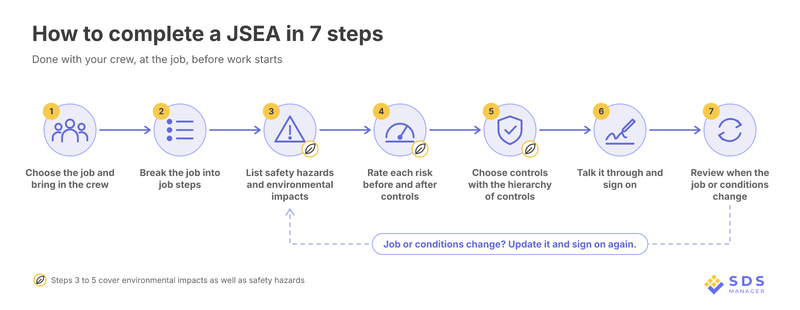
Step 1: Choose the Job and Bring In the People Who Will Do It
Write one JSEA for each job or task, not one for a whole site. The people who will do the work should help write it, because they know the site, the equipment and the part of the job that usually goes wrong.
The model WHS Act also requires a business to consult its workers when it identifies hazards and decides how to control them (sections 47 and 49).
Start the form with the basics: what the job is, where and when it happens, who is on the crew, and any permits or licences the work needs.
Step 2: Break the Job Into Its Main Steps
Break the job into its main actions in the order you do them, which for most jobs means about 5 to 10 job steps. These job steps become the rows of your JSEA, and each one starts with a verb.
For example, pressure cleaning the driveway of a small business with a petrol-powered pressure washer breaks into five job steps: set up the work area, refuel the washer, clean the driveway, collect the wash water, and pack up.
A job step that is too broad, like "do the pressure cleaning", hides the separate hazards of refuelling and collecting the wash water. A job step that is too narrow, like "press the trigger", leaves the crew with dozens of lines nobody reads.
Step 3: List the Safety Hazards and Environmental Impacts in Each Step
For each job step, write down two things: what could hurt a person, and what could escape into the ground, a drain, the air or a neighbour's yard. Name the hazard itself, not the outcome. "Petrol spill while refuelling" tells the crew what to control, while "fire" does not.
Chemicals need extra care, because the label rarely tells you the full environmental risk, and the safety data sheet (SDS) does. The model WHS Regulations require every SDS to include three sections that cover environmental risk:
- Section 6, which says what to do if the chemical spills
- Section 12, the ecological information, such as harm to fish and soil
- Section 13, which explains how to dispose of the chemical and its container
A folder of SDSs back at the office does not help a crew working on a driveway. Keeping every sheet in SDS management software that works on a phone lets the crew check sections 6, 12 and 13 at the job, before the chemical goes anywhere.
Step 4: Rate the Risk of Each Hazard and Impact
Rate each hazard and impact by how likely it is and how bad the result could be.
Many businesses use a 5x5 risk matrix, where likelihood and consequence each get a score from 1 to 5 and the two scores combine into a rating such as low, medium, high or extreme. Use your company's matrix if it has one, so every crew scores the same way.
Most matrices describe consequences in terms of injury, so it helps to add an environmental scale with three levels:
- Minor: contained on site and cleaned up straight away, such as a few drops of fuel on a drip tray
- Moderate: reaches soil or a drain but is stopped before it leaves the site
- Major: reaches a waterway, a neighbour's property or a public drain, or has to be reported to the state EPA
Rate each hazard and impact twice, once before controls and once after. If the second rating is not lower, the control is not working and needs to change.
Step 5: Choose Controls Using the Hierarchy of Controls
Choose controls in the order the law sets out, starting with the most effective. Regulation 36 of the model WHS Regulations follows the hierarchy of controls.
First, eliminate the risk where you can. If you cannot, substitute something less hazardous, isolate people from the hazard, or use engineering controls such as guards. Then add administrative controls, such as rules and procedures, and use personal protective equipment (PPE) last. The same order works for environmental impacts. For the driveway job, the controls at each level are:
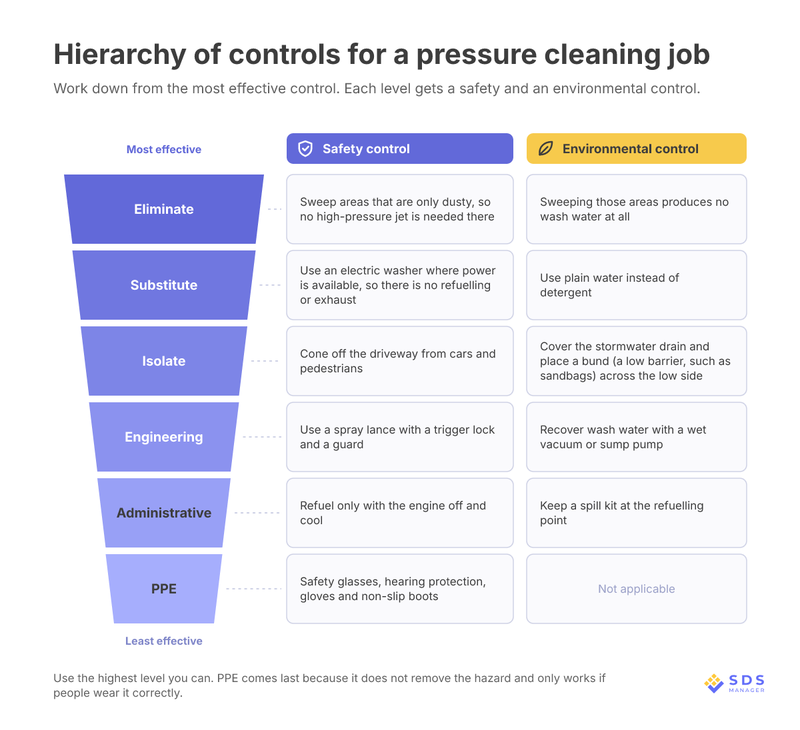
Write each control so the crew knows exactly what to do. WorkSafe Queensland's guidance on safe work method statements points out that a statement like "use appropriate PPE" does not detail the control measures. "Safety glasses and earmuffs while the washer is on" does. Next to each control, write the name of the person responsible for it.
If no control brings a risk down to a level your company's matrix accepts, stop and talk to your supervisor before the job starts.
Plan for a spill too, by noting where the spill kit is and who to call.
Reporting rules differ between states. In New South Wales, section 148 of the Protection of the Environment Operations Act 1997 requires a pollution incident that causes or threatens material harm (harm to people's health or to the environment that is more than trivial) to be reported immediately, including to the NSW EPA on 131 555.
Step 6: Talk Through the JSEA and Sign On Before Work Starts
Before work starts, the crew leader (the person in charge of the job on the day) reads the JSEA aloud at the job and walks through each step, hazard and control. Everyone who does the work then signs on by signing the JSEA to show they took part, including anyone who arrives after the start.
The talk-through is where a worker can say "that drain overflows when it rains" or "we don't have a drip tray", and the JSEA gets fixed before anyone picks up a tool.
A signature only shows that someone signed. If your crew skips the talk-through, the JSEA becomes "tick and flick" paperwork that people sign without reading. Keep the signed JSEA at the job, where the crew can check it while they work.
Step 7: Review the JSEA When the Job or Conditions Change
Update the JSEA before carrying on whenever the job, the site, the weather, the crew or the equipment changes, or after an incident or near miss. Regulation 38 of the model WHS Regulations requires controls to be reviewed in five situations:
- A control is not managing the risk it was put in place for, including after a notifiable incident (a death, serious injury or illness, dangerous incident or violent incident that must be reported to your state's workplace safety regulator).
- A change at the workplace is about to happen that could create a new or different risk.
- A new hazard or risk is identified.
- Consultation with workers shows a review is needed.
- A health and safety representative, a worker elected to represent other workers on safety, asks for one.
On a JSEA, a review can be as simple as stopping, adding the new hazard and control, and having the crew sign on again. When the job is finished, hand the JSEA to your supervisor with notes on anything that went wrong or changed, so the next crew starts from a better version.
JSEA Example: Pressure Cleaning a Business Driveway
A completed JSEA shows how the safety and environmental columns work side by side. Pressure cleaning is a good test, because the job has obvious safety hazards (a high-pressure jet, petrol and noise) and an environmental impact that is easy to miss: the dirty wash water.
In March 2025, EPA Victoria fined a builder nearly $4,000 after wash water from pressure cleaning a new driveway carried a chemical into stormwater drains that flow to the Werribee River. EPA Victoria's position is that only rain should go down stormwater drains.
For that job, a completed JSEA could carry these entries, with sample risk ratings that will vary with your own matrix:
| Job step | Safety hazards | Environmental impacts | Controls (person responsible) | Risk before, then after |
|---|---|---|---|---|
| 1. Set up the work area | Tripping on hoses; cars entering the driveway | Wash water flowing to the stormwater drain at the kerb | Cone off the driveway, run hoses along the edge, cover the drain and place a bund across the low side (crew leader) | Medium, then low |
| 2. Refuel the washer | Burns; fire from fuel spilled near a hot engine | Fuel spilling onto soil or into the drain | Engine off and cool, refuel on a drip tray away from the drain, spill kit beside the fuel can (operator) | High, then low |
| 3. Clean the driveway | Injection injury (the jet forcing water through the skin); slips; noise | Wash water with oil and grime; noise for neighbours | Never point the lance at a person; safety glasses, earmuffs and non-slip boots; plain water only; keep to agreed work hours (operator) | High, then medium |
| 4. Collect the wash water | Back strain from lifting full containers | Wash water reaching the drain or being tipped onto a garden bed | Wet vacuum the bunded area, fill drums only halfway, send the water to a licensed liquid waste contractor (crew leader) | Medium, then low |
| 5. Pack up | Lifting the washer onto the ute; hoses across the footpath | Leftover fuel, rags and grit going into the general bin | Two-person lift or ramp, remove the drain cover last, bag used rags and absorbent for proper disposal (crew) | Medium, then low |
The environmental column changed this plan in three places: the drain cover and bund, the drip tray for refuelling, and the wet vacuum for the wash water. A safety-only JSA would have protected the crew and still sent dirty water into the drain.
What Is the Difference Between a JSA and a JSEA?
A JSA looks only at harm to people, while a JSEA follows the same steps and adds the harm a job could do to the environment. Some businesses use the two names loosely, and in North America the safety-only version is usually called a job hazard analysis (JHA).
A JSA is enough for jobs that have no way to affect the environment, such as moving stock inside a warehouse or changing a light in an office. Once a job involves chemicals, fuel, water or waste, or a client asks for the environmental side, the JSEA is the right form.
If you are unsure, choose the JSEA, because it covers everything a JSA does.
What Is the Difference Between a JSEA and a SWMS?
The main JSEA vs SWMS difference is legal: a safe work method statement (SWMS) is required by law before high risk construction work starts, while a JSEA is a planning tool that the law does not name.
Regulation 291 of the model WHS Regulations defines high risk construction work as a list of 18 types of work. They include work with a risk of a fall of more than 2 metres, work on or near live electrical installations, and work in or near a confined space.
| Point | JSEA | SWMS |
|---|---|---|
| Legal basis | Not named in workplace safety law; used to meet the general duty to manage risks | Regulation 299 of the model WHS Regulations (the OHS Regulations 2017 in Victoria) |
| When you need one | When your site, client or business requires it, and as good practice for planned jobs | Before high risk construction work starts: 18 types under the model regulations, 19 in Victoria |
| What it must contain | Set by your business or the site | The high risk work, its hazards and risks, the controls, and how the controls are put in place, monitored and reviewed |
| Environmental risks | Included | Not required |
| How long to keep it | No set period in workplace safety law | Until the high risk work is finished, or 2 years after a notifiable incident |
The two documents often work together on the same job. A roofing crew, for example, needs a SWMS for the fall risk, and might also complete a JSEA each morning for that day's conditions and the environmental side, such as roof wash water and offcuts.
Most of the differences between a JSA and a SWMS also apply to a JSEA, because adding environmental columns does not change a document's legal status.
Move Your JSEA Risks Into One Register So Every Review Happens on Time
Paper JSEAs are filed away once the job ends. Each crew scores the same hazard its own way, and review triggers such as a new crew member or a near miss rely on someone keeping track of them. The next crew often starts from a blank form instead of what the last one learned.
This week, find the last few JSEAs for the job your crew does most often. Compare the ratings and controls, agree on one version, and give it a review date.
The Risk Management module in EHS Solution by SDS Manager scores every risk on one 5x5 matrix and ranks controls from elimination through to PPE. Each risk also gets an owner and a review date, so overdue reviews come up on their own instead of passing unnoticed.
Frequently Asked Questions
Can You Use a JSEA Instead of a SWMS?
Yes, you can use a JSEA instead of a SWMS only if it contains everything regulation 299 of the model WHS Regulations requires. That means the high risk construction work, its hazards and risks, the control measures, and how those controls are put in place, monitored and reviewed. Work outside the 18 types of high risk construction work (19 in Victoria) needs no SWMS at all.
What Are the 5 Steps of a JSA?
The 5 steps of a JSA, as Canada's Centre for Occupational Health and Safety lists them, are selecting the job, breaking it into a sequence of steps, identifying the hazards, deciding how to control them, and communicating the results. A JSEA uses the same five steps, adds environmental impacts at the hazard step, and adds a risk rating, a crew sign-on and a review.
Is a JSEA the Same as a Risk Assessment?
Yes, a JSEA is a type of risk assessment, done for one job at the place where the work happens. A broader workplace risk assessment covers a whole site, process or piece of equipment, and the JSEA applies the findings of that broader assessment to the task in front of the crew.
Is a Take 5 the Same as a JSEA?
No, a Take 5 is not the same as a JSEA. A Take 5 is a short personal check each worker does before a task, often in a small pocket book, while a JSEA is a written plan the crew completes together for the whole job. The two work together: the JSEA plans the job, and the Take 5 checks conditions before each task.
Is a JSEA the Same as a Safe Operating Procedure (SOP)?
No, JSEA is not the same as a safe operating procedure (SOP). An SOP sets out the standard way to do a routine task every time, while a JSEA checks the hazards and environmental impacts of one job, on the day, at that site. An existing SOP is a good starting point for the job steps in a JSEA.
Can You Reuse a JSEA for the Same Job?
Yes, you can reuse a JSEA as a starting point for a repeat job, as long as the crew checks it against the current site, weather, equipment and crew, adds anything new, and signs on again. WorkSafe ACT takes the same view of safe work method statements. It says a generic SWMS used at different workplaces may not meet WHS laws unless it is first reviewed for the hazards at that workplace and amended.
How Long Should You Keep a Completed JSEA?
How long you keep a completed JSEA depends on your company or client rules, because the model WHS laws set no fixed period for it. If an incident happens on the job, keep the JSEA for longer than your usual period, because it records what was planned. For comparison, a SWMS must be kept until the high risk construction work is finished, or for 2 years after a notifiable incident.