Safe Work Australia reported that 37 of the nation's 188 workplace deaths from traumatic injuries in 2024 happened in construction, which accounts for 20% of all worker fatalities.
Among the most fatal industries, construction is 3rd behind transport (54) and agriculture (44).
Safety is only one part of the picture. A sudden price increase for materials, an unpaid progress claim, a trade scheduling clash, or an environmental spill can shut down a project just as fast as a safety breach.
Good risk management in building construction protects both your team on site and the commercial health of your business. It works as an ongoing four-step cycle that runs from early planning through to final handover.
This guide explains how each step of risk management works, why it matters, which legal documents you need, and the common mistakes to avoid on Australian sites.
Key Takeaways
- Risk management in building construction is an active four-step cycle: identify, assess, control, and review. Completing a single assessment during the tender stage leaves the most important job-site stages undone.
- Full project risk management means tracking five areas: work health and safety, project operations, financial cash flow, contracts, and environmental rules.
- Inspect sites during peak working hours because overlapping trades create risks that do not exist early in the morning.
- Psychosocial hazards, including excessive overtime and tight deadlines, carry the same legal weight as physical hazards like falls from height.
- Elimination is the most effective safety control, but it must be addressed early during the design and buying stages before site work starts.
- A Safe Work Method Statement must describe the specific task on your actual site and be explained to the crew before work begins. Downloaded templates do not meet legal requirements.
- Hiring a subcontractor does not remove your duty of care. A written WHS management plan is legally required once project construction reaches $250,000, or $450,000 in South Australia.
What Is Risk Management in Building Construction?
Risk management in building construction is the process of spotting hazards on site, working out how serious they are, setting up controls, and checking regularly to make sure those controls work. Safe Work Australia’s Model Code of Practice for Construction Work defines this as a continuous loop because conditions change every time a new trade arrives on site.
A complete system manages five key risk categories across the project:
- Safety (WHS): Physical safety - Physical injuries, equipment movement; Health and Hygiene - worker fatigue, toxic dust, and mental health risks.
- Operational: Material delivery delays, equipment breakdowns, bad weather, and trade scheduling conflicts.
- Financial: Cash flow shortages, rising material costs, late progress payments, and contractor insolvency.
- Legal and Contractual: Scope changes, unapproved variations, late completion penalties, and building defects.
- Environmental: Soil runoff into storm drains, chemical spills, loud noise, and dust blowing to neighbouring properties.
A risk assessment completed before a build starts is only the first step. It captures hazards at a single point in time, but it does not run day-to-day controls or adapt when site conditions change.
How to Manage WHS Risks in Building and Construction
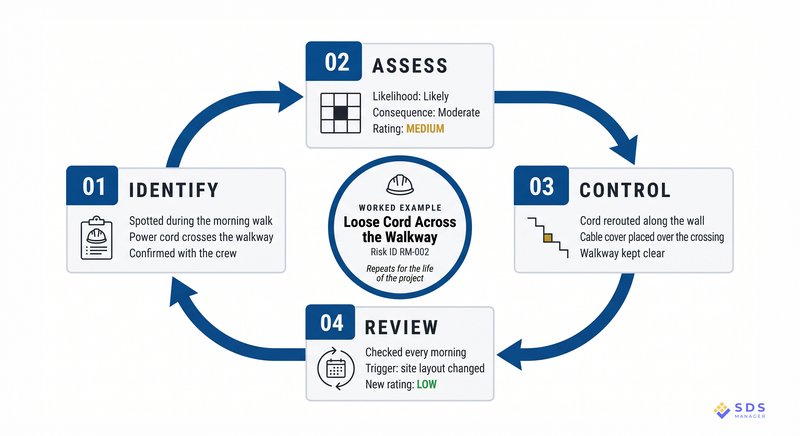
The Model Code of Practice for Construction Work builds safety management around four clear steps. Every site checklist, risk register, and safety form exists to support one of these stages:
- Identify Hazards
- Assess Risks
- Control Risks
- Review Controls
Identifying the right control depends on finding out what the hazard is and how likely, so it is important to carry out these steps in the above order.
Step 1: Identify the Hazards
Identifying hazards starts with walking the site. Use a smartphone or tablet during your walk to take photos of problem areas. Photos automatically include date and time stamps, which makes it easy to show subcontractors exactly what needs to be fixed.
Walk the site during the busiest part of the day. A site with one trade working at 6:30 AM has very few interactions. By midday, the same site might have three trades, an excavator, and a concrete truck working in the same space.
Timing matters just as much as the inspection itself. A single carpenter working at 6:30 AM faces different conditions than a site bustling at noon with three trades, a crane, and concrete delivery trucks. When you can only run one daily walk, inspect during peak activity to spot dangerous trade crossovers.
Speak directly with frontline workers rather than talking only to supervisors. Ask them what slows them down or feels unsafe. Workers see daily site hazards that quick walk-throughs miss. Consulting with workers is also a mandatory legal duty under the Model WHS Act.
Review your past incident logs and near-miss reports at the same time. A near miss is proof that the conditions needed to cause an injury are already present on your site.
| Risk Category | Common Site Examples | Why It Gets Missed |
|---|---|---|
| Physical Safety | Falls from heights, mobile plant, falling objects, trenches, confined spaces | Workers get used to the site and overlook familiar hazards |
| Health and Hygiene | Silica dust, asbestos, excessive noise, hazardous chemicals, heat stress | Health damage builds up over years rather than causing an immediate accident |
| Psychosocial | Unrealistic deadlines, long working hours, workplace bullying, job insecurity | Often treated as office issues rather than genuine site hazards |
| Operational and Site | Blocked delivery access, missing materials, overlapping trade schedules | Accepted as regular site friction instead of tracked as a project risk |
| Financial and Legal | Unsigned variation orders, delayed progress payments, scope disputes | Left for office accountants instead of tracked on site by project leaders |
| Environmental | Mud washing into local drains, chemical spills, dust drifting to neighbours | Treated as minor issues until local councils or environmental regulators issue fines |
Start by prioritizing physical safety risks because falls from height and moving machinery cause most construction fatalities.
Psychosocial hazards must be listed on your site risk register alongside physical risks. Australian WHS laws place psychosocial health on the same legal footing as physical safety. Subcontractors cannot change the main contract schedule, but they can control working hours and make sure workers can report safety concerns without fear of losing work.
Inspections will also identify tasks classified as high-risk construction work. Identifying these tasks is what legally triggers the requirement to prepare a Safe Work Method Statement before that work begins.
Step 2: Assess the Risk
Assessing a risk requires two judgements:
First, use a risk assessment matrix to determine the severity and likelihood of a risk. A simple 3x3 matrix (Low, Medium, High) works well and is faster to use than a complex 5x5 grid.
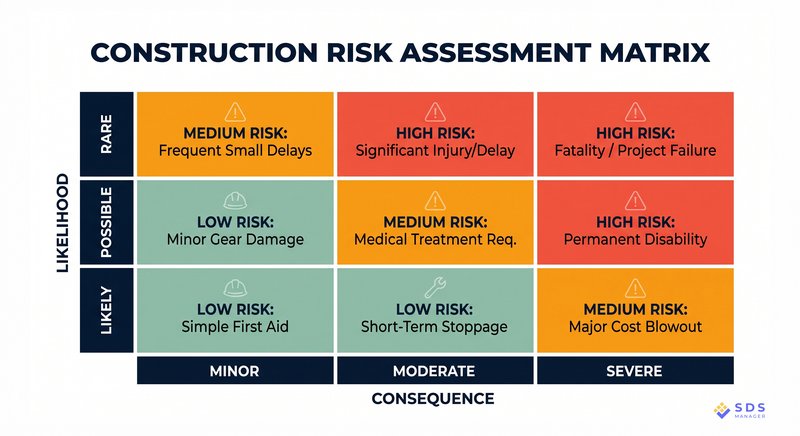
The score gives you a clear order of priority so you know which hazards to fix first. Two experienced supervisors might give a trench slightly different numbers. That difference is fine as long as the rating helps the team prioritize action instead of wasting time arguing over scores.
Second, do what is legally required to be “So Far as Is Reasonably Practicable” according to the WHS Act: This includes deciding what is reasonably practicable requires weighing five factors:
- How likely the hazard is to cause harm.
- How severe that harm could be.
- What you know, or should know, about the hazard and ways to control it.
- Whether suitable control measures are available.
- The cost of controls, but only if the expense is grossly out of proportion to the risk.
Cost is the most misunderstood factor. You cannot skip a safety control simply because it costs money, creates extra work, or lowers your profit margin. A control can only be rejected on cost if the expense is vastly out of proportion to the actual risk.
Does the Test Change Between States?
The standard of care is consistent across Australia, but the legislation behind it is not. Victoria operates under the Occupational Health and Safety Act 2004 rather than the Model WHS Act, setting out similar duties under different section numbers. The dollar value that triggers a mandatory site plan also changes depending on where you build:
| Jurisdiction | Project Value Trigger | Document Required |
|---|---|---|
| NSW, Qld, Tas, ACT, NT, WA, Commonwealth | $250,000 | WHS management plan |
| Victoria | $350,000 | Health and safety co-ordination plan |
| South Australia | $450,000 | WHS management plan |
South Australian sites carry one further change. From 1 July 2026, the state lowered its high-risk construction work fall threshold from three metres to two metres, bringing it into line with every other jurisdiction. Any work with a risk of falling more than two metres in South Australia now requires a SWMS, where previously it did not.
Step 3: Control the Risk
Controlling a risk means selecting safety measures from a fixed order of effectiveness called the Hierarchy of Control. You must always aim for the highest practical level on the list.
The Hierarchy of Control
The hierarchy starts with eliminating the hazard and ends with personal protective gear.
| Control Level | What It Means | Construction Site Example |
|---|---|---|
| Elimination | Remove the hazard from the job completely | Order prefabricated wall frames instead of framing walls at height on site |
| Substitution | Replace the hazard with a safer option | Use water-based sealers instead of solvent-based sealers |
| Isolation | Separate people from the hazard | Install physical guardrails and exclusion zones around floor openings |
| Engineering | Use mechanical controls or physical barriers | Attach dust extractors to concrete cutting tools |
| Administrative | Change how work is planned and performed | Create clear traffic plans and set strict crane operating hours |
| PPE | Protect the individual worker directly | Provide hard hats, safety boots, eye protection, and respirators |
Focus on elimination and substitution early during design and contract procurement. For example, choosing precast concrete panels eliminates the need for extensive formwork at height.
Once construction starts on site, elimination or substitution is rarely an option. Site supervisors must then rely on isolation, engineering controls, and administrative procedures.
Personal protective equipment acts as a personal barrier between a worker and a hazard.
PPE only protects the person wearing it, and it only works if it is fitted properly, used correctly, and in good condition. A hard hat does nothing for a worker not wearing one, standing nearby if loose bricks fall from scaffolding. Higher-level controls, like edge boards and catch nets, protect everyone on site automatically.
PPE is still necessary as a secondary control. For example, perimeter guardrails stop most falls, while a safety harness provides backup protection when a worker must step outside the rail to secure a connection.
Step 4: Review the Controls
Check your controls whenever site conditions change rather than waiting for a set calendar date. Focus your review directly on the specific task or area that has changed.
Construction is dynamic. A safety control that works for one trade may fail when another trade moves into the same work area.
Look for five main triggers to start a review:
- A control measure fails to prevent a safety issue or hazard.
- A new hazard appears that was not covered in the original assessment.
- The task scope, work sequence, or site layout changes.
- Workers or trade contractors raise new safety concerns.
- A Health and Safety Representative (HSR) asks for a review.
How to Manage Commercial Risk on a Construction Project
WHS risk is only one of the five categories a construction business carries. Operational, financial, legal and contractual, and environmental risks move through the same four steps: identify, assess, control, and review, and together they decide whether the project is profitable rather than only whether it is safe. What changes at the control step is the response available to you, since a commercial risk is rarely fixed with a guardrail.
The Four Risk Responses
Once a risk has a rating, there are only four things you can do with it:
- Avoid. Change the plan so the risk cannot occur. Declining a fixed-price contract on a site with unknown ground conditions removes the excavation cost risk instead of managing it.
- Transfer. Move the financial consequence to another party through insurance, a subcontract, or a contract clause. Transfer moves the cost, not the legal duty, and a WHS duty cannot be transferred by any contract.
- Reduce. Lower the likelihood, the consequence, or both. Ordering long-lead items during design reduces the chance that a supply delay stops the trades.
- Accept. Carry the risk knowingly and set money aside to cover it. Acceptance is a decision rather than an oversight, so it belongs on the register with a named owner like everything else.
The common error is treating transfer as a substitute for the other three. A certificate of currency does not stop a delay from happening. It only settles who pays for it afterwards.
What Belongs in a Risk Register
Whichever of the four responses you choose, it only holds if it is written down somewhere a reviewer can check later. A register works when each row can be acted on without a follow-up conversation, and that takes eight fields:
| Field | What It Records |
|---|---|
| Risk ID | A reference number so the risk can be discussed without describing it again |
| Description | The risk stated as cause and consequence, not a single word like "weather" |
| Category | Safety, operational, financial, contractual, or environmental |
| Rating | Likelihood against consequence, before any controls are applied |
| Response | Avoid, transfer, reduce, or accept |
| Controls | The specific measures in place, not the intention to put them in place |
| Owner | One named person, never a company or a trade |
| Review date | When the entry is next checked, and what triggers an earlier check |
Two fields carry most of the value. A description written as cause and consequence tells the reader what to act on, so "heavy rain delays the slab pour and pushes every following trade" is usable where "weather" is not. A single named owner then makes the entry someone's job. A risk assigned to "the site team" belongs to nobody.
Contract and Variation Risk
One entry that belongs on every register, and is missing more often than any other, is variation risk. Most commercial disputes on small projects trace back to work performed without a signed variation. A client asks for a change, the site supervisor agrees to keep things moving, and the paperwork is left until the job quietens down. By the time it is raised, the contract's notice period may have expired and the claim is difficult to recover.
Three habits prevent most of it. Confirm every instruction in writing before the work starts, even when the client is standing in front of you. Check the notice periods in your contract, because many standard forms require a claim within a set number of days and treat silence as acceptance. Price variations as they arise rather than in a batch at the end, when the client has already committed the budget elsewhere.
Retention, progress claim timing, and payment terms deserve the same treatment. Each of them belongs on the register as a financial risk with an owner, because an unpaid progress claim affects the business more immediately than most site hazards.
Setting Contingency That Survives the Job
Accepting a risk, the fourth response, still needs money behind it, and that money is contingency. Building it from the register rather than as a flat percentage produces a figure you can defend and, more usefully, spend deliberately.
Work through the accepted risks, estimate the cost of each if it eventuates, weight that by how likely it is, and total the result. A common approach on residential work lands somewhere between 5% and 10% of contract value, though the correct figure depends on how much of the design is resolved before work starts.
Two rules keep contingency doing its job. Decide in advance who can release it and what evidence they need; otherwise it drains into small unrecorded decisions. Record every drawdown against the risk it covered, so at handover you can see which risks actually cost money and price the next job better.
Why Is Risk Management Important in Construction?
None of the four commercial responses matter if someone is seriously hurt. Safe Work Australia statistics confirm that falls from height, being hit by moving objects, and being hit by falling objects cause most site fatalities, and no transfer clause or contingency line changes that outcome.
Unmanaged risks also create major commercial losses. A serious safety incident or environmental spill brings site work to an immediate halt. When safety regulators issue stop-work notices, project timelines blow out, contractual delay penalties apply, insurance costs jump, and clients remove the builder from future tender lists.
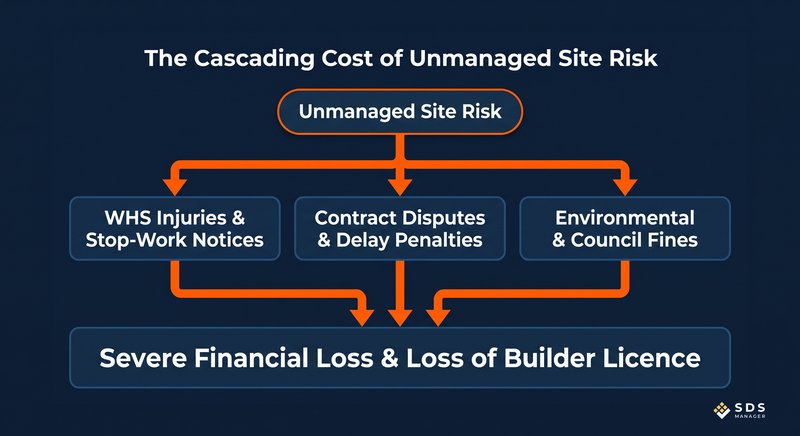
Business owners, directors, and site officers hold a personal duty of due diligence under the WHS Act (in Victoria, officer liability runs through s 144 of the OHS Act instead). If an officer fails to verify that safety controls are active on site, they can face personal fines and criminal charges.
Seven Mistakes That Make Construction Risk Management Fail
The failures below are ordered by how often they turn up rather than by how serious they are, since the common ones cause more cumulative harm than the rare ones.
- Using generic downloaded SWMS documents. Downloading a generic template does not meet WHS requirements. Learn the difference between a job safety analysis and a SWMS. A compliant SWMS must list the exact high-risk task, describe actual site conditions, and involve the crew doing the work.
- Relying on PPE first. Giving a worker a dust mask is faster than setting up an on-tool extraction vacuum, but it leaves everyone else in the area exposed to dust.
- Assuming subcontractor insurance transfers your duty. A subcontractor having public liability insurance does not remove your safety obligations. The principal contractor and the subcontractor hold concurrent duties for the same task. You must review their SWMS and check their work practices before they begin work.
- Starting jobs at$250,000 or more without a written WHS management plan. Under WHS law, the principal contractor must prepare a written plan before work begins on projects valued at $250,000 or more. In South Australia, the mandatory threshold is $450,000.
- Leaving the risk register untouched after the tender. Every entry on your risk register needs a named person responsible for managing it. If a risk has no assigned owner, nobody is checking the control on site.
- Ignoring financial, contractual, and environmental risks. Focusing only on physical safety leaves you open to unexpected price increases, unapproved variations, and council fines for stormwater pollution.
- Filing safety documents that are never communicated. Safety manuals left in the site office do not protect workers. Regulators look for evidence that supervisors briefed workers during morning toolboxes and site inductions.
Documents Needed for Effective Risk Management in Building Construction
Four core documents form the base of a strong site risk management system:
| Document | What It Covers | Who Prepares It | When It Is Required |
|---|---|---|---|
| WHS Risk Policy | Business safety commitments, roles, and how workers report hazards | Business Owner or PCBU | Recommended for all construction companies |
| WHS Management Plan | Site responsibilities, induction rules, consultation systems, and SWMS tracking | Principal Contractor | Mandatory at $250,000 (or $450,000 in SA) |
| Safe Work Method Statement | Step-by-step breakdown of a high-risk task and its matching controls | The trade PCBU doing the work | Mandatory before high-risk construction work begins |
| Project Risk Register | Complete record of site hazards, commercial risks, control measures, and risk owners | Site Supervisor or Project Manager | Recommended for all active construction projects |
Under Australian WHS regulations and PCBU duties in every state and territory except Victoria, you must keep every SWMS on site for the duration of the high-risk work. If a notifiable safety incident occurs, the SWMS retention rule requires you to keep the document for at least two years from the incident date.
Match your documentation to the scale of your job. A residential renovation needs a clear safety policy, relevant task SWMS documents, and an active risk register, not an oversized corporate manual.
Managing Risk is Only the First Step
Risk registers rarely fail at the start of a job. They fail when the site gets busy, control reviews begin to slip, and nobody notices until an incident or audit exposes the gap.
Paper forms and shared spreadsheets make this particularly difficult. They do not flag overdue reviews, and accountability becomes unclear when dozens of people can edit the same file.
Use risk management software that keeps every open risk accessible to the person responsible for it, flags reviews the moment they lapse, and has the evidence ready when a regulator asks, instead of leaving you to rebuild the trail after they reach your site.
Frequently Asked Questions
How Often Should a Construction Risk Assessment Be Reviewed?
A construction risk assessment should be reviewed whenever a control stops working, a new hazard appears, the work changes, consultation raises a concern, or a health and safety representative requests it, rather than on a fixed calendar date. Most active sites end up reviewing high-risk tasks weekly, because the work changes that often.
What Is the $250,000 Rule in Construction Safety?
The $250,000 rule is the threshold at which a construction project requires a written WHS management plan from the principal contractor before work starts, based on the value of the construction work rather than any single contract. South Australia sets its own figure at $450,000.
Can a Builder Be Personally Fined for a WHS Breach?
Yes, a Builder Be Personally Fined for a WHS Breach because officers hold a personal duty of due diligence under the WHS Act, and a serious breach can result in a personal fine or, in the most serious cases, imprisonment, separate from any penalty against the company. In Victoria, officer liability runs through s 144 of the OHS Act instead.
Does a Small Residential Builder Need a WHS Policy?
Yes, a Small Residential Builder Need a WHS Policy. Even a single-page policy is worth having, whatever the size of the business, because it establishes the accountability and reporting expectations that every other safety document on the job depends on.
What Is the Biggest Risk in Construction?
Falls from height are the single biggest physical risk in Australian construction and account for a disproportionate share of the industry's fatalities each year. Psychosocial risks such as unreasonable time pressure now carry the same statutory weight, although they rarely appear on a physical hazard checklist.

Arysha Alif Khan

Arysha Alif Khan is an EHS and chemical safety specialist with a background in biochemistry, biotechnology, and public health. She works closely with the product and regulatory teams to turn complex chemical regulations, SDS requirements, and workplace safety standards into clear, practical guidance for people.