Every Australian business fits into one legal category once it starts operating: a person conducting a business or undertaking, or PCBU for short.
That one term carries the primary duty of care under Australia's Work Health and Safety (WHS) Act. A business can't meet a duty it doesn't know it holds. That's why understanding PCBU responsibilities is the first real step toward meeting them.
In this guide, we will explain everything you need to know about PCBU responsibilities.
Key Takeaways
- PCBU responsibilities cover six everyday duties: keep people safe, find and fix hazards, protect mental health, provide training and emergency systems, provide facilities and report serious incidents, and consult workers.
- A PCBU is any person or group that runs a business or undertaking. The term covers sole traders, companies, government bodies and community groups, not just employers with staff.
- The "reasonably practicable" test sets how far each duty stretches. It weighs how likely harm is and how bad it would be against what controls exist and what they cost. Reporting a serious incident works differently, because that duty is absolute.
- A PCBU's duties protect workers, a term wide enough to cover contractors and volunteers, plus anyone else the work could put at risk. Officers carry a separate personal duty to check the business is meeting its own.
- A PCBU cannot hand its duty to anyone else, and no contract can shift it. Where several businesses share a site, each one holds its own duty and meets it to the extent it can genuinely influence and control the matter.
- The model WHS Act sets a top category 1 penalty of $2,368,000 for a PCBU or officer and $11,839,000 for a company, as at 1 July 2025. Industrial manslaughter goes higher, up to 20 years in prison.
- PCBU responsibilities vary by state in the detail. Victoria still says "employer" under its own OHS Act, and only some states require the hierarchy of controls for psychosocial risk.
What Is a PCBU?
A PCBU is a "person conducting a business or undertaking." Australian Work Health and Safety (WHS) law uses it for whoever holds the main safety duty at a workplace. It replaced the older word "employer," so the duty now reaches anyone who runs a business, not just those with staff.
Each part of the term does a job. "Person" can mean a group as well as one individual, so it covers a company or a club. "Conducting" means running the business day to day, not simply owning the building. "Business or undertaking" takes in for-profit and non-profit work alike, so a charity thrift store counts as much as a private firm.
Put together, the same rule covers a sole trader, a large construction firm, and a council running a public pool. Even if the businesses are nothing alike, if you run anything at all, your duty remains the same.
What Are a PCBU's Main Responsibilities?
A PCBU's main responsibilities come down to six everyday duties:
- Keep people safe.
- Find hazards and control them.
- Protect mental health as well as physical health.
- Give workers the training and emergency systems they need.
- Provide proper facilities, and report it when something serious goes wrong.
- Consult workers on the health and safety decisions that affect them.
A PCBU holds all six at once, and none of them is optional.
Keep Workers and Other People Safe
Keeping workers and other people safe comes down to the place itself. The site has to be safe enough to be unlikely to hurt anyone in it. According to SafeWork Australia, this includes the site’s layout, lighting, floors and surfaces, entries and exits, fixtures and fittings, and ventilation.
Take a café kitchen for example. Fryers push heat and steam into a narrow galley, tiled floors stay wet right through service, and deliveries arrive through the same door customers use.
The duty extends beyond the payroll, too. It protects a delivery driver, a visiting client, or a member of the public nearby, as long as the work could put them in harm's way.
Find Hazards and Control Risks
Finding hazards means looking for what could go wrong on site. Controlling risks means reaching for the strongest fix first, then working down. That order has a name, “the hierarchy of controls”, and it runs in four tiers:
- Remove the hazard entirely: Every PCBU starts here, and the lower tiers only apply where removing it isn't reasonably practicable.
- Substitute, isolate, or engineer: Swap the hazard for something safer, separate people from it, or design the risk out.
- Administrative controls: Change how people work through rules, procedures, signage and training, which protect people who follow them.
- Personal protective equipment: This is the last line of defense. Give workers gloves, masks, eye or hearing protection, which protect workers against physical harm.
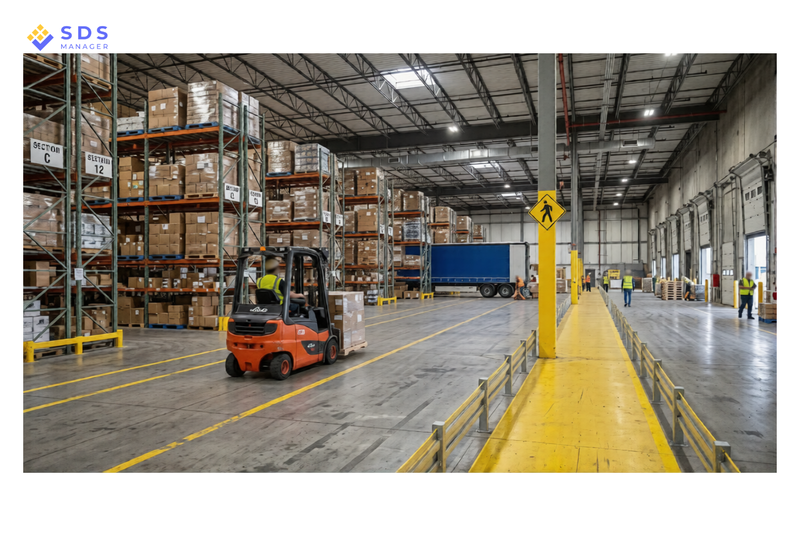
Take a warehouse, for example, where forklifts share aisles with people on foot. The strongest fix removes the hazard: change the layout so forklifts never drive where people walk. If that isn't possible, the second tier separates people from the danger, with a fenced walkway or sensors that slow a forklift when someone is close.
The third tier is administrative, meaning rules like a one-way system or sounding the horn when reversing, which only work while everyone remembers them. The last tier is PPE, and a hi-vis vest doesn't stop a forklift, it only makes the worker easier to see.
That hierarchy isn't only good practice. For many risks, including chemicals, falls, noise and building work, the WHS Regulations make it mandatory. Elsewhere it stays optional, though working down the tiers is still the clearest way to show the business chose a control properly.
Controls don't last forever, so a hazard handled today comes back the moment the job changes. That applies to the hazards you can't see as much as the ones you can.
Manage Psychological Health and Psychosocial Hazards
Managing psychological health means treating mental harm as seriously as physical harm. The WHS Act counts health as both physical and mental, so a PCBU has to find and control psychosocial hazards the same way it handles the obvious physical ones.
A psychosocial hazard is anything in the way work is designed or managed that can harm someone's mental health: bullying, heavy workloads, unclear roles, low control over the working day. Remote work rules can create that last one, when someone's hours and tasks are set entirely by someone else.
Meeting this duty takes changing the work, not adding a wellness policy on top of it. Say a call centre tracks every worker's idle time and flags anyone falling behind. That raises stress and removes any sense of control over the pace of the day. So, the PCBU has built the hazard itself. To fix it, the tracking must be redesigned.
However, most states make a PCBU apply the hierarchy of controls to psychosocial risk, while Western Australia and Tasmania don't. A PCBU in either state still has to manage psychosocial risk so far as is reasonably practicable. But it can choose how, instead of working through the tiers in order.
Victoria is different again, because its psychological health rules say employers must remove psychosocial risk where they can and reduce it where they can't.
Wherever you are, though, none of it protects anyone unless workers are properly trained so they actually know how to do the work safely.
Provide Safe Work, Training and Emergency Support
Providing safe work, training and emergency support means giving people the systems and instruction they need to do the job, and to handle it going wrong. That training, under PCBU responsibilities, fails unless it is regularly practised.
For example, a cleaner starting a night shift in an unfamiliar office block needs instruction on the products they'll use, supervision until they can work alone, and detail on the hazards of that building.
Emergency planning belongs to the same duty, and it matters most for someone working alone in a building they barely know, because there's nobody nearby to follow. So the PCBU must arrange these details in advance, so the workers learn where the exit is, where to gather outside, and who to call if a spill or fire breaks out.
Training also has a shelf life, so when your equipment, chemicals or tasks change, the instruction changes with them. But knowing how to work safely only helps if the workplace gives people what they need to do it, and that is the next duty.
Provide Facilities, First Aid and Report Notifiable Incidents
This duty has two halves. The first is what the site provides every day: toilets, drinking water, washing and eating facilities, and first aid gear with someone trained to use it. A site missing these fails the duty, however good its other systems are. Seasonal and outdoor work makes this harder, because the facilities have to move with the work.
The second half applies when someone is actually hurt. First aid handles most injuries, but if one is serious enough, the business also has to report it. Reporting notifiable incidents applies to three kinds of event: a death, a serious injury or illness, or a dangerous incident such as an uncontrolled chemical spill or a collapse. The Act defines that middle category, which includes treatment as a hospital in-patient, amputation, a serious head or eye injury, a spinal injury, and loss of a bodily function.
When any of those three events happens, three duties follow immediately. Unlike most PCBU duties, these are absolute rather than qualified by what is reasonably practicable :
- Tell the regulator straight away, by the fastest means available, and put it in writing within 48 hours if asked.
- Leave the site alone until an inspector arrives or the regulator clears the business to resume work.
- Keep a record of the incident for at least five years.
Five years is a long time for a paper file to survive staff changes and office moves. Storing reports in incident management software keeps them intact and searchable for the whole period.
Picture a fruit-packing shed where a failed guard crushes a worker's hand. The PCBU gives first aid, tells the regulator straight away, and leaves the conveyor exactly as it stopped until the regulator says otherwise, rather than clearing the line to keep the shift running.
On a building site, some of these events also fall under high-risk construction work, which carries its own permit and reporting rules.
Consult Workers and Their Representatives
Consulting workers and their representatives is a duty in its own right, not a courtesy. A PCBU must consult anyone who is, or is likely to be, directly affected by a health and safety matter, and consulting has a set shape. As a PCBU, you have four things to do:
- Share relevant health and safety information.
- Give workers a reasonable chance to express their views and shape the decision.
- Take those views into account before deciding.
- Tell workers the outcome.
Workers can also elect a health and safety representative to speak for them. If they do, the PCBU has to bring that person into the conversation, not just speak to workers one at a time. Larger workplaces often add a safety committee, and many businesses agree on a way to settle safety issues before disputes start.
Consulting carries real protections for workers. A worker can stop unsafe work where carrying on would expose them to serious risk, and a business breaks the law if it punishes someone for raising a concern.
Say a bakery buys new trolleys for moving trays between the oven and the cool room. Asking the staff first tends to surface what a supplier demo never shows, like the fact that the trolleys don't fit through the doorway.
The Eight Elements of the Primary Duty of Care
The eight elements of the primary duty of care restate those six everyday duties in the Act's own words. Seven sit in section 19(3), and one more sits in section 19(4), covering worker accommodation.
| Element | What It Covers |
|---|---|
| Safe work environment | Layout, lighting, work areas, floors and surfaces, entries and exits, fixtures and fittings, ventilation |
| Safe plant and structures | Machinery, vehicles and fixed structures kept safe to use |
| Safe systems of work | Tasks ordered so the process itself isn't a hazard |
| Safe use, handling and storage of plant, structures and substances | Equipment, materials and chemicals managed from delivery to disposal |
| Accessible and adequate facilities | Toilets, drinking water, washing and eating facilities, first aid |
| Information, training, instruction and supervision | What all persons need for the task and the site, not just general advice |
| Monitoring worker health and workplace conditions | Tracking whether the work is affecting health over time |
| Maintenance of worker accommodation | Housing the PCBU owns or controls, where the worker must live there because nothing else is available |
No element outranks another. Get seven right and ignore health monitoring, and you've still fallen short, because the Act treats the list as one duty rather than a set of boxes.
Those eight elements cover the main duty, but a business can hold other duties too, depending on what it does. A business that designs, makes, imports or supplies plant, substances or structures has to make sure those products are safe to use at work.
The same goes for one that installs or sets up plant, and for anyone who manages or controls a workplace or the fittings in it. A single business can be carrying three or four of these duties at once without realising .
What Does "Reasonably Practicable" Mean?
"Reasonably practicable" means doing what can sensibly be done about a risk, given how serious it is and what's available to fix it. This one standard sets how far a PCBU must go on each of the eight elements. The Act names five things you have to weigh:
- How likely the hazard or risk is.
- How much harm it could cause.
- What the person knows, or ought to know, about the hazard and the ways of removing or reducing it.
- What ways of removing or reducing the risk are available and suitable.
- The cost of those ways, and whether that cost runs grossly disproportionate to the risk.
Order matters here. A business weighs the first four before cost comes into it at all, and cost only excuses a control when it's wildly out of proportion to the risk that control would remove.
For instance, a factory can't skip guarding a press because guards cost money, since a crush injury is likely, and the fix is easy to get. A smaller risk works differently. For a box of paper stored where someone might trip, moving it onto a shelf may be all the standard asks for.
Knowing how far the duty reaches is only half the picture. Who it reaches matters just as much.
Who Do a PCBU's Duties Protect?
A PCBU's duties protect two groups: workers and other persons whose safety the work could affect. For example, in a coffee shop, the barista is a worker, and the customer waiting at the counter is the other person.
The Act draws both groups widely on purpose, because older employer-only laws let a business argue its duty stopped at its own staff.
The Broad Definition of "Worker"
The WHS Act defines "worker" widely enough to cover anyone who carries out work for a PCBU in any capacity. That takes in employees, contractors and subcontractors, labour hire workers, outworkers, apprentices and trainees, work experience students, and volunteers. What they have in common is that they all work, even if they are not paid.
That matters most where several businesses share one site. On a building site, the head contractor employs its own labourers. Working alongside them are an electrical subcontractor's crew, a scaffolding team, and an apprentice sent by a training provider. The head contractor's duty protects all of them, not just the people they pay.
"Other Persons" at the Workplace
"Other persons" at the workplace means anyone at or near the site who isn't a worker but whom the work could still harm. People belong to this group because they're exposed to the risk, not because they work for or contract with the business.
A retail store makes it concrete. A customer in the aisles, a delivery driver at the dock, and a passer-by on the footpath all count, and none of them works for the store.
The duty doesn't stop at the property line either. When a crane lifts materials over a public footpath, the hazard goes past the site, and the duty goes with it.
Who Counts as a PCBU and Who Doesn't?
Any person or group running a business or undertaking counts as a PCBU, whatever its size or legal shape. Ordinary homeowners, volunteer groups with no paid staff, strata bodies for homes, elected councillors and employees are all left out, because none of them is running one.
Homeowners are the clearest case. Someone having repairs done on their own house isn't a PCBU, because there is no business involved at all. That changes the moment a business starts operating from the site, so if you have begun selling cakes from your kitchen, you are a PCBU now.
Volunteer groups are harder, because there is real activity going on. The exclusion only applies where volunteers do all the work and nobody draws a wage. So where does that leave a group with one paid coordinator and twenty volunteers? It is a PCBU, and that single wage is what makes the difference.
The same wage test decides strata bodies for residential premises, which are excluded as long as they employ nobody. Elected councillors are excluded for a different reason: when they act in that role, they are not running a business of their own.
Employees are the last exclusion, and the most common one. The duty belongs to the business that employs them, which makes the difference between an employee and an employer worth setting out on its own.
Is a PCBU the Same as an Employer?
No, a PCBU isn't the same as an employer, though the two overlap in most everyday cases. "Employer" describes one legal relationship with staff, while "PCBU" covers anyone running a business at all.
That is why an employee is not a PCBU. The employee works in the business, but the business is the one running it, so the duty belongs to the business.
It works in the other direction too. A sole trader with no staff is a PCBU but has nobody to be an employer of, and closing that gap is why the term exists.
So, to sum it up, an employer is always a PCBU, but a PCBU isn't always an employer. The duty follows the business, not the payroll.
Victoria is the exception to all of this. Its Occupational Health and Safety Act 2004 still uses "employer" and never adopted the PCBU model, so a business trading only in Victoria will meet "employer" in its own state law. Whatever the term, though, the duty never applies on its own.
How Do PCBU Duties Work With Other WHS Roles and Businesses?
PCBU duties work alongside other WHS roles instead of replacing them, so several duties can apply to the same workplace at once. Three of those roles matter here, and each sits in a different relationship to the PCBU's duty.
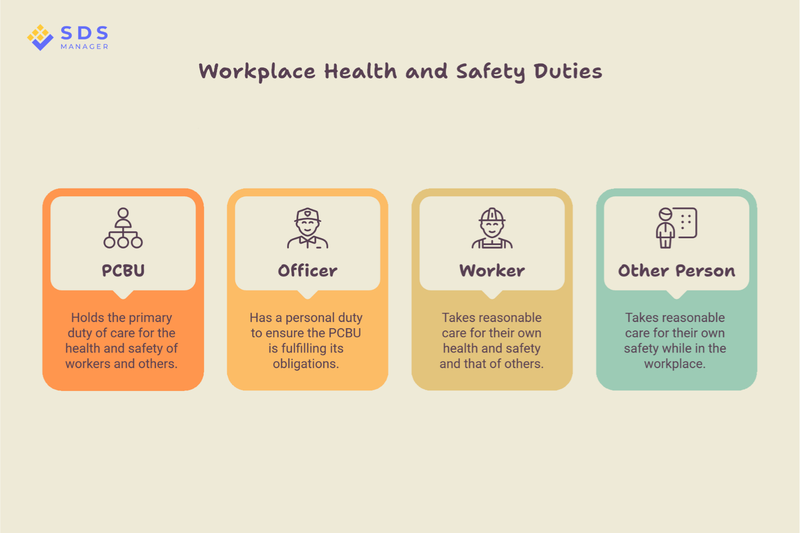
An officer has a duty to check that the PCBU is meeting its own. Workers and visitors have a smaller duty, covering their own safety and anyone their actions affect. And another business on the same site has the same duty in full, at the same time.
This applies in ordinary situations, not only on large projects. If an electrician comes to rewire a small gym, the gym is one PCBU and the electrical business is another. Both owe a duty to the electrician, to the staff and members nearby. Neither one is covered by the other.
So responsibility doesn't pass down a chain. head contractor holding a duty doesn't release the subcontractor, and an officer signing off doesn't cover the PCBU. Each duty stands on its own.
Officers and Their Due Diligence Duty
An officer is a director, or anyone else who makes or takes part in decisions affecting a whole business or a large part of it. That officer must exercise due diligence to confirm the PCBU is meeting its WHS duties.
This personal duty sits on top of the business's duty rather than replacing it, so a regulator can prosecute the company and the officer separately over the same failure. If you sit on a board, or you make the calls for a large part of a business, this one is personal.
Due diligence means an officer checks the safety systems actually work, instead of trusting that someone else has handled it. The Act sets out six reasonable steps:
- Keep up to date knowledge of work health and safety matters.
- Understand the business's work and the hazards and risks that come with it.
- Make sure the business has the resources and processes to remove or reduce risks, and uses them.
- Make sure the business takes in information about incidents, hazards and risks, and acts on it in good time.
- Make sure the business has and follows processes for meeting its duties.
- Verify that the business provides and uses those resources and processes.
Step six is the one officers most often miss, because verifying takes evidence rather than assurance. Scheduled checks logged in audit and inspection software give an officer something concrete to point to.
This duty reaches well past the boardroom. A small business with one director carries it too, scaled to what that business does.
Workers' and Other People's Duties
Workers and other people carry duties of their own, though much narrower ones. A worker must take reasonable care for their own safety and for anyone their work affects, follow reasonable instructions, and cooperate with the business's safety rules. “Reasonable” here means the expected level of care any ordinary worker should have, not necessarily the care from a safety expert.
Visitors carry a lighter version of the same duties. A contractor's client walking through a warehouse, for instance, must still wear the high-vis vest they're handed and stay inside the marked walkways, but nothing more is expected of them than that.
One person's failure doesn't cancel anyone else's. If a worker ignores a marked exclusion zone and gets hurt, that worker has failed their duty. But the PCBU's duty to set up the zone, the signs, and the training still stands. And if the PCBU did all of that, the worker's breach is the worker's, not something the PCBU answers for.
Overlapping Duties: When Multiple PCBUs Share a Workplace
When multiple PCBUs share a workplace, their duties overlap rather than divide, and each business owes a duty to the same people at the same time. None can escape it by pointing at another business, and none can contract out of it.
A shopping centre is the ideal example for this. Centre management is one PCBU, a tenant supermarket is a second, the cleaning contractor is a third, and the lift servicing company is a fourth.
If a leaking chiller leaves water pooling in a shared corridor, centre management can't call it the supermarket's problem, and the cleaner can't assume management has already dealt with it.
That doesn't make every PCBU answerable for everything, though. Each one meets its duty as far as it can genuinely influence and control the matter, and control is rarely shared evenly.
Centre management holds the keys to the corridor and the maintenance contract. The supermarket controls what happens on its own floor, and what it passes on when something spills. The cleaner controls whether a wet-floor sign goes up in the next two minutes. Each of those may contribute to the same hazard.
Sharing a workplace also means sharing the physical space. A tenant and a building owner both carry duties for the work environment and the facilities in it, down to who has arranged for the air conditioning to be serviced. Labour hire works the same way: the agency that supplies a worker and the business that directs them on site both hold a duty toward that person.
The WHS Act requires all these businesses to consult, cooperate and coordinate with each other. Doing that reliably takes a routine, not good intentions.
How to Meet Your PCBU Duties Day-to-Day
You meet your PCBU duties day-to-day by turning these key responsibilities of a PCBU into a routine rather than a one-off exercise. A workable start looks like this:
- Walk your site and list every hazard, covering physical risks, chemicals, and psychosocial factors such as workload and role clarity.
- Apply the hierarchy of controls to each one, working down from removing the hazard.
- Keep chemical information current and easy to find.
- Consult your workers, and consult any other PCBU on site.
- Review controls after any change: new equipment, a new task, or a near miss.
Step three is where small businesses lose track, because "keep chemical information current" hides a set of legal duties. A hair salon with forty products on the shelf carries the same duties as a factory. Any business handling hazardous chemicals must:
- Get the safety data sheet (SDS) from the maker or importer before anyone uses the chemical, and keep it current on a five-year cycle.
- Keep that SDS easy to reach for any worker who might handle the chemical.
- Maintain a register of hazardous chemicals, with the SDS for each.
- Maintain a manifest and tell the regulator once quantities pass the threshold.
- Label containers properly, including anything decanted, and placard the site where the rules require it.
An up-to-date hazardous chemical register gives a PCBU one place to check what sits on your site and how to store it. That beats memory, or a folder nobody has opened in months. Getting this wrong isn't only an administrative problem.
What Happens If a PCBU Doesn't Meet Its WHS Duties?
A PCBU that doesn't meet its WHS duties can face criminal charges under one of three offence categories. The category turns on how serious the conduct was, not on how much harm resulted.
- Category 1 is the worst. It applies where a duty holder exposes someone to a risk of death or serious injury, and does so with gross negligence or recklessly.
- Category 2 applies where a duty holder fails a duty, and that failure exposes someone to the same risk, without the gross negligence.
- Category 3 applies where a duty holder simply fails a duty. The regulator needs to prove nothing more.
The model WHS Act sets these maximum penalties as at 1 July 2025:
| Offence | PCBU or officer | Body corporate |
|---|---|---|
| Category 1 | $2,368,000 | $11,839,000 |
| Category 2 | $475,000 | $2,373,000 |
| Category 3 | $159,000 | $795,000 |
A category 1 offence can also mean prison, and the model Act sets that maximum at 15 years, though the term varies by state. These figures rise with inflation each 1 July, and states set their own on top. Comcare puts the Commonwealth category 1 maximum for a company at $17.034 million, well above the model figure.
Above those three sits one more charge. Industrial manslaughter applies where a duty holder's conduct causes a worker's death, and most states have now created the offence. The model penalty runs to $20,441,000 for a company and 20 years in prison.
Money is rarely the whole cost. A serious breach can bring an enforceable undertaking, an improvement notice setting a date to fix a problem, or a prohibition notice stopping the work outright.
Licence conditions and insurance costs can outlast the fine, and prison is the one consequence you can't insure against. Those consequences don't look identical everywhere, either.
Do PCBU Responsibilities Differ Across Australian States?
Yes, PCBU responsibilities differ across Australian states in the detail, though the core duty holds everywhere. Australia has nine WHS jurisdictions, and this is how they compare:
| Jurisdiction | Governing Act | Term used | Hierarchy of controls required for psychosocial risk |
|---|---|---|---|
| NSW, Qld, SA, ACT, NT, Commonwealth | Model WHS Act, as enacted locally | PCBU | Yes |
| Western Australia | Work Health and Safety Act 2020 (WA) | PCBU | No |
| Tasmania | Model WHS Act, as enacted | PCBU | No |
| Victoria | Occupational Health and Safety Act 2004 (Vic) | Employer | Separate rules from 1 December 2025 |
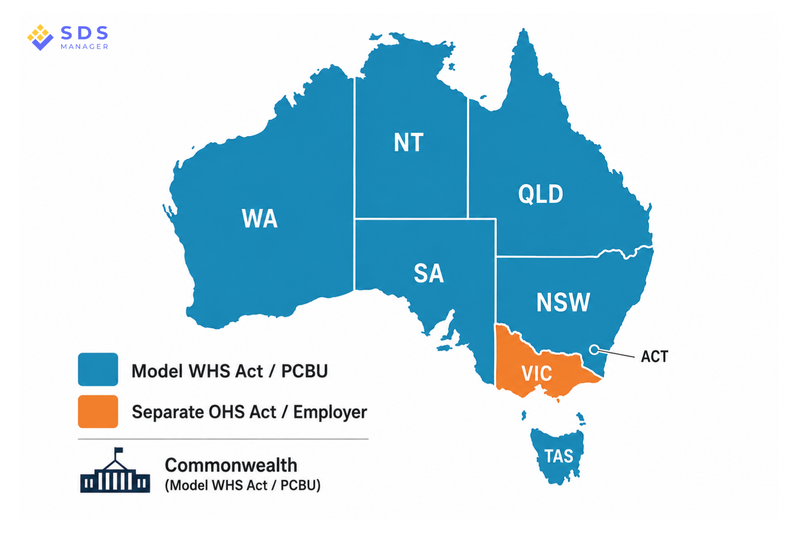
Two differences are worth knowing beyond the table. Western Australia's Work Health and Safety Act 2020 departs from the model in more than its penalty amounts, so a business operating there should check the local Act rather than assume the model applies.
And in New South Wales, approved codes of practice have carried direct legal weight since 1 July 2026, so a PCBU departing from the Managing Psychosocial Hazards at Work Code must show an equal or higher standard of protection.
If your work crosses state lines, don't assume your home rules apply there. A PCBU has to check the law where the work actually happens. Whichever state that turns out to be, the underlying job stays the same.
Turning PCBU Responsibilities Into a Routine
You don't have to fix all six duties this week. Start with the one that carries the most risk in your workplace, get that into a routine, then move to the next.
Most of what follows is record keeping that has to stay current: a hazard register, incident reports, a chemical register with an SDS for every product, and notes from every consultation. None of it is hard on its own. It just has to be there and up to date on the day someone asks for it, and paper folders rarely manage that, whereas an EHS management software such as EHS Solution by SDS Manager keeps the records in one place and flags what has gone out of date before an inspector does.
Frequently Asked Questions
Is a Sole Trader Considered a PCBU?
Yes, a sole trader is considered a PCBU. If you run a business on your own, you're a PCBU from the day you start, even with no staff at all. The primary duty of care still applies. It covers you personally, and it covers anyone else your work could affect, such as a client or a subcontractor you bring onto a job.
Can a PCBU Delegate Its WHS Duties to Someone Else?
No, a PCBU can't delegate its WHS duties to someone else. The Act won't let you transfer a duty or contract out of it. You can hire a consultant or a safety officer to help do the work, but the legal responsibility stays with you.
Do PCBU Duties Apply to Volunteers or Volunteer Organisations?
Yes, PCBU duties apply to volunteers, and they apply to some volunteer groups but not others. A volunteer working for a PCBU counts as a worker, so the primary duty of care covers that person just as it covers an employee. Whether your group is itself a PCBU is a separate question: if volunteers do all the work and nobody draws a wage, you usually sit outside the definition, and that changes the moment you hire a single paid worker.
What's the Difference Between a PCBU and an Officer?
The difference between a PCBU and an officer is that a PCBU is the business itself, while an officer is a person within it. An officer is usually a director, or anyone else who makes or takes part in decisions affecting the whole business or a large part of it. The PCBU carries the primary duty of care, and the officer carries a separate personal duty to check the business is meeting it. If you're a director of your own small company, you hold both.
What Is a PCBU Called in Victoria?
Victoria calls a PCBU an "employer," because it never adopted the model WHS Act and still runs its own Occupational Health and Safety Act 2004. The duties are broadly similar, but you won't find the term PCBU anywhere in Victorian state law. If you trade across the Victorian border, track which term applies where.
Can One Person Be Both a PCBU and a Worker?
Yes, one person can be both a PCBU and a worker, and this happens often among sole traders. A plumber is the PCBU for their own business but also counts as a worker within it. If that's you, duties run both ways: the PCBU duty toward anyone your work affects, and a worker's duty to take reasonable care for your own safety.

Arysha Alif Khan

Arysha Alif Khan is an EHS and chemical safety specialist with a background in biochemistry, biotechnology, and public health. She works closely with the product and regulatory teams to turn complex chemical regulations, SDS requirements, and workplace safety standards into clear, practical guidance for people.