Construction sites carry risks that most workplaces don't. Falls from height, trench collapse, and live electrical work drive a disproportionate share of construction deaths.
Australian WHS law responds by singling out these tasks for extra planning before work starts.
The meaning of HRCW is high-risk construction work, a category defined under the model WHS Regulations. It legally requires a Safe Work Method Statement before the work can begin.
This article covers the full HRCW list, the SWMS obligation it carries, and how the rules differ by state.
Key takeaways
- HRCW means high-risk construction work, a category set out in regulation 291 of the model WHS Regulations.
- A Safe Work Method Statement (SWMS) is legally required before any HRCW activity starts, prepared by the PCBU carrying out the work.
- Falling more than 2 metres is the most common HRCW trigger on residential and commercial sites.
- Victoria defines HRCW under its own regulation 322, separate from the national model.
- South Australia's fall threshold drops from 3 metres to 2 metres on 1 July 2026, aligning it with the rest of the country.
- A SWMS must be kept for at least 2 years after a notifiable incident connected to the work.
- HRCW is a different concept from a High Risk Work (HRW) licence, which covers specific trades like dogging, rigging, and crane operation.
What Is HRCW?
HRCW stands for high-risk construction work. It is a defined legal term under the model WHS Regulations, set out in regulation 291. The category exists because construction activities carry a higher chance of serious injury or death than most other work.
When a task falls into one of the listed HRCW categories, the person conducting the business or undertaking (PCBU) responsible for that work must prepare a Safe Work Method Statement. This has to happen before the work begins. The trigger is the type of task, not the size of the project or the trade doing it.
How Many Activities Count As HRCW?
Safe Work Australia currently groups high-risk construction work into 18 categories under regulation 291. They range from falls over 2 metres to diving work.
| # | HRCW category | Example |
|---|---|---|
| 1 | Falling more than 2 metres | Roof work, scaffolding, elevated platforms |
| 2 | Work on a telecommunication tower | Antenna or tower maintenance |
| 3 | Demolition of a load-bearing or structurally significant element | Removing a load-bearing wall |
| 4 | Work likely to disturb asbestos | Renovating a pre-1990 building |
| 5 | Structural alteration or repair needing temporary support | Underpinning, removing a beam |
| 6 | Work in or near a confined space | Entering a tank, pit, or void |
| 7 | Work in or near a shaft, trench deeper than 1.5 m, or tunnel | Deep service trenches |
| 8 | Work involving explosives | Controlled rock breaking |
| 9 | Work on or near pressurised gas mains or piping | Excavation near a gas main |
| 10 | Work on or near chemical, fuel, or refrigerant lines | Fuel line work at a depot |
| 11 | Work on or near energised electrical installations | Work near live switchboards |
| 12 | Work in a contaminated or flammable atmosphere | Enclosed-space painting |
| 13 | Tilt-up or precast concrete work | Precast panel installation |
| 14 | Work on, in, or adjacent to a road, railway, or traffic corridor | Footpath and driveway works |
| 15 | Work where a powered mobile plant is moving | Excavator or crane operating nearby |
| 16 | Work in artificial extremes of temperature | Cold-room construction |
| 17 | Work in or near water with a drowning risk | Pool construction, waterfront sites |
| 18 | Diving work | Underwater infrastructure inspection |
The threshold is set nationally through model WHS regulations, but each state and territory adopts and can modify its own version. That is why Queensland still applies a 3-metre threshold to housing construction, while other jurisdictions use 2 metres.
South Australia has been the clearest outlier, with a fall threshold of 3 metres until recently. SafeWork SA and ReturnToWorkSA data show 1,585 workers' compensation claims for construction falls since the 2016/17 financial year, costing more than $64 million. The total cost exceeded 64 million dollars. From 1 July 2026, South Australia's threshold drops to 2 metres, matching the national model.
That change now captures the exact height band responsible for 68 percent of falls from above two metres recorded between 2020 and 2022.
The SWMS Obligation That Comes With HRCW
A SWMS is a document that sets out the HRCW activity, its hazards, and the controls that manage them. It exists because generic site safety plans don't reliably capture the risks of a task like trenching or demolition.
The PCBU carrying out the HRCW must prepare the SWMS before work starts. It must also confirm that workers follow it and provide a copy to the principal contractor. If a notifiable incident occurs during the work, the SWMS must be kept for at least 2 years afterward.
The SWMS also has a retention rule. It must stay accessible on site and available for inspection at least until the HRCW is completed. If the SWMS is revised at any point, every version should be kept, not just the latest one. And if a notifiable incident occurs in relation to the work, the SWMS must be kept for at least 2 years from the date of the incident, not from when the work wrapped up.
Who Is Responsible For HRCW Compliance?
Responsibility for HRCW compliance sits mainly with the PCBU carrying out the work, though it extends to others on site.
- The PCBU carrying out the HRCW is responsible for preparing the SWMS, usually the subcontractor performing the task.
- The principal contractor must obtain a copy of the SWMS before allowing the work to start.
- Multiple PCBUs on the same site must consult, cooperate, and coordinate where their HRCW activities overlap.
- One SWMS can cover several HRCW activities, or a separate SWMS can be prepared for each activity.
State-By-State Differences In HRCW
HRCW does differ from state to state, mainly in fall-height thresholds and which regulations apply.
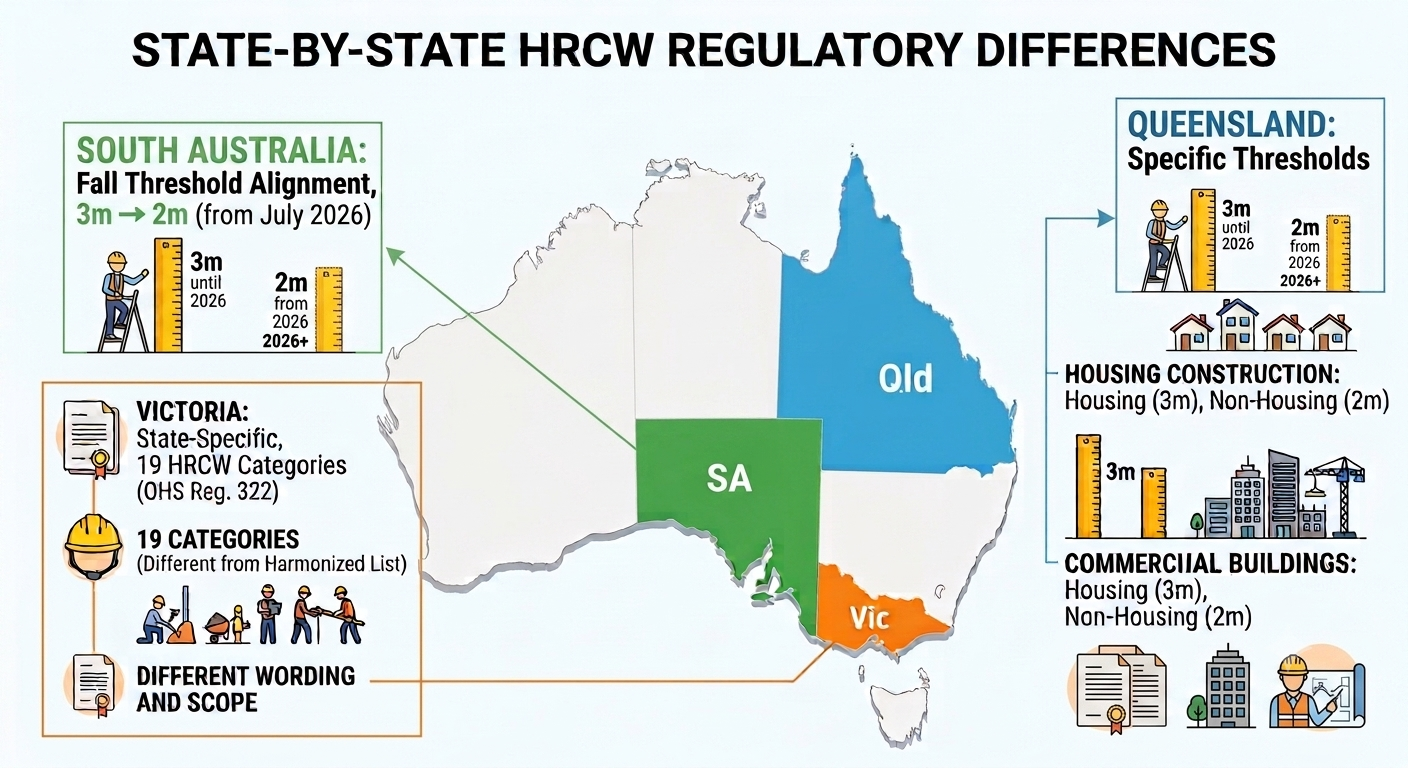
Victoria: Runs its own equivalent under regulation 322 of the Occupational Health and Safety Regulations 2017, with 19 categories and different wording from the harmonised list used elsewhere.
South Australia: Fall threshold sits at 3 metres until 1 July 2026, when it aligns with the national 2-metre standard.
Queensland: Work health and safety law is based on national model regulations, but each state and territory adopts its own version. That is why Queensland still applies a 3-metre threshold to housing construction, while other jurisdictions use 2 metres.
Builders operating across state lines need to check the local threshold rather than assuming the national figure applies everywhere.
Is HRCW The Same As A High Risk Work Licence?
No, HRCW is not the same as a High Risk Work (HRW) licence, though the two sometimes overlap. HRCW is task-based: any construction activity in the 18 categories above triggers a SWMS, regardless of who performs it.
On the other hand, an HRW licence is trade-based, and it applies to specific classes of work such as dogging, rigging, scaffolding, and crane operation. Each of these requires formal training through a registered training organisation before anyone can perform the work legally.
The two systems can overlap on the same task. For instance, scaffold erected above 2 metres is a good example: it needs a SWMS because the height triggers HRCW, and it needs an HRW licence because scaffolding itself is a licensed trade.
Keeping The HRCW Trigger Current
Identifying the correct HRCW category is only the first step. The bigger challenge for most PCBUs is keeping SWMS records current across every active site, especially once a business operates in more than one state.
A SWMS also needs review whenever the work changes or a new risk emerges, not just once at the start of a project, so a document created months ago can go out of date without anyone noticing. That gets harder as thresholds shift between states, the way South Australia's is about to on 1 July 2026.
A system for tracking regulatory changes across sites removes most of that manual tracking, flagging which SWMS need a fresh look when a rule changes underneath them.
Frequently Asked Questions
Is scaffolding always classed as HRCW?
Yes, scaffolding is classed as HRCW when it involves a risk of falling more than 2 metres, which covers most scaffold use on construction sites. Erecting it may also require a separate HRW licence.
What happens if HRCW starts without a SWMS?
If HRCW starts without an SWMS, it breaches the WHS Regulations. The breach can lead to enforcement notices, fines, or a stop-work order from the regulator.
Is HRCW the same in every Australian state?
No, HRCW is not the same in every state. Most jurisdictions use the same 18-category model list, but Victoria runs its own equivalent, and fall-height thresholds vary in Queensland and, until mid-2026, South Australia.
Is a SWMS the same as a JSA?
No, SWMS is not the same as a JSA. A SWMS is a specific legal document required for HRCW under WHS law. A JSA is a general safety planning tool for any type of work.

Mehreen Iqbal

Started with a Bachelors in Microbiology, then a Masters in Public Health; Currently a Workplace Safety Expert.