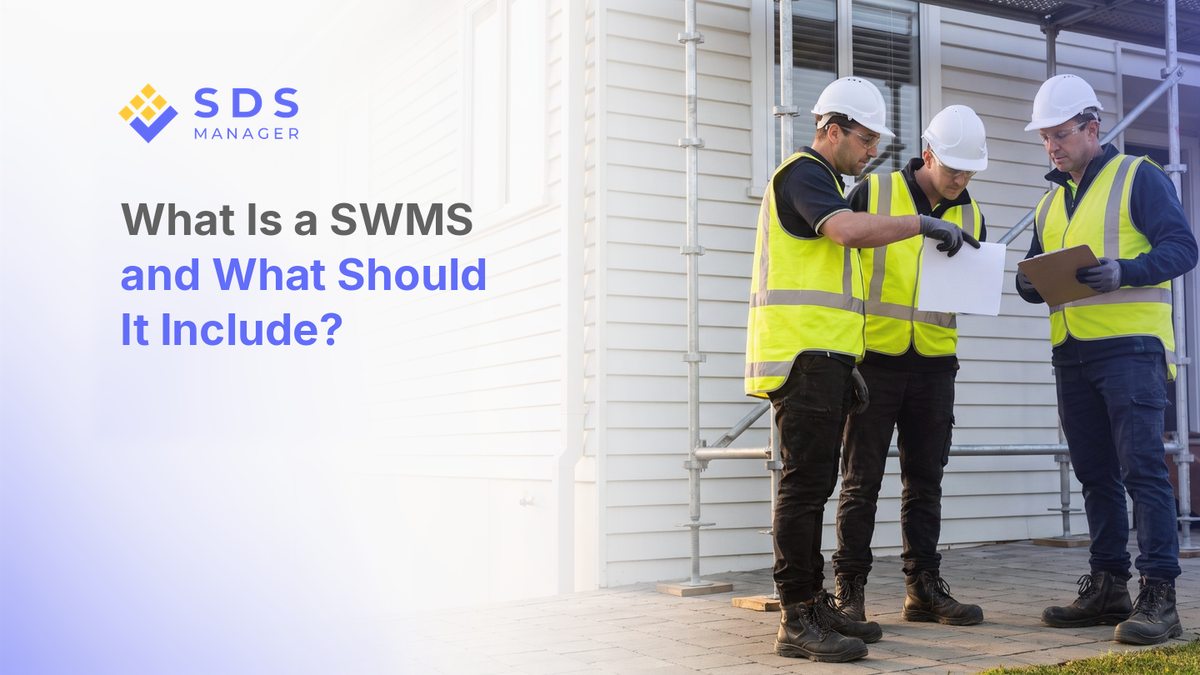
A SWMS (safe work method statement) is a written plan that sets out high risk construction work, the hazards and risks it creates, and how those risks will be controlled.
A SWMS has to be in place before high risk work starts on an Australian building site, such as work with a risk of falling more than 2 metres, work in a trench deeper than 1.5 metres, or work near live electrical services. The contractor or employer carrying out that work prepares the SWMS, and on a construction project, the principal contractor asks for a copy before the job starts.
Many of the SWMS handed over are copied from a template written for a different job, so they list hazards in general terms and leave out the ones on that site. A generic SWMS is a problem, because the SWMS is the document your crew works from and the one an inspector can ask to see.
In this article, you'll learn what a SWMS is used for, what it must include, how to write one step by step, and what a completed example looks like.
Key Takeaways
- A SWMS (safe work method statement) is a written plan that sets out high risk construction work, its hazards and risks, and the controls for them, and it must be ready before that work starts.
- Regulation 299 of the model WHS Regulations requires a SWMS to identify the high risk construction work, specify the hazards and risks, describe the control measures, and describe how those controls will be implemented, monitored and reviewed.
- The controls in a SWMS should be specific enough to check on site, because a line such as "use appropriate PPE" leaves the decision to workers on the day.
- The contractor or employer carrying out high risk construction work prepares the SWMS in consultation with workers, gives the principal contractor a copy before work starts, and must stop the work if it is not following the SWMS.
- A SWMS must be kept until the high risk construction work is finished, or for at least 2 years after a notifiable incident connected to that work.
What Is a SWMS Used For?
A SWMS is used to plan high risk construction work before it starts and to give everyone on the job one agreed description of how that work will be done safely. It turns the decisions made during planning into instructions your crew can follow on the day, and it gives a supervisor or inspector something specific to check.
You only need a SWMS for high risk construction work, the construction work that the WHS Regulations list as higher risk. Examples include work with a risk of falling more than 2 metres, work in a trench deeper than 1.5 metres and work near energised electrical services.
Other construction work still needs its risks managed so far as is reasonably practicable, but it does not need a SWMS.
Each person on the job reads the SWMS for a different reason:
- Workers use it to know how the job will be done and which controls they must use at each step.
- Supervisors use it to check that the work on site matches what was planned.
- The principal contractor, the business in charge of a whole construction project, uses it to see how each contractor will manage its high risk work before that work starts.
- An inspector from your state or territory regulator can ask to see it during a site visit.
Safe Work Australia classes a SWMS as an administrative control, meaning a control that works through instructions, training and supervision rather than physical barriers.
It records how the risks will be controlled, but it does not control anything by itself. The scaffold, the guardrail and the exclusion zone do that, and the SWMS tells everyone they must be in place before work starts.
Because a SWMS has to direct real work, the law is specific about what it must say.
What Must a SWMS Include?
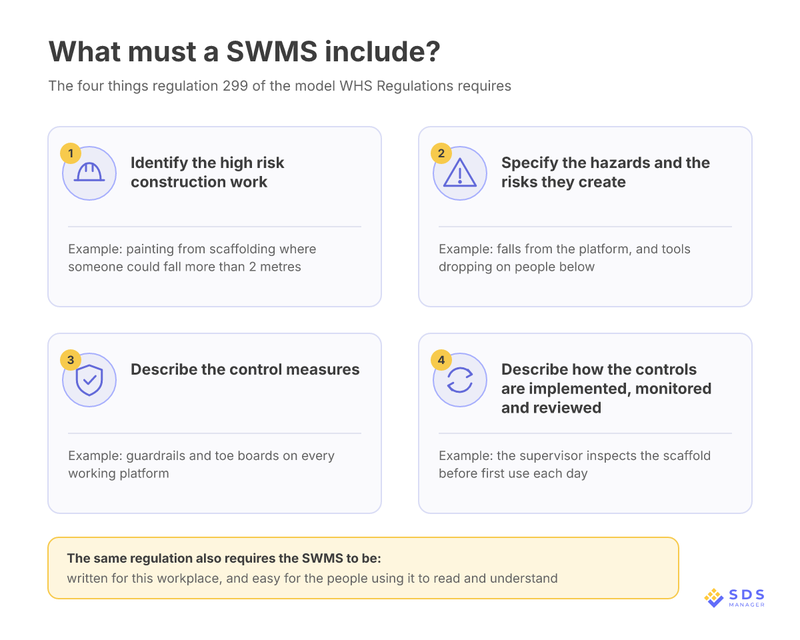
A SWMS must do four things under regulation 299 of the model WHS Regulations, the national model law that most states and territories follow:
- Identify the work that is high risk construction work.
- Specify the hazards relating to that work and the risks to health and safety they create.
- Describe the measures that will be used to control those risks.
- Describe how those control measures will be implemented, monitored and reviewed.
The same regulation adds two conditions. The SWMS has to be prepared with the actual conditions of the workplace in mind, and on a construction project it must take into account the principal contractor's WHS management plan, the written safety plan for the whole project.
It also has to be set out and expressed in a way that the people who use it can readily access and understand.
Safe Work Australia’s Code of Practice: Construction Work, updated in November 2024, says a SWMS should give clear direction on the control measures, so if a worker reading a control still has to decide what to do, it needs more detail.
What Goes in a SWMS Template, and What to Leave Out
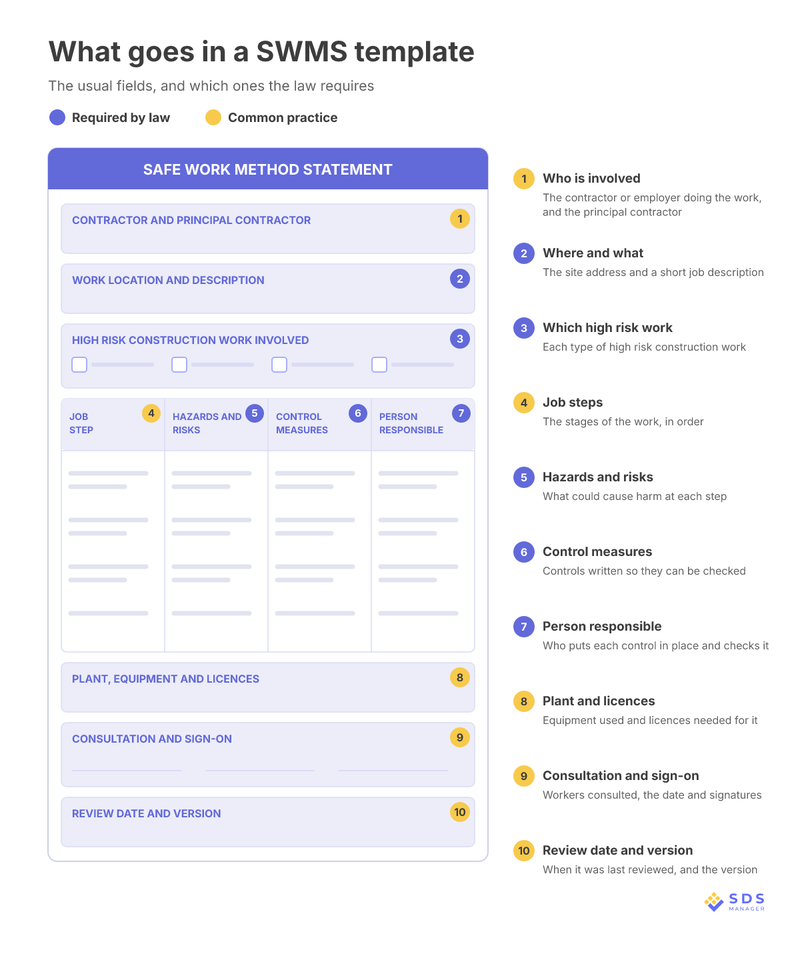
A SWMS template turns the four legal requirements into a table, with one row for each step of the job and columns for the hazards, the controls and the person responsible. The law sets what a SWMS must say, but not what it must look like, so most people start from a template rather than a blank page.
The fields around that table add the details your crew and the principal contractor need. These include who is doing the work, where it is, and when the SWMS will next be reviewed.
| Field | What to include | Why it is there |
|---|---|---|
| Contractor or employer and principal contractor details | Names and contact details of the contractor or employer doing the work and of the principal contractor | Practice: shows who is responsible for the SWMS |
| Work location and description | The site address and a short description of the job | Law: the SWMS must reflect the conditions at that workplace |
| High risk construction work involved | Each type of high risk construction work the job includes | Law: regulation 299 requires the work to be identified |
| Job steps | The stages of the work, in the order they happen | Practice: gives the hazards and controls a clear structure |
| Hazards and risks | What could cause harm at each step, and the harm it could cause | Law: regulation 299 requires hazards and risks to be specified |
| Control measures | The specific controls for each hazard, written so they can be checked | Law: regulation 299 requires the controls to be described |
| Person responsible and how controls are checked | Who puts each control in place, who checks it and when | Law: regulation 299 requires a description of how controls are implemented, monitored and reviewed |
| Plant, equipment and licences | Equipment used and any licence a worker needs for it | Practice: lets the principal contractor check competency before work starts |
| Consultation and sign-on | Names of workers consulted, the date and their signatures | Practice: a record of consultation, which the law requires to happen |
| Review date and version | When the SWMS was last reviewed and its version number | Practice: every revised version should be kept |
A SWMS does not need everything a template has room for. WorkSafe Victoria advises leaving out references to Australian Standards and other documents, risk matrices and risk scores, and any task that is not high risk construction work.
The Federal Safety Commissioner's SWMS fact sheet also says lists of legislation and risk ratings are not required. Each of these makes a SWMS longer without telling your crew what to do.
Some principal contractors still ask for more than the law requires, such as risk scores, a risk matrix, tasks that are not high risk construction work, or their own template. WorkSafe Victoria says information that is not about high risk construction work belongs in other documents, such as procedures and instructions.
If a principal contractor still wants these extras, put them in a separate document or an appendix. Keep the table your crew works from short and focused on the high risk work. The SWMS information sheet from Safe Work Australia says a SWMS should be short, and a long one is harder for a crew to read, follow and check.
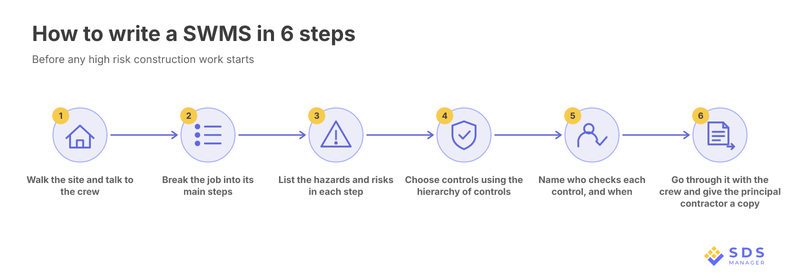
How to Write a SWMS in 6 Steps
You write a SWMS by working through six steps, from walking the site to giving the principal contractor a copy. Picture a crew getting ready to repaint the outside of a two-storey house from scaffolding, where anyone on the upper platforms could fall more than 2 metres.
Step 1: Walk the Site and Talk to the Crew Before You Write
Start on site, because a SWMS has to describe this job in this place. Walk the site with the people who will do the work. Note anything that changes how the job is done: how you get in and out, the ground under the scaffold, overhead power lines, other trades working nearby, and neighbours or the public.
On the house repaint, a sloping driveway and the power line running to the house would both change how the scaffold goes up.
Talking to the crew at this stage is also a legal requirement. The Code of Practice says workers, and their health and safety representatives (HSRs) if they have any, must be consulted when a SWMS is prepared. Workers who have done the job before often know about hazards that a template leaves out.
If you start from a generic SWMS, change it to fit the site. The Code allows a generic SWMS for work you do regularly, but it must be reviewed for the hazards and risks of the specific workplace and revised as necessary.
Step 2: Break the Job Into Its Main Steps
List the job as a short series of steps in the order the work happens. Each step should be one stage of the work that a worker would recognise, such as "set up the scaffold", rather than a single action like "pick up the brush".
Steps that are too broad hide hazards, and steps that are too small add length without adding safety.
For the house repaint, four steps cover the job: setting up the scaffold, preparing the surfaces, painting, and taking the scaffold down.
Step 3: List the Hazards and Risks in Each Step
For each step, write down the hazards and the risks they create. A hazard is anything that could cause harm, such as an open scaffold edge. A risk is the chance of that harm happening and how serious it would be, such as a painter falling from the top platform. The same step-by-step hazard check is the first part of risk management in building construction.
Look beyond the obvious fall hazard. Scraping and sanding old paint creates dust, and Queensland Health notes that paints with high levels of lead were used in many Australian houses before 1970. New paints and solvents can also harm skin, eyes and lungs. Falling tools and paint tins are a hazard for anyone walking below the scaffold.
Step 4: Choose Controls Using the Hierarchy of Controls
For each risk, choose controls in the order set by the hierarchy of controls. First, remove the hazard if you can. Then substitute something safer, isolate people from the hazard, or use engineering controls, which are physical changes such as guardrails. Administrative controls come after those, and personal protective equipment (PPE) comes last.
On the house repaint, painting the lower walls from the ground with an extension pole removes some of the height work altogether. A water-based paint can replace a solvent-based one, and an exclusion zone below the scaffold keeps people away from falling objects.
Then write each control so that someone else could check it on site. The Code of Practice gives "use appropriate personal protective equipment (PPE)" as an example of a statement that does not detail the control. Compare two versions of the same control:
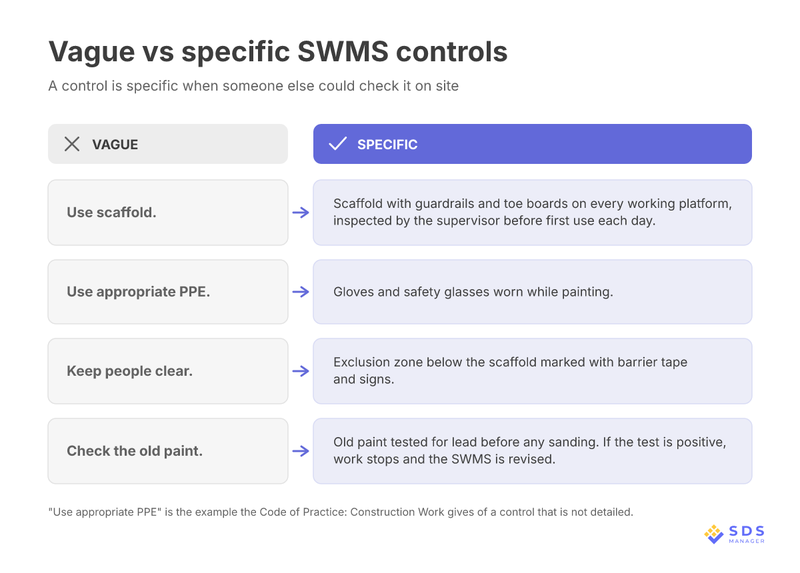
Queensland adds one more rule for falls. Under section 299(4) of Queensland's WHS Regulation, a SWMS for work with a risk of falling more than 2 metres that relies only on administrative controls or PPE must describe all the control measures that were considered.
Step 5: Name Who Checks Each Control, and When
Put a name or role against every control, along with when it will be checked. Regulation 299 requires the SWMS to describe how controls will be implemented, monitored and reviewed, and a named person with a set time is the clearest way to show that.
For the house repaint, the scaffolder signs off the scaffold once it is up, the supervisor inspects it before work each day, and each painter checks their platform before stepping onto it.
Step 6: Go Through It With the Crew and Give the Principal Contractor a Copy
Before work starts, go through the SWMS with everyone who will do the job, step by step, so each person knows the controls they are responsible for. Use plain words, and add pictures or diagrams where they help. Safe Work Australia suggests this for workers from non-English-speaking backgrounds.
If the work is part of a construction project, give the principal contractor a copy before the high risk construction work starts. Regulation 301 places that duty on the contractor or employer carrying out the work.
What Does a SWMS Example Look Like?
A SWMS example is a filled-in table with one row for each step of the job. Each row shows the hazards and risks in that step, the controls that will be used, and the person responsible for them. For a crew repainting the outside of a two-storey house from scaffolding, a completed SWMS has four rows, one for each stage of the job.
| Job step | Hazards and risks | Control measures | Person responsible |
|---|---|---|---|
| 1. Set up the scaffold | Falls of more than 2 metres while the scaffold goes up; scaffold movement on the sloping driveway; contact with the power line to the house | Scaffold erected by a licensed scaffolder on sole boards and base plates, levelled for the slope. Electricity distributor contacted before set-up to cover or isolate the power line to the house. Scaffold handed over with a completed scaffold tag | Scaffolder; supervisor |
| 2. Prepare the surfaces | Dust from scraping and sanding; lead in old paint; eye injury from flying flakes | Old paint tested for lead before any sanding. If the test is positive, work stops and the SWMS is revised for lead paint removal. Safety glasses worn while scraping | Supervisor; each painter |
| 3. Paint from the scaffold | Falls from the working platform; dropped tools and tins hitting people below; contact with the power line from extension poles or rollers; paint on skin and in eyes | Guardrails and toe boards on every working platform. Exclusion zone below the scaffold marked with barrier tape and signs. Insulated fibreglass extension poles only, kept clear of the power line. Water-based paint used. Gloves and safety glasses worn while painting | Each painter; supervisor checks the exclusion zone daily |
| 4. Take down the scaffold | Falls while dismantling; falling scaffold parts | Scaffold dismantled by the licensed scaffolder. Exclusion zone kept in place until the scaffold is fully down | Scaffolder; supervisor |
Every control in this SWMS can be checked by someone walking past the job, and every control has a person attached to it. Before choosing the paint, the painter can confirm its hazards and the PPE it calls for in the product's safety data sheet.
Who Writes a SWMS, and Who Has to Follow It?
The contractor or employer carrying out the high risk construction work writes the SWMS and makes sure the work follows it. In WHS law, that contractor or employer is the PCBU (person conducting a business or undertaking), which can be a company, a subcontractor or a self-employed tradesperson.
Preparing the SWMS is one of the duties of a PCBU on a construction site. Each person involved in the work has a different duty around the SWMS:
- Contractor or employer (PCBU): prepares the SWMS, consults workers, makes sure the work follows it, and reviews it when the controls change.
- Principal contractor: takes all reasonable steps to obtain a copy before the work starts. Under the model WHS Regulations, a construction project costing $250,000 or more has a principal contractor.
- Supervisors: check that the work on site matches the SWMS.
- Workers: follow the SWMS, take part in consultation, and speak up when the work and the SWMS do not match.
If the work is not being done the way the SWMS says, regulation 300 requires it to stop immediately, or as soon as it is safe to stop. Work can restart only in line with the SWMS.
If the crew finds a safer way to do the job, the Code of Practice says to revise the SWMS before work starts again.
When more than one contractor has the duty to prepare a SWMS for the same work, they must consult and cooperate with each other. That way, the crew works from one agreed method instead of two that contradict each other.
Is a SWMS a Risk Assessment?
A SWMS is not a risk assessment. A risk assessment works out how likely harm from a hazard is and how serious it could be, and it usually comes first. The SWMS then records the controls for high risk construction work in a form your crew can follow.
WorkSafe Victoria says a SWMS is not the same as a risk assessment or a job safety analysis.
The WHS Regulations do not expressly require a risk assessment for construction work, although the Code of Practice notes that one will often help decide which controls to use. A job safety analysis (JSA) looks a lot like a SWMS on paper, but no Australian law requires one by name. A job safety and environmental analysis (JSEA) follows the same step-by-step format and also covers the job's effect on the environment, such as spills, waste and runoff.
| Document | What it is | Legal Requirement | When it is used |
|---|---|---|---|
| Risk assessment | A process for working out how likely and how serious harm from a hazard is | Not expressly required for construction work under the model WHS Regulations | Before choosing controls, especially when the right control is not obvious |
| Safe operating procedure (SOP) | Written instructions for doing a routine task or using a machine the same way every time | Not required by name | For repeated tasks and equipment use |
| Job safety analysis (JSA) | A step-by-step check of a task's hazards and controls | Not required by name | Before tasks that are not high risk construction work, or to plan the steps that later go into a SWMS |
| SWMS | A written plan for high risk construction work, its hazards and its controls | Required before high risk construction work starts | Before and during high risk construction work |
How Long Should a SWMS Be Kept?
Keep a SWMS until the high risk construction work it covers is finished. If a notifiable incident happens in connection with that work, keep the SWMS for at least 2 years after the incident. A notifiable incident is a death, a serious injury or illness, or a dangerous incident that must be reported to the regulator.
While you keep it, the SWMS must be readily accessible to the workers doing the job and available for an inspector to see. The Code of Practice allows a SWMS to be kept electronically, and it says every version should be kept when the SWMS is revised.
When Should a SWMS Be Reviewed
A SWMS should be reviewed whenever the work or its controls change, not on a set date. The WHS Regulations give a SWMS no expiry date, so it stays in use for as long as it still describes the work and the controls on site. It is reviewed in five situations:
- A control does not control the risk it was put in place for.
- A change at the workplace is about to happen that is likely to create a new or different risk.
- A new hazard or risk is identified.
- Consultation with workers shows that a review is needed.
- A health and safety representative asks for a review.
Workers and their HSRs must also be consulted when a SWMS is reviewed. On the house repaint, a positive lead test would be a new hazard, so the controls and the SWMS would both be revised before any more sanding.
Move Your SWMS Paperwork Into One Digital System
A SWMS only protects people when the current version reaches the site and the crew who use it. On jobs with several contractors, SWMS often arrive by email and end up in separate folders. Old versions stay in circulation, and a revised SWMS may never reach the people doing the work.
List every high risk job you are currently running and check two things for each one: that the SWMS on site is the latest site-specific version, and that the crew has been through it. When those SWMS are spread across inboxes and folders, the check takes hours, and it has to be repeated every time a contractor sends a revision.
With EHS Solution by SDS Manager you can keep contractor approvals, and each contractor’s documents, including their SWMS, on one register, so you can see which version is current before work begins.
Frequently Asked Questions
Do You Need a SWMS for Every Job?
No, you need a SWMS only for jobs that involve high risk construction work. Testing, maintenance or repair work of a minor nature, such as replacing a few individual roof tiles, is not construction work under the model WHS Regulations, so it does not need one.
Is a SWMS a Legal Document?
Yes, a SWMS is a legal document required in Australia, according to the WHS Regulations, before high risk construction work starts and requires the work to follow it. In Victoria, the same requirement comes from the Occupational Health and Safety Regulations 2017.
Does a SWMS Need to Be Signed?
No, a SWMS does not need to be signed under the model WHS Regulations. The Code of Practice says a SWMS may include the signature of each worker who took part in preparing it, and Safe Work Australia's own template has space for those signatures.
Can One SWMS Cover More Than One High Risk Activity?
Yes, one SWMS can cover more than one type of high risk construction work, as long as it identifies each one and sets out the hazards and controls for each. A job that combines work at height with work near a power line can have a single SWMS that covers both.
Is an AI-Generated SWMS Acceptable?
An AI-generated SWMS is acceptable only after it has been checked against the actual site. WorkSafe Victoria treats it like a generic SWMS. It must be reviewed on site before work starts, cover all the high risk work and its risks, and have anything that does not apply to the site removed.
Does a SWMS Need to Be Translated?
Yes, SWMS needs to be in a language the workers using it can understand. WorkSafe Victoria advises giving workers who do not speak or read English a SWMS in a language they can easily understand.
What Is a Concrete SWMS?
A concrete SWMS is a SWMS for concrete work. It is required when the concreting is high risk construction work, such as tilt-up or precast concrete work. It is also required when the concrete job involves another high risk activity, such as work in a trench deeper than 1.5 metres or in an area where powered mobile plant, such as an excavator or forklift, is moving.

Arysha Alif Khan

Arysha Alif Khan is an EHS and chemical safety specialist with a background in biochemistry, biotechnology, and public health. She works closely with the product and regulatory teams to turn complex chemical regulations, SDS requirements, and workplace safety standards into clear, practical guidance for people.