Most workplace deaths in Australia come from the same few causes every year, and those causes are the biggest risks to look for in your own job or workplace.
Safe Work Australia, the Australian Government agency that develops national work health and safety policy, recorded 222 workplace deaths in Australia in 2025, counting workers killed by injuries at work. That was the highest number since 2012, and vehicle incidents caused about four in ten of them.
In this article, we cover how many workplace fatalities happen each year, what causes most of these deaths, which industries and workers face the most risk, and how to prevent the main causes.
Key Takeaways
- Vehicle incidents were the most common cause of Australian workplace deaths in 2025 (92 deaths), followed by falls from a height (28) and being hit by falling objects (21).
- By industry, transport, postal and warehousing had the most workplace deaths in 2025 (61), but agriculture, forestry and fishing had the highest rate: 13.0 deaths per 100,000 workers.
- Men made up 93% of the workers killed at work in Australia in 2025, and machinery operators and drivers died at almost six times the national rate.
- To prevent the three main causes of workplace deaths, use marked walkways that keep people away from vehicles, edge protection for work at height, and secured loads with exclusion zones under lifts.
How Many Workplace Deaths Are There in Australia Each Year?
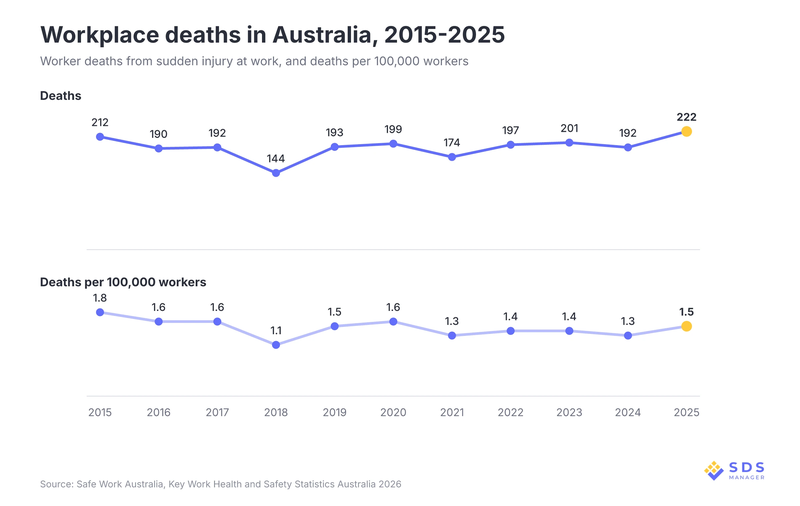
Workplace fatalities in Australia averaged 197 a year from 2021 to 2025 and rose to 222 in 2025, according to Safe Work Australia's Key Work Health and Safety Statistics Australia 2026, released on 12 October 2026.
The Safe Work Australia fatality statistics count workers killed by a sudden injury at work. They leave out deaths from work-related disease, suicides and deaths while travelling to or from work.
Members of the public killed by work activity are not part of the worker count either, and Safe Work Australia does not publish figures for them on its dashboards.
The 2025 death rate was 1.5 per 100,000 workers, above the 2021-2025 average of 1.4.
A count tells you how many deaths happened, while a rate tells you how likely any one worker is to die. Because the workforce keeps growing, a year can have more deaths and still have a lower rate.
The death rate has fallen over the long term, from 2.6 per 100,000 in 2005 (258 deaths) to 1.8 in 2015 (212 deaths). The 2025 rate is still 15% lower than in 2015. However, both the number of fatalities and the rate went up in 2025, so you can't assume the long-term fall will continue.
The 2026 edition of Key Work Health and Safety Statistics Australia is the latest yearly edition, and the next is expected around October 2027.
Safe Work Australia's running count during the year is usually lower than the final figure. Past years are also revised as coroners' reports and investigations are finalised: the 2024 total, published as 188 in the 2025 edition of the report, now stands at 192.
What Are the Most Common Causes of Workplace Deaths?
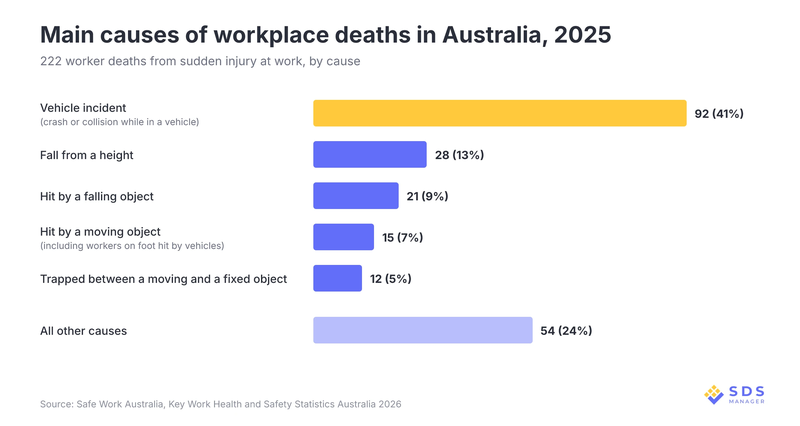
The most common causes of workplace deaths in Australia are vehicle incidents, falls from a height and being hit by falling objects. Together, they caused 141 of the 222 fatalities in 2025 (64%). Vehicle incidents alone caused 92 deaths (41%), more than any other cause.
| Cause | Deaths | Share of deaths |
|---|---|---|
| Vehicle incident (crash or collision while in a vehicle) | 92 | 41% |
| Fall from a height | 28 | 13% |
| Hit by a falling object | 21 | 9% |
| Hit by a moving object (including workers on foot hit by vehicles) | 15 | 7% |
| Trapped between a moving and a fixed object | 12 | 5% |
| All other causes | 54 | 24% |
Vehicles cause the most fatalities because so many jobs involve driving or operating one, from trucks and delivery vans to tractors, loaders, boats and aircraft.
How a death is recorded depends on where the worker was. In a delivery yard, for example, a driver killed when their truck crashes counts as a vehicle incident, while a worker on foot struck by a reversing truck counts as being hit by a moving object.
From 2003 to 2025, about two in three (65.5%) of the 5,140 worker deaths involved a vehicle in any way, which covers more deaths than the vehicle incident category alone.
Falls from a height have been the second most common cause for three years in a row, with 30 deaths in 2023, 24 in 2024 and 28 in 2025. These are falls from roofs, ladders, scaffolds and the backs of trucks.
If any part of your job involves working at height, your state or territory's rules for working safely at heights apply to you.
Deaths from falling objects rose from 12 in 2023 to 21 in 2025.
The remaining 24% were spread across many smaller causes, including assaults (7), contact with electricity (6), being hit by an animal (6) and drowning (5).
Which Industries and Workers Are Most at Risk?
Farming, transport and construction are the industries most at risk, and machinery operators and drivers are the workers most at risk, though the industry with the most deaths isn't always the one with the highest risk per worker.
What Are the Most Dangerous Industries in Australia?
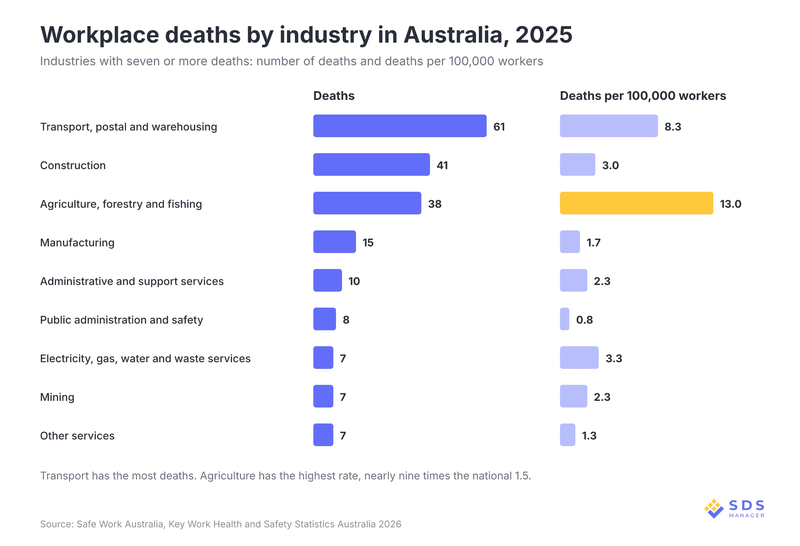
Measured per worker, agriculture, forestry and fishing is the most dangerous industry in Australia, with 13.0 deaths per 100,000 workers in 2025, nearly nine times the national rate of 1.5.
Transport, postal and warehousing had the most deaths (61), followed by construction (41) and agriculture (38).
Transport has more fatalities, but each person working on a farm, in a forest or on a fishing boat is more likely to die at work.
Farm work relies on tractors and quad bikes, which can roll over on slopes. Across all industries, vehicle rollovers caused 6 deaths in 2025.
| Industry | Deaths | Deaths per 100,000 workers |
|---|---|---|
| Transport, postal and warehousing | 61 | 8.3 |
| Construction | 41 | 3.0 |
| Agriculture, forestry and fishing | 38 | 13.0 |
| Manufacturing | 15 | 1.7 |
| Administrative and support services | 10 | 2.3 |
| Public administration and safety | 8 | 0.8 |
| Electricity, gas, water and waste services | 7 | 3.3 |
| Mining | 7 | 2.3 |
| Other services | 7 | 1.3 |
Construction had almost one in five of all deaths. Much of that work, such as work on roofs or near moving machinery, counts as high-risk construction work, for which work health and safety (WHS) laws require a safe work method statement (SWMS), a written plan for doing the job safely.
If your workplace isn't a farm, a road or a building site, the risk still isn't zero. In 2025, about one in five fatalities (22%) happened outside the six industries with the most deaths, from transport down to public administration. Within those six, deaths in administrative and support services were 72% above that industry's five-year average.
Which Workers Are Most Likely to Die at Work?
Machinery operators and drivers made up 35% of workplace deaths in Australia in 2025 (77 deaths) and died at 8.7 per 100,000 workers, almost six times the national rate.
| Occupation | Deaths | Deaths per 100,000 workers |
|---|---|---|
| Machinery operators and drivers | 77 | 8.7 |
| Labourers | 48 | 3.9 |
| Technicians and trades workers | 35 | 1.8 |
| Managers | 30 | 1.6 |
| Professionals | 19 | 0.5 |
Of the 30 fatalities among managers in 2025, 18 were farmers or farm managers.
Men made up 93% of the workers killed in 2025 (206 of the 222) and died at a rate of 2.7 per 100,000 workers. By comparison, 15 women died, at a rate of 0.2. For the remaining worker, sex was not recorded.
In 2025, 62% of the workers killed were 45 or older, and workers aged 65 and over died at 5.5 per 100,000, more than three times the national rate.
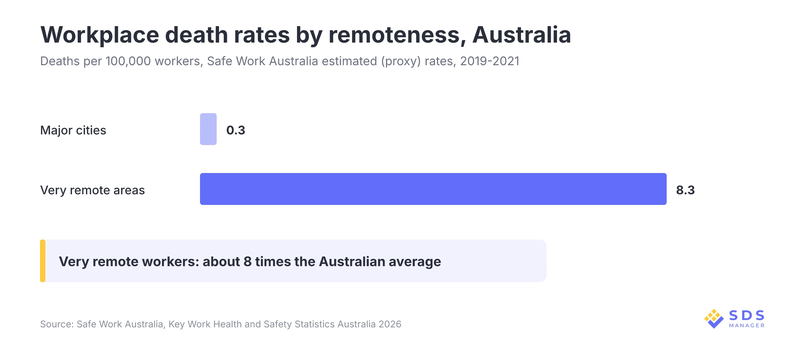
Safe Work Australia estimates that in 2019-2021 the workplace death rate was 0.3 deaths per 100,000 workers in major cities and 8.3 in very remote areas, where workers were about 8 times more likely to die at work than the Australian average.
If you drive or operate machinery for work outside the cities, you belong to both highest-risk groups: machinery operators and drivers, and remote workers.
How Can Workplace Deaths Be Prevented?
The best way to prevent workplace deaths is to control the three causes that kill the most workers: vehicles, falls from a height and falling objects. Under the WHS laws that apply in every state and territory except Victoria, this is the job of the person conducting a business or undertaking (PCBU). That is usually the employer or business running the work.
The PCBU must keep workers and others, such as visitors, safe so far as is reasonably practicable. In Victoria, the Occupational Health and Safety Act 2004 gives employers and self-employed people a similar duty.
On site, the warning signs are vehicles reversing near people on foot, unguarded edges and loads lifted over work areas. Put controls in place before work starts.
| Cause | What it looks like on site | How to avoid it |
|---|---|---|
| Vehicles and moving machines such as forklifts, loaders and tractors | People on foot where trucks, forklifts or loaders move or reverse; tractors and quad bikes on slopes | Marked walkways, a spotter or camera when reversing, seatbelts and rollover protection |
| Falls from a height | Open edges, roof work, ladders used for long jobs, climbing onto truck trays | Edge protection, guardrails or fall-arrest equipment before anyone goes up |
| Falling and moving objects | Unsecured loads, people standing under lifts, machines without guards | Secured loads, exclusion zones under lifts, and machine guards kept in place |
Under the WHS laws that apply in every state and territory except Victoria, you can stop or refuse work that would put you at serious risk. Your concern must be reasonable, and the risk must come from a hazard you face now or are about to face. You must tell the PCBU as soon as you can and stay available for other suitable work.
Tell your supervisor about the danger straight away. If your workplace has a health and safety representative (HSR), tell them too. An HSR is a worker elected to speak for your group on safety.
Report every other hazard on your site to your supervisor or HSR, using the steps for spotting and reporting hazards at work.
Record Every Close Call and Fix the Cause
Every close call, an event where no one was hurt but someone could have been, is recorded with where and when it happened. Close calls are reviewed at each toolbox talk, a short safety meeting before work starts.
Close calls that go unrecorded hide patterns, such as a truck that keeps reversing near the same gate or a load that keeps slipping on the same job.
Manage your incidents with EHS Solutions by SDS Manager, which records every incident and close call with a phone call, and its dashboards show where close calls cluster.
Start a free trial and fix the cause of repeat close calls before they turn into incidents.
Frequently Asked Questions
How Many Workplace Injuries Are There in Australia?
Workplace injuries and illnesses in Australia led to 147,200 serious workers' compensation claims in 2024-25, more than 400 a day. A serious claim involves a week or more off work. Safe Work Australia's 147,200 figure is preliminary and is a separate measure from the 222 workplace deaths recorded in 2025.
Are Work-Related Disease Deaths Counted in Australia's Workplace Death Figures?
No, deaths from work-related disease are not counted in Australia's workplace death figures. Safe Work Australia's count, including the 222 deaths in 2025, covers only deaths from sudden injuries. The Asbestos and Silica Safety and Eradication Agency estimates that about 4,000 Australians die each year from asbestos-related diseases, from exposure at work or elsewhere.
How Many Workplace Deaths Involve Reversing Vehicles?
Safe Work Australia does not publish a separate count of workplace deaths involving reversing vehicles in its key statistics. A death involving a reversing vehicle usually counts as a vehicle incident when the worker is inside a vehicle that collides with another vehicle or an object, or as being hit by a moving object when the worker is on foot.
Which State Has the Most Workplace Deaths in Australia?
New South Wales had the most workplace deaths of any state or territory in 2025, with 77, followed by Queensland with 45. The Northern Territory (2.7 per 100,000 workers) and Tasmania (2.5) had the highest rates. State and territory regulators count differently: WorkSafe Victoria counts members of the public and some work-related disease deaths and suicides, unlike Safe Work Australia.
How Many Workplace Deaths Were There in Australia in 2024?
There were 192 workplace deaths in Australia in 2024, according to Safe Work Australia's current figures. The total was published as 188 in the 2025 edition of Key Work Health and Safety Statistics Australia and was revised up as coroners' reports and investigations were finalised.

Arysha Alif Khan

Arysha Alif Khan is an EHS and chemical safety specialist with a background in biochemistry, biotechnology, and public health. She works closely with the product and regulatory teams to turn complex chemical regulations, SDS requirements, and workplace safety standards into clear, practical guidance for people.