
A job safety analysis (JSA) breaks a job into steps, identifies hazards in each step, and decides how to control them before anyone starts. It can be used on any job that can be described as a series of steps.
You may also see it called a job hazard analysis (JHA). The two names describe the same method, and both OSHA in the US and the Canadian Centre for Occupational Health and Safety (CCOHS) publish guides on it.
By the end of this article, you'll know what a JSA is, how to do one in four steps, and what a finished one looks like.
Key Takeaways
- Job safety analysis (JSA) makes a job safer before work starts. It names the job, breaks it into steps, identifies the hazards in each step, and sets a control for each hazard.
- Job safety analysis (JSA) and job hazard analysis (JHA) are the same method under two names: CCOHS uses job safety analysis and lists job hazard analysis as another name, while OSHA's guide uses job hazard analysis.
- A job safety analysis takes four steps: select the job, list the job steps, identify the hazards in each step, and determine how to control each hazard.
- CCOHS states that most jobs can be described in fewer than ten steps, and it recommends splitting a longer job into two analyses.
- The fourth step of a job safety analysis uses the hierarchy of controls, which ranks fixes from most to least effective: removing the hazard (elimination), swapping in something safer (substitution), adding a guard or device (engineering controls), changing how people work (administrative controls), and protective gear (personal protective equipment, or PPE).
- OSHA does not require a job safety analysis by name, though it does require a written hazard assessment for choosing protective equipment. In Canada, federal rules and provincial codes such as Alberta's require employers to assess hazards before work begins, and a JSA is a common way to meet that duty.
- A job safety analysis protects people only if workers review it before they start and someone reviews it when the job changes.
What Is Job Safety Analysis?
Job safety analysis (JSA) is a way to make a job safer before anyone starts it. It is usually recorded on a short written form with four parts:
- Job: the task being analyzed and where it is done, such as opening delivered boxes in a stockroom.
- Job steps: the actions of the job in the order they happen, such as "pick up the knife" or "cut the tape".
- Hazards: anything that could hurt someone, such as a blade, a heavy load, or a wet floor.
- Controls: the actions taken to remove a hazard or make it less likely to hurt someone.
OSHA's guide, Job Hazard Analysis (OSHA 3071), uses the other common name for the same method. It describes a job hazard analysis as a technique that focuses on job tasks to identify hazards before they occur. CCOHS uses the name job safety analysis and lists job hazard analysis and job hazard breakdown as other names for it.
A few related terms also appear. The Government of Canada's hazard prevention program guide names task safety analysis, a closely related technique that also finds hazards by observing a task as it is performed. Some safety websites and training providers say "job safety assessment", although OSHA's and CCOHS's guides do not use that term, and it usually means a JSA.
Hazards are easily confused with their consequences. A blade left out is a hazard. A cut hand is what could happen, which is known as the consequence. How likely a cut is and how serious it would be together determine the risk, and the difference between a hazard and a risk is worth distinguishing. Keeping the hazard and what could happen separate makes the right control easier to choose, because the hazard itself is being fixed and not just the injury described.
The wider habit of looking for hazards before they cause harm is called hazard identification, and a JSA is one method of doing that for a single job.
How Does a Job Safety Analysis Reduce Workplace Risk?
A job safety analysis reduces workplace risk by finding hazards before the work starts and fixing them at the source. Each hazard gets a control chosen with the hierarchy of controls, which lowers how likely an injury is, how serious it would be, or both. A JSA also helps in three other ways:
- It records the safe way to do a job, so a new worker does not learn it through trial and error.
- It draws on what the workers doing the job know. OSHA's guide advises involving employees because they have a unique understanding of the job, which helps find hazards others miss.
- It provides a document to check when the job, the tools, or the people change.
How to Do a Job Safety Analysis in 4 Simple Steps
Conducting a job safety analysis takes four steps, one for each part of the form: select the job, list the job steps, identify the hazards, and determine the controls.

Step 1: Select the Job to Analyze
Start with the jobs most likely to hurt someone. CCOHS lists the jobs to put first: those where incidents happen often, those where incidents are rare but serious, new jobs, changed jobs, and jobs done rarely. Rarely done jobs belong on the list because workers may be at greater risk when they take on non-routine work.
A worksite's own records can show which of those jobs to start with. OSHA's guide on conducting a job hazard analysis recommends reviewing the worksite's history of accidents and near misses, then ranking jobs by priority. A near miss is an event where no one was hurt, but someone could have been.
The workers involved in the job should be asked as well, because they often know which jobs worry them most. CCOHS states that a supervisor, a health and safety specialist, or a health and safety committee member can lead the analysis.
Step 2: List the Job Steps in Order
Once the job is chosen, list its job steps: the actions it takes, in the order they happen. Start each step with a verb. "Carry the box to the table" and "cut the tape" are steps. "Be careful with the knife" is not, because nobody can do it. Each step should be specific enough that a hazard can be identified in it.
CCOHS's rule of thumb is that most jobs can be described in fewer than ten job steps, and it recommends splitting a longer job into two analyses. OSHA's guide gives no number but makes the same point: avoid a breakdown so detailed that it becomes unnecessarily long, or so broad that it leaves out basic steps.
List the job steps with the person who does the job, and watch the job being done where possible. CCOHS notes that watching does not depend on anyone's memory and helps people recognize hazards.
Step 3: Identify the Hazards in Each Job Step
For each job step, ask what could go wrong, and write down both the hazard and what could happen because of it. Take cutting tape with a box knife. What could go wrong? The blade could slip. What would that do? It could cut a hand.
To identify more hazards, examine the person, the task, the tools, and the surroundings together. CCOHS suggests questions such as whether a body part can get caught in something, whether the worker can slip, trip or fall, and whether lifting, pushing or pulling can cause strain.
Only list hazards at this stage. CCOHS advises against trying to solve anything yet. Listing first and fixing second helps prevent accepting the first fix that comes to mind.
Step 4: Determine How to Control Each Hazard
For each hazard, start with the control that removes it, and move to a less effective one only when removing the hazard is not possible. Safety professionals call this order the hierarchy of controls.
The US National Institute for Occupational Safety and Health (NIOSH) lists five levels from most to least effective, and it notes that the top three control exposure without significant human interaction. Each level gives a different kind of fix, and a box knife shows all five:
- Elimination: removes the hazard entirely. For a box knife, that means buying packaging that opens by hand, so no blade is needed.
- Substitution: swaps in something safer. A self-retracting safety cutter can replace a fixed-blade knife.
- Engineering controls: add a physical guard or device. A box opener that holds the blade inside a shield is one example.
- Administrative controls: change how people work. The cutting steps are written down, people are trained on them, and a rule is set to cut away from the body.
- Personal protective equipment (PPE): gear the worker wears, such as cut-resistant gloves.
Wording varies a little between agencies. CCOHS, for example, lists eliminating the hazard, containing it, revising work procedures, and reducing exposure, with protective equipment in the last group. The idea is the same: fix the source before relying on people.
Whichever level is chosen, each control should be written as an action. CCOHS recommends avoiding general statements such as "be careful" or "use caution". A good control states both what to do and how to do it, as in "cut away from the body, with the blade set to the depth of the tape". Controls that depend on people's behavior are less reliable, so a job whose only control is a warning sign needs a more effective one.
Once the controls are written down, CCOHS treats sharing them as a fifth step. The results must be communicated to every worker who does or will do the job, because an analysis only protects the people who see it.
| Job step | Hazard | What could happen | Control |
|---|---|---|---|
| 1. Carry the box to the cutting table | Heavy box, cluttered walkway | Strained back, a trip, or a box dropped on the foot | Check the weight label first, use a cart for heavy boxes, keep the walkway clear |
| 2. Pick up the knife | Exposed blade | Cut hand | Use a self-retracting safety cutter |
| 3. Cut the tape | Blade slips or cuts too deep | Cut to the hand or leg, damaged contents | Cut away from the body, set the blade to the depth of the tape, hold the box steady |
| 4. Open the flaps and unpack | Sharp cardboard edges and strapping | Small cuts and scrapes | Wear cut-resistant gloves, remove strapping before unpacking |
| 5. Put the knife away | Blade left out on the table | Someone else is cut later | Retract the blade and return the cutter to its holder right away |
| 6. Flatten the empty box | Leftover staples and tape ends | Puncture or scrape | Pull staples before flattening, then put the flat box straight in the recycling bin |
Each control is an action someone can take, and each one answers a single hazard. Because the hazard column lists only hazards and not injuries, every control can be checked against the hazard it is meant to stop.
Laid out as a blank form, the same columns make a usable template. A review date and a sign-off line complete it, and OSHA's own sample form adds fields for the job title, location, analyst, and date. A job hazard analysis form provides this layout and works equally well for a JSA, because the two names describe the same method. Where a site scores risk, a 5x5 risk matrix can supply a rating column.
JSA vs. Risk Assessment: What's the Difference?
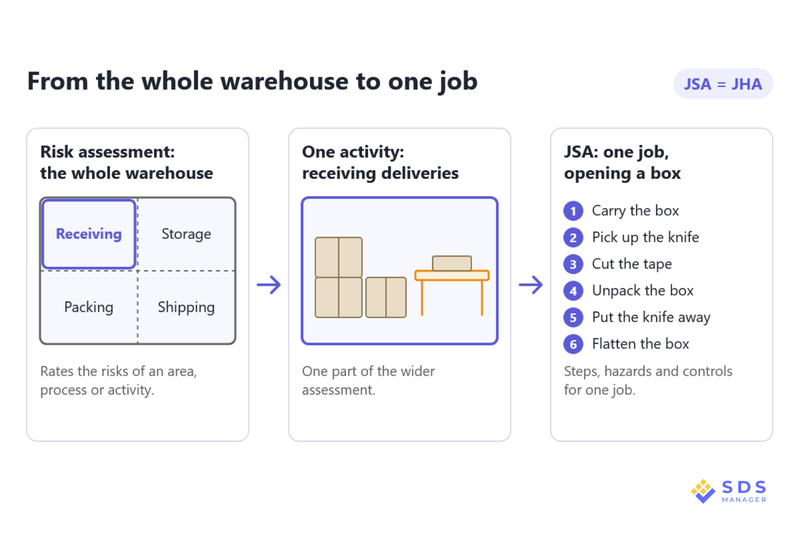
A job safety analysis looks at one job step by step, while a risk assessment covers a wider area, process, or activity and ranks its risks by how likely and how severe they are. The two work together: a risk assessment shows where the biggest risks are, and a JSA works out how one job in that area should be done safely.
| Job safety analysis | Risk assessment | |
|---|---|---|
| Scope | One job, broken into steps | An area, process, activity, or whole operation |
| Main question | What could go wrong in each step, and how is it controlled? | Which hazards carry the most risk, and which come first? |
| Risk scoring | Optional; the focus is hazards and controls for each step | Usually rates likelihood and severity, often on a risk matrix |
| Usually led by | A supervisor, with the workers who do the job | A competent person or team, such as an EHS lead with supervisors and workers |
| Typical output | A form of job steps, hazards, and controls, used to brief workers | A ranked list of risks and planned controls |
When reviewing a whole warehouse, a risk assessment is the right tool, because it covers the building, its processes, and its activities. Once that assessment flags opening boxes as a job worth a closer look, a JSA is used to work through that one job. A JSA is one of the types of risk assessment, and it is the one built for a single job.
Job Safety Analysis Legal Requirements in North America
Neither the US nor Canada requires a document called a job safety analysis, but both require employers to deal with workplace hazards, and Canada's rules are more explicit about assessing them.
Does OSHA Require a Job Safety Analysis?
A job safety analysis is not legally required in the US by name. OSHA's guide presents it as a technique employers can use. Two OSHA rules still point in the same direction. The General Duty Clause requires every employer to keep the workplace free of recognized hazards that could cause death or serious harm.
The personal protective equipment standard requires a written hazard assessment before protective gear is chosen. A JSA is a common way to show that this work was done.
Is a Job Safety Analysis Legally Required in Canada?
A job safety analysis is not legally required in Canada by name either, but Canadian rules ask for hazard assessment more directly. Federally regulated workplaces must identify and assess their hazards, and each province and territory sets its own rules.
Alberta, for example, requires a written, dated hazard assessment before work begins, with affected workers involved. A JSA is a common way to meet duties like these, and the local rules should be checked because details differ from one province or territory to another.
6 Common JSA Mistakes and How to Fix Them
- Writing it without the people who do the job: Walk through the job with the person who does it, and watch it being done. As CCOHS notes, the workers doing the job have the knowledge and experience to spot the hazards in each step.
- Writing vague controls: "Be careful" and "use caution" are reminders, not controls. Write an action someone can do, such as "keep the walkway clear".
- Mixing up the hazard and the consequences: "Cut hand" is what could happen, and "exposed blade" is the hazard. Give each its own column so the control targets the hazard.
- Leaning on PPE for everything: Gloves and glasses are at the bottom of the hierarchy. CCOHS ranks protective equipment among the least effective measures, because it works only if it is worn and used correctly. Ask first whether the hazard can be removed or swapped out.
- Selecting jobs by intuition instead of records: OSHA's guide identifies accidents and near misses as signs that existing controls may not be adequate, so start with those records. Near-miss reports are easier to use when they are stored in incident management software, where they stay searchable.
- Filing the JSA away and never reviewing it: A form that no longer matches the job creates a false sense of security. Put a review date on every analysis. OSHA's guide stresses that it is particularly important to review one after an injury or illness on the job. CCOHS advises revising it when equipment, materials, processes, or the environment change.
Make Your Job Safety Analysis Accessible to Workers
Writing the job safety analysis is only half the work. It protects people only if they see it before the job starts, and only while it still matches how the job is done.
CCOHS states that the results must be shared with every worker who does or will do the job, and that the analysis needs revising whenever equipment, materials, processes, or the environment change.
A JSA form that is printed once and filed away usually fails both conditions. Nobody is told when the job changes, and nobody can tell who has seen the latest version.
This week, select the job with the most injuries or near misses, complete the four steps with the people who do it, and put a review date on the form.
Every revision also means retraining. OSHA's guide advises that any time an analysis is revised, all the employees affected by the changes are trained in the new methods. CCOHS recommends rewriting the analysis as a short written procedure for teaching, because a table is not ideal for instruction.
EHS Solution by SDS Manager can turn a finished analysis into a short course in a safety training module, assigned by role and site, so you can see who has completed it and who still needs to.
Frequently Asked Questions
Why is worker input important in a job safety analysis?
Worker input is important in a job safety analysis because the people who do the job know how it is actually done, including steps a supervisor may not see. OSHA's guide notes that employees have a unique understanding of the job, and CCOHS adds that involving workers builds acceptance of the resulting procedure and controls. In Alberta, the OHS Code also requires employers to involve affected workers in hazard assessment.
Should every job have a job safety analysis?
Ideally, every job would have a job safety analysis, but the time and effort involved mean most workplaces start with the jobs most likely to cause harm. CCOHS notes that each analysis also needs revising whenever equipment, raw materials, processes, or the environment change, so every extra analysis is one more to keep up to date.
What counts as one job in a job safety analysis?
A job in a job safety analysis is one specific work assignment, such as operating a grinder or changing a flat tire. CCOHS cautions that an analysis does not suit jobs defined too broadly, such as overhauling an engine, or too narrowly, such as positioning a car jack.
What else can a job safety analysis be used for?
A job safety analysis can also teach and check the job. CCOHS identifies several uses: it can serve as a teaching aid for initial job training, a briefing guide for infrequent jobs, a standard for inspections and observations, and a help when investigating incidents.
How often should a job safety analysis be reviewed?
A job safety analysis should be reviewed periodically and whenever the job changes. OSHA's guide sets no fixed timeframe and advises reviewing sooner after an injury or illness on the job. CCOHS states that an analysis needs revising whenever equipment, raw materials, processes, or the environment change.
What should you do after a near miss on a job that has a job safety analysis?
After a near miss on a job that already has a job safety analysis, talk it through with everyone who does the job. OSHA's guide recommends discussing a close call with all employees who perform the job and reminding them of the proper procedures. It also advises training the affected employees whenever an analysis is revised.
Does a job safety analysis have to be written down?
A job safety analysis is normally written down because the results have to be shared with the people doing the job and reviewed later. OSHA's guide and CCOHS both include a sample form. The format is flexible, and a form, table, or spreadsheet works as long as the steps, hazards, and controls are clear.
Is there a difference between Job Safety Analysis and Job Hazard Analysis?
There is no practical difference between job safety analysis and job hazard analysis: both break a job into steps, identify the hazards, and set controls. Only the name changes, with OSHA using job hazard analysis and CCOHS using job safety analysis. Some employers separate the two internally, but no standard definition separates them.

Arysha Alif Khan

Arysha Alif Khan is an EHS and chemical safety specialist with a background in biochemistry, biotechnology, and public health. She works closely with the product and regulatory teams to turn complex chemical regulations, SDS requirements, and workplace safety standards into clear, practical guidance for people.