Workplaces change all the time: a new part, a new cleaning product, a different shift pattern. Most of these changes look too small to check. But each one can still bring a hazard that your current risk assessment, procedures and training never covered.
Those hidden hazards are why safety teams review a change before it happens.
Management of change (MOC) in safety is a written process for reviewing, approving and communicating a change before it is made, so the change adds no hazard that nobody assessed.
In this article, you'll learn what management of change is for, what happens when a change skips it, which changes need a review, and how to take one through seven steps.
Key Takeaways
- Management of change (MOC) in safety covers changes to equipment, chemicals, procedures, people, premises and control software, and each change is reviewed and approved before it is made.
- A change that skips management of change reaches workers with hazards nobody assessed, and with procedures, records and training that still describe the old setup.
- In 2013, an explosion at the Williams Olefins plant in Louisiana killed 2 workers and injured 167, according to the US Chemical Safety Board. The plant's management of change review was done only after new valves were in service, and it missed the dangerous pressure build-up the valves made possible.
- A workplace change needs a management of change review unless it is a replacement in kind, meaning a swap that meets the original design specification.
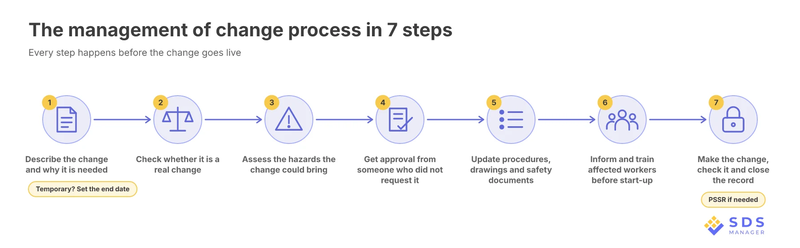
- An MOC review runs in seven steps: describe the change, check whether it is a real change, assess the hazards, get independent approval, update documents, train affected workers before start-up, then make the change and close the record.
- Process safety laws in the US, UK, EU and Australia, and the ISO 45001 standard, require organizations to manage changes before they are made.
What Is the Purpose of Management of Change in Safety?
Management of change exists to check a change before it starts. Your risk assessments, procedures and training were written for the old way of working. Any change can leave them out of date, and nobody notices until something goes wrong.
An MOC review answers four questions before anyone touches the equipment or the procedure:
- What is changing, and why?
- What could go wrong during and after the change?
- Who needs to approve it?
- Which documents and whose training need updating?
MOC started as a core part of process safety, the work of keeping hazardous chemicals inside the pipes, tanks and reactors built to hold them.
However, MOC now reaches well beyond chemical plants. ISO 45001, the international standard for occupational health and safety management, expects any organization that uses it to plan its changes this way.
In health and safety terms, management of change is the habit of asking those four questions every time something changes.
Which Changes Need a Management of Change Review?
A change needs a management of change review when it alters your equipment, chemicals and materials, procedures, people or organization, site, or software and controls, and it is not a replacement in kind. Temporary changes count too, even if they last only a few days.
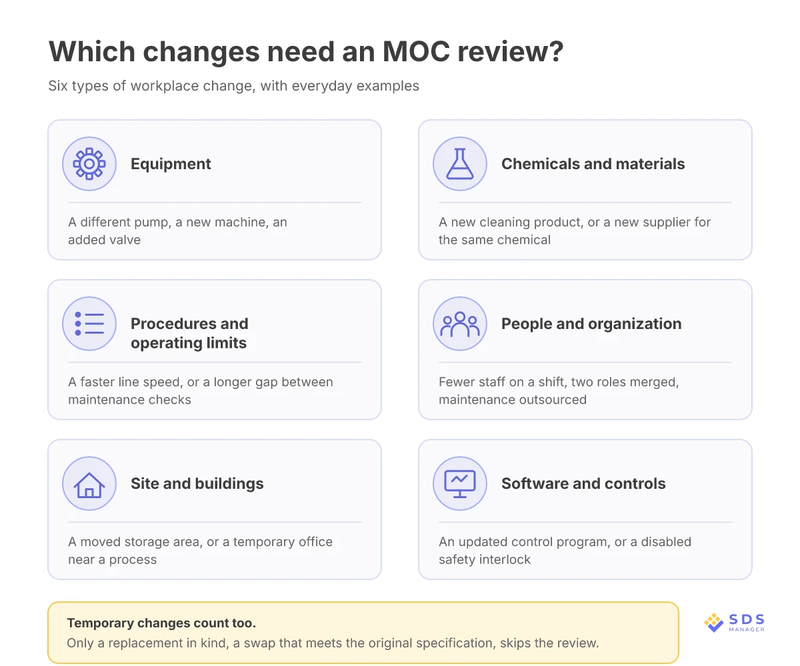
Each type of change can weaken a different safety control, so the table pairs everyday examples with what can go wrong.
| Type of change | Everyday examples | What can go wrong |
|---|---|---|
| Equipment | A different pump, a new machine, an added valve, a changed alarm level | The new item runs at pressures, speeds or temperatures the old controls were not built for |
| Chemicals and materials | A new cleaning product, a new supplier for the same chemical, a stronger concentration | New health or fire hazards, the wrong gloves, unsafe storage next to other chemicals |
| Procedures and operating limits | A faster line speed, a new cleaning method, a longer gap between maintenance checks | Workers follow steps that no longer keep them safe |
| People and organization | Fewer staff on a shift, two roles merged, maintenance outsourced, a new supervisor | Safety tasks fall between roles, or nobody left has the right experience |
| Site and buildings | A moved storage area, a new walkway, a temporary office near a process | People work closer to a hazard, or exit routes change |
| Software and controls | An updated control program, a disabled safety interlock | A safety shutdown no longer works as designed |
Changes to people and organization are the ones most easily missed. The UK Health and Safety Executive (HSE) found that organizational changes are often not checked as carefully as changes to plant and equipment.
OSHA lists staffing levels, contracting out work and budget cuts as changes that can need an MOC when they affect a covered process.
Before a restructure starts, a change impact assessment lets you map which safety tasks each role gains or loses. Use that map in the MOC review.
For high-hazard sites, reviewing these changes is the law. In the US, sites that handle large amounts of highly hazardous chemicals must manage change under OSHA Process Safety Management and the EPA Risk Management Program.
The UK and EU set the same duty through COMAH and the Seveso III Directive, and Australia through its major hazard facility rules in the WHS Regulations.
Canada's national process safety standard (CSA Z767) and ISO 45001 include management of change too.
Where no rule names MOC, general safety law still expects you to revisit your risk assessments. In the UK, for example, an employer must review a risk assessment when there has been a significant change in the work it covers.
You might fairly ask whether every small swap needs this much attention. Most do not. A like-for-like replacement carries no new hazard, which is why a quick test sorts real changes from routine ones.
What Is a Replacement in Kind?
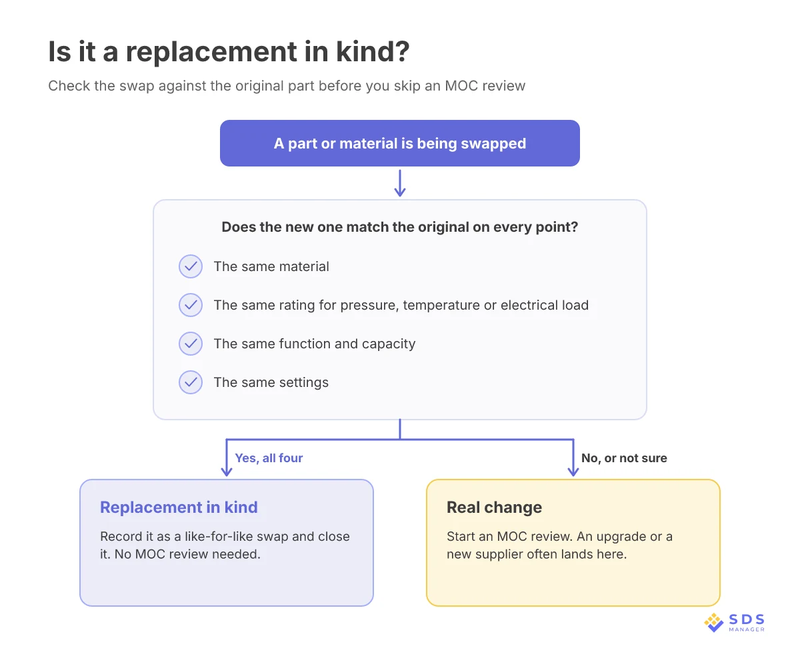
A replacement in kind is a swap that meets the original design specification, so it needs no MOC review. OSHA defines it as "a replacement which satisfies the design specification". A part passes that test only when it matches the original on every point:
- the same material
- the same rating for pressure, temperature or electrical load
- the same function and capacity
- the same settings
If any answer is "no" or "not sure", treat the swap as a change.
An upgraded part from a new supplier can fail the test even when it is better, because better often means different. A stronger pump, for example, can push more pressure into pipework sized for the old one.
How the Management of Change Process Works in 7 Steps
MOC uses the same seven steps for every change, but the effort grows with the risk. For example, moving a storage rack needs a few lines on a form, while a new chemical feed line needs a full review.
The steps follow what process safety law requires and what the Center for Chemical Process Safety (CCPS) recommends.
Step 1: Describe the Change and Why It Is Needed
Write down what is changing, where, why, who is asking for it and how long it will last. Mark the change as permanent or temporary, because a temporary change needs an end date from the start.
This description covers two points OSHA expects every MOC review to address: the technical basis, meaning the reason the change is safe and needed, and the time period.
A request that just says "upgrade pump" gives reviewers nothing to assess. Name the new pump, its rating and the reason the old one is not enough.
Step 2: Check Whether It Is a Real Change
Run the replacement-in-kind test on the request. If nothing differs from the original specification, record it as a like-for-like swap and close it. If the change differs on any point, it is a real change and moves on to the hazard assessment.
When work is waiting, calling an upgrade "like for like" is an easy way to keep it moving. Writing the test result on the request makes that call visible to whoever approves it.
Step 3: Assess the Hazards the Change Could Bring
Ask what could go wrong during the change and after it, who could be hurt, and which controls you need.
HSE advises assessing the transition as well as the end result. A change can be safe once it is finished and still dangerous while it is half done.
Use your normal risk assessment method, and write only the hazards found and the controls chosen on the MOC record.
Changes made to improve safety go through this step too. A new machine guard, for example, can make it harder to reach the emergency stop behind it.
Step 4: Get Approval From Someone Who Did Not Request the Change
Have the change approved by someone other than the person who asked for it. CCPS recommends that qualified reviewers be independent of the person who raised the change, with final approval often given by a further independent person.
OSHA also expects your MOC procedure to set out who can authorize a change.
Reviewers should cover the skills the change touches: operations, maintenance, safety, and the workers who do the job.
Match the level of sign-off to the risk. A supervisor can approve a low-risk change, while a higher-risk change needs a site manager or safety lead. HSE suggests higher sign-off as a change becomes more safety-significant.
Step 5: Update Procedures, Drawings and Safety Documents
Update every document the change affects before work starts. That usually means operating procedures, drawings, maintenance plans, risk assessments, job safety analysis and emergency plans. For a chemical change, it also means the safety data sheet (SDS), container labels and the chemical inventory.
At covered sites, this is a legal duty. OSHA requires employers to update their process safety information and operating procedures when a change affects them.
Step 6: Inform and Train Affected Workers Before Start-Up
Tell and train everyone whose work the change affects before the change goes live. That includes operators, maintenance staff and contractors. OSHA requires this training before start-up at covered sites, and it is good practice everywhere else.
Keep a record of who was briefed and when. That record shows that every affected worker heard about the change before working with it.
Step 7: Make the Change, Check It, and Close the Record
Make the change as approved, check that what was built matches what was approved, and then close the MOC record. A record stays open until every document is updated and every affected worker is trained.
Some changes also need a pre-startup safety review (PSSR), a last inspection of the completed work before start-up. Not every MOC needs one.
For a temporary change, keep the MOC record open until the change is removed. An MOC left open for months after the work ends hides which changes still carry risk.
Management of Change Example: Switching to a New Cleaning Chemical
A chemical swap is an everyday change in workshops, warehouses and cleaning crews, and it shows how short a well-run MOC can be.
Say a workshop replaces its parts degreaser with a cheaper product from a new supplier. The new product fails the replacement-in-kind test, because it is a different chemical with its own hazards.
A completed MOC record for that change would hold these entries.
| Field | What was recorded |
|---|---|
| Change requested | Replace the current parts degreaser with a new product from a new supplier |
| Reason | Lower cost for the same cleaning job |
| Replacement in kind? | No. Different chemical, different hazards |
| Hazards found | More flammable than the old product, needs a different glove material, must be stored away from oxidizers |
| Controls | Store in the flammables cabinet, issue the glove type listed on the new SDS, run the wash station's extraction fan during use |
| Approved by | Workshop supervisor and site safety lead |
| Documents updated | New SDS added, containers labeled, chemical risk assessment and cleaning procedure revised |
| Training | Every degreaser user briefed on the new SDS and gloves before first use |
| Closed | Date closed, after a check that the old stock was removed |
For a low-risk change, a record like this takes minutes. It also doubles as your MOC form, since each field matches one of the seven steps.
The SDS entry matters most here. If the new SDS never reaches your SDS library, workers and emergency responders are left reading the old product's hazards.
How Do You Manage Temporary and Emergency Changes?
A temporary change goes through the same MOC review as a permanent one, with a fixed end date added.
An emergency change can be made first only when waiting would create a greater risk. It then needs a fast review by a small group, followed straight away by the full MOC paperwork.
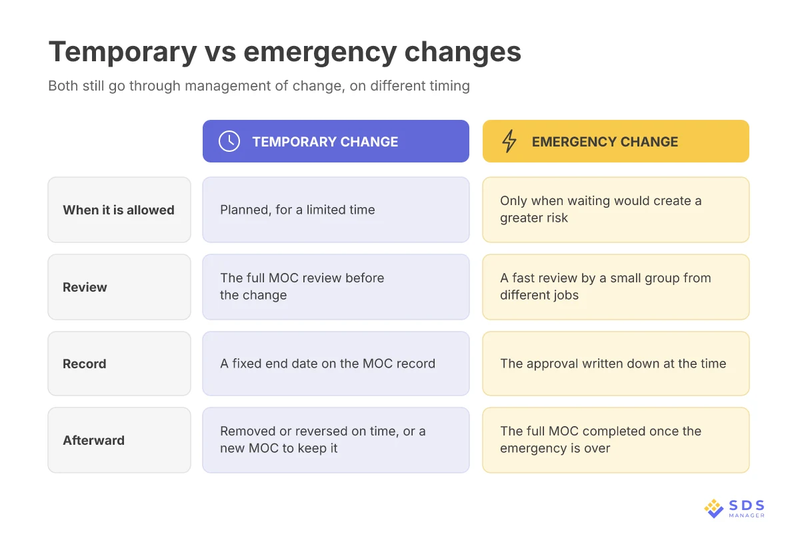
For a temporary change, set the end date when you approve it, then check that the change is removed or reversed on time. If it needs to stay, raise a new MOC and review it as a permanent change.
Published guidance and company programs set different time limits, so choose one for your site and write it into your MOC procedure.
A change that lasts only a week can seem to deserve less paperwork. The hazard is just as real for a week as for a year, though. A temporary hose under pressure can fail on day two as easily as in year two.
Emergency changes still need a review, only a faster one. The Process Safety Report, a newsletter on process safety management, limits emergency changes to cases where doing nothing risks serious short-term harm, and suggests a quick review by about three people from different disciplines.
Write the approval down at the time, and complete the full MOC once the emergency is over.
CSB's 2001 safety bulletin on management of change states that MOC should also cover departures from normal operating limits, not only planned projects.
Because "it's urgent" is easy to claim, define in your procedure what counts as an emergency and who can approve one.
What Happens When You Skip Management of Change?
When a change skips management of change, it reaches the workplace with hazards nobody assessed, and with procedures and training that still describe the old setup. At sites covered by process safety law, it also leaves a gap that the regulator can cite.
The 2013 explosion at the Williams Olefins chemical plant in Geismar, Louisiana, killed 2 workers and injured 167, according to the US Chemical Safety and Hazard Investigation Board (CSB).
In 2001, the plant had added valves to its reboilers, heat exchangers that heat a distillation column (a tower that separates chemicals by boiling point). Williams completed the MOC for those valves only after the plant was already running with them.
That late review relied on yes-or-no checklists, and it missed the main hazard: a closed valve could cut a reboiler off from its pressure relief valve. Years later, one reboiler ruptured while it was cut off in exactly that way.
CSB concluded that an MOC has to happen before the change, with people from several disciplines, and must not be treated as a paperwork or box-ticking exercise.
That finding answers the most tempting shortcut, which is to make the change now and do the paperwork later. A review done after a change is in service cannot stop a hazard that is already there.
Most skipped reviews do not end in an explosion. They show up as four smaller failures:
- New hazards nobody checked: a new cleaning chemical needs different gloves or separate storage, and nobody knows.
- Workers trained for the old setup: operators follow a procedure that no longer matches the equipment in front of them.
- Records that describe the old setup: drawings, safety data sheets and emergency plans mislead maintenance staff and emergency responders.
- Temporary fixes that stay: a bypass or temporary hose is still in place years after the job that needed it.
At chemical sites, each of these is a breakdown in process safety.
In the US, OSHA can cite an employer for changing a covered process without an MOC. OSHA can also cite an employer that fails to act on hazards an MOC review found.
You avoid these failures by knowing which changes need an MOC review in the first place.
Track Every Change From Request to Sign-Off
Paper forms and email chains lose track of which changes still need approval, document updates or training. That is how a change goes live with its review half done.
Run your MOC reviews in EHS Solutions by SDS Manager. Record each change's risk assessment, assign follow-up actions with owners and due dates, and assign training to the affected roles, so every open item is visible before start-up.
When a change involves a chemical, SDS Manager keeps the new SDS in your library before anyone opens the container.
Frequently Asked Questions
What Is the Difference Between Management of Change and a Pre-Startup Safety Review?
Management of change reviews a change before it is made, while a pre-startup safety review (PSSR) checks the finished work before the process restarts. Under OSHA's process safety rules, a PSSR is needed only when a change is large enough to alter the process safety information, the written data on a process's chemicals, technology and equipment.
Is Management of Change the Same as Change Management?
Management of change is not the same as change management. Management of change is a safety control that checks a change for new hazards, while change management is a business practice that helps people accept a change. A restructure that merges two supervisor roles needs both, so staff understand the new setup and no safety task gets lost in the move.
What Are the Three Types of Management of Change?
The three types of management of change are technical, operational and organizational. Technical changes affect equipment and technology, operational changes affect procedures, and organizational changes affect people and structure. Some sources list more categories, but they fit inside these three.
Does Management of Change Apply to Small Businesses?
Yes, management of change applies to small businesses, usually in a simpler form. For lower-risk operations, the Center for Chemical Process Safety accepts a general policy carried out by trained staff. ISO 45001 also applies to organizations of any size.
How Do You Know If Your Management of Change Reviews Are Working?
Your management of change reviews are working when few MOCs are open or overdue, no temporary change is past its end date, and almost no MOCs are completed after the change. After the Williams Olefins explosion, CSB said the company should expand its safety indicators to check that its MOC reviews are effective.

Arysha Alif Khan

Arysha Alif Khan is an EHS and chemical safety specialist with a background in biochemistry, biotechnology, and public health. She works closely with the product and regulatory teams to turn complex chemical regulations, SDS requirements, and workplace safety standards into clear, practical guidance for people.