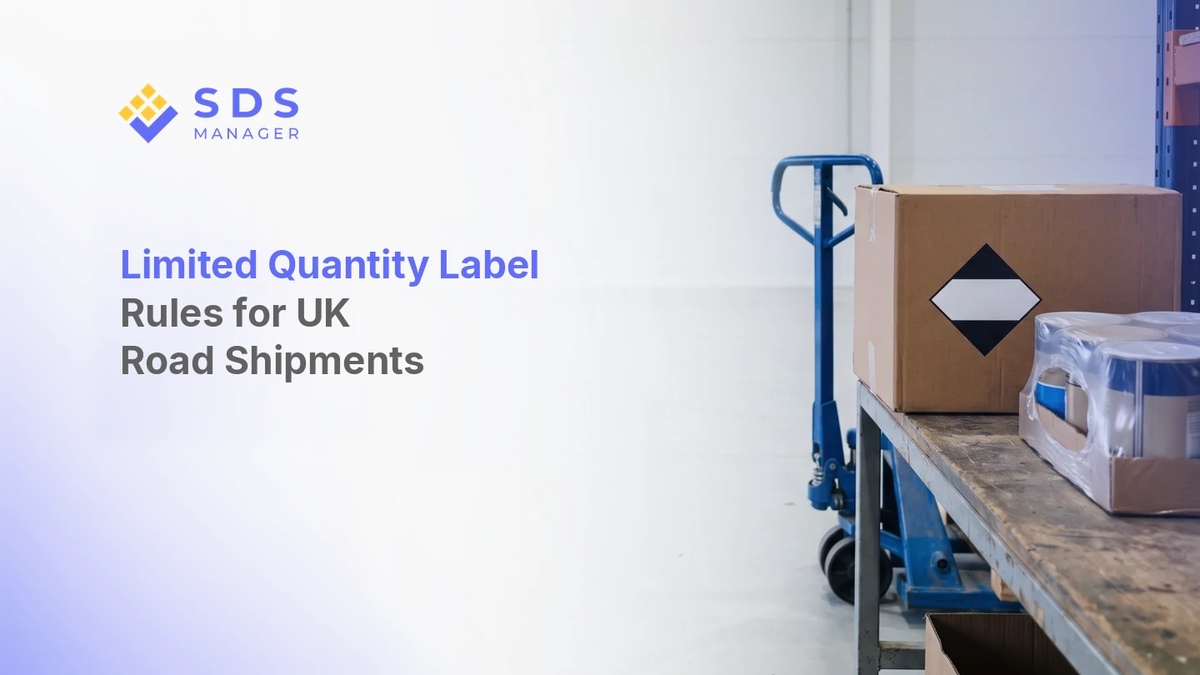
Many paints, aerosols and cleaners count as dangerous goods on UK roads. Most of them, though, leave the warehouse in small retail packs. These fall under ADR, the European agreement on road dangerous goods, which treats them more lightly.
That lighter treatment depends on two things: staying within the quantity limits set for each product, and marking the outside of the pack with a limited quantity label.
The limited quantity label is a black-and-white diamond that ADR requires on boxes and shrink-wrapped trays of dangerous goods packed in small inner containers. A version with a black “Y” in the centre is used when part of the journey is by air.
This article covers what the label must look like, how to check that a product can travel as a limited quantity, what your carrier needs from you, and when a lorry needs marking.
Key Takeaways
- Limited quantity (LQ) is an ADR exemption for small inner packs of dangerous goods, and the goods stay dangerous goods for the whole journey.
- A limited quantity label must be at least 100 x 100 mm, and the 50 x 50 mm version is allowed only when the package is too small.
- The limited quantity label with a black Y is used when any part of the journey is by air, and it also counts as a road LQ mark.
- A product can go as LQ only when column 7a of ADR Table A shows a figure above zero for its UN number.
- An LQ box can weigh at most 30 kg gross and an LQ shrink-wrapped tray at most 20 kg gross, packaging included.
- LQ goods sent by road need no dangerous goods note, but the consignor must tell the carrier their total gross mass before carriage.
- Vehicles over 12 tonnes maximum mass carrying more than 8 tonnes of LQ goods need LQ marks at the front and rear, unless they already show orange plates.
What Does Limited Quantity Mean Under ADR?
Under the Agreement concerning the International Carriage of Dangerous Goods by Road (ADR), limited quantity (LQ) means dangerous goods in small inner receptacles, usually retail packs. They travel in a box or on a shrink-wrapped tray, and once the conditions are met, most other ADR rules do not apply. An inner receptacle is the bottle, tin or tube inside.
In Great Britain, ADR 2025 applies through the Carriage of Dangerous Goods and Use of Transportable Pressure Equipment Regulations 2009 (CDG 2009), with several exceptions.
Limited quantity dangerous goods carry the limited quantity symbol to show that the exemption applies. A box marked this way skips most of the paperwork, package labelling and safety adviser rules that fully regulated loads need.
A box of 1-litre paint tins leaving a builders' merchant depot is still a box of dangerous goods. But as LQ, it needs the mark, sound packaging and a weight figure for the carrier, not the full set of papers and vehicle equipment a fully regulated load needs.
Some dispatch teams read the exemption as meaning LQ goods are no longer dangerous goods. The exemption does remove work, but the goods keep their classification, and the mark, the quantity limits, staff training and the gross-mass figure for the carrier all still apply.
The LQ mark is a transport mark for the warehouse staff and drivers who load and carry the box, while the hazard pictograms on each tin follow the GB classification, labelling and packaging (CLP) Regulation, Great Britain's version of the Globally Harmonized System (GHS) for chemical supply. Knowing the difference between GHS labels and transport labels tells you why one product can carry both.
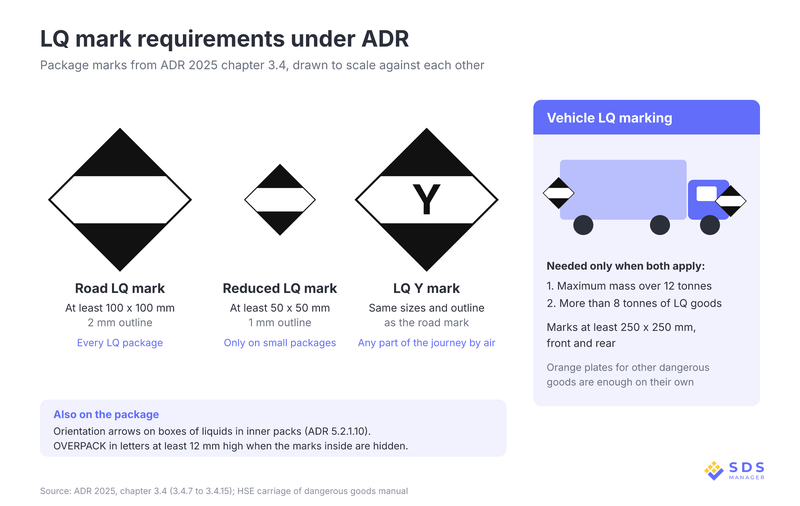
The limited quantity label requirements under ADR come down to one diamond, a square set on its point, with black top and bottom sections and a white or contrasting centre. It must be at least 100 x 100 mm, or 50 x 50 mm only when the package is too small for 100 mm.
A limited quantity sticker for a road shipment is the plain diamond, with no words or numbers inside.
Chapter 3.4 of the ADR 2025 text sets out the package mark requirements, and each one applies under its own condition.
| Item | Requirement | When |
|---|---|---|
| Standard mark | 100 x 100 mm minimum, 2 mm outline | Every LQ package, unless it is too small |
| Reduced mark | 50 x 50 mm minimum, 1 mm outline | Only when the package is too small |
| Y mark | Same design with a black Y in the centre | When any part of the journey is by air |
| Orientation arrows | Two arrows on opposite sides of the package | Boxes of liquids in inner packs (ADR 5.2.1.10) |
| Visibility | Readily visible, legible and weatherproof | Always |
| Overpack | "OVERPACK" in letters at least 12 mm high, plus the LQ mark | When the marks inside are hidden |
The mark only counts when the goods inside qualify, and whether they qualify comes down to one figure per product.
Which Goods Can Be Sent as a Limited Quantity?
Goods can be sent as a limited quantity when ADR Table A, ADR's list of dangerous goods and limits, gives them a figure above zero in column 7a and each inner receptacle stays within that figure. The whole package is then capped at 30 kg gross for a box and 20 kg gross for a shrink-wrapped tray, as GOV.UK's guidance on transporting limited quantities sets out.
Three steps determine whether a product qualifies.
- Find the UN number in Section 14 of the SDS: The safety data sheet (SDS) is the supplier's hazard document for a chemical, and its Section 14, transport information, gives the UN number, class, and packing group (I, II or III, by degree of danger) that both the label and the Table A lookup need. A UN number is the four-digit ID for a dangerous substance. Section 14 is one of the 16 sections of an SDS, and it is the one to open first at dispatch.
SDS Manager's free ADR transport label generator reads the transport details from Section 14 of the product's SDS and prints its transport label as a PDF, so nobody retypes the UN number from a sheet.
- Look up column 7a in ADR Table A: Find the product's row, where column 7a gives the most each inner receptacle may hold; 0 means the goods cannot go as LQ. Because ADR Table A is sorted by UN number, UN numbers in dangerous goods transport are where every lookup starts.
- Check the gross weight and the pack: Weigh the finished package with its packaging, because both caps are gross figures. You need good-quality, suitable packaging; UN-approved packaging is not needed. Corrosive liquids of packing group II in glass bottles need a rigid intermediate pack between the bottle and the box, and breakable inner packs on a tray need an intermediate pack too.
The Health and Safety Executive (HSE) gives worked examples that show how the inner limit and the package cap combine for four common products.
| Product | UN number | Inner limit | Package and gross limit |
|---|---|---|---|
| Paint, packing group II | UN 1263 | 5 L cans | Box up to 30 kg (or 1 L cans on a tray up to 20 kg) |
| Hydrochloric acid, packing group II | UN 1789 | 1 L | Box up to 30 kg |
| Hydrochloric acid, packing group III | UN 1789 | 5 L | Box up to 30 kg |
| Caustic soda (solid) | UN 1823 | 1 kg | Box up to 30 kg |
The 30 kg figure is the whole package, not each bottle. A box of four 2.5-litre bottles of packing group III hydrochloric acid qualifies because each bottle is under the 5 L inner limit and the full box stays under 30 kg gross.
Do You Need a Dangerous Goods Note for Limited Quantities?
No. You do not need a dangerous goods note for limited quantities sent by road, but you must tell the carrier the total gross mass of the LQ goods in the consignment before carriage, in a form that can be traced, such as an email or a note on the consignment record.
The dangerous goods note (DGN) is the usual form of the ADR transport document, and LQ goods by road need no ADR transport document at all.
The carrier needs the gross-mass figure because the total decides whether the vehicle needs LQ marking. A written figure also leaves the consignor and the carrier the same record to check, which is one of the chemical transport safety best practices for any shared load.
When the vehicle needs LQ marking: A vehicle needs limited quantity marking only when both of these conditions are met: Its maximum mass is over 12 tonnes, and it carries more than 8 tonnes of LQ goods.
The marks go on the front and rear, at least 250 x 250 mm. If the load also needs orange plates (the orange panels on dangerous goods vehicles) for other dangerous goods, the plates alone are enough. Remove or cover the marks when no LQ goods are on board.
Most vans never meet both conditions, because a van's maximum mass is far below 12 tonnes. For heavier lorries, the carrier decides from the consignor's gross-mass figure.
Vehicle marking is only one part of moving chemicals by road, and the safest way to transport chemicals also depends on how the load is secured and kept apart from goods it could react with.
The retail derogation: In Great Britain, UK Road Derogation No 4 lets goods from LQ or combination packages (inner packs inside an outer box) travel without the outer packaging on journeys from a depot to a shop or end user and back. No single item may exceed 30 litres or kilograms, and the total may not exceed 333 litres or kilograms.
The derogation does not cover classes 1, 4.2, 6.2 or 7 (explosives, goods liable to catch fire on their own, infectious substances and radioactive material), and it does not apply on international journeys.
Can You Print Your Own Limited Quantity Labels?
Yes. You can print your own limited quantity labels, as long as the printed mark keeps the minimum size and design and stays legible for the journey.
- Print to size: Set the printer to actual size, because a PDF scaled to fit the page can shrink the diamond below its minimum.
- Pick the right version: Use the plain mark for road journeys and the Y mark when any part of the journey is by air.
- Use durable stock: Print on label stock that stands up to rain, cold and handling, because the mark must stay legible and weatherproof until delivery.
- Buying rolls: Label suppliers sell ready-printed rolls in both the 100 mm and 50 mm sizes, which saves printing time on sites that send LQ boxes every day.
Not every consignment goes as LQ. For products sent under the full ADR rules, you can print transport labels from your SDS library instead of copying the Section 14 details by hand.
The LQ mark is not one of the chemical hazard symbols on a CLP label, so a printed LQ mark never replaces the pictograms on the product itself.
How Do You Check a Limited Quantity Package Before Dispatch?
Check the product, the pack, the mark and the paperwork for the carrier, in that order, before the goods leave:
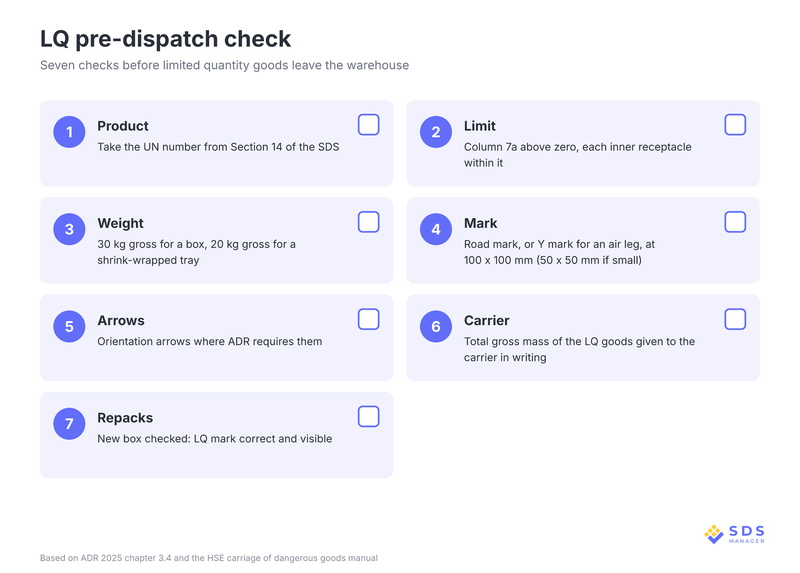
Dispatch checks are one part of chemical warehouse safety, which also covers how chemicals are stored and handled before they reach the packing bench.
Get Every LQ Consignment Labelled Right
No LQ consignment leaves the warehouse until column 7a, the gross weight, the mark and the gross-mass figure for the carrier have all been checked.
The UN number and the column 7a lookup start in Section 14 of each SDS. Retyping them from PDFs slows the check, and a new supplier version of the SDS can go unnoticed.
Today, pull Section 14 for the products you dispatch most and confirm each one's column 7a figure.
SDS Manager's free transport label generator finds the product's SDS among more than 30 million and prints its transport label from the Section 14 details, in the size you need.
Print transport labels from each SDS for free.
Frequently Asked Questions
Does a Limited Quantity Package Need a Hazmat Label?
No. A limited quantity package does not need a hazmat label, called a hazard label in ADR (the class diamond used on fully regulated loads), when it goes by road, because the LQ mark replaces it. The exemption covers road carriage only, so a package that also travels by air needs the Y mark and the air rules.
Where Can I Find Hazardous Chemicals Stickers?
You can find hazardous chemicals stickers from safety label suppliers, or print them yourself from the product's safety data sheet. These stickers are the CLP hazard pictograms for the product's users, not transport marks, so a box sent as LQ still needs the LQ mark on the outside.
Do You Need a DGSA for Limited Quantities?
No. You do not need a DGSA, a dangerous goods safety adviser, for limited quantities of some dangerous goods, according to GOV.UK. The exemption comes from ADR 1.8.3.2, which lets countries exempt firms whose consignments stay within the limited quantity rules, and Great Britain applies it through CDG 2009.
Do Staff Need ADR Training to Handle Limited Quantities?
Yes. Staff who handle limited quantities need ADR training, because ADR training (chapter 1.3) still applies to LQ. The Health and Safety Executive for Northern Ireland (HSENI) puts the same rule plainly: anyone involved must be trained in line with ADR, whether they pack, load or sign off the consignment.
What Is the Difference Between Limited Quantity and Excepted Quantity?
The difference between limited quantity and excepted quantity is the amount: excepted quantities hold at most 30 g or 30 ml per inner packaging (1 g or 1 ml for some goods), coded E1 to E5 in column 7b, and use their own mark. A limited quantity can hold far more, up to the column 7a figure for each inner receptacle.
Does the LQ Mark Need a UN Number?
No. The LQ mark does not need a UN number, because LQ goods by road need no UN number on the package. The UN number still matters before dispatch, since it is how you find the product's column 7a limit.
Do the Same Limited Quantity Rules Apply in Northern Ireland?
Yes. The same limited quantity rules apply in Northern Ireland, because Northern Ireland applies ADR through its own 2010 regulations. They are the Carriage of Dangerous Goods and Use of Transportable Pressure Equipment Regulations (Northern Ireland) 2010.
Does the Driver Need an ADR Licence for Limited Quantities?
No. A driver does not need an ADR licence (the driver training certificate) to carry only limited quantities. General ADR awareness training still applies to the driver, as it does to everyone else involved in the consignment.
Does a Vehicle Carrying Limited Quantities Need ADR Safety Equipment?
No. A vehicle carrying only limited quantities does not need the ADR fire extinguishers and safety equipment kit required for fully regulated loads. Of the vehicle and crew rules in ADR Part 8, limited quantities require only a few, such as awareness training for staff involved.

Arysha Alif Khan

Arysha Alif Khan is an EHS and chemical safety specialist with a background in biochemistry, biotechnology, and public health. She works closely with the product and regulatory teams to turn complex chemical regulations, SDS requirements, and workplace safety standards into clear, practical guidance for people.