Not every workplace accident is a RIDDOR reportable incident, and treating every bump or scare as reportable wastes time on reports the law never asked for. The reverse mistake costs more: missing a report that genuinely qualifies is a criminal offence in its own right.
This article sets out the test that actually decides the question, the full list of categories that pass it, and the specific case of who reports a gas incident under RIDDOR, a duty that splits in a way most guidance skips over.
Key takeaways
- A RIDDOR reportable incident has to pass a three-part test: it must be work-related, fall within a listed category, and fall within RIDDOR's territorial scope, which covers Great Britain and extends offshore.
- Reportable categories include deaths, specified injuries, over-7-day injuries, certain non-worker injuries, six specific occupational diseases, occupational cancer and biological-agent illness, dangerous occurrences, and gas incidents.
- Gas incidents carry a split reporting duty: gas distributors and suppliers report certain gas-related harm, while Gas Safe registered engineers separately report dangerous gas fittings they find.
- Precautionary hospital visits, X-rays with no treatment, and fractures to fingers, thumbs, or toes don't meet the threshold on their own.
- Northern Ireland runs its own, older version of RIDDOR, with a lower 3-day injury threshold instead of Great Britain's 7-day one.
- Getting the "reportable or not" question wrong doesn't remove the reporting duty. Under-reporting risks prosecution, and the deadline for a genuinely reportable incident still runs from the accident date regardless of when the mistake gets noticed.
What Is a RIDDOR Reportable Incident?
A RIDDOR reportable incident is a work-related event that falls within one of the categories set out in the Reporting of Injuries, Diseases and Dangerous Occurrences Regulations 2013. The regulations don't cover every accident.
They cover a defined list: deaths, certain injuries, certain diseases, dangerous occurrences, and gas incidents. An event only becomes reportable once it's both work-related and matches one of those categories exactly, which is why the test in the next section matters more than memorising the list itself.
The Three-Part Test: Is Your Incident Actually Reportable?
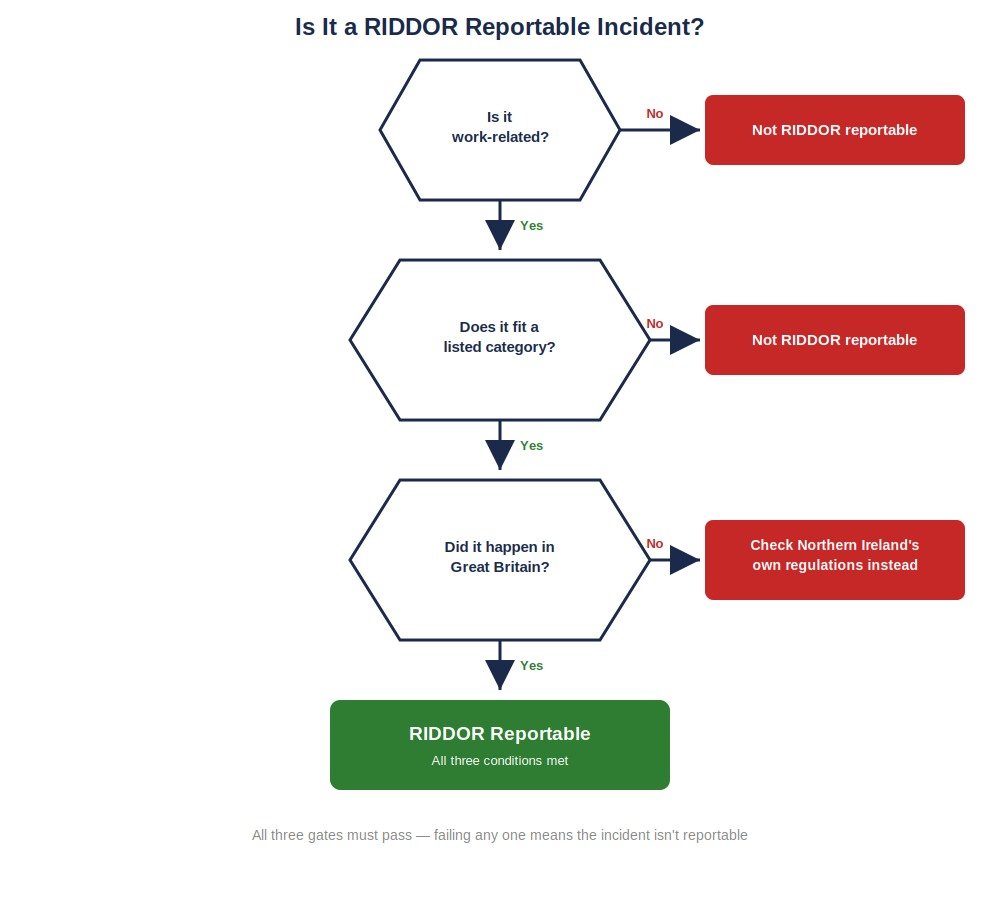
An incident is RIDDOR reportable only when it satisfies all three of the following.
- It's work-related: The accident has to arise out of or in connection with work. HSE looks at three things: the way the work was carried out, any machinery, plant, substances or equipment used, and the condition of the site or premises. An act of non-consensual physical violence against someone at work also counts as an accident. Fault doesn't factor into this test.
- It fits a listed category: The outcome has to match one of the specific categories the regulations define, not just seem serious in a general sense.
- It falls within RIDDOR's territorial scope: RIDDOR covers England, Scotland, and Wales. Regulation 19 extends it to offshore installations, wells, pipelines, and other work in UK waters. Northern Ireland runs its own, separate regulations instead.
All three conditions have to be true at once. A serious injury that happens outside work, or a work-related injury that doesn't match any listed category, both fail the test regardless of how significant either looks.
Work-relatedness is where most borderline calls are actually settled, and it's rarely the dramatic cases that cause trouble.
For example, a worker who slips on ice in the company car park is reportable if the employer controls that car park and hadn't gritted it, because the condition of the premises caused the fall.
On the other hand, a worker who faints from a pre-existing medical condition and is hurt in the fall usually isn't reportable, since the work did not cause the collapse. That changes if a workplace condition made the outcome worse, such as fainting near an unguarded edge.
What Injuries Are Reportable Under RIDDOR?
Deaths
The death of any person is reportable if it results from a work-related accident. Suicide is excluded from this category, but only where intent is actually established, not assumed. Where a work-related death is ambiguous, and there's no positive evidence of suicidal intent, it should be treated as accidental and reported.
If a worker survives the initial accident but dies from it within one year, that death is reportable as a fatality in its own right, even if the original injury was already reported.
There's no requirement to report the death of a self-employed person occurring on premises they solely control, rather than merely own or occupy.
Specified Injuries
Regulation 4 lists eight specified injuries:
- Fractures other than to fingers, thumbs, or toes
- Amputation of an arm, hand, finger, thumb, leg, foot, or toe
- Permanent loss or reduction of sight in one or both eyes
- Crush injuries to the head or torso causing damage to the brain or internal organs
- Serious burns covering more than 10% of the body, or causing significant damage to the eyes, respiratory system, or vital organs
- Scalping requiring hospital treatment
- Loss of consciousness caused by a head injury or asphyxia
- Any injury caused by working in an enclosed space that leads to hypothermia or heat-induced illness, requires resuscitation, or means the person is admitted to hospital for more than 24 hours
Loss of consciousness is reportable, however briefly it lasts, since the test is whether the person stopped responding to communication, not the duration.
Over-7-Day Injuries And The 3-Day Record Rule
An injury that leaves a worker away from work, or unable to perform their normal work duties, for more than 7 consecutive days must be reported as soon as practicable and in any event within 15 days. The count starts the day after the accident and includes weekends.
A separate, lower threshold sits underneath this: Regulation 12 of RIDDOR 2013 requires any injury causing more than 3 consecutive days of incapacity to be recorded, even though it isn't reportable to HSE on its own. That 3-day record duty comes from RIDDOR itself, not a separate law, which is worth getting right since the two thresholds are easy to conflate.
Are Non-Worker Injuries Reportable Under RIDDOR?
Yes, but only under specific conditions. A member of the public or a visitor is reportable if they're taken directly from the accident scene to hospital for treatment, and the injury arose from a work activity. Examinations or diagnostic tests with no treatment given, such as an X-ray, don't count. Neither does a visit the person makes on their own sometime after the accident, even if it happens the same day.
All three conditions, work-relatedness, direct transport from the scene, and actual treatment, have to be met together.
One route sits outside that test entirely: a specified injury suffered by a non-worker on hospital premises is reportable in its own right, with no requirement that they were brought there from anywhere else.
Are Occupational Diseases and Chemical Exposures Reportable?
Yes, though RIDDOR actually treats this as two separate categories, not one. Regulation 8 covers a specific, short list of diagnosed conditions. Regulation 9 covers occupational cancer and illness caused by biological agents, and works on a different logic entirely.
The Six Reportable Conditions
Regulation 8 lists exactly six diseases: Carpal Tunnel Syndrome, cramp of the hand or forearm, occupational dermatitis, Hand Arm Vibration Syndrome, occupational asthma, and tendonitis or tenosynovitis of the hand or forearm. Each is only reportable when it's linked to the specific work exposure the regulations name, such as regular use of vibrating tools for HAVS or exposure to a known skin sensitiser for dermatitis.
This list dropped from 47 diseases to six when RIDDOR 2013 came into force. HSE's April 2026 consultation, which closed on 30 June 2026, proposes expanding it to 19, reintroducing conditions such as asbestosis, pneumoconiosis, silicosis, and beryllium disease alongside new additions such as noise-induced hearing loss.
The same consultation proposes simplifying the online reporting form itself, aimed at the same over-reporting and under-reporting problem this article opens with.
Exposure To Carcinogens, Mutagens And Biological Agents
Regulation 9 requires reporting of occupational cancer, and any disease or acute illness caused by an occupational exposure to a biological agent, defined under COSHH as a micro-organism, cell culture, or human endoparasite capable of causing infection, allergy, or toxicity.
Cancer is only reportable where there's an established causal link to a workplace carcinogen or mutagen, such as mesothelioma linked to asbestos exposure or nasal cancer linked to wood dust. Ordinary community illnesses like colds or stomach upsets don't qualify, since the exposure has to be traceable to the person's actual work.
What Dangerous Occurrences Are Reportable?
Twenty-seven categories apply to general workplaces under Schedule 2, covering events with the potential to cause serious harm even when nobody is actually hurt. These include lifting equipment collapse, uncontrolled releases of hazardous substances, and structural collapse.
Further categories apply specifically to mines, quarries, transport systems, and offshore installations. A dangerous occurrence is reportable purely because of what could have happened, which is why it's treated as its own category rather than folded into the injury rules above.
Who Reports a Gas Incident Under RIDDOR?
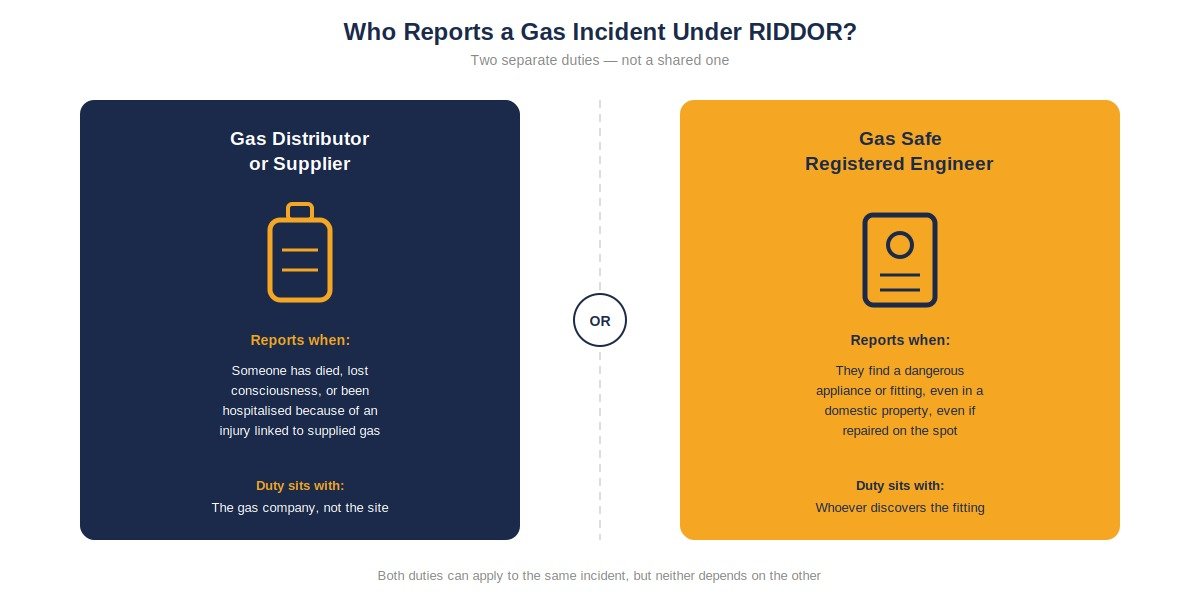
The duty splits between two different parties, depending on who identifies the problem.
The Gas Distributor Or Supplier's Duty
Regulation 11(1) applies to two distinct roles, not one general "gas company" category.
The first is anyone who conveys flammable gas through a fixed pipe distribution system, such as a national gas distributor.
The second is a filler, importer, or supplier of a refillable container of liquefied petroleum gas (LPG), specifically excluding retail supply.
Either duty holder must report an incident if they learn that someone has died, lost consciousness, or been taken to hospital because of an injury arising from that gas, whether from fire, explosion, or carbon monoxide exposure.
This duty sits with the distributor or LPG supplier, not the site where the incident happened.
The Gas Safe Engineer's Duty
Separately, a registered Gas Safe engineer must report any gas appliance or fitting they find that's dangerous enough to risk death, loss of consciousness, or a need for hospital treatment, using the Report of a Dangerous Gas Fitting form.
This applies even in a domestic property, and even if the engineer repairs the fitting on the spot.
The two duties don't overlap: one belongs to the company supplying the gas, the other to Gas Safe registered engineers specifically; not to anyone else who happens to notice the fitting.
What Doesn't Count as a RIDDOR Reportable Incident?
- Precautionary hospital visits. If someone is taken to hospital purely as a precaution with no injury apparent, it isn't reportable.
- Fractures to fingers, thumbs, or toes. These are specifically excluded from the specified-injury list, though they may still qualify under the over-7-day rule if the incapacity lasts that long.
- Self-diagnosed suspected fractures. A fracture only counts once a doctor diagnoses or confirms it, including on a GP fit note.
- Community illness with no work link. A cold or stomach bug caught outside work doesn't become reportable just because the person happens to fall ill during a shift.
- The death of a self-employed person on premises they solely control. This sits outside the fatality category entirely.
- Accidents involving a moving vehicle on a public road. These fall outside RIDDOR, since the police hold primary responsibility for road traffic legislation, with four exceptions that remain reportable: loading or unloading operations, work alongside the road such as road maintenance, escapes of substances from the vehicle, and accidents involving trains.
RIDDOR Reporting Deadlines: How Long You Have
Once an incident passes the three-part test, a separate clock starts. Deaths, specified injuries, dangerous occurrences, and non-worker hospitalisations require notification without delay, then a written report within 10 days.
Gas incidents follow the same without-delay notification duty, with their own 14-day deadline for the written report.
Over-7-day injuries get 15 days, with no separate notification step. Occupational diseases follow a different trigger entirely, reported without delay once the written diagnosis reaches the responsible person.
Working out which of these clocks applies is often where compliance actually breaks down, more so than identifying the category itself. The full RIDDOR reporting timescales set out each deadline, the appeals process, and how to build a process that catches all of them.
RIDDOR Reportable Incidents: Worked Examples
- A warehouse worker fractures a wrist falling from a ladder and needs 9 days off work. Reportable as a specified injury, since a wrist fracture isn't excluded the way finger, thumb, and toe fractures are. Where an injury qualifies as both a specified injury and an over-7-day injury, the specified-injury clock takes over: notify without delay, then report within 10 days, not the 15-day window that applies to over-7-day injuries alone.
- A customer slips on a wet floor with no warning sign and is taken straight to hospital by ambulance. Reportable as a non-worker injury, since it's work-related, direct from the scene, and involves treatment.
- A crane's lifting equipment fails mid-lift with no one underneath. Reportable as a dangerous occurrence, regardless of the fact that nobody was hurt.
- An employee is sent home after a minor bump on the head and returns to work the next day. Not reportable, since there's no loss of consciousness and no incapacity beyond a single day.
- A machinist develops HAVS after years of using vibrating tools, confirmed by written diagnosis. Reportable as one of the six occupational diseases under Regulation 8.
- A worker attends hospital for an X-ray after a fall, and the X-ray shows nothing broken. Not reportable, since an examination with no treatment given doesn't meet the non-worker or specified-injury threshold.
Logging each of these scenarios as they happen, rather than reconstructing them from memory weeks later, is what actually makes the reportable-or-not call easier the next time.
How Are Accidents and Incidents Reported Under RIDDOR?
Reporting under RIDDOR isn't a single form or a single destination. Injuries and dangerous occurrences use separate forms through HSE's online RIDDOR reporting system, despite RIDDOR 1995's earlier combined "Report of an Injury or Dangerous Occurrence" form having been split apart when RIDDOR 2013 came into force.
Diseases use the “Report of a Case of Disease” form, and gas incidents use their own pair: “Report of a Flammable Gas Incident” and “Report of a Dangerous Gas Fitting.” Fatal accidents and specified injuries can also be phoned through to the Incident Contact Centre for a faster initial notification, though this is optional rather than required.
Several categories fall outside HSE's system entirely. Offshore oil and gas incidents are reported using the Report of an Oil and Gas Incident (ROGI) form. Incidents on relevant transport systems go to the Office of Rail and Road, and licensed nuclear sites report to the Office for Nuclear Regulation. Incidents in Northern Ireland don't go to HSE at all, but to HSENI using the equivalent NI2508 form series under that jurisdiction's own regulations.
Within Great Britain, the report also has to reach the authority with actual jurisdiction, which depends on the sector rather than the location: HSE covers higher-risk sectors, and local authorities cover lower-risk public-facing ones. Routine site audits also catch a share of these categories before they escalate into something reportable at all.
RIDDOR Reportable Incidents Come Down to One Test
Whether an incident is RIDDOR reportable comes down to the same three-part test every time: work-related, on the list, and within Great Britain. Getting the category right matters more than knowing every deadline by heart, since the deadline only becomes relevant once the category question is settled.
A business that trains staff to recognise the boundaries covered here, especially the exclusions that trip people up, spends far less time second-guessing borderline cases when something actually happens.
Frequently Asked Questions
Is a Near Miss a RIDDOR Reportable Incident?
Yes, a near miss is a RIDDOR reportable incident only if it matches one of the 27 defined dangerous occurrence categories under Schedule 2. Near misses generally don't qualify outside that specific list.
Is a COVID-19 Case Still Reportable Under RIDDOR?
Yes, a COVID-19 case is still reportable under RIDDOR but only through three specific routes. A work-related death, a disease case, or a dangerous occurrence involving the actual or possible release of coronavirus, each tied to occupational exposure. Most day-to-day workplace transmission doesn't meet any of these three routes.
Does RIDDOR Apply in Northern Ireland?
No, RIDDOR does not apply in Northern Ireland because it runs its own separate regulations. Its written report deadline is 10 days, against Great Britain's 15 days for the equivalent injury category.
Is an X-Ray Visit Reportable Under RIDDOR?
No, an X-ray visit alone isn't reportable under RIDDOR. Examinations and diagnostic tests with no actual treatment given don't meet RIDDOR's treatment threshold.
What Are the Penalties for Failing to Report Under RIDDOR?
The penalties for failing to report under RIDDOR are an unlimited fine in England and Wales and, in the most serious cases, up to 2 years' imprisonment for an individual. RIDDOR itself creates no offences; prosecution runs through Section 33 of the Health and Safety at Work etc. Act 1974.
Who Is the Responsible Person for RIDDOR Reporting?
The responsible person for RIDDOR reporting is usually the employer, extending to the self-employed and anyone in control of the premises where the incident occurred. The duty follows whoever holds that role, not any single named individual.
Is Anaphylaxis a Reportable Incident Under RIDDOR?
Yes, Anaphylaxis is a reportable incident under RIDDOR only if it causes loss of consciousness or meets the over-7-day incapacity threshold, not because of the diagnosis itself. It may separately qualify under the biological-agent category if it stems from a specific occupational exposure.
Do You Have to Report a Concussion Under RIDDOR?
Yes, you have to report a concussion under RIDDOR only if it involves loss of consciousness, however briefly. A concussion without loss of consciousness only becomes reportable if it separately causes more than 7 days of incapacity.

Mehreen Iqbal

Started with a Bachelors in Microbiology, then a Masters in Public Health; Currently a Workplace Safety Expert.