From the risk assessment pinned to the noticeboard to the label on a drum of cleaning chemicals: Almost every UK workplace safety rule you will ever follow traces back to one piece of legislation that names almost none of them.
That legislation is the Health and Safety at Work etc. Act 1974, which replaced a patchwork of trade-by-trade safety statutes. Parliament wrote broad duties into the Act and gave ministers power to fill in the specifics through regulations. So, the framework could survive fifty years of changing industry without being rewritten each time.
In this HSWA 1974 overview, we cover those duties and who holds each one, where the specific requirements you have to meet actually come from, how the Act is enforced, and the narrow situations where it stops applying.
Key Takeaways
- HSWA 1974 sets general duties on employers, employees, the self-employed, people in control of premises, and suppliers of work equipment and substances, and it applies across Great Britain with no minimum business size.
- Section 2 is the central employer duty: protect the health, safety and welfare of your own employees so far as is reasonably practicable, across five listed matters including plant, substances, training, the workplace itself and welfare facilities.
- Section 7 puts two duties on every employee personally: take reasonable care for yourself and others, and co-operate with your employer.
- No section of HSWA 1974 requires a risk assessment. That requirement comes from regulation 3 of the Management of Health and Safety at Work Regulations 1999.
- Employers with five or more employees must write down both their health and safety policy and the significant findings of their risk assessment.
- Breaching the general duties is a criminal offence. In England and Wales, the fine is unlimited in both the magistrates' court and the Crown Court, and imprisonment on indictment runs to two years.
What Is HSWA 1974?
The Health and Safety at Work etc. Act 1974 is the primary piece of legislation covering occupational health and safety in Great Britain. It sets out general duties that employers owe their employees and the public, that employees owe themselves and each other, and that the self-employed owe themselves and others.
The Act reaches workplaces of every size in Great Britain, from a sole trader upward, with no minimum headcount below which it stops applying.
You will see the same statute written four ways. HSWA, HASAWA, HSW Act, and simply "the 1974 Act" all refer to this one law, and none of them is a separate piece of legislation. The "etc." in the title matters too. It signals that the Act reaches past employees to members of the public, to premises, and to the supply of articles and substances for use at work.
The more useful label is the enabling Act, which means a statute that sets out broad duties and then hands ministers the power to make detailed regulations underneath it. HSWA 1974 states what has to be achieved. The regulations made under it state what has to be done.
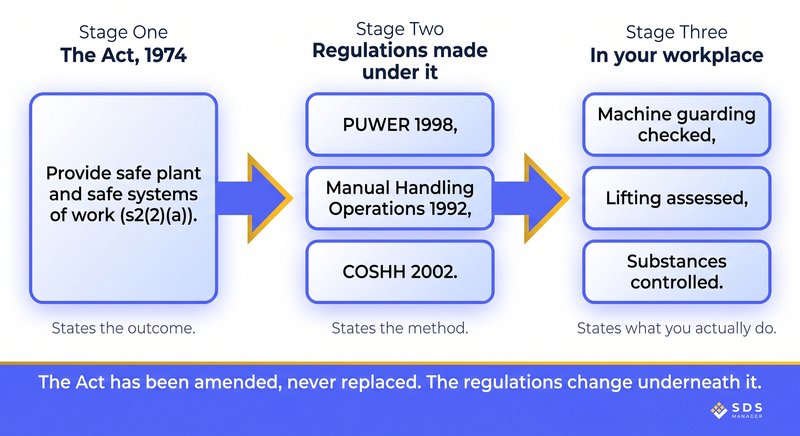
That structure is why the Act's wording sounds so unspecific. It names the outcome and leaves the method to regulations.
Take a mid-sized warehouse. The Act never mentions racking inspections, forklift training intervals or aisle widths, because a statute that named them in 1974 would have been out of date within ten years. Instead it requires the employer to provide safe plant and safe systems of work, and leaves the specifics to regulations that can be updated without an Act of Parliament.
Why the Health and Safety at Work Act 1974 Was Introduced
Before 1974, UK workplace safety law was a patchwork of industry-specific statutes, and large numbers of workers were covered by none of them. Rules existed for factories, for mines and quarries, for shops and offices, each with its own inspectorate and its own gaps. Whether you were protected depended on what your employer happened to do for a living.
The Robens Committee, reporting in 1972, argued that the fragmentation was the problem rather than any individual rule. Its recommendation shaped the HSWA 1974 Act: one framework covering everyone at work, duties owed by employers and workers alike, and a single regulator to enforce them.
Fatal injuries to workers have fallen sharply over the fifty years since. HSE recorded 495 worker deaths in 1981, 217 in 2005/06, and 126 in 2025/26 the Great Britain in 2025/26. That makes the 2025/26 total provisionally the lowest in a single year.
HSE's published statistics remain the source to check for the current annual figure and the long-run comparison. The comparison is worth reading with the caveat that the UK economy has also shifted away from heavy industry over the same period.
The Act has been amended repeatedly since. Three changes matter to a beginner:
- In 2013, breach of most health and safety regulations stopped being directly actionable in a civil claim.
- In March 2015, fines on summary conviction in England and Wales became unlimited, replacing a £20,000 cap.
- In October 2015, the section 3 duty on self-employed people narrowed to those whose work could put others at risk.
Each one narrowed or shifted something the original Act had settled.
HSWA 1974 Summary: The General Duties, Section by Section
The Act's general duties sit in sections 2 to 9, and each one names a different duty-holder. Before the sections themselves, one phrase needs unpacking, because it qualifies nearly all of them.
“So far as is reasonably practicable” means weighing the size of the risk against the time, cost and trouble of controlling it, and doing what a reasonable person would do on that balance. The judgment is made in advance, not after an incident.
It does not mean doing everything possible, and it does not mean doing whatever is cheapest. Where the risk is high, considerable expense is still reasonable; where the risk is trivial, a disproportionate control is not required.
The same control can therefore be reasonable in one setting and not another. Edge protection at height on a construction site is plainly proportionate. The same standard applied to a two-person office with a step stool is not.
Under section 40 of the Act, if a duty-holder is prosecuted, it is for them to prove that doing more was not reasonably practicable, which is the opposite of the burden most people assume.
Section 2: What Employers Owe Their Own Employees
HSWA 1974 section 2 carries the central duty in the whole Act. Section 2(1) requires every employer to "ensure, so far as is reasonably practicable, the health, safety and welfare at work of all his employees".
Section 2(2) then lists five matters that duty extends to in particular:
- (a) safe plant and safe systems of work, provided and maintained
- (b) arrangements for safety in the use, handling, storage and transport of articles and substances
- (c) the information, instruction, training and supervision needed to keep employees safe
- (d) a safe place of work, including safe access to it and exit from it
- (e) a safe working environment, with adequate welfare facilities and arrangements
These are five angles on one duty rather than five separate boxes. A single task shows how they overlap: decanting a drum of oven cleaner into a spray bottle in a café kitchen engages (b) through the handling of the substance, (c) through whether the person doing it was trained, and (e) through whether there is somewhere to wash it off skin.
Section 2(3) requires a written statement of your general health and safety policy, together with the organisation and arrangements for carrying it out, brought to the notice of all employees. The Employers' Health and Safety Policy Statements (Exception) Regulations 1975 create an exception for any employer with fewer than five employees from that written requirement.
The remaining subsections cover consultation. Section 2(4) allows recognised trade unions to appoint safety representatives, section 2(6) requires employers to consult them, and section 2(7) requires a safety committee where those representatives ask for one.
Section 3: Protecting People Who Are Not Your Employees
Section 3(1) requires every employer to run their business so that people who are not their employees are not exposed to health or safety risks, again so far as is reasonably practicable. Visitors, contractors, customers, delivery drivers and neighbours all sit inside this duty.
A large share of prosecutions rest on section 3 rather than section 2, because the people hurt by a badly run work activity are often not on the payroll. What the section does not stretch to is pure welfare and amenity complaints, such as the provision of toilets for non-employees, or nuisance issues with no health and safety dimension.
Section 3(2) applies the same duty to self-employed people, but only to those conducting an undertaking of a prescribed description. That wording was inserted by the Deregulation Act 2015 and is covered under the exclusions below.
Section 4: Duties on Whoever Controls the Premises
Section 4 covers non-domestic premises made available to people who are not your employees as a place of work, or as a place where they use plant or substances provided for them. Anyone with control of those premises, the access and exit routes, or the plant and substances in them must take measures reasonable for someone in their position to keep them safe.
Landlords, managing agents and building owners are the obvious duty-holders here, and the duty follows control rather than ownership. Anyone who has taken on maintenance or repair duties through a contract or tenancy is treated as having control of whatever those duties cover.
There is no section 5 in this list because it no longer exists. It covered harmful emissions into the air, and it was repealed once environmental law took that job over, in England and Wales in 1996 and in Scotland in 2015.
Section 6: Duties on Designers, Manufacturers, Importers and Suppliers
Section 6 puts duties on anyone who designs, manufactures, imports or supplies an article or substance for use at work. The article must be safe when set up, used, cleaned and maintained; it must be tested where testing is needed, and adequate information about safe use must be supplied with it.
The information duty falls on everyone within the supply chain until the final consumer rather than being one-off. Section 6(1)(d) requires suppliers to pass on revised information when something later comes to light that creates a serious risk to health or safety.
Before 2015, this was the statutory root of the safety data sheet a purchaser receives with a hazardous chemical and the updated version they receive when the classification changes. Now the requirement has been adopted under Article 31 of GB REACH.
Who Does HSWA 1974 Apply To?
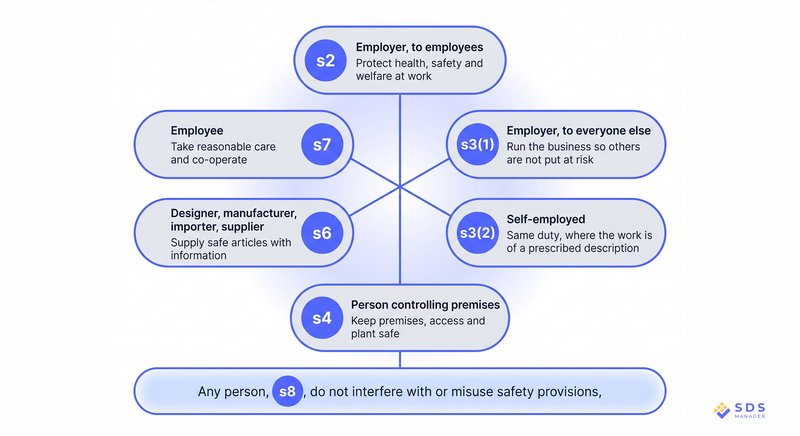
The HSWA 1974 applies to:
| Section | Person Responsible | What their duty covers |
|---|---|---|
| 2 | Employers, towards their employees | Protect their health, safety and welfare at work |
| 3(1) | Employers, towards everyone else | Run the business so non-employees are not put at risk |
| 3(2) | Self-employed people | Same duty, where the work is of a prescribed description |
| 4 | Anyone controlling non-domestic premises | Keep the premises, access and plant safe for people working there |
| 6 | Designers, manufacturers, importers, suppliers | Supply safe articles and substances, with adequate information |
| 7 | Employees | Take reasonable care, and co-operate with the employer |
| 8 | Any person | Do not interfere with or misuse safety provisions |
Business size changes none of this. There is no threshold below which the Act stops applying, and a sole trader who employs one person is an employer for section 2 purposes. What size does change is paperwork, and two thresholds sit at five employees: the written health and safety policy under section 2(3), and the recorded risk assessment under the 1999 Regulations.
Geography does set a limit. HSWA 1974 covers Great Britain, meaning England, Scotland and Wales. Northern Ireland has its own near-identical legislation and its own regulator.
HSWA 1974 Employees' Responsibilities: Sections 7, 8 and 9
The HSWA 1974 Act puts two duties on you personally as an employee, adds one prohibition that binds everybody, and gives you one protection in return.
- Section 7(a) requires you to take reasonable care for the health and safety of yourself and of anyone who may be affected by what you do or fail to do at work.
- Section 7(b) requires you to co-operate with your employer so far as is necessary for them to comply with their own duties, which in practice covers attending the training, following the system of work, and taking part in the health surveillance you are asked to attend.
- Section 8 prohibits any person from intentionally or recklessly interfering with or misusing anything provided in the interests of health, safety or welfare. Note the wording is "no person" rather than "no employee", so it catches contractors and visitors too.
- Section 9 works the other way. No employer may charge an employee for anything provided to meet a specific statutory requirement, which is why legally required personal protective equipment cannot be deducted from wages.
Three things are commonly assumed to be employee duties and are not. You do not carry your employer's section 2 duty, you are not required to fund your own protective equipment, and you are not obliged to fix a hazard yourself rather than report it.
Employees can be prosecuted under section 7, and it does happen, though it is uncommon and generally reserved for deliberate or reckless conduct rather than ordinary mistakes. For most workers, the realistic consequence of ignoring a safety rule is an internal disciplinary process, not a criminal court.
Which Section of HSWA 1974 Requires Risk Assessment?
None of them. HSWA 1974 does not use the term "risk assessment" anywhere in its general duties, and the requirement people are looking for comes from regulation 3 of the Management of Health and Safety at Work Regulations 1999, which was made under the Act.
The connection runs in three steps:
- Section 2(1) requires an employer to protect employees so far as is reasonably practicable, and section 3(1) extends the same protection to non-employees.
- Neither obligation can be met without first knowing what the risks are, so assessment is implied by the duty without ever being named in it.
- Regulation 3 of the 1999 Regulations converts that into an explicit requirement for a "suitable and sufficient" assessment of the risks to employees and to others.
Regulation 3(1) mirrors the Act's structure almost exactly. Paragraph (a) covers risks to your own employees, which is section 2 territory. Paragraph (b) covers risks to people not in your employment, which is section 3 territory.
Regulation 3(6) sets the recording threshold: where an employer employs five or more employees, they must record the significant findings of the assessment and identify any group of employees especially at risk. Below five employees, the assessment is still required; only the written record is not.
Knowing which law carries the duty changes what an enforcement case is built on. Action over a missing or inadequate assessment is normally brought under the 1999 Regulations, frequently alongside a section 2 or section 3 charge.
Regulation 3(3) also requires the assessment to be reviewed whenever there is reason to think it is no longer valid or the work has changed significantly, and keeping assessments, controls and review dates in risk management software rather than scattered spreadsheets makes that review far easier to prove.
The Regulations Made Under HSWA 1974
This is where the Act's generality becomes concrete. Regulations made under HSWA 1974 carry the specific requirements most workplaces actually recognise as "health and safety", and the Act itself functions as their legal parent.
Regulations made under HSWA 1974
| Regulation | What it covers | Who it typically affects |
|---|---|---|
| Management of Health and Safety at Work Regulations 1999 | Risk assessment, competent persons, health surveillance, arrangements | Every employer |
| COSHH 2002 | Hazardous substances, exposure control, monitoring | Anyone using chemicals at work |
| RIDDOR 2013 | Reporting incidents and diseases to the regulator | Every employer and self-employed person |
| Workplace (Health, Safety and Welfare) Regulations 1992 | Temperature, lighting, welfare facilities, cleanliness | Every workplace |
| PPE at Work Regulations 1992, amended 2022 | Providing and maintaining protective equipment | Employers whose controls need PPE |
| DSEAR 2002 | Fire, explosion and corrosion risk from dangerous substances | Sites storing flammables or generating dusts |
Management of Health and Safety at Work Regulations 1999
The 1999 Regulations turn section 2 into a working method. Alongside the risk assessment duty, they require employers to appoint one or more competent persons, to put arrangements in place for planning and reviewing preventive measures, and to provide health surveillance where the assessment identifies a need for it.
COSHH 2002
The Control of Substances Hazardous to Health Regulations 2002 govern work with substances that can harm health, from solvents and cleaning products to flour dust and welding fume. A COSHH assessment builds directly on the general risk assessment, using the hazard information provided in the supplier's safety data sheet.
RIDDOR 2013
RIDDOR requires certain deaths, injuries, occupational diseases and dangerous occurrences to be reported to the enforcing authority within set deadlines. Getting this wrong is common, largely because the categories are narrower than people expect and which incidents are reportable turns on a three-part test rather than on how serious the injury felt at the time.
The Other Regulations Worth Knowing About
The remaining rows in the table above follow the same pattern: each takes one hazard or one part of the working environment and sets out what has to happen about it.
That table is not the full list, and it is not meant to be. Several hundred sets of regulations have been made under the Act. Which ones bind you depends on what your business actually does, so the practical starting point is your risk assessment rather than a reading list.
Who Enforces HSWA 1974?
Enforcement is split between two bodies. The Health and Safety Executive covers higher-risk work including construction, manufacturing, agriculture, quarries and offshore installations. Local authority environmental health teams cover lower-risk premises including shops, offices, hotels, restaurants and warehousing. A small number of sectors have their own regulator, such as the Office for Nuclear Regulation.
Which one applies to you determines who arrives, what they are looking for, and who you deal with afterwards.
What Inspectors Can Do: Improvement and Prohibition Notices
Inspectors from either body have legal powers that go well beyond asking questions. They can enter premises without notice or a warrant, take measurements, photographs and samples, require documents to be produced, and interview people.
Two formal notices do most of the work.
An improvement notice identifies a contravention and sets a date by which it must be put right, and the activity can continue in the meantime.
A prohibition notice stops the activity immediately, or from a specified date, where the inspector judges there is a risk of serious personal injury, and it does not depend on a breach having been proved. Prosecution sits behind both.
Both are appealable to an employment tribunal, and the deadline is 21 days from service. Which notice you received decides what happens while you wait. Appealing against an improvement notice suspends it until the appeal is disposed of or withdrawn. A prohibition notice stays in force regardless, and lifts early only if you apply to the tribunal and it directs otherwise. The tribunal can affirm the notice, cancel it, or modify its terms.
Ignoring a notice is its own offence under section 33(1)(g), separate from whatever breach prompted it, and carries up to two years on indictment. Notices also appear on HSE's public enforcement register, which is where prospective clients and insurers find them.
The document-production power is the one that catches organisations out most often. Keeping inspection findings and their corrective actions in audit and inspection software rather than in a filing cabinet is largely about being able to produce them on the day rather than a fortnight later.
What an inspection costs: fee for intervention
A visit that finds something wrong leaves more than paperwork behind. It also leaves a bill.
If the inspector puts a material breach in writing, HSE charges you for the time it took to find it and help you put it right. It calls this fee for intervention, and the rate is £188 an hour from 1 April 2026. The clock covers the visit, the report, any specialist advice, and the follow-up with your managers and workers.
The written Notification of Contravention is what starts the charging. Advice on its own, spoken or written, costs nothing, so the line between a quiet word and an invoice is whether the inspector thought the breach serious enough to put on paper.
That line matters more than it looks. Two or three breaches found in one morning can reach four figures, and unlike a fine, no court has to agree first.
For most businesses this is the whole of their contact with HSE enforcement. Far more visits end in a Notification of Contravention than end in a courtroom.
What Are the Penalties for Breaching HSWA 1974?
Breaching the general duties is a criminal offence, not a civil matter. Section 33 creates the offences, and Schedule 3A sets the mode of trial and the maximum penalty for each one. Most cases never approach the ceilings, but the ceilings are high.
Fines and Imprisonment
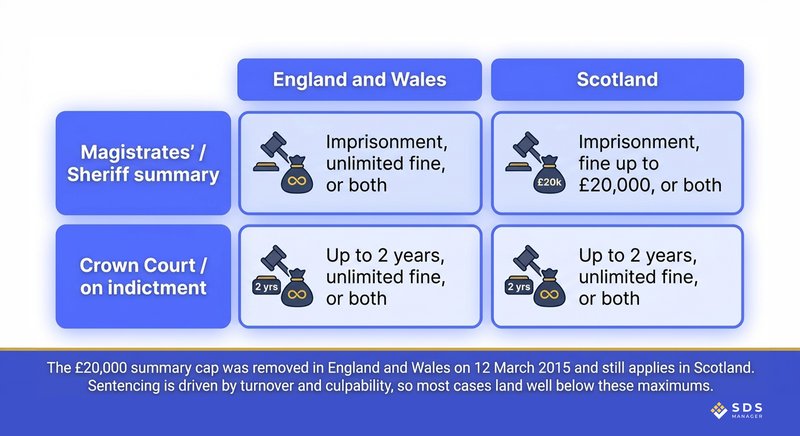
For a failure to discharge a duty under sections 2 to 6, the case can be heard either summarily or on indictment. In the magistrates' court, the penalty is 12 months' imprisonment, an unlimited fine, or both. In the Crown Court it is up to two years' imprisonment, an unlimited fine, or both.
The unlimited summary fine applies in England and Wales, where the previous £20,000 cap was removed on 12 March 2015 by regulations made under the Legal Aid, Sentencing and Punishment of Offenders Act 2012. In Scotland, the £20,000 summary maximum still stands.
Where a case reaches sentencing, the statutory maximum barely matters. Courts in England and Wales work from the 2016 sentencing guideline, and the first thing it asks about is your turnover.
How far short of the standard did you fall? That runs from a deliberate breach at one end to a minor lapse at the other. And how much risk did you create? That is scored on what could have happened rather than what did, so a near miss can still sit near the top.
Those answers meet in a grid that hands the judge a starting point and a range to move within. A small organisation means turnover between £2 million and £10 million.
Fine starting points for a small organisation, turnover £2m to £10m, category range in brackets:
| Culpability | Harm 1 | Harm 2 | Harm 3 | Harm 4 |
|---|---|---|---|---|
| Very high | £450,000 (£300,000 to £1.6m) | £200,000 (£100,000 to £800,000) | £100,000 (£50,000 to £400,000) | £50,000 (£20,000 to £190,000) |
| High | £250,000 (£170,000 to £1m) | £100,000 (£50,000 to £450,000) | £54,000 (£25,000 to £210,000) | £24,000 (£12,000 to £100,000) |
| Medium | £160,000 (£100,000 to £600,000) | £54,000 (£25,000 to £230,000) | £24,000 (£12,000 to £100,000) | £12,000 (£4,000 to £50,000) |
| Low | £45,000 (£25,000 to £130,000) | £9,000 (£3,000 to £40,000) | £3,000 (£700 to £14,000) | £700 (£100 to £5,000) |
Source: Sentencing Council, 2016 definitive guideline.
A serious failing that put people at real risk starts a small business at £450,000, before the judge has adjusted anything either way. A large organisation, meaning turnover of £50 million or more, at very high culpability and the worst harm category, starts at £4 million and can run to £10 million.
Huws Gray Limited was fined £2.2 million at Chelmsford Magistrates' Court in March 2026 under section 2(1). A worker was crushed by a three-tonne pallet when a colleague started a conveyor without knowing he was inside it.
Connect Property Services Limited was fined £400,000 at Stevenage in January 2026, again under section 2(1), after a maintenance worker died inhaling vapour from flooring adhesive in a bathroom with no ventilation.
Where a death is involved, a second charge can run alongside the HSWA one. Corporate manslaughter comes from its own Act, the Corporate Manslaughter and Corporate Homicide Act 2007, and it applies where the way an organisation was run caused the death and the failure reached senior management.
The same sentencing guideline covers both, and corporate manslaughter starts higher. A small organisation faces a starting point of £540,000, or £800,000 for the more serious of the two categories.
Personal Liability for Directors and Managers
Neither a HSWA fine nor a corporate manslaughter conviction touches an individual. A company cannot be imprisoned, and no person can be charged with corporate manslaughter at all. A person can still face a manslaughter charge in their own right, but that is a separate offence with its own test.
Section 37 is how individuals are reached instead. Where a company commits an offence, and it is proved to have been committed with the consent or connivance of, or to be attributable to neglect by, a director, manager, secretary or similar officer, that individual is guilty of the same offence and can be prosecuted alongside the company.
Section 36 does similar work where the real fault lies with some other person. Beyond fines and imprisonment, a conviction can support disqualification from acting as a company director.
Both of those cases put the company in the dock. Where a death is involved, a heavier charge can apply alongside the section 2 one.
Corporate manslaughter comes from its own Act, the Corporate Manslaughter and Corporate Homicide Act 2007, and it applies where the way an organisation was run caused the death and the failure reached senior management.
The same 2016 guideline sets that fine, and it starts higher. A small organisation faces a starting point of £540,000, or £800,000 for the more serious of the two categories. Only the organisation can be convicted, so no one goes to prison on that charge.
When Does HSWA 1974 Not Apply?
The exclusions are narrow, and sources get them wrong in both directions. Some state flatly that no exemptions exist. Others invent them. Four genuine limits are worth knowing.
Domestic Staff in a Private Household
Section 51 says that nothing in Part I applies to a person "by reason only that he employs another, or is himself employed, as a domestic servant in a private household" (Health and Safety at Work etc. Act 1974).
The words "by reason only" limit it tightly. Someone running a business from home is not excluded for that business, and a contractor working at a private house is covered by their own employer's duties in the normal way.
Self-Employed People Whose Work Puts No One Else at Risk
Since 1 October 2015, section 3(2) has applied only to a self-employed person conducting an undertaking of a prescribed description, a change made by the Deregulation Act 2015. Where the work could pose no risk to the health and safety of others, the section 3 duty falls away.
The prescribed undertakings remain covered whatever the risk assessment says: work with asbestos, construction, railways, agriculture, gas installation work, and the contained use of genetically modified organisms. The change alters nothing for a self-employed person who employs anybody, because that makes them an employer with section 2 duties.
Northern Ireland
HSWA 1974 extends to Great Britain and is extended by Order to territorial waters and offshore activities on the continental shelf. Northern Ireland operates near-identical duties under its own legislation, enforced by its own regulator, so the practical duties are similar, but the statute you cite is different.
What HSWA 1974 Does Not Give You: No Direct Compensation Claim
Section 47(1) states that nothing in Part I confers a right of action in civil proceedings for failure to comply with sections 2 to 7 or contravention of section 8. Breaching the Act is a crime, and the criminal case does not compensate the injured person.
A personal injury claim runs in negligence instead, where a conviction can be strong supporting evidence but is not itself the claim. Section 47(2) and 47(2A) went further in 2013, removing direct civil liability for breach of most health and safety regulations as well.
The 2025 Amendment Bill and Where the Act Goes Next
A bill to amend HSWA 1974 was introduced in October 2024 and withdrawn by its sponsor on 19 June 2025, the day before its second reading. It never became law, and the Act is unchanged by it.
The Health and Safety at Work etc. Act 1974 (Amendment) Bill was a Private Members' Bill sponsored by Liz Saville Roberts MP and developed with the Suzy Lamplugh Trust and Rights of Women. It would have placed explicit duties on employers to prevent violence and harassment at work, with a particular focus on violence against women and girls, delivered through risk assessments covering harassment, written policies, training, and a guidance framework published by HSE.
Why campaigners went to health and safety law at all is the part worth understanding. The general duty in section 2 is broad enough to reach harassment in principle, since harassment damages health, but the Act names nothing explicit about it, and a duty nobody can point to is difficult to enforce. That is the enabling-Act structure showing its limits rather than its strengths.
Momentum on workplace harassment has instead gone into employment and equality law. The Worker Protection (Amendment of Equality Act 2010) Act 2023 introduced a duty to take reasonable steps to prevent sexual harassment from October 2024, and measures in the Employment Rights Act 2025 raise that to all reasonable steps and add a duty not to permit harassment of employees by third parties such as customers and clients, from 30 October 2026.
Nothing here changes what you must do under HSWA 1974 today. The duties described throughout this guide remain the current law.
How you Match Your Work Against HSWA 1974
The Act reads as vaguely as it does because it was built to outlast the industries it governs, and the specific rules were always meant to sit in the regulations underneath it. Once you know which general duty is yours, the regulations that apply to your work become much easier to place.
If you work for someone, the practical list is short: follow the training you are given, use the equipment and systems properly, report hazards rather than working around them, and leave safety provisions alone.
If you employ someone, the list runs longer. Identify which duties fall on you, assess the risks to employees and to anyone else affected, write the policy down if you have five or more employees, provide the information and training people need, consult your workforce, keep the records, and check whether any of it is working. That last step is where a small set of leading and lagging indicators is more useful than another folder of completed forms.
Frequently Asked Questions
Is HSWA 1974 Still in Force?
Yes. The Health and Safety at Work etc. Act 1974 remains the primary occupational health and safety legislation in Great Britain and has been amended many times rather than replaced. The most recent attempt to amend it, a Private Members' Bill on workplace violence and harassment, was withdrawn in June 2025.
What Is the Difference Between HSWA 1974 and MHSWR 1999?
HSWA 1974 sets the general duty, and MHSWR 1999 sets the specific method. The Act says an employer must protect employees so far as is reasonably practicable; the 1999 Regulations say how, by requiring a suitable and sufficient risk assessment, competent persons and documented arrangements.
Does HSWA 1974 Cover Agency Workers, Contractors and Volunteers?
Yes, HSWA 1974 covers agency workers and contractors, usually through a combination of section 2 and section 3, and both the agency and the host business can hold duties at the same time. Volunteers are the harder case, because they are not employees, but section 3 still applies where a work activity could put them at risk.
Do I Need a Written Health and Safety Policy Under HSWA 1974?
Yes, you need a health and safety policy under section 2(3) regardless of size, but you only have to write it down if you employ five or more people. The Employers' Health and Safety Policy Statements (Exception) Regulations 1975 exempt smaller employers from the written requirement, though many still document it for insurance and tendering purposes.
Can I Claim Compensation Directly Under HSWA 1974?
No, you cannot claim compensation directly under HSWA 1974. Section 47 rules out a civil right of action for breach of the general duties, so compensation claims run in negligence instead. A criminal conviction under the Act can support such a claim as evidence, but it is a separate process with a separate outcome.

Arysha Alif Khan

Arysha Alif Khan is an EHS and chemical safety specialist with a background in biochemistry, biotechnology, and public health. She works closely with the product and regulatory teams to turn complex chemical regulations, SDS requirements, and workplace safety standards into clear, practical guidance for people.