
A GHS label on a shipped chemical container must show six elements:
- a product identifier,
- a signal word,
- hazard statements,
- pictograms,
- precautionary statements, and
- the name, address and phone number of the manufacturer, importer or other responsible party.
In the United States, these requirements come from OSHA's Hazard Communication Standard (HCS).
Every element on the label comes from the chemical's hazard classification, which is recorded in Section 2 of its Safety Data Sheet (SDS). Making a compliant label is therefore less about design and more about transferring the right information, in the right order, from the SDS to the container. If you are new to the system itself, start with our overview of what GHS labeling is.
In this guide, we will show how to make both kinds of labels: the full label on a shipped container, and the simpler label an employer adds after moving a chemical into another container.
Key Takeaways
- Before you make a GHS label, start with the current SDS for the exact product. All hazard information on the label comes from Section 2, so an outdated or wrong sheet gives you a wrong label.
- Then, decide which label you need. A shipped container needs all six GHS elements. A workplace (secondary) container can carry just the product identifier and general hazard information.
- If you are the manufacturer or importer, finish the hazard classification first. You can’t build a label until it’s done.
- To start making the GHS label, Copy the product identifier exactly as it appears on the SDS.
- Then, add the pictograms, one signal word (“Danger” or “Warning”) and every hazard statement from Section 2, grouped together on the label. Apply the precedence rules so you don’t duplicate elements.
- Add the precautionary statements in this order: prevention, response, storage, disposal. On shipped containers, also add the supplier’s name, address and phone number.
- Print in English on stock that survives the chemical. Make sure the pictogram borders are red. Check the printed label line by line against the SDS.
First, decide which label you are making
OSHA recognizes two kinds of container label, and they carry different requirements. Decide which one you need before you start, because it changes what must appear on the label.
| Shipped container label | Workplace label | |
|---|---|---|
| Also called | Primary, supplier or manufacturer label | Secondary container label |
| Who applies it | Chemical manufacturer, importer or distributor | Employer, after a chemical is transferred to another container |
| Required content | All six GHS label elements | Product identifier plus at least general hazard information, or the full set of elements |
| Supplier contact details | Required | Not required |
| OSHA paragraph | 1910.1200(f)(1) | 1910.1200(f)(6) |
GHS label example
The label below is a shipped-container label for acetone, a common solvent. Acetone is typically classified as a flammable liquid (Category 2), an eye irritant (Category 2A) and a single-exposure target organ toxicant (Category 3, drowsiness or dizziness), which produces two pictograms, the signal word "Danger," and three hazard statements.
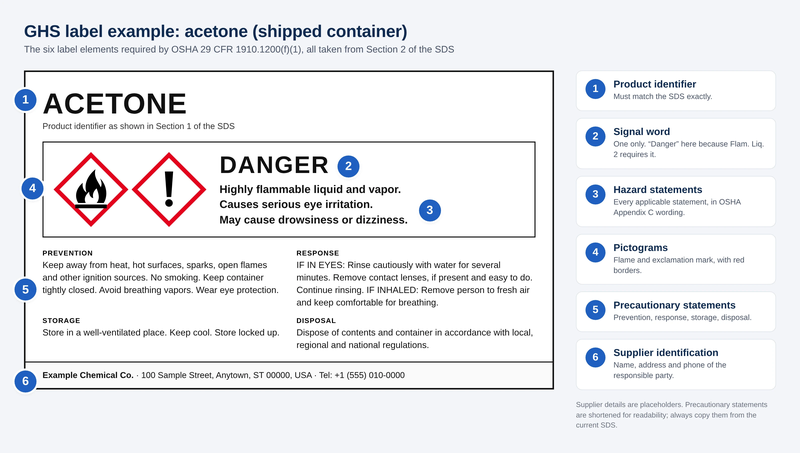
The precautionary statements on a real acetone label are usually longer than shown here; this example keeps the most important ones so the structure is easy to read. A workplace label for a spray bottle of the same acetone could carry just the product identifier, the two pictograms, "Danger" and the three hazard statements.
The six required elements of a GHS label
A GHS-compliant label is one that meets the standards outlined by the Globally Harmonized System of Classification and Labelling of Chemicals (GHS), a system adopted by OSHA to ensure chemical hazards are communicated clearly and consistently across all workplaces in the U.S.
OSHA lists the required elements for shipped containers in 1910.1200(f)(1). Each one is taken from the chemical's classification; none of them is a free-text field.
1. Product identifier
The name or number used for the chemical on its label and in Section 1 of its SDS. It can be a chemical name, a trade name, a product code or a batch identifier, but it must match the SDS exactly so that anyone holding the container can find the right sheet.
2. Signal word
One word that indicates relative severity: "Danger" for the more severe hazard categories and "Warning" for the less severe. A label carries only one signal word. If any hazard on the product calls for "Danger", "Warning" does not appear.
3. Hazard statements
Standardized phrases assigned to each hazard class and category, describing the nature and degree of the hazard, for example "Highly flammable liquid and vapor" or "Causes serious eye irritation". Every hazard statement that applies to the classification must appear, and the wording follows OSHA's Appendix C rather than the manufacturer's own phrasing.
4. Pictograms
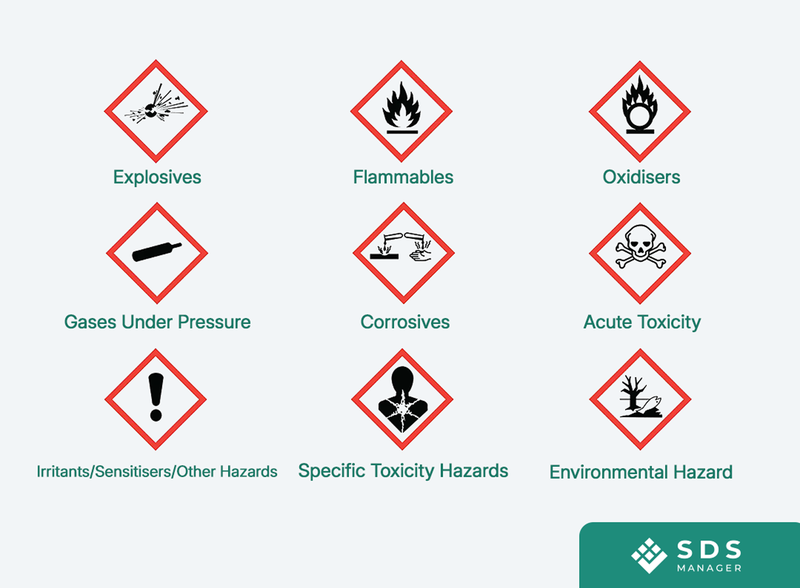
Black symbols on a white background inside a red diamond border. OSHA's HCS uses eight pictograms: flame, flame over circle, exploding bomb, gas cylinder, corrosion, skull and crossbones, exclamation mark and health hazard. The ninth GHS pictogram, environment, is not mandatory under OSHA, although it may appear on labels prepared for other markets. See GHS pictograms and what they mean for each symbol.
5. Precautionary statements
Standardized phrases describing measures to minimize or prevent adverse effects from exposure, improper storage or handling. They cover four areas: prevention, response, storage and disposal. For example, "Keep away from heat, hot surfaces, sparks, open flames and other ignition sources. No smoking."
6. Supplier identification
The name, address and telephone number of the chemical manufacturer, importer or other responsible party. This gives users and emergency responders a direct route to more information.
OSHA does not prescribe a single layout, but the pictograms, signal word and hazard statements must be located together on the label (1910.1200(f)(3)). Supplementary information, such as directions for use, is permitted as long as it does not contradict or cast doubt on the required elements.
How to make a GHS label, step by step
The steps below produce a full shipped-container label. Employers making a workplace label can follow steps 1, 2 and 7, then use the shorter content described under workplace labels.
Step 1: Get the current SDS
Start from the most recent SDS for the exact product, not a similar product or an older revision. Labels and SDSs must agree, and an outdated sheet is the most common source of label errors. A managed SDS library that flags revisions makes this step reliable.
SDS Manager can help you keep your SDS library updated by automatically alerting you when new versions are available.
Step 2: Read the classification in Section 2
Section 2 of the SDS lists each hazard class and category, together with the label elements assigned to them: signal word, hazard statements, precautionary statements and pictograms. If you are the manufacturer or importer, this classification is your own responsibility and must be completed before the label can be built.
Step 3: Apply the precedence rules
A product with several hazards does not simply collect every element. OSHA's Appendix C sets these rules:
- If the skull and crossbones applies, the exclamation mark is not used for acute toxicity.
- If the corrosion pictogram applies, the exclamation mark is not used for skin or eye irritation.
- If the health hazard pictogram applies for respiratory sensitization, the exclamation mark is not used for skin sensitization or for skin or eye irritation.
- If "Danger" applies to any hazard, "Warning" does not appear.
- All applicable hazard statements appear. Precautionary statements may be combined, and those that are clearly redundant or not relevant to the product may be left out.
Step 4: Write the product identifier and supplier details
Use the product identifier exactly as it appears on the SDS. Add the name, address and telephone number of the manufacturer, importer or other responsible party.
Step 5: Place the hazard block
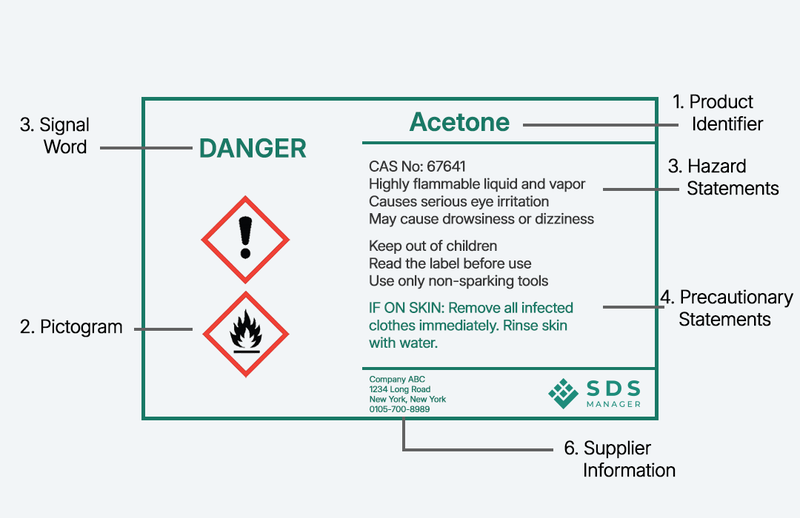
Group the pictograms, signal word and hazard statements together, as OSHA requires. A common layout puts the product identifier at the top, the hazard block beneath it, precautionary statements below that, and supplier details at the bottom.
Step 6: Add the precautionary statements
List the precautionary statements in a logical order, typically prevention, response, storage and disposal. Combined statements such as "IF IN EYES: Rinse cautiously with water for several minutes" save space without losing meaning.
Step 7: Choose the size and stock, then print
Pick a label large enough for every element to be legible at a normal reading distance, on a material that will survive the container's contents and environment. Labels must be in English; other languages may be added (1910.1200(f)(10)). See label size, materials and printing below.
Step 8: Check and maintain
Compare the printed label line by line against Section 2 of the SDS before applying it. When significant new hazard information becomes available, the label must be revised within six months (1910.1200(f)(11)), so tie label reviews to SDS revisions.
Small containers and other special cases
Small containers
OSHA first expects the full label to fit, using a pull-out label, fold-back label or tag if needed. Where that is not feasible, 1910.1200(f)(12) allows a reduced label:
- 100 ml or less: product identifier, pictogram(s), signal word, the manufacturer's name and phone number, and a statement that the full label information is on the immediate outer package.
- 3 ml or less: where any label would interfere with normal use, the container needs only the product identifier.
In both cases the immediate outer package must carry the full label, and the small containers must be stored inside it.
Mixtures
Label the mixture according to its own classification on the SDS, not by combining the labels of its ingredients. The precedence rules in step 3 still apply.
Drums and totes that are also shipped as dangerous goods
A container moving by road, rail, air or sea may need a DOT or other transport label in addition to its GHS label. The two serve different readers and are not interchangeable; see GHS labels vs transport labels. Where a DOT pictogram appears on a shipped container, OSHA's Appendix C says the GHS pictogram for the same hazard should not also appear.
Damaged or illegible labels
Labels on incoming containers must not be removed or defaced unless the container is immediately relabeled with the required information (1910.1200(f)(9)).
Workplace (secondary) labels: what is different
GHS compliance doesn’t end with the original chemical container. If a hazardous chemical is transferred to a secondary container, such as a spray bottle or small storage jar, it must also be labeled according to GHS requirements.
When an employer transfers a chemical from a labeled container into another container, OSHA gives two options for the workplace label (1910.1200(f)(6)):
- The same information as a shipped label (elements 1 to 5), without the supplier's name, address and phone number; or
- The product identifier plus words, pictures, symbols or a combination of them that give at least general information about the chemical's hazards.
OSHA confirmed in a 2017 interpretation letter that a workplace label using the second option does not need hazard statements, precautionary statements or the manufacturer's details, provided employees are trained on the system and the SDS is available to them during every shift. This is also why in-house systems such as NFPA or HMIS labels can serve as workplace labels when the training program covers them.
A label is not required on a portable container that is filled from a labeled container and intended only for the immediate use of the employee who performed the transfer (1910.1200(f)(8)). Once the container is shared, left unattended or kept for later, it needs a label.
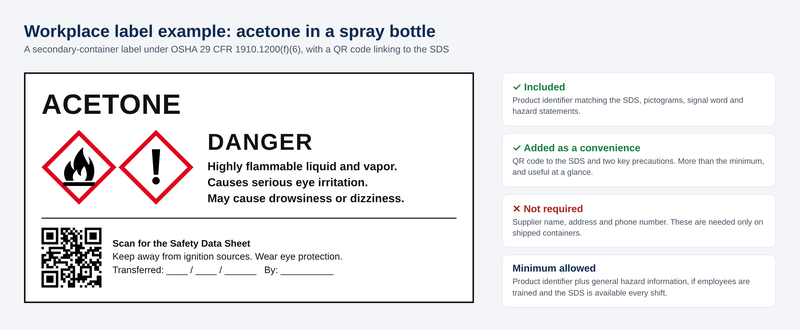
In practice, most safety teams print workplace labels that carry the product identifier, pictograms, signal word and key hazard statements, with a QR code linking to the SDS. That exceeds the minimum and makes the label useful at a glance. The quickest way to produce one is our free secondary container label generator, which pulls the label content from the SDS. Detailed rules are covered in GHS secondary container label requirements.
Label size, materials and printing
Size
OSHA does not set a minimum label size or pictogram size. The test is practical: every required element must be legible and prominently displayed on the container. Very small type is the usual failure point; if the text has to shrink below a comfortably readable size, move to a larger label or a fold-out format. Labels for the EU are different, because the CLP Regulation sets minimum label and pictogram dimensions by container volume.
Materials
Choose label stock for the conditions the container will see:
- Solvents and oils: synthetic face stock (polyester or polypropylene) with a chemical-resistant adhesive and a resin or thermal-transfer print.
- Water, washdown and outdoor storage: waterproof synthetic stock with UV-resistant inks.
- Drums shipped by sea: label stock certified to BS 5609, the British standard commonly used to show that labels remain legible after prolonged seawater immersion.
- Cold storage: an adhesive rated for low-temperature application and service.
Printing
Color matters, because the pictogram border must be red. Desktop color label printers, pre-printed pictogram labels with a black over-print, or professional print runs all work. For workplace labels, standard sizes for Dymo, Avery and Brady printers cover most bottles and jugs.
Test before rollout
Apply a sample label to the actual container, expose it to the product for a few days, and check that the print, adhesive and pictograms are intact.
Common GHS labeling mistakes
Hazard Communication is consistently among OSHA's most frequently cited standards, and labeling errors are a recurring part of those citations. The mistakes below are the ones most worth checking for.
- Working from an outdated SDS. The label no longer matches the current classification, or matches a different supplier's version of the product.
- A product identifier that differs from the SDS. "Acetone 99%" on the label and "Acetone, ACS grade" on the SDS forces workers to guess which sheet applies.
- Ignoring precedence rules. An exclamation mark next to a skull and crossbones for the same acute toxicity hazard, or both "Danger" and "Warning" on one label.
- Paraphrased hazard statements. Hazard statements follow OSHA's standardized wording; rewriting them in your own words is not compliant.
- Pictograms without the red border. Black-and-white printing of the full shipped label does not meet the requirement.
- Missing supplier details on shipped containers. Workplace labels may omit them; shipped labels may not.
- Labels that fade, smear or peel. A label that has become illegible no longer communicates the hazard, whatever it said when it was printed.
- Unlabeled transfer containers. Spray bottles and jugs that leave the hands of the person who filled them, or are kept for later use, are the most common workplace-label gap.
Ensure Safety Through Proper Labeling
Creating a GHS-compliant label may seem detailed at first, but once you understand the core elements and how to apply them, it becomes a simple, repeatable process. Accurate labeling is more than just a regulatory requirement; it’s a key part of protecting employees, preventing chemical accidents, and maintaining a safety-first workplace culture.
Managing GHS-compliant labels and Safety Data Sheets doesn’t have to be time-consuming. SDS Manager offers smart, user-friendly tools to help you stay compliant. From a free secondary label generator to QR-code access to SDSs, everything you need is in one place.
Frequently asked questions
What happens if I use an outdated SDS to create a label?
Using an outdated SDS may result in inaccurate hazard information and regulatory non-compliance. If the hazard classification has changed since that version, the label may show the wrong pictograms, signal word or hazard statements, and workers could miss a hazard they need to protect against.
Can I leave out elements like pictograms or supplier information if the label is small?
Yes, you can leave out some label elements on a small container, but only when a full label won’t fit. OSHA first expects the full label to fit, using a fold-back label, pull-out label or tag if necessary. If that is not feasible, containers of 100 ml or less may carry a reduced label, and containers of 3 ml or less may carry only the product identifier, as long as the full label is on the outer package (1910.1200(f)(12)).
How do I know which pictograms to include?
You know which pictograms to include by checking the chemical’s hazard classification in Section 2 of the SDS, which lists the pictograms assigned to it. If more than one applies, follow OSHA’s precedence rules. For example, leave out the exclamation mark for skin irritation when the corrosion pictogram is already on the label.
Is it okay to use both “Danger” and “Warning” on the same label?
No, it is not okay to use both “Danger” and “Warning” on the same label. Use only one signal word, the one for the most severe hazard. If any hazard on the product calls for “Danger”, use “Danger” alone, even if the other hazards would only call for “Warning”.
Does label placement really matter?
Yes, label placement matters, because labels must be clearly visible, legible and securely attached so they hold up under workplace conditions. Put the label where workers will see it when they pick up or pour from the container, not on the base or under a handle.
Can I include extra safety notes or information on the label?
Yes, you can include extra safety notes or information on the label, as long as they don’t contradict or cast doubt on the required elements. Directions for use are a common example. Keep it brief and refer users to the SDS for full details. Extra text shouldn’t crowd the pictograms, signal word or hazard statements, or make them harder to read.
Does OSHA require GHS labels?
Yes, OSHA requires GHS labels on containers of hazardous chemicals. OSHA’s Hazard Communication Standard is aligned with the GHS, and every container of hazardous chemicals leaving a manufacturer, importer or distributor must carry a label with the six elements described above. Employers must keep those labels intact and label workplace containers as described in 1910.1200(f)(6).
What is not required on a GHS label?
A GHS label does not require the hazard class and category names, CAS numbers, ingredient percentages or first-aid detail beyond the precautionary statements; these belong on the SDS. Workplace labels also do not require supplier contact details. You may add some of this information as supplementary information, as long as it doesn’t contradict the required elements or crowd them off the label.
Can a GHS label be in Spanish?
Yes, a GHS label can include Spanish, but only alongside the English text, because OSHA requires every label to be in English (1910.1200(f)(10)). Adding Spanish is common in workplaces with Spanish-speaking employees. A bilingual label still has to keep all required elements legible, so make sure the second language doesn’t shrink the English text below a readable size.
Do non-hazardous products need a GHS label?
No, non-hazardous products do not need a GHS label. GHS labeling applies only to chemicals classified as hazardous. Many workplaces still label containers of water or non-hazardous solutions so they are not mistaken for clear, hazardous liquids.
How often should GHS labels be reviewed?
GHS labels should be reviewed whenever the SDS is revised. OSHA requires shipped labels to be updated within six months of the manufacturer becoming aware of significant new hazard information. For workplace labels, check them whenever a new SDS version arrives and replace any that have faded, smeared or peeled.
Can I use an NFPA diamond instead of a GHS label?
No, you cannot use an NFPA diamond instead of a GHS label on shipped containers. On workplace containers, NFPA or HMIS labels are acceptable under 1910.1200(f)(6)(ii) when employees are trained on the system and SDSs are readily available. NFPA ratings are designed mainly for emergency responders and use a different number scale from GHS hazard categories, so training should explain the difference. See GHS labels vs NFPA labels.

Arysha Alif Khan

Arysha Alif Khan is an EHS and chemical safety specialist with a background in biochemistry, biotechnology, and public health. She works closely with the product and regulatory teams to turn complex chemical regulations, SDS requirements, and workplace safety standards into clear, practical guidance for people.