
Under OSHA’s Hazard Communication Standard, every secondary container of a hazardous chemical needs a label with the product identifier and words, pictures or symbols giving at least general hazard information, or the full shipped-container label. The only exemption is a portable container for the immediate use of the employee who filled it.
While most companies are familiar with labeling primary chemical containers, secondary container labeling is often misunderstood or overlooked.
In this article, we break down everything you need to know about secondary container labels, including what they are, when they’re required, and what OSHA accepts on the label, including GHS-style and NFPA or HMIS labels.
Key takeaways
- Each secondary container needs the product identifier plus general hazard information, or the full shipped label (29 CFR 1910.1200(f)(6)).
- No label is needed only for a portable container that the person who filled it uses right away ((f)(8)).
- Workplace labels must be legible, in English and prominently displayed; other languages can be added ((f)(10)).
- OSHA accepts NFPA or HMIS labels if the SDS and training give employees the specific hazards.
- SDS Manager prints secondary labels with QR codes, H- and P-statements and PPE icons from any SDS in your library.
What Is a Secondary Container?
A secondary container is any vessel used to store or dispense a hazardous chemical after it has been transferred from its original (primary) manufacturer container. These include spray bottles, measuring cups, small jugs, test tubes or vials, storage jars or buckets.
For how the two label types differ, see primary vs secondary container labels.
Even if a chemical is only being used temporarily in a secondary container, proper labeling is required if the container leaves the user’s control, even briefly.

When Is GHS Labeling Required on Secondary Containers?
Under OSHA’s Hazard Communication Standard (29 CFR 1910.1200), any container holding a hazardous chemical must be labeled. The only exception is when the container is used immediately and only by the person who filled it (paragraph (f)(8)). In all other situations, secondary container labels are required, especially if:
- The container will be left unattended
- Multiple people may use or access it
- It will be stored for later use
- It moves outside the work area where it was filled
Failure to properly label secondary containers can result in regulatory violations, chemical exposure, and emergency response delays.
What Must Be on a GHS-Compliant Secondary Label?
OSHA gives employers two options. The label can repeat the full shipped-container label, or show the product identifier plus words, pictures or symbols that give at least general hazard information, as long as the SDS and training give employees the specific hazards (29 CFR 1910.1200(f)(6)).
| Option | What the label must show | When it fits |
|---|---|---|
| (f)(6)(i) Full shipped-container label | Product identifier, signal word, hazard statement(s), pictogram(s) and precautionary statement(s), as in (f)(1)(i)-(v). The manufacturer’s name and address are not needed. | The label tells workers everything on its own; the usual choice for GHS-style labels |
| (f)(6)(ii) Workplace label | Product identifier and words, pictures or symbols giving at least general hazard information; the specific hazards must be available to employees through other information, such as the SDS and training | NFPA or HMIS labels and pre-printed bottles, as in OSHA’s 2017 interpretation letter |
A secondary container label doesn’t need to be as extensive as a primary container label and most employers use a GHS-style label because it carries everything on its own. A recommended GHS-style secondary label contains:
- Product Identifier: The name must exactly match the one on the Safety Data Sheet (SDS).
- GHS Pictograms: Only include the pictograms that apply to the chemical’s classified hazards.
- Signal Word: Either “Danger” or “Warning”, depending on the severity of hazards.
- Hazard Statements: These describe the nature of the hazard (e.g., “Causes skin irritation”).
- Precautionary Statements (Recommended): Include safety guidance like “Wear protective gloves” or “Keep away from heat.” All this information can be found in Section 2 of the chemical’s SDS. Below is an example of a compliant GHS Secondary Label generated by SDS Manager's free secondary label generator:

The Easy Way: Use an Automated Label Generator
Designing and printing secondary labels manually can be time-consuming. If you do it by hand, follow how to make a GHS label step by step. SDS Manager offers a free GHS Secondary Label Generator that:
- Auto-fills hazard info from your SDS
- Supports all standard label sizes
- Includes QR codes linking directly to the SDS
- No design or regulatory expertise needed
Just enter the chemical name, verify the details, and print; it’s that easy.
Labeling every container in your stockroom?
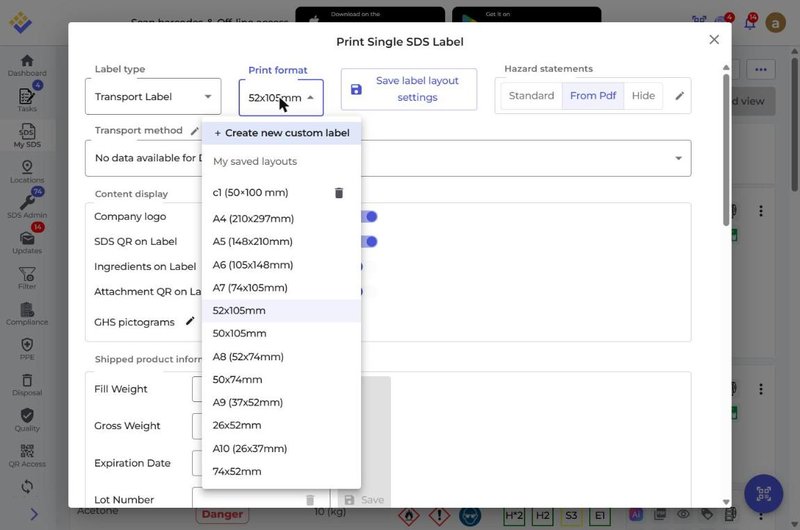
The free generator handles one label at a time. In SDS Manager, you can print a label for any SDS in your library: open the SDS, click the label button and choose one of 15 sizes. Each label carries a QR code that opens the SDS, plus the H- and P-statements and PPE icons from the SDS, and NFPA and HMIS labels come from the same library. Labels print on Dymo printers and on Avery and Brady label sheets.
Start a 30-day free trial and print labels from your own SDS library →
Labeling Small Containers
Labeling small or oddly shaped containers can be tricky. Here’s how to stay compliant:
- Use abbreviated labels: As long as they contain the required elements.
- Print labels in high contrast: To ensure readability.
- Attach tags if needed: For containers too small for full labels.
- Use durable, smudge-resistant materials: Especially in wet or high-use environments.
OSHA’s small-container rules in paragraph (f)(12) apply to manufacturers, importers and distributors shipping containers of 100 ml or less, not to labels you make for your own workplace containers. For those, (f)(6) lets a container be labeled, tagged or marked, so a tag or abbreviated label works as long as it carries the (f)(6) information.
For stationary process containers such as tanks, (f)(7) lets you use signs, placards, batch tickets or operating procedures instead of individual labels, if they identify the containers and stay readily accessible in the work area.
Don’t Skip Secondary Labeling
It’s easy to think of secondary labeling as an afterthought but that’s a mistake. Hazard Communication (29 CFR 1910.1200) is No. 2 on OSHA’s preliminary list of most frequently cited standards for fiscal year 2026. By ensuring every container, even a small spray bottle, is labeled correctly, you're not only complying with GHS and OSHA standards, but you're also actively protecting your team’s health and safety.
Frequently Asked Questions
Do I need to label a spray bottle if I’m using it right away?
No, you don’t need to label a spray bottle if you filled it from a labeled container and only you will use it, right away, within your shift (29 CFR 1910.1200(f)(8)). If anyone else will use it, or it will be left for later, it needs a label.
Can I use handwritten labels?
Yes, you can use handwritten labels, as long as they are legible and include all the required elements. They must be in English, and you can add other languages alongside it ((f)(10)).
Are pictograms required on every secondary container?
No, pictograms aren’t required on every secondary container. Under 29 CFR 1910.1200(f)(6)(ii), a workplace label can use other words, pictures or symbols, such as an NFPA diamond, as long as it gives general hazard information and employees can get the specific hazards from the SDS and training. A GHS-style label with pictograms is still the simplest way to meet the rule.
What happens if I forget to label a secondary container?
If you forget to label a secondary container, you’re in violation of the Hazard Communication Standard, and OSHA can cite your company and issue a fine. An unlabeled container also raises the risk that someone will misuse the chemical or be exposed without knowing the hazard.
Can I use NFPA or HMIS labels on secondary containers?
Yes, you can use NFPA or HMIS labels on secondary containers. In a 2017 interpretation letter, OSHA confirmed that pre-printed bottles showing the chemical name, an NFPA diamond and pictograms meet (f)(6)(ii). An employer who relies on NFPA or HMIS instead of complete labels must be able to show that employees understand the hazards at least as well as they would with complete labels. Compare the two systems in GHS labels vs NFPA labels.
Who is responsible for secondary container labels?
The employer is responsible for secondary container labels, because paragraph (f)(6) puts workplace labeling on the employer. Chemical manufacturers, importers and distributors are responsible for the labels on shipped containers.