Most SDS management software looks the same in a 30-minute demo: a search bar, a PDF viewer, and a QR code on a poster. The differences appear months later, when a supplier revises a safety data sheet, a second site comes online, or the renewal quote arrives.
A typical SDS management tool stores the sheets you upload and stops there. It won't notice when a supplier revises a safety data sheet. So, someone on your team ends up chasing updates by email.
It can take a login and several screens for a worker to find the right sheet in an emergency. It rarely covers the rules in every country where you operate, so a new site often means a workaround or a second system. And it usually won't share a price until after a demo, which makes the renewal quote the first number you can really compare.
That’s why, in this article, we have a shortlist of 10 best SDS management platforms and five criteria you can test each demo against.
Key Takeaways
- SDS Manager is the best enterprise-grade SDS management software for multi-jurisdiction organizations, with integration to your team's own AI tools, supplier update alerts as soon as a new SDS is issued, and covers regulations spanning the global market, including OSHA, WHMIS, REACH, GHS, and many more.
- EcoOnline and Quentic are European-rooted EHS platforms that pair SDS updates with chemical risk assessment, with EcoOnline focused on COSHH and REACH assessments and Quentic on hazardous chemical registers and AI extraction from SDS PDFs.
- HSI is a safety training and EHS provider whose SDS management adds Tier II reporting, offline access, QR codes, and a 24-hour chemical hotline.
- CloudSDS and mSDS Source are dedicated SDS platforms with SSO and automated SDS update handling, with CloudSDS adding an SDS API and mSDS Source adding bilingual OSHA and WHMIS support and a fully outsourced Gold tier.
How Did We Choose the Best SDS Management Software?
The best SDS management software was chosen on five criteria, in the order you meet them once a platform is live. You load your library, keep it current, get it to workers, meet each country's rules, and scale across sites. Every platform was checked against its vendor's own product pages in September 2026.
- Library setup: whether the vendor builds your first library from the files, product lists, or label photos you already have, or leaves the indexing to your team.
- Revision tracking: whether new SDS versions reach your library automatically, on a fixed cycle, or only when someone requests them.
- Worker access: whether an employee on the floor can open the right SDS in seconds by QR code, barcode, mobile app, or offline copy. The OSHA Hazard Communication Standard (29 CFR 1910.1200) requires SDSs to be readily accessible to employees during each work shift, so access is a compliance question too.
- Regional compliance: whether one platform covers OSHA in the US, WHMIS in Canada, COSHH in the UK, REACH in the EU, and Safe Work Australia's hazardous chemicals requirements, or is strongest in one region.
- Enterprise scale: whether the platform supports single sign-on (SSO, one company login for every tool), two-factor authentication, an API (a connection that lets other software exchange data with it), multi-site structure, and user growth without per-seat fees.
Best SDS Management Software at a Glance
SDS management platforms fall into two categories: dedicated SDS tools and modules within larger EHS suites, and each handles the five criteria differently. Plan-level detail matters, too, because a tool listed on a vendor's site may be available only in its top tier.
| Platform | Best For | Best Feature |
|---|---|---|
| SDS Manager | Enterprises and multi-country teams that want instant updates from suppliers and AI integration | Supplier monitoring with automatic or reviewer-approved SDS upgrades |
| Cority | Enterprises running SDS inside a full EHS suite | Pre-screen and approval workflows for new chemicals |
| Sphera | Manufacturers tying SDS data to product stewardship | Expert-managed SDS indexing and supplier follow-up |
| EcoOnline | UK and European teams centered on COSHH | Pre-built COSHH assessment library |
| Quentic | European teams managing hazardous substance registers | SDS Extract, AI bulk extraction from SDS PDFs |
| HSI | Organizations bundling SDS with safety training | Tier II reporting and a 24-hour chemical hotline |
| CloudSDS | Teams that want SDS data inside their own systems | SDS API with managed binder conversion |
| mSDS Source | North American schools, municipalities and healthcare | Fully outsourced Gold tier |
| ChemAlert | Australian and New Zealand heavy industry | SDSs validated by an in-house scientific team |
| Chemical Safety Software | Labs and universities | SDS, inventory and hazardous waste tracking in one suite |
1. SDS Manager
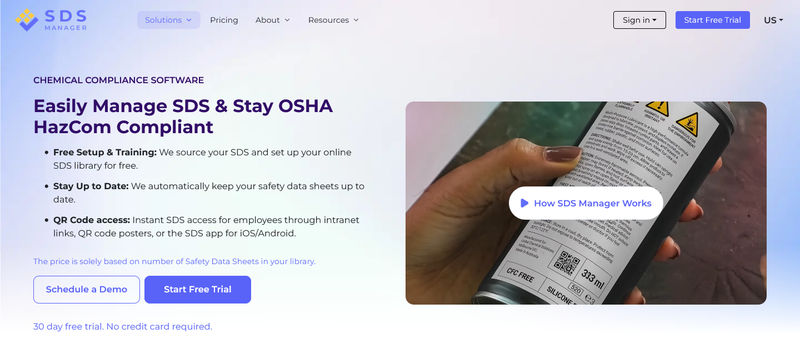
If you run chemical safety across several sites, business units, or countries, SDS Manager is the strongest enterprise pick in 2026.
SDS Manager can integrate your SDS library with your team’s AI tool (including major LLMs) and provides SDS update notifications as soon as a supplier updates their SDS. It covers regulatory requirements globally, including North America, the UK, the EU, Australia, and many more, all in the same account. SDS management and chemical inventory tracking share one library across every site and country.
Teams that make or import chemicals can also use ExactSDS to author their own sheets. When the safety program grows beyond chemicals, incidents, audits, risk, and training can run through EHS Solutions by SDS Manager. SMBs with lesser requirements also have the option for Basic or Premium plans and can move up as the library grows.
SDS Manager Key Features
- Free import of existing SDS files, or a Full-Service option in which SDS Manager builds the library.
- Supplier monitoring that flags new SDS versions and upgrades them automatically or after a reviewer approves.
- Version control that archives every replaced SDS with its revision date, who replaced it, and when.
- OSHA, COSHH and chemical risk assessments, plus ingredient screening against lists such as TSCA, Prop 65, EPCRA and REACH.
- GHS, NFPA and HMIS secondary container labels with QR codes from the secondary label generator, plus ADR and DOT transport labels.
- QR code posters, barcode scanning, and an iOS and Android app with offline access for workers.
- SSO, two-factor authentication, an API, and four ISO certifications for enterprise rollouts.
Ideal For: Companies of all sizes with strong enterprise-grade integration, running several sites or several countries that want enterprise security features without an enterprise sales cycle. Smaller teams start on the Basic or Premium plan and move up as the library grows.
2. Cority
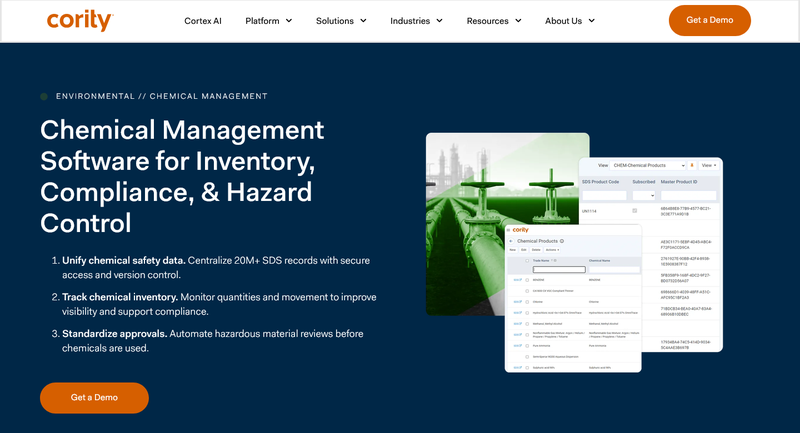
Cority fits organizations that already run occupational health, industrial hygiene and environmental programs in one system and want SDS management added to it. Cority describes its chemical management software as connecting "SDS management, inventory tracking, approvals, and hazard communication in one platform."
Cority Key Features
- An SDS library with version control, managed alongside chemical inventory in the CorityOne platform.
- Inventory tracking of chemical quantities, storage locations, and usage across facilities.
- Pre-screen and approval workflows that review chemical requests for safety and compliance before purchase or use.
- Label generation and hazard communication "per OSHA HazCom, GHS, and regional standards."
- Mobile access to chemical data, SDSs, and workflows through the myCority app.
- Automation through Cortex AI, which Cority describes as having human-in-the-loop oversight.
Ideal For: Large enterprises that want SDS management inside the same platform as their health, hygiene, and environmental records. Teams that need only SDS access and labels get more system than the job requires.
3. Sphera
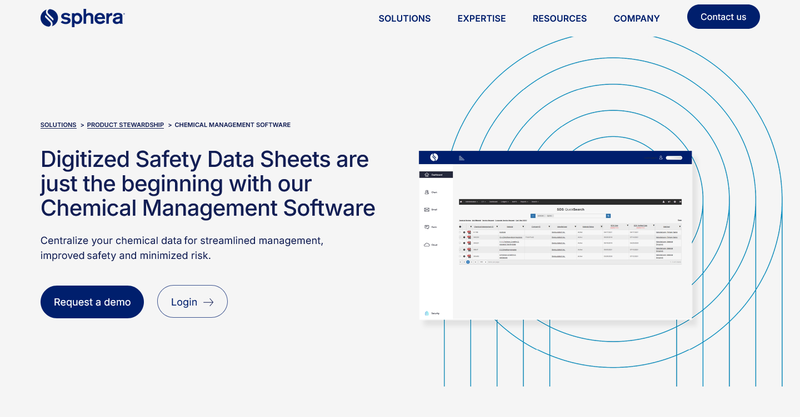
Sphera approaches SDS management from product stewardship, the discipline of managing a product's safety and regulatory data across its life cycle. That background shows in a service-led model: "Sphera's team of experts indexes over 300 unique points on your supplier SDS."
Supplier updates are part of the same service. Sphera states that SDSs are updated at least every 24 months, with Sphera's experts doing the legwork of calling suppliers.
Sphera Key Features
- Expert-managed SDS indexing and supplier follow-up handled by Sphera's team.
- Container-level chemical inventory tracking with storage properties and locations.
- Reporting that covers EPCRA, SARA Title III, GHS and REACH requirements.
- Reports for employees, suppliers, customers, and regulators, plus support for Right-to-Know requirements.
- Chemical data export through reports, Excel, or APIs.
- A chemical risk assessment module and separate SDS authoring products.
Ideal For: Large manufacturers and government hazmat programs that want SDS data managed by a vendor team and connected to product stewardship. If you need supplier revisions in your library within days, confirm the update cycle in your contract.
4. EcoOnline
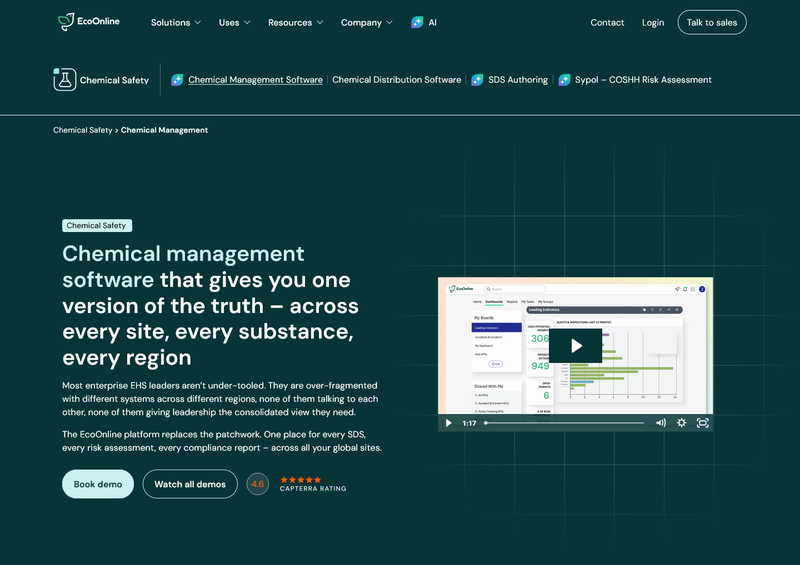
For teams whose SDS work centers on chemical risk assessment, EcoOnline is a strong fit, particularly in the UK and Europe, where COSHH and REACH assessments are routine. EcoOnline's chemical management tools include chemical risk assessment tools with guided workflows and chemical substitution workflows.
EcoOnline Key Features
- Automatic SDS updates, with EcoOnline contacting manufacturers and updating status and revision dates.
- Safety Protection Sheets (a shorter version of the SDS) with a QR code that opens the full sheet.
- QR code access and offline access for field teams.
- A library of pre-built COSHH assessments that teams adapt instead of writing each one from scratch.
- Substitution workflows for replacing a hazardous chemical with a safer alternative.
- Multi-site support for "hundreds of sites, multiple business units, and global operations from a single instance."
Ideal For: UK, Nordic and wider European organizations that want COSHH-style chemical risk assessment inside a broader safety and ESG suite.
5. Quentic
Quentic is built around the European model of hazardous substance management, where a hazardous chemicals register, risk assessments, and operating instructions are kept together. In September 2026, Quentic announced it had "successfully separated from AMCS Group, re-establishing itself as a standalone business."
Quentic Key Features
- SDS Extract, an AI assistant that pulls data from uploaded SDS PDFs in bulk.
- Automated update reminders and SDS requests sent to suppliers.
- Side-by-side comparison of content changes between SDS versions.
- SDS Premium, a full-service option in which Quentic handles SDS updates and large international SDS collections.
- A hazardous chemicals register and legally compliant risk assessments for everyone working with hazardous chemicals.
- Software hosted in Germany.
Ideal For: German-speaking and wider European organizations that want hazardous substance registers and risk assessments in the same system as their SDSs. Teams that also work under OSHA or WHMIS should ask how the platform handles North American requirements.
6. HSI
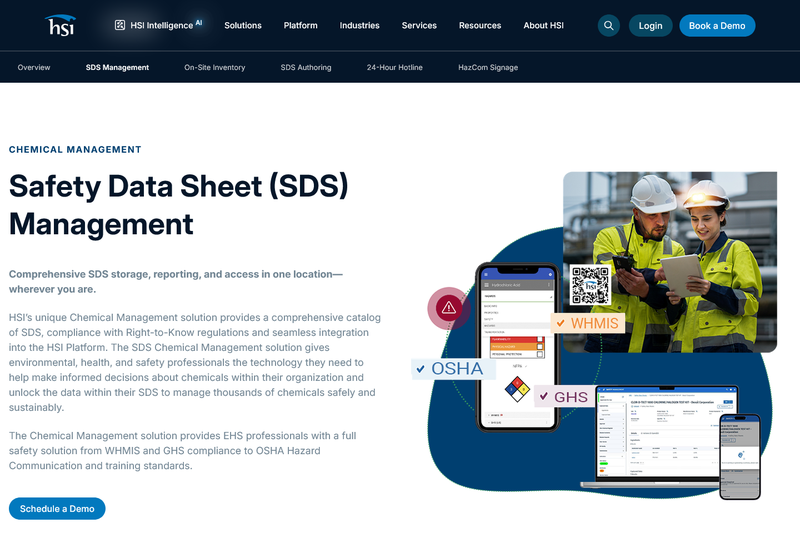
HSI suits organizations that want SDS management and safety training from the same vendor. Its SDS management is part of the HSI platform, alongside EHS software and a learning management system (LMS, software for assigning and tracking training).
HSI's SDS management includes Tier II reporting, the annual hazardous chemical inventory filing required under EPCRA.
HSI Key Features
- Tier II reporting and SDS ingredient data indexing.
- Online and offline access to your custom SDS collection, searchable by location, CAS number, hazard, chemical name, or manufacturer.
- QR code capabilities and GHS secondary container labeling.
- A 24-hour chemical hotline.
- OSHA, GHS, and WHMIS alignment.
- On-site inventory services, where HSI staff inventory your chemicals for you, plus SDS authoring and consulting.
HSI states that it "updates our SDS library on an annual basis to ensure data is up-to-date."
Ideal For: US and Canadian organizations that already use HSI for safety training and want HazCom, SDS access, and Tier II reporting on the same account.
7. CloudSDS
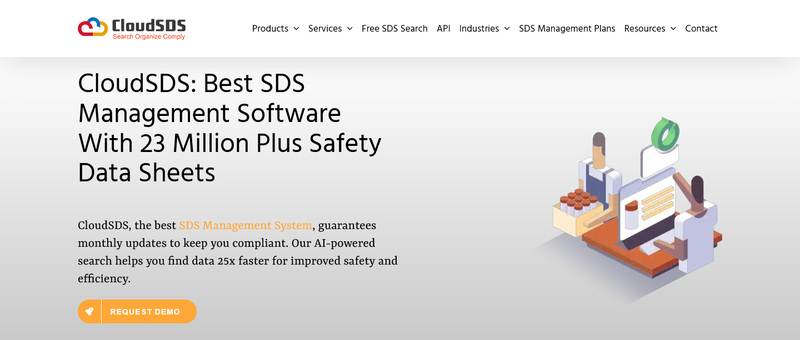
CloudSDS is a dedicated SDS platform for teams that want SDS data inside their own systems. It offers an SDS API with "180 critical and difficult-to-find data points," along with managed services such as converting paper binders to digital ones.
CloudSDS Key Features
- Four plans: Basic, Advanced, Professional, and Enterprise.
- Alerts for SDS updates and secondary container label generation from the Advanced plan.
- Mobile apps on the Professional plan.
- SSO, unlimited facilities, unlimited locations, and unlimited users on the Enterprise plan.
- Manufacturer SDS requests set per plan, from 50 a year on Advanced to 500 a year on Enterprise.
- Chemical inventory tools that include Tier II reporting, plus translation and SDS authoring services.
Ideal For: Teams that want to pull SDS data into their own systems through an API, or hand binder conversion and translation to a service team. Mobile apps and unlimited users are in the upper plans, so match the plan to your headcount.
8. mSDS Source
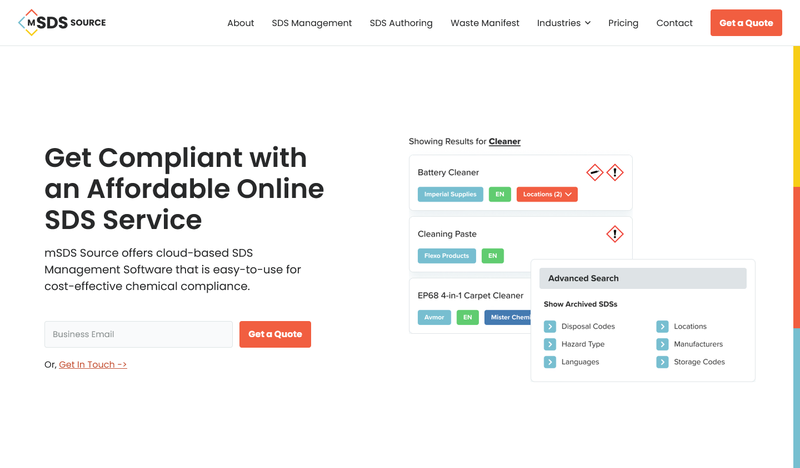
If your sites are schools, municipal buildings or hospitals in the US and Canada, mSDS Source is built for that buyer. It supports OSHA and WHMIS "in both English and French" and includes free onboarding.
Its Gold tier goes further and is "the complete outsourced SDS management solution." The self-managed Red Level costs $1,299 per year with all employee access included.
mSDS Source Key Features
- Automated SDS update management, so customers receive the latest versions in their libraries.
- A mobile app with offline functionality.
- A unique QR code for each SDS, which can go on labels, equipment or storage areas.
- SSO support with automatic user provisioning from existing company credentials.
- A secondary container label generator for GHS, NFPA and HMIS formats, optional with the Blue and Gold tiers.
- Setup and training for most customers within a few weeks.
Ideal For: North American public-sector and healthcare organizations that want a bilingual interface and the option to outsource SDS upkeep entirely.
9. ChemAlert
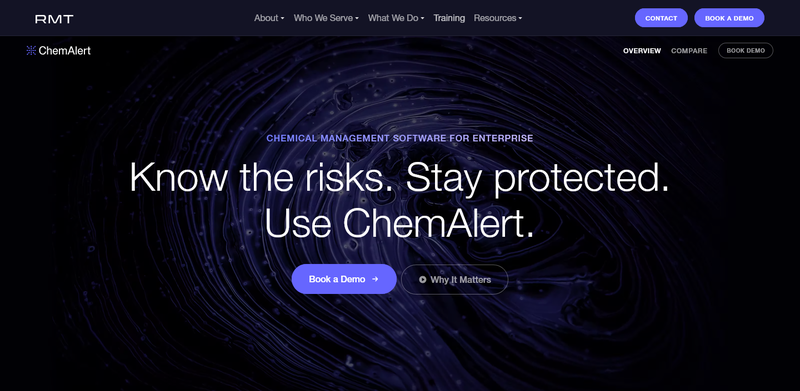
ChemAlert, developed by RMT Global in Western Australia, puts scientific validation at the center of its SDS library. RMT describes ChemAlert as "backed by a dedicated scientific and regulatory research team with expertise in toxicology, chemistry, WHS compliance and global GHS standards."
ChemAlert Key Features
- Original manufacturer SDSs validated by RMT's in-house scientists, alongside ChemAlert's own research reports.
- Automatic creation of compliant stock registers and reports on hazardous or dangerous chemicals.
- Chemical risk assessments built into the platform.
- An iOS and Android app with barcode scanning for inventory and SDS access.
- Unlimited scientific and technical support from RMT's in-house team.
- Migration of existing data handled by RMT during setup.
Ideal For: Australian and New Zealand mining, oil and gas, and heavy industry sites that want scientist-reviewed SDS data and WHS-focused chemical registers.
10. Chemical Safety Software
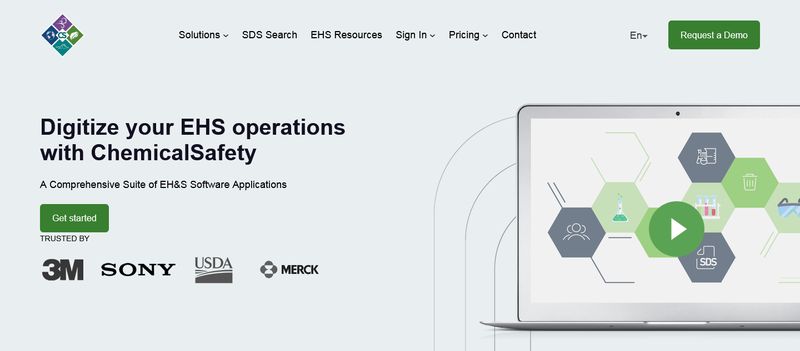
Labs and universities that want SDS management tied to chemical inventory and waste tracking will find Chemical Safety Software a close fit. Its SDS plans cost $69 to $149 per month, with a Complete plan priced on request.
Chemical Safety Software Key Features
- A dedicated SDS sourcing team that finds the SDS records you need.
- iOS, Android and Windows mobile apps on every plan.
- Local offline backups of your SDS library.
- GHS label printing on the Standard, Plus and Complete plans.
- Storage for 1,000 SDSs on Basic, 2,500 on Standard and 5,000 on Plus, with unlimited storage on Complete.
- SDS updates of 5, 10 or 15 per month depending on the plan, with updates included on Complete.
Chemical inventory, hazardous waste and regulatory reporting modules are sold alongside the SDS plans as part of the wider EH&S suite.
Ideal For: Labs, universities and research sites that want SDS management, chemical inventory and waste tracking from one vendor.
What Should You Look For When Choosing an SDS Management Platform?
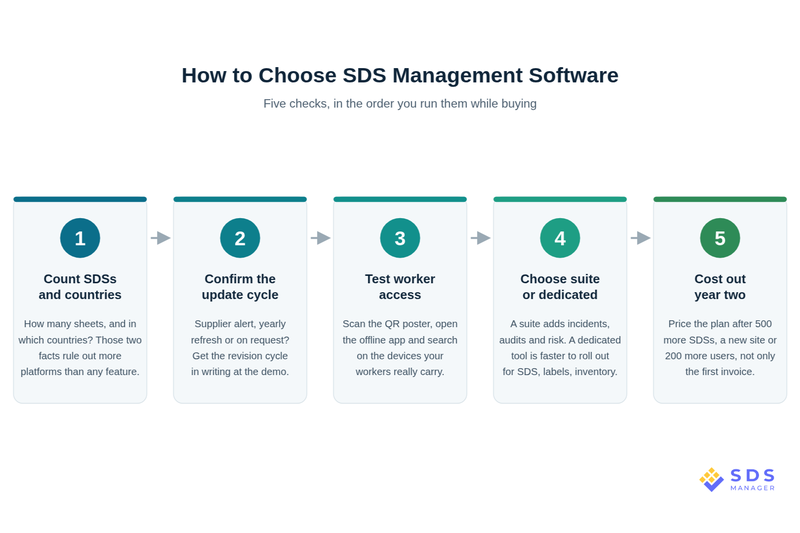
Choosing an SDS management platform comes down to five checks, in the order you would run them while buying:
- SDS count and countries: these two facts rule out more platforms than any feature does. A library of 300 SDSs at one US site needs a different platform from 6,000 SDSs spread across Canada, the UK and Australia.
- Revision cycle: "automatic updates" can mean an alert the day a supplier publishes a new version, a scheduled refresh once a year, or a request you submit against a monthly allowance. A sheet two versions out of date can list the wrong exposure limit or PPE, so get the cycle in writing during the demo.
- Worker access: OSHA has stated that employees should not have to ask for an SDS, so a login wall or a request through a supervisor works against you. The practical test is to scan the QR poster, open the offline app, and run a search on the devices your workers carry.
- Suite or dedicated tool: if your safety team also wants incident reporting, audits, and risk management in one system, the best EHS software options are worth comparing too. Where SDS access, labels, and inventory are the whole job, a dedicated platform is faster to roll out and easier to budget.
- Year-two cost: the price after you add 500 SDSs, a new site, or 200 users matters as much as the first invoice. Compare each vendor's answer with a vendor whose price list is published.
Take Control of Your SDS Library Today
Pick the three platforms whose type and pricing model match your library size and countries. Before the first demo, look up a few of your own products in a free SDS search to see which supplier versions are current.
Then put each one through the same test: import a sample of your real SDSs, scan a QR poster on a worker's phone, and ask for next year's price at double your current SDS count.
SDS Manager, with its transparent pricing model, covers North American, UK, EU, and Australian requirements in one account, and lets you import your existing library during a 30-day trial, so you can test it on real data that you own.
Frequently Asked Questions
What is SDS Management Software?
SDS management software is a system that stores safety data sheets in one searchable library, keeps them current as suppliers issue new versions, and gives workers quick access by QR code, app, or search. Most platforms also add secondary container labels and chemical inventory tracking, though some only store the files you upload, so revision tracking is the feature to check first.
How Much Does SDS Management Software Cost?
SDS management software costs anywhere from a free plan for small libraries to custom enterprise contracts, depending on the pricing model. Published examples include SDS Manager from $19 per month for 100 SDSs billed annually, mSDS Source's Red Level at $1,299 per year, and Chemical Safety Software's plans from $69 to $149 per month.
What Is the Difference Between Free and Paid SDS Software?
Free SDS software usually covers a small library and basic access, while paid plans add the tools that keep a library compliant over time. SDS Manager's free plan covers up to 200 SDSs and produces an electronic SDS binder, and its paid plans add labels, revision alerts, QR access, and offline apps.
Do You Need SDS Software to Be OSHA Compliant?
SDS software is not required for OSHA compliance, though many employers use it because it makes access and updates easier to prove. OSHA's Hazard Communication Standard requires that SDSs be readily accessible to employees during each work shift, and paper binders or electronic systems can both meet that rule.
Can You Switch SDS Platforms Without Losing Your Library?
Switching SDS platforms is possible without losing your library, because most vendors import existing SDS files. SDS Manager imports a zip file of your current SDSs, recreates your folder structure as locations, and can extract files directly from several existing SDS systems.
Which SDS Management Software Works in More Than One Country?
SDS management software that works across countries has to cover each country's own chemical rules, not only GHS. SDS Manager covers OSHA in the US, WHMIS in Canada, COSHH in the UK, REACH in the EU, and Safe Work Australia requirements, while several other platforms focus on one region.

Arysha Alif Khan

Arysha Alif Khan is an EHS and chemical safety specialist with a background in biochemistry, biotechnology, and public health. She works closely with the product and regulatory teams to turn complex chemical regulations, SDS requirements, and workplace safety standards into clear, practical guidance for people.