If your safety records are scattered, you already know the drill. The incident reports live in one system, the audit findings in another, the training logs somewhere else entirely, and every time an audit rolls around, someone on your team burns days manually piecing it together.
Here's the thing though: that scramble is exactly what separates the best EHS software from the rest. The good platforms keep everything synced automatically. The rest leave that job to you.
So we put the 10 best EHS software platforms of 2026 up against six criteria, each one really asking the same question: does this platform actually turn a finding into a fix, or just file it away and move on?
Key Takeaways
- Choose EHS Solutions by SDS Manager if you want enterprise-level incident, risk, and audit records management linked together, with a fast rollout.
- Consider Cority if deep occupational health is a core requirement.
- Consider Enablon or Sphera if enterprise governance and process safety must hold up at a global scale.
- Consider EHS Insight or Evotix if a configurable mid-market platform is the main requirement.
How Did We Choose The Best EHS Software?
We scored every platform against six criteria that separate a system that controls risk from one that only records it. Each score draws on vendor documentation, product demos, and verified customer reviews.
- Linked records: whether one action, such as an incident, automatically triggers the next, such as a risk assessment.
- Investigation depth: whether the platform scales to severity, running a full root cause analysis on serious events instead of treating every event the same.
- Verified fixes: whether a corrective action needs independent verification before it's closed, not just sign-off from the person who made it.
- Audit trail: whether a full record of findings and fixes is built in, or has to be pieced together by hand.
- Rollout speed: how long before the platform is actually preventing incidents, not just installed.
- Frontline adoption: whether workers are actually able to use the platform day to day, or find it too slow to bother with.
The list below covers some of the top-ranked EHS management software suites globally. Our top pick scores highest on linked records and rollout speed.
EHS Software at a Glance
Here we compare each platform on its core strength and how fast it can typically be set up for your company.
| Platform | Core strength | Typical deployment | Onboarding |
|---|---|---|---|
| EHS Solutions by SDS Manager | Incident, risk, and audit records linked together, with AI-assisted reporting | 2 to 4 weeks | Self-guided setup |
| CorityOne | Occupational health and industrial hygiene depth | About 6 months | Vendor-assisted setup |
| Intelex | Configurable EHSQ workflows | About 7 months | Vendor-assisted setup |
| Enablon | Enterprise governance and operational risk | 12 to 24 months | Vendor-assisted setup |
| SpheraCloud | Process safety for high-hazard sites | 12 to 24 months | Vendor-assisted setup |
| Benchmark Gensuite | Broad modular app library | 6 to 12 months | Vendor-assisted setup |
| EHS Insight | Configurable mid-market breadth | About 4 months | Self-guided setup |
| Ideagen EHS | Compliance depth for regulated industries | Not publicly stated | Vendor-assisted setup |
| EcoOnline | Chemical safety and ESG reporting | Weeks | Self-guided setup |
| Evotix | No-code connected platform | Not publicly stated | Self-guided setup |
Now, let’s get to know more about the top EHS software.
1. EHS Solutions by SDS Manager
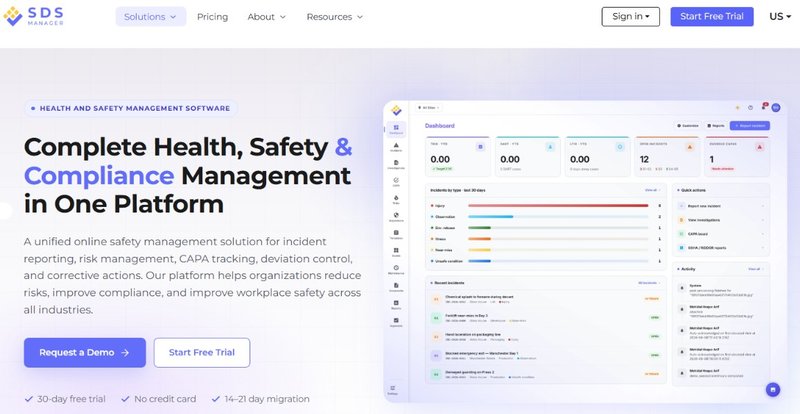
If your team wants incident, audit, and risk records synchronized in a single system built for compliance instead of scattered across separate ones, choose EHS Solutions by SDS Manager.
It's strongest where it counts day to day: a logged incident automatically opens its own corrective action and updates the risk score, so records stay linked instead of waiting to be copied between tools. And at two to four weeks to go live, you find out quickly whether it fits, rather than committing to half a year of setup first.
Key features
- Centralized Incident Management and Fixes: Every incident, investigation, and fix lives in one system, and closing a fix needs sign-off from someone other than the person who made it.
- Automated Regulatory Reporting: Auto-fills forms like OSHA 300 (US) and RIDDOR (UK) straight from incident data, so nobody re-enters the same details twice.
- Digital Audits and Inspections: Every audit checklist stays locked to the version used at the time, with each inspection scored Pass, Needs Attention, or Fail.
- Mobile Access, On Site and Offline: Cloud-based with offline mobile apps, plus asset tracking that flags overdue maintenance right on the dashboard.
- Risk Scoring That Updates Automatically: Scores every hazard before and after safety measures on a 5-by-5 scale, and updates automatically when a compliance gap shows up elsewhere.
Ideal for
Large, regulated enterprises across any industry with hazardous work, from manufacturing and construction to oil and gas, food processing, and warehousing, that want incident reporting, investigation, verified corrective actions, audits, and regulatory paperwork all handled automatically in one connected system, with a rollout measured in weeks.
2. CorityOne
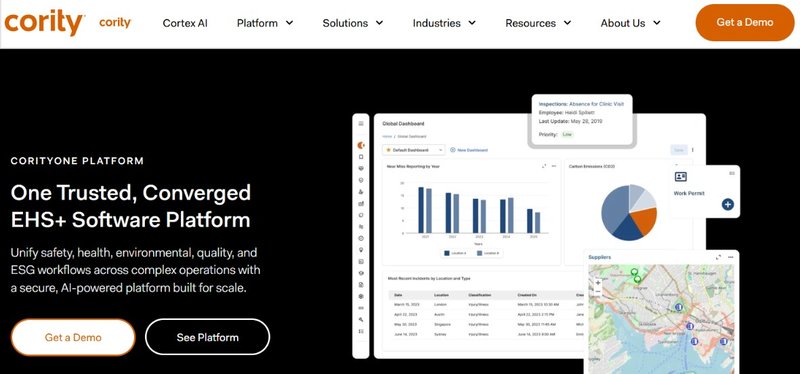
Where EHS Solutions trades on speed, CorityOne trades on depth. If your program needs occupational health managed alongside core safety, on the same enterprise-grade system, CorityOne is one of the few platforms built specifically for that combination.
Its investigation depth and health-tracking outrun most of the field, though that comes with a longer runway: expect around six months to go live.
Key features
- Occupational Health Tracking: Tools for tracking employee health checkups and monitoring workplace exposure over time, a level of detail few EHS platforms offer
- Exposure Monitoring: Tools to measure and track things like dust, chemicals, or noise that workers are exposed to on the job
- Core Safety Management: Incident, risk, and audit management shared across the CorityOne suite
- Quality and Sustainability Reporting: Quality and ESG (environmental, social, and governance) tools for organizations combining safety, quality, and sustainability reporting in one platform
- Connections to Other Systems: A connection feature that lets CorityOne share data automatically with other business software you already use, such as your HR or inventory systems
Ideal for
Large, regulated enterprises that need occupational health data on the same system as core safety, especially in pharma, healthcare, chemicals, and heavy manufacturing.
3. Intelex
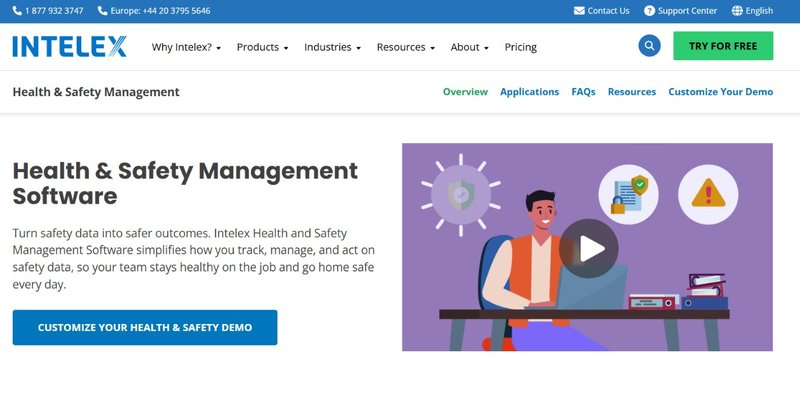
Intelex's whole pitch is configurability: shape the workflows around how your teams actually work, instead of adapting to a vendor's fixed template, with EHSQ (EHS plus quality) software built for that kind of flexibility. That adaptability is what it scores highest on, though bending a platform to fit every site takes setup time, and going live runs to roughly seven months.
Key features
- Custom Workflows: Custom forms and adjustable workflows that can be built without a full development project
- Adjustable Reporting: Adjustable dashboards and reporting across incidents, audits, risk, and environmental data, consistently cited as a platform strength
- Safety and Quality Together: Safety and quality managed in the same system, including tracking product defects and supplier problems
- Mobile Apps: Native iOS and Android apps, rated #1 in Mobile by Verdantix, though some reviews note a gap between mobile and desktop
- Add-ons and Connections: More than 15 add-on tools, plus the ability to connect with other business software you already use, like accounting or inventory systems, and connected sensors on equipment
Ideal for
Multinational operations that need to configure EHSQ workflows differently across many sites and countries, rather than run one fixed template everywhere.
4. Enablon
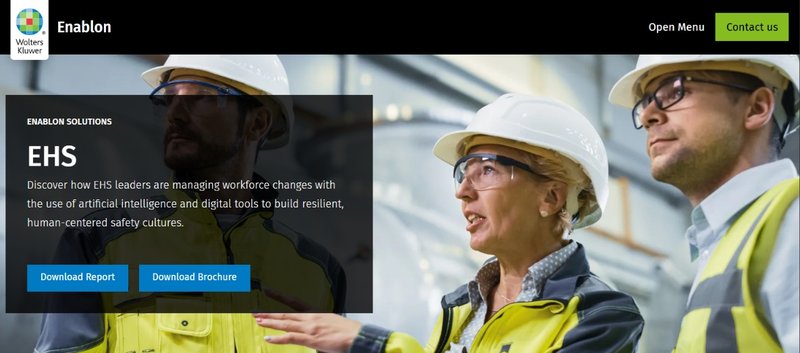
Enablon is the first of two platforms here built for pure enterprise scale. It’s made for organizations that want to fold safety into a much bigger company-wide risk-management and oversight program rather than run it as a separate system.
Owned by Wolters Kluwer, it's one of the largest enterprise EHS platforms in use, holding safety, risk, and compliance data across many countries. Breadth and governance are where it leads; that reach is also why rollout is the longest on this list, often twelve to twenty-four months.
Key features
- Broad Tool Library: One of the broadest sets of add-on tools in the category, spanning safety, company-wide risk, and sustainability
- Company-Wide Risk Tracking: In-depth tools for tracking company-wide risks and making sure the right people are accountable for them
- Work-Permit Management: Safety tools and work-permit management (permits and approvals for high-risk jobs) for high-hazard, asset-heavy operations
- Connected Investigations: Investigation tools that pull related information, such as active permits and training records, into a single view
- Global Program Support: Support for programs spanning many countries, sites, and regulations
Ideal for
Global enterprises that need EHS made part of a broader risk, controls, and governance function rather than run as a standalone safety system.
5. SpheraCloud
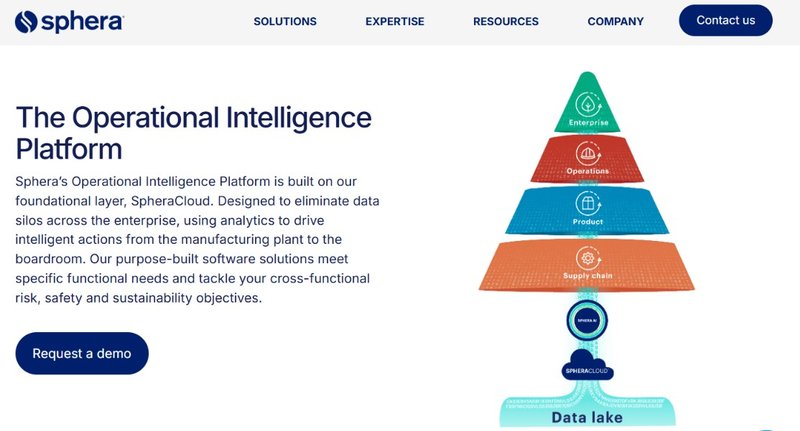
Like Enablon, SpheraCloud asks for a long runway to go live, usually twelve to twenty-four months, but the payoff is narrower and deeper: a handful of the highest-stakes industries instead of every industry at once.
SpheraCloud's depth in hazard analysis is the standout; like the other enterprise platforms here, though, it asks for a twelve-to-twenty-four-month rollout in return.
Key features
- Hazard Analysis: Hazard analysis and company-wide risk tools built for high-hazard environments
- Major-Accident Prevention: Tools focused on preventing major industrial accidents, like chemical leaks or equipment failures, at facilities where a mistake can be catastrophic
- Chemical Safety and Product Impact: Tools for managing chemical safety data and tracking a product's environmental impact from creation to disposal
- Audit-Ready Records: Time-stamped, traceable records designed to hold up under regulatory and internal audit review
- Connected Risk Picture: Data connecting incidents to the company's wider risk picture, so a single event is visible in the context of everything else happening on site
Ideal for
Oil and gas, chemicals, refining, and mining operations where process safety drives the safety program, ahead of general EHS compliance.
6. Benchmark Gensuite
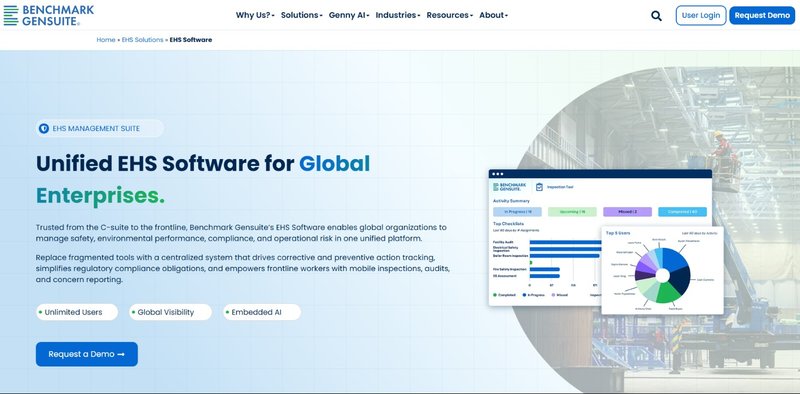
Benchmark Gensuite's appeal is for teams that want to build their own program from a broad menu of EHS apps rather than adopt one fixed suite. It covers incidents, inspections, compliance calendars, and dozens of other tools, so you can start small and add more as the program grows.
That range is Benchmark Gensuite’s strength; assembling a program piece by piece is also why it lands in the middle on rollout, usually six to twelve months.
Key features
- Broad Module Coverage: Broad coverage across incident, inspection, and compliance-calendar tools
- Cross-Tool Action Tracking: Action tracking that spans many tools within one account
- Built-in AI: AI features built across the suite, marketed under the Genny AI assistant
- Pick-and-Choose Structure: A flexible, pick-and-choose structure that scales as your program grows
- Frontline Reporting: QR-code and mobile reporting for frontline workers
Ideal for
Large organizations that want to assemble a program piece by piece from a broad module menu, and can accommodate a 6-to-12-month rollout.
7. EHS Insight
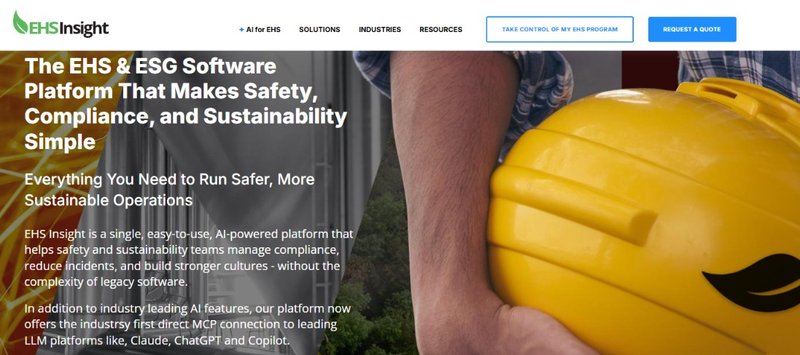
After three platforms that each ask for the better part of a year or more, EHS Insight is a genuine change of pace. It targets the gap for mid-sized companies that want broad EHS coverage without a heavy enterprise rollout. It takes an average of four months to go live, quicker than most large-scale suites, and rollout speed alongside that adaptable, growing-team fit is exactly where it scores well.
Key features
- Full EHS Coverage: Incident, near-miss, audit, training, and environmental tools covering the full range of day-to-day EHS work
- US Recordkeeping: OSHA 300, 300A, and 301 recordkeeping (the standard US injury and illness report forms), with investigation and root-cause tools to help figure out why an incident happened
- Mobile App: A mobile app built for quick frontline use
- Adjustable Setup: An adjustable structure that adapts to different programs without a heavy enterprise-scale setup
- Sustainability Data: ESG (environmental, social, and governance) and sustainability data collection, which G2 scores above some larger suites
Ideal for
Growing safety teams (roughly 250 to 10,000 employees) that want broad EHS coverage now, without committing to an enterprise-scale rollout timeline.
8. Ideagen EHS
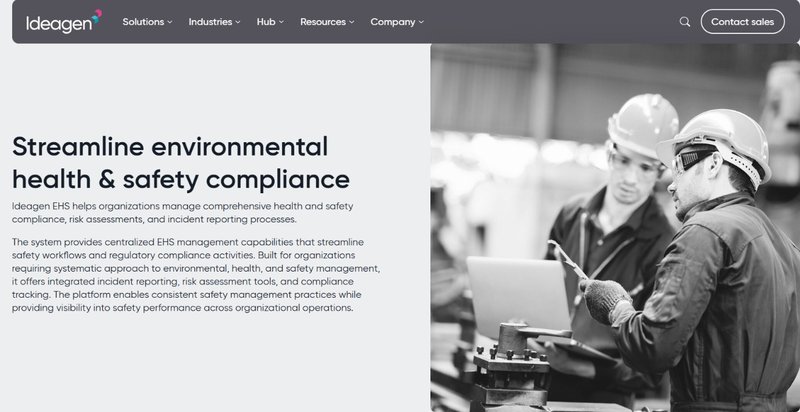
Ideagen EHS is built for regulated operations where compliance can't have gaps, particularly aerospace and manufacturing.
Now part of Ideagen (formerly ProcessMAP), it runs 14-plus tools across the full range of EHS work, and that compliance depth across safety, environment, and occupational health is its clearest strength.
Key features
- Wide Discipline Coverage: A wide set of tools across safety, environment, workplace health, and occupational health.
- Incident and Behavior Reporting: Incident and near-miss reporting with automated workflows and tools for logging unsafe behavior before it causes an incident
- AI-Assisted Risk Handling: AI-assisted risk classification and automatic action-plan creation
- Emissions and Compliance Reporting: Air emissions and regulatory compliance reporting for multi-site operations
- Mobile Apps: Native mobile apps for incidents, audits, inspections, and observations
Ideal for
Aerospace, complex manufacturing, and other regulated operations that need compliance depth across safety, environment, and occupational health in one system.
9. EcoOnline
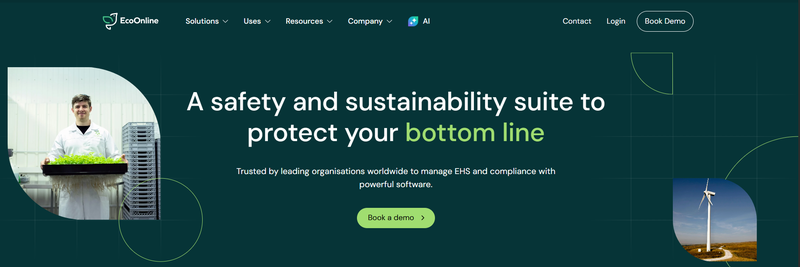
Many EcoOnline customers are live within 30 days, and that speed is the platform's clearest advantage. If ESG (environmental, social, and governance) reporting needs to run alongside core EHS in one system, it covers both from the same platform, used by thousands of organizations.
Key features
- Proactive Hazard Logging: Tools that let workers log unsafe conditions before they turn into incidents
- Sustainability Reporting: ESG and sustainability reporting aligned to climate frameworks
- Multi-Site Core Tools: Standard incident, risk assessment, and audit tools across multiple sites
- Mobile-First Reporting: Mobile-first hazard and near-miss reporting with real-time analytics
- Fast Onboarding: Guided onboarding and ready-made templates, with many organizations live within 30 days
Ideal for
Construction, manufacturing, and chemical firms that need chemical safety and ESG reporting built into the same system as core EHS rather than bolted on separately.
10. Evotix
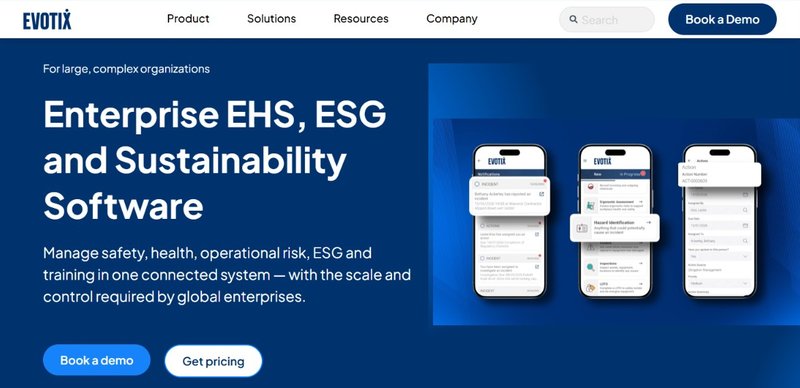
Finally, we take a look at Evotix. While it may not have speedy deployment, its strength lies in user-friendliness for workers. Evotix’s no-code platform (your team builds and adjusts workflows through point-and-click settings, not custom programming) brings health, safety, and environmental data together in one place.
Its native mobile apps make safety feel like daily work rather than extra paperwork. That focus on frontline adoption, paired with build-your-own flexibility, is where it stands out.
Key features
- No-Code Setup: No-code setup for workflows and digital forms, built through point-and-click settings instead of custom programming
- Mobile Field Apps: Native mobile apps for field teams to log incidents and observations
- AI-Assisted Incidents: AI-assisted incident handling that shows similar past cases and their fixes
- One Shared System: One system used the same way across health, safety, and environmental teams, so no group works from a separate tool
- Work-Permit and Change Tracking: Tools for managing high-risk work permits and tracking changes to how a job or process is done
Ideal for
Mid-market and enterprise teams that want to configure their own connected system without relying on developer time for every change.
What Should You Look For in EHS Software?
Forget the feature list for a second. Every platform on this list reports incidents, runs audits, and stores training records, so those boxes being checked won't actually tell you much once you're comparing real options.
The gap between a platform that controls risk and one that just records it comes down to a handful of things, and you can check every one of them yourself in a demo before you sign anything.
- Does logging an incident automatically update the risk register and start a fix, or do you have to make that connection by hand?
- Can the person who logs a fix also close it themselves, or does someone else have to check and approve it first? Independent approval before closing is confirmed only for EHS Solutions by SDS Manager among the ten platforms compared here. The rest do not document it publicly.
- Is the audit trail built in automatically, with saved checklist versions, or will you have to assemble one by hand before your next audit?
- Does the rollout timeline match your actual deadline? A platform that takes 12 to 24 months will not help this year's safety goals.
- Will workers actually use the mobile experience in the field, or is it slow enough that they will skip it? Test this yourself rather than taking a sales demo's word for it.
Here's the real test, underneath all five of those: can you trace any incident all the way to its verified fix, and trace any procedure change back to the event that caused it? If a platform can do both on a single record, it's worth shortlisting. If it can't, you're looking at a system for storing records, not one for controlling risk, whatever the sales deck calls it.
If you want to see the difference for yourself, try running a real chemical safety audit through a shortlisted platform and watch how much of the trail it builds without you.
Frequently Asked Questions
What is the best EHS software?
The best EHS software is EHS Solutions by SDS Manager, because it links incident, risk, and audit records automatically, requires independent sign-off on every fix, and rolls out in as little as two to four weeks. Also, there is CorityOne if you want deep occupational health tracking, or SpheraCloud if you want tools built for high-hazard industrial sites.
What is the difference between EHS software and EHSQ software?
The difference between EHS software and EHSQ software is that EHSQ adds quality management, tracking product defects (nonconformance) and supplier issues on the same system as incidents, audits, risk, and compliance. Also, manufacturing and aerospace tend to prefer EHSQ, since safety and quality problems there often share a root cause.
How long does EHS software take to implement?
It takes anywhere from a few weeks to 24 months to set up EHS software. The exact timeline depends on how the platform is built, how many tools you roll out, and whether moving your existing data over and training your team are included in the vendor's quote. Platforms built for self-guided setup, such as EHS Solutions by SDS Manager, tend to go live in weeks. Those built around a full vendor-managed rollout, like CorityOne and SpheraCloud, typically run closer to a year or more.
How do you improve frontline adoption of EHS software?
To improve frontline adoption of EHS software, test the mobile and offline experience yourself before you buy: tools that work well in the field get used, and ones that don't get skipped. Ask existing customers how adoption held up after their rollout, not just during the sales demo. A tool workers find too slow to use in the moment won't get used at all, no matter how complete its feature set.
What features should EHS software have?
EHS software should have incident reporting, audits, corrective actions, risk assessment, and compliance tracking. Those are baseline features, covered by nearly every platform on the market. What separates a strong platform is less obvious: automatic links between modules, and independent verification before a fix can close. Match the module set to your program's real needs rather than the length of the feature list.
Choose the Right EHS Software for Your Needs
By now the pattern across these ten should be pretty clear: nobody wins on every criterion, and the right pick just depends on which gap is actually costing you time.
The best EHS software fits how your team already works day to day, and links the incident, audit, and risk records you're already collecting instead of leaving them scattered across separate systems.
So start with whatever's causing the most friction right now, whether that's an incident that never quite gets closed out or an audit trail you rebuild by hand every single time, and judge candidates on how well they close that one specific gap.
For most teams, that friction traces back to the same root cause: incident, risk, and audit data spread across systems that were never built to talk to each other. If that's your program, a connected EHS platform built around linked records is the natural place to start looking.

Arysha Alif Khan

Arysha Alif Khan is an EHS and chemical safety specialist with a background in biochemistry, biotechnology, and public health. She works closely with the product and regulatory teams to turn complex chemical regulations, SDS requirements, and workplace safety standards into clear, practical guidance for people.