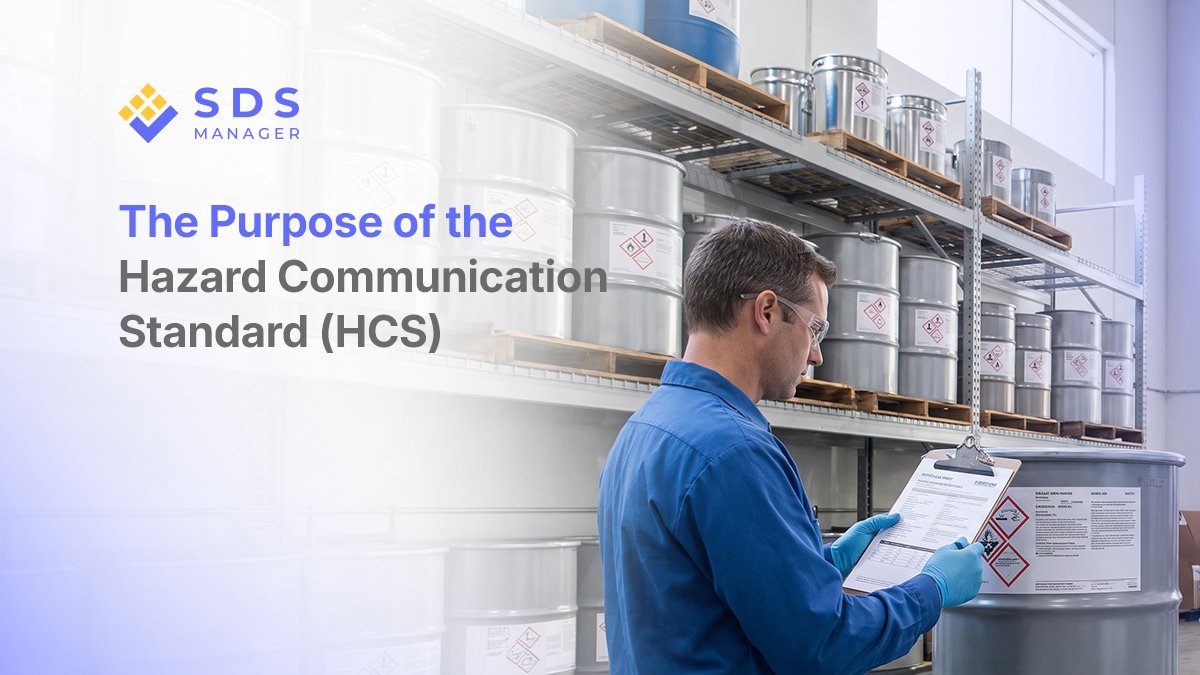
The Hazard Communication Standard (HCS) has a clear purpose: to make sure workers know the hazards of the chemicals they handle and how to work with them safely. OSHA does this by requiring those hazards to be classified and shared through container labels, safety data sheets (SDS), and worker training. This overview explains what the standard is for, how it works, and which businesses it covers.
Key Takeaways
- The Hazard Communication Standard (HCS) is the U.S. OSHA regulation at 29 CFR 1910.1200 that requires the hazards of all chemicals produced or imported to be classified and communicated to employers and workers.
- OSHA estimates over 32 million U.S. workers are exposed to hazardous chemicals across more than 3.5 million workplaces.
- The HCS communicates chemical hazards through four parts: hazard classification, container labels, safety data sheets (SDS), and worker training.
- The HCS applies to chemical manufacturers, importers, distributors, and any employer whose workers may be exposed to hazardous chemicals.
- OSHA's May 2024 final rule aligned the HCS with Revision 7 of the Globally Harmonized System (GHS), the UN system for classifying and labeling chemical hazards.
- The 2024 update requires hazard information to be clear enough for workers to understand and act on, an approach OSHA describes as the 'right to understand.'
What is the purpose of the Hazard Communication Standard (HCS)?
The HCS works by making chemical manufacturers and importers evaluate and document the hazards of everything they produce. Its purpose is to carry that hazard information, in a consistent form, to every workplace and worker that receives the chemical.
That obligation is set out in federal regulation at 29 CFR 1910.1200, and it covers every hazardous chemical that enters a U.S. workplace.
Its reach is wide. OSHA estimates that over 32 million workers are exposed to hazardous chemicals in more than 3.5 million U.S. workplaces. Before the standard, a worker often had no reliable way to know a drum or solvent could cause harm. The HCS replaced that uncertainty with a standardized system of hazard information.
Why does OSHA require hazard communication?
Workplaces that use chemicals can be subject to harm in many ways. Exposure can cause organ damage and cancer, and some reactions trigger fires or explosions. OSHA wrote the standard because that risk is widespread, and often invisible to the workers exposed to it.
When OSHA first built the case for the rule, it relied on national exposure data. The agency's hazard communication rulemaking record drew on NIOSH findings. About 25 million American employees could be exposed to one or more of 8,000 identified chemical hazards. The same record linked chemical exposure to more than 174,000 illnesses across a two-year span. OSHA concluded that weak hazard communication put workers at significant risk, and that a federal standard was the fix.
Knowing a chemical's identity and hazards lets an employer choose safer products and train staff before harm occurs.
How the HCS communicates chemical hazards
The HCS communicates hazards through four connected parts. Each one moves information from the chemical's maker toward the worker who handles it.
The four parts of the HCS
| Part | What it does | Who is responsible |
|---|---|---|
| Hazard classification | Evaluates each chemical against set criteria for health and physical hazards | Manufacturers, importers |
| Container labels | Show a signal word, pictogram, and hazard statement so risks read at a glance | Manufacturers, importers, employers |
| Safety data sheets (SDS) | Give full handling, exposure, and emergency detail in a standard 16-section format | Manufacturers and importers prepare them; employers keep them accessible |
| Worker training | Teaches employees to read labels and SDSs and to handle chemicals safely | Employers |
The label elements come straight from the chemical's classification. That's why a GHS label and its safety data sheet always describe the same hazards.
Who has to follow the HCS?
Three groups have to follow the HCS: the manufacturers and importers who make and classify chemicals, the distributors who convey that information downstream, and the employers whose workers handle the chemicals. The rule reaches further than many businesses expect.
- Chemical manufacturers and importers classify hazards and prepare labels and safety data sheets, then send both downstream.
- Distributors pass that label and SDS information along to the businesses they supply.
- Employers with hazardous chemicals on site keep labels intact and store SDSs within worker reach. They also run a written hazard communication program and train staff.
The definition of a hazardous chemical is broad. Degreasers, paints, flammable aerosols, and common cleaning agents can all qualify. A business doesn't have to be a chemical plant to fall under the OSHA hazard communication standard.
Twenty-five states plus Puerto Rico and the Virgin Islands run their own OSHA-approved State Plans. Most match the federal rule, with some local variations.
What the 2024 update changed
OSHA's 2024 final rule updated the HCS to match Revision 7 of the Globally Harmonized System (GHS) and pushed the standard from a right to know toward a right to understand. Published in May 2024, the rule took effect that July.
The update sharpened how hazards reach workers:
- Clearer criteria for classifying certain health and physical hazards.
- New label rules for small containers, with full detail kept on the outer packaging.
- Updated safety data sheet content, including expanded physical-property fields.
- New hazard categories, such as desensitized explosives and chemicals under pressure.
Compliance phases in over several years rather than all at once. OSHA later extended the deadlines by four months, moving the first manufacturer date for substances to May 19, 2026. For most workplaces, the practical effect is a wave of reissued labels and safety data sheets. Suppliers update them to match the updated GHS Revision 7 SDS requirements.
The standard's purpose still anchors chemical safety
The Hazard Communication Standard has kept the same purpose since 1983: giving exposed workers the information they need to stay safe. Each revision since has sharpened how clearly chemical hazards are communicated, most recently in 2024.
What the standard asks of an employer is steady upkeep. Labels and training have to stay current, and every hazardous chemical on site needs an accessible, up-to-date safety data sheet. As a library grows into the hundreds or thousands, keeping every document current gets harder. That upkeep is where a dedicated SDS management platform earns its place.
Frequently Asked Questions
When was the Hazard Communication Standard created?
OSHA first issued the HCS in 1983, aligned it with the GHS in 2012, and updated it again in 2024.
What is the main goal of the Hazard Communication Standard?
The main goal is to make certain workers exposed to hazardous chemicals know the risks and how to protect themselves. OSHA delivers this through classification, labels, safety data sheets, and training.
Is the Hazard Communication Standard the same as HazCom?
Yes. "HazCom" is the common shorthand for OSHA's Hazard Communication Standard, codified at 29 CFR 1910.1200.
Does the HCS apply to small businesses?
Yes. Any employer whose workers may be exposed to hazardous chemicals must comply, regardless of company size or industry.
What is the difference between the right to know and the right to understand?
The right to know means workers can access hazard information. The right to understand, emphasized in the 2024 update, means that information is clear enough to act on.
How often do Hazard Communication violations get cited by OSHA?
OSHA recorded 2,888 hazard communication violations in fiscal year 2024. That made it OSHA's second most-cited standard for the year.

Arysha Alif Khan

Arysha Alif Khan is an EHS and chemical safety specialist with a background in biochemistry, biotechnology, and public health. She works closely with the product and regulatory teams to turn complex chemical regulations, SDS requirements, and workplace safety standards into clear, practical guidance for people.