How an OSHA citation closes
When OSHA cites a workplace, the employer has to correct each hazard by the abatement date. For most citations, the employer then certifies the correction in writing, and for many it also sends evidence such as photos, invoices or training records. Once OSHA accepts that, the case closes.
From then on, OSHA's public record says nothing about the hazard unless OSHA comes back. The case file shows a fix was certified. It doesn't show whether the fix still holds a year later.
How often does OSHA come back?
Not often. Of the 139,777 first citations in our study, only 16,831 (12.0%) were followed by a qualifying OSHA return visit within about three years. The typical gap was 522 days. For the other 122,946 citations, OSHA's records can't tell you whether the hazard stayed fixed.
When OSHA did return, it usually wasn't a full inspection. 90.4% of return visits were partial in scope, and 82.2% were triggered by a complaint or referral. A complaint about a forklift won't re-examine a machine guard.
How often is the same rule cited again?
At the first qualifying return visit, 916 of the 16,831 followed citations (5.4%) were cited again for the identical paragraph, nearly 1 in 18. When we counted only complete-scope return visits, the share rose to 7.4%.
Since partial visits may not look at the original hazard, treat these numbers as a floor, not an estimate of how often hazards really come back.
OSHA repeat violations vs. the same rule cited again
An OSHA repeat violation is a formal classification. OSHA uses it when an employer was previously cited for the same or a substantially similar condition and the earlier citation became a final order. Repeat violations carry OSHA's highest penalty range, so a recurring hazard can cost far more the second time.
In our data, OSHA applied the Repeat label to 361 citations. In the same group, 916 were cited again for the identical paragraph. The formal label tells a smaller story than the citation data.
Which OSHA standards come back most?
Of 106 OSHA standards with enough data to rank, machine guarding and lockout/tagout lead the list:
- 1910.212(a)(1) machine guarding: 23.3% cited again
- 1910.147(d) lockout/tagout application of control: 21.1%
- 1910.212(a)(3)(ii) point-of-operation guarding: 14.8%
- 1910.147(d)(4)(i) lockout/tagout devices affixed: 11.3%
- 1910.134(e)(1) respirator medical evaluation: 11.2%
These controls have to hold up every shift. Guards come off for maintenance and don't go back on, and lockout steps get skipped when production is under pressure or a new crew takes over.
The results were similar across manufacturing sectors, ranging from 4.8% to 5.9%. Recurrence comes down to which rules and controls are involved, not which industry.
Three checks after every OSHA citation
The report includes a checklist page. Each check takes under an hour:
- Re-verify the cited condition. A few months after the case closes, go back to the machine or task named in the citation and check the exact paragraph. If it fails, treat it as a new finding.
- Check the same rule elsewhere. Look at other lines, shifts and buildings with the same equipment or task, and extend the corrective action there.
- Keep the evidence with the case. File photos, work orders and training records with the citation. A certified fix without evidence can't be shown to a later inspector.
About the data
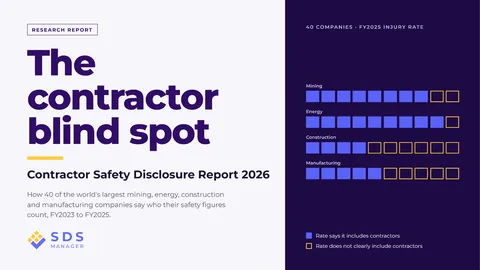
The study uses U.S. Department of Labor OSHA inspection and violation records for federal OSHA manufacturing plants (NAICS 31–33), cases closed 2015–2022. It describes OSHA's records for the plants OSHA chose to inspect. It doesn't measure how safe any individual plant is.
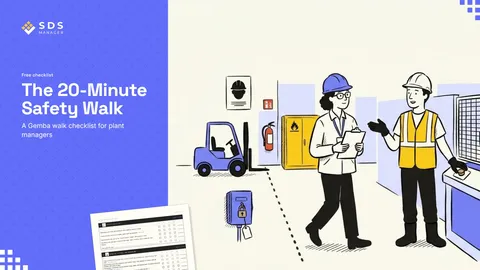
Download the free report to see the full ranking of OSHA standards and the three-check worksheet. If your site has been cited, the 20-Minute Safety Walk checklist is a practical way to keep re-checking the floor.