Where contractors fit in safety figures
In high-risk industries, contractors often do the most hazardous work: shutdowns, maintenance, demolition, work at height. If a company's injury rate counts only its employees, the company can look safer than the work it directs.
A contractor safety program is only as useful as the data behind it, and that data is only useful if the label says who it counts.
What we found
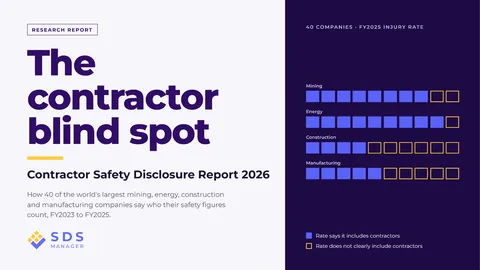
We read three years of public reports from 40 large listed companies, 10 per sector, and asked the same question of every figure: does the report say whose injuries are counted?
- Deaths are counted clearly. 31 of 40 companies say their FY2025 fatality count includes contractors.
- Injury rates are often unlabeled. Only 26 of 40 say a rate includes contractors. Most of the rest don't say who the rate counts. They don't explicitly exclude contractors either.
- Hours are the missing piece. Only 7 of 40 publish contractor hours worked, all of them in mining and energy. None of the 20 construction and manufacturing companies do.
- Compare years with care. 108 of 400 recent figures can't be compared directly with the year before because labels, site boundaries or acquisitions changed.
Why contractor hours matter for TRIR and LTIR
The total recordable incident rate (TRIR) and lost-time injury rate (LTIR) are both calculated per hours worked. In the U.S., TRIR is usually the number of recordable cases × 200,000 ÷ total hours worked. Other companies use 1,000,000 hours as the base.
Without the contractor hours, nobody can check how a contractor injury rate was built or compare it fairly with another company's. A rate published without its population and its hours is hard to use, however good the number looks.
Serious injuries: the biggest gap
Nearly half of the serious-injury figures we looked for couldn't be found. Many companies give contractors only a fatality count. That leaves out the serious injuries that come before fatalities, the ones a contractor safety management system most needs to see.
"Including non-employees" doesn't always mean contractors
Of 325 figures that named non-employees, 28 widened the count to temporary or agency workers but left contractors out. A reader who sees "employees and other workers" can't assume contractors are included.
Five disclosure practices
The report closes with five practices, none of which needs new data:
- Label every figure with who it counts. One sentence beside the table is often enough.
- Show contractors separately and in the total. That shows readers where the risk sits.
- Publish the hours behind every rate. Without hours, a rate can't be checked.
- Keep definitions stable and flag changes. When a boundary moves, say so and restate the prior year.
- Report serious injuries for contractors too. Use the GRI 403-9 high-consequence injury measure, split by employees and contractors.
Using this on your own site
You don't have to be a listed company for this to apply. If you report a site TRIR to leadership, check whether contractor injuries and hours are in it, and write that on the report. When you prequalify contractors, ask for their hours alongside their incident rates.
About the data
All figures come from the companies' own public sustainability reports, ESG data books and annual reports for FY2023–FY2025, as published by early October 2026. Company names are withheld. The study measures how clearly figures are labeled, not how safe any company is. A figure we couldn't find isn't a zero.
Download the free report for the full sector results and the five-practice checklist. To make sure contractors are part of your safety induction, see the EHS Induction Register Template.