What is a safety training procedure?
A safety training procedure is a documented process that sets out how your organization trains workers to recognize hazards and work safely. It answers four questions:
- Who needs training?
- What do they need to learn?
- When must they be trained, and how often?
- How do you prove it happened?
A procedure turns training from something that happens when someone remembers into a system with clear rules.
Who needs safety training?
Exposure sets the requirement, not job title. Anyone who could be exposed to a hazard needs training on it. That includes:
- Frontline workers who use machinery, handle chemicals or work at height
- Supervisors and managers who enter hazardous areas
- Maintenance staff and contractors, who often do non-routine, higher-risk work
- Temporary and seasonal workers, who may be new to the site and the hazards
- Visitors entering controlled or restricted areas, who need at least a site briefing
For temporary workers supplied by an agency, OSHA treats the staffing agency and the host employer as jointly responsible for training. The host employer usually provides the site-specific training.
What OSHA requires
Many OSHA standards require training before a worker is exposed to a hazard. Examples include hazard communication (29 CFR 1910.1200), lockout/tagout (1910.147), forklifts (1910.178), respiratory protection (1910.134) and permit-required confined spaces (1910.146).
OSHA also expects training to be delivered in a language and vocabulary workers understand.
Elements of a safety training program
ANSI/ASSP Z490.1, the US consensus standard for safety, health and environmental training, describes a training program in five parts:
Training needs assessment
Match each role to its hazards and the training it requires. A training matrix is the simplest way to record this.
Training development
Set learning objectives and design training around the actual tasks and equipment. Include hands-on practice where skills are involved.
Delivery
Use qualified trainers. Train before exposure, not after the first week.
Evaluation
Check that trainees can do what they were trained to do, through a practical test, a supervised task or a quiz.
Documentation
Keep records of every session.
Training records
Record the trainee, topic, date, trainer, duration and how competence was checked. Some standards require specific records. The lockout/tagout standard, for example, requires a certification that training was done.
When to retrain
Retrain workers:
- At the intervals set by standards, such as annually for respirator users
- When a job, process, chemical or piece of equipment changes
- After an incident or near miss linked to the task
- When a worker's performance shows they haven't understood the training
Example procedure entry
- Role: Warehouse operative
- Hazards: Forklift traffic, manual handling, chemicals in storage
- Required training: Site induction, hazard communication, manual handling, pedestrian safety around forklifts
- Timing: Before starting work; hazard communication again when new chemicals are added
- Evidence: Signed attendance sheet and practical check by the supervisor
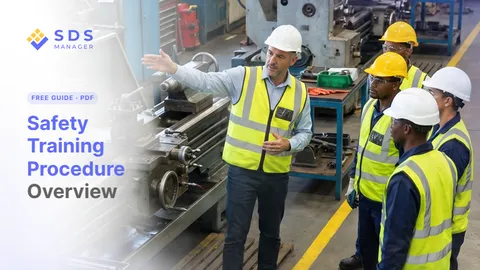
Download the free safety training procedure overview to set up your program. To turn it into a formal document, use the SOP for Safety Training Procedures template.