A COSHH assessment is a legal requirement under the Control of Substances Hazardous to Health Regulations 2002, used to identify hazardous substances in your workplace, evaluate the risks, and put the right controls in place to protect workers.
Occupational lung disease alone kills approximately 12,000 workers annually in the UK, more than workplace accidents, yet many employers still lack basic hazardous substance controls (ShiftFlow, 2026). If you've never completed one before, or your current assessments are overdue for a review, this guide walks you through every step.
What Is a COSHH Assessment?
A COSHH assessment is a systematic process required under the COSHH Regulations 2002 to identify hazardous substances in your workplace, evaluate their risks, and document the controls you have in place to protect workers. It applies to any business where chemicals, fumes, dust, vapours, or biological agents are used, stored, or generated, from manufacturing and construction to cleaning and healthcare (CCOHS, 2025).
The assessment is the foundation of your COSHH compliance programme. Everything else, your controls, your training, your health surveillance obligations, flows from it.
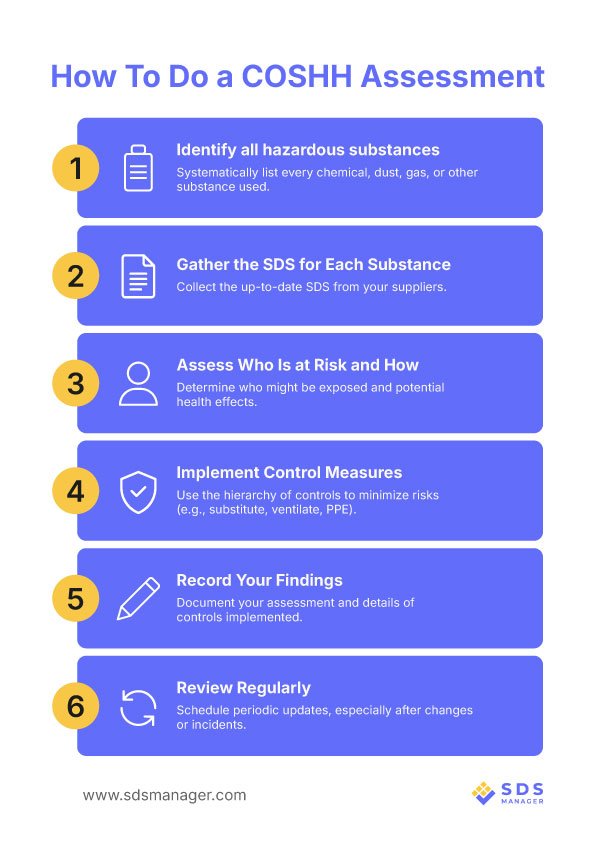
How to Complete a COSHH Assessment in 6 Steps
A COSHH assessment doesn't need to be complicated. Follow these six steps, as outlined by the HSE, to identify hazardous substances in your workplace, evaluate the risks, and put the right controls in place.
Step 1: Identify All Hazardous Substances
Walk through your workplace, every room, cupboard, workshop, vehicle, and storage area, and write down every chemical product you use, store, or generate during your work. COSHH covers commercial products like cleaners, paints, adhesives, and solvents, substances produced by your processes such as wood dust, welding fume, flour dust, and diesel exhaust, and biological agents like bacteria, moulds, and viruses in healthcare or waste handling (COSHHmate, 2026).
Take a thorough approach. Forgotten products still need assessing, and inspectors will check every corner.
Step 2: Gather the Safety Data Sheet for Each Substance
For every chemical product on your list, you need the manufacturer's Safety Data Sheet (SDS). Your supplier must provide one free of charge under UK REACH regulations. If any are missing, contact your supplier and request the current version.
The SDS is your primary source of hazard information, but it is not the finished assessment. The sections you will use most are Section 2 for hazard identification, Section 4 for first aid measures, and Section 8 for exposure controls and PPE requirements (Training Tale, 2026). Transfer that information into your assessment form, tailored to how the substance is actually used in your workplace.
SDS Manager pulls directly from your SDS library to automatically identify hazardous chemicals, assess exposure risks, and generate compliant assessments with the right PPE and control measures built in.
Create your COSHH Assessment with SDS Manager
Step 3: Assess Who Is at Risk and How
Consider every person who could be exposed, including employees, contractors, cleaners, maintenance workers, and visitors. Then identify how exposure could occur: inhalation from breathing in fumes or dust, ingestion from contact with contaminated hands, skin absorption, or injection from sharp objects (Training Tale, 2026).
Assess how often workers are exposed, for how long, and at what concentrations. A substance used briefly in a well-ventilated area carries a very different risk profile to one used for hours in an enclosed space.
Step 4: Implement Control Measures
Work through the COSHH hierarchy of controls in order, from most to least effective: elimination, substitution, engineering controls such as local exhaust ventilation, administrative controls, and PPE (COSHHmate, 2026). PPE is always the last resort, used only when higher-level controls are insufficient on their own.
A practical example: replacing a toxic cleaning product with a safer alternative eliminates the risk entirely, which is always preferable to issuing gloves and a mask and hoping for the best.
Step 5: Record Your Findings
Document every substance, the risks identified, and the controls in place. Records must be written down and accessible to both employees and the HSE. The format does not need to be complex, but it does need to reflect your actual workplace, not a generic template copied from the internet.
Examination and test records must be kept for at least five years, and health surveillance records for significantly longer depending on the substances involved (ShiftFlow, 2026).
Step 6: Review Regularly
A COSHH assessment is a living document. Review it at least annually, and also whenever a new substance is introduced, a work process changes, a health incident occurs, or monitoring suggests your controls are no longer effective (Training Tale, 2026).
Regulation 10 of COSHH also requires ongoing health surveillance for workers exposed to known carcinogens or respiratory sensitisers, so build that into your review cycle (BrightHR, 2025).
What Happens If You Fail to Comply?
HSE fines averaged £18,500 in 2024 for COSHH failures, and serious breaches can exceed £300,000, particularly where exposure leads to long-term harm (SIS Ltd, 2025). In the Crown Court, fines are unlimited, and individuals can face up to two years' imprisonment for certain offences. Directors and managers can be personally prosecuted if they consented to or were involved in the breach (swiftRMS, 2026).
A cleaning company was fined £80,000 after an employee developed chemical burns from improper handling of disinfectants without PPE or a completed COSHH assessment (SIS Ltd, 2025). Beyond fines, a prosecution is public record and can affect your ability to win contracts.
Frequently Asked Questions
Who is responsible for completing a COSHH assessment?
The employer is legally responsible, though the assessment can be carried out by any competent member of staff with sufficient knowledge of the substances and processes involved.
How long does a COSHH assessment take?
The process takes around 15 to 30 minutes per substance once you have your SDSs in order. The most time-consuming part is building your initial substance inventory (COSHHmate, 2026).
Does every substance need its own assessment?
Yes. Each substance or process that presents a hazard needs its own assessment, tailored to how it is used in your specific workplace.
How often should a COSHH assessment be reviewed?
At least annually, and immediately whenever substances, processes, or working conditions change.

Mehreen Iqbal

Started with a Bachelors in Microbiology, then a Masters in Public Health; Currently a Workplace Safety Expert.