When an OSHA case closes, the file says the hazard was fixed. OSHA's records can only show whether the fix held if an inspector comes back to the same plant and looks at the same rule.
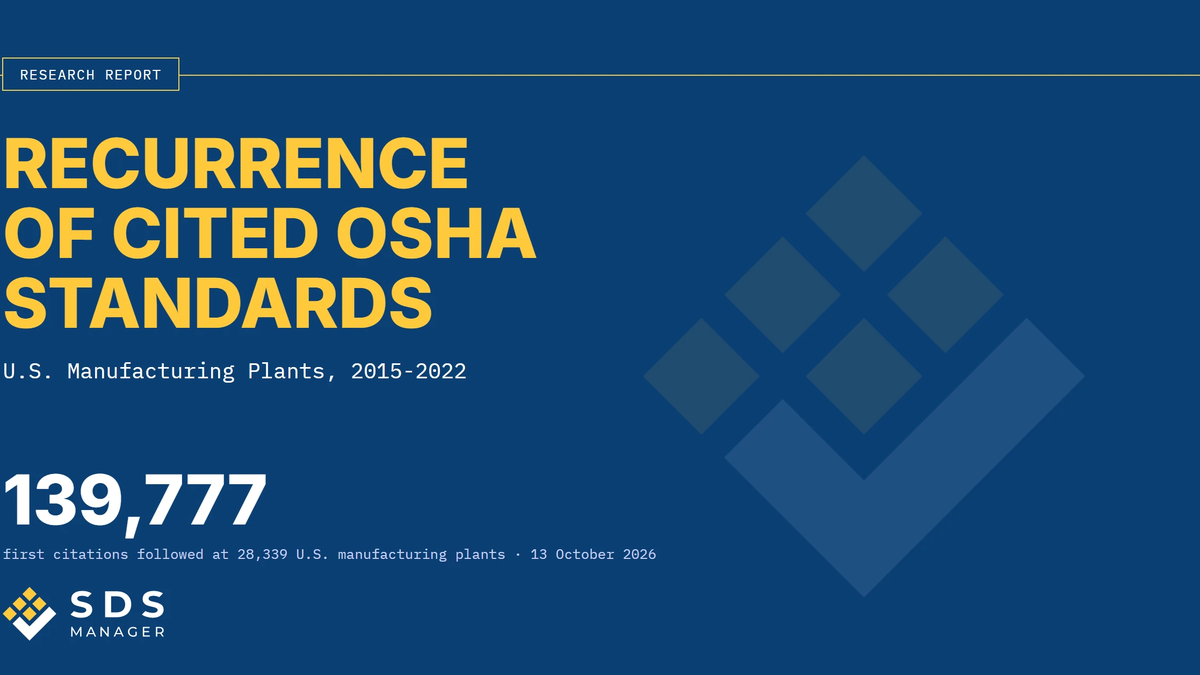
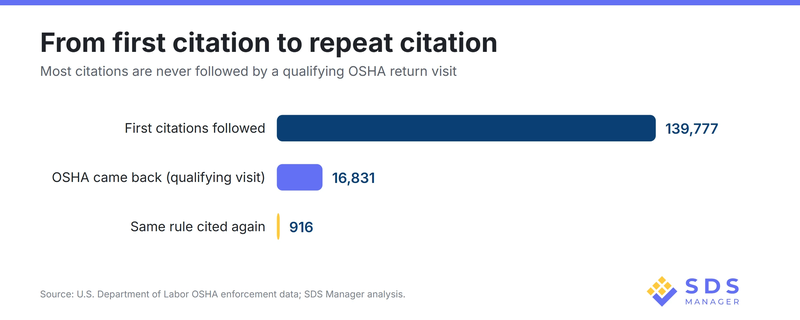
SDS Manager's Recurrence of Cited OSHA Standards report followed 139,777 first citations at 28,339 U.S. manufacturing plants, in federal OSHA cases closed from 2015 to 2022. Only 16,831 of them (12.0%) were followed by a qualifying OSHA return visit within about three years. At that visit, 916 (5.4%) were cited again for the identical paragraph.
Key takeaways
- Fewer than 1 in 8 first citations (12.0%) got a qualifying OSHA return visit within about three years.
- When OSHA returned, 916 citations (5.4%) were cited again for the identical paragraph, nearly 1 in 18.
- Machine guarding under 1910.212(a)(1) came back most often: 23.3% of its followed citations were cited again.
- Most return visits (90.4%) were partial inspections that may not have looked at the original hazard.
- The share cited again was similar across the three manufacturing sectors, at 4.8% to 5.9%.
What did the OSHA recurrence study find?
Most OSHA citations at manufacturing plants are never followed by another inspection. Nearly nine in 10 first citations, 122,946 (88.0%), had no qualifying return visit within about three years. Where OSHA did return, the typical gap was 522 days.
A citation with no return visit isn't evidence that the hazard was fixed. The study counts those outcomes as unknown.
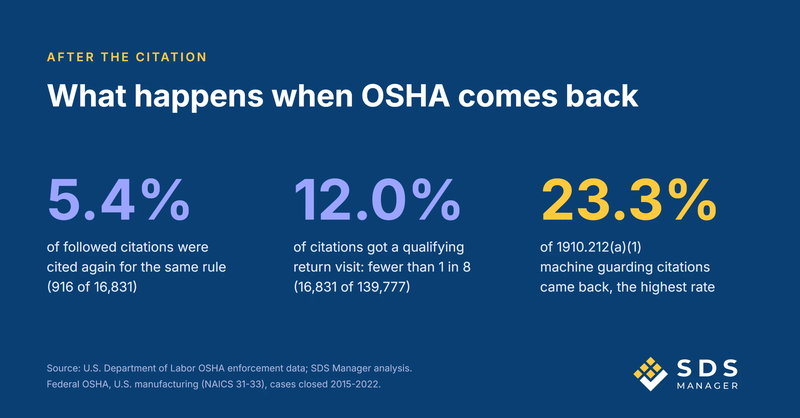
Among the citations that did get a return visit, 916 of 16,831 were cited again for the same paragraph, with a 95% range of 5.0% to 6.0%. Counting every qualifying visit in the window, not only the first, the share rises to 6.5%.
OSHA applied its formal Repeat label far less often, to 361 of the 16,831 pairs. A plant can be cited for the same paragraph twice without the second citation being classified as a repeat.
Which OSHA standards are cited again most often?
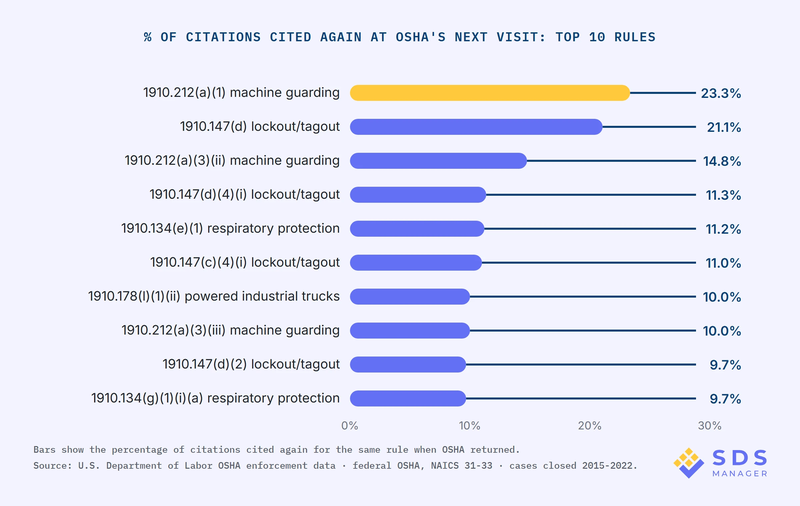
Machine guarding and lockout/tagout lead the list. Of 106 exact rules with at least 30 followed citations, 1910.212(a)(1) machine guarding ranked first, with 254 of 1,088 citations (23.3%) cited again. Next came 1910.147(d) lockout/tagout at 21.1% and 1910.212(a)(3)(ii) machine guarding at 14.8%.
These are controls that have to be kept up every shift, not installed once. Production changes, new equipment and shift turnover all make it easy for a guard or a lockout step to slip.
"Most OSHA citations close with a signed abatement form, and the public record goes quiet after that. Machine guarding and lockout/tagout come back most often because they depend on people keeping a control in place every shift. A re-check a few months after closure is often the only way a site learns whether its fix held."
-Arysha Alif Khan, Product Compliance Manager, SDS Manager
Why can't most return visits confirm a fix?
Most return visits are narrow, so they may never look at the original citation. Of all return visits, 90.4% were partial inspections, and 82.2% were triggered by complaints or referrals rather than planned inspections. A visit prompted by a complaint about a forklift won't re-examine a machine guard.
When the study counted only complete-scope return visits, the share cited again rose to 7.4% (134 of 1,804). That makes the 5.4% headline a floor on recurrence, not an estimate of it.
The type of visit also shaped the result. Referral visits, the most common type, cited the same paragraph again in 5.9% of pairs, against 0.9% for monitoring visits.
| Type of return visit | Pairs | Cited again | Share |
|---|---|---|---|
| Referral | 7,045 | 413 | 5.9% |
| Complaint | 6,793 | 359 | 5.3% |
| Planned (programmed) | 2,073 | 111 | 5.4% |
| Monitoring | 323 | 3 | 0.9% |
| Fatality/catastrophe | 302 | 23 | 7.6% |
| Unprogrammed related | 211 | 5 | 2.4% |
Does recurrence differ across manufacturing sectors?
No sector stands out. The share cited again was 5.4% in metal, machinery and equipment (NAICS 33), 5.9% in wood, paper, chemical and plastics (NAICS 32) and 4.8% in food, textile and apparel (NAICS 31). Their 95% ranges overlap, so none can be called higher or lower than the others. Recurrence follows the rule and the control behind it more than the industry.
Three checks for confirming cited hazards stay fixed
With fewer than 1 in 8 citations followed by a qualifying return visit, the site is usually the only one in a position to re-verify a fix. The pattern in the data points to three checks:
- Re-verify the cited condition after the case closes, at the exact machine or task named in the citation.
- Check the same rule on other lines, shifts and buildings within a month.
- Keep the photos, work orders and training records that show the fix with the case record.
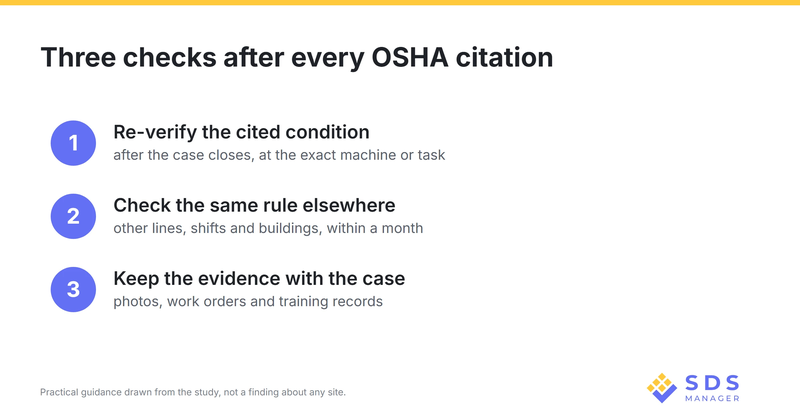
Practical guidance drawn from the study, not a finding about any site. Source: Recurrence of Cited OSHA Standards 2026.
Anyone can look up a site's inspection history on OSHA's establishment search.
How was the study conducted?
The study used the U.S. Department of Labor's public OSHA records, downloaded on October 7, 2026. Each first citation was followed to OSHA's next qualifying visit to the same plant, where there was one.
- Sample: 139,777 first citations at 28,339 U.S. manufacturing plants under federal OSHA, from cases closed between 2015 and 2022.
- Sources: OSHA's official inspection and violation files for 2003 to 2025, covering 2.07 million inspections and 4.69 million violation records across all industries.
- Measures: whether OSHA came back within about three years, and whether it cited the identical rule paragraph at that visit. Follow-ups that only checked the fix, records-only visits and visits of the other type (safety or health) didn't count.
- Matching: OSHA has no permanent plant ID, so plants were matched by address and business name. A hand check of 100 matches found no errors.
- Checks: 30 citation histories and 30 inspections were checked by hand against OSHA's records, and all matched. Under other definitions set before the analysis, the main share stayed between 4.2% and 7.4%.
- Limits: OSHA chooses which plants to inspect, so the results describe its records, not how safe any plant is. A later citation doesn't prove the hazard was there the whole time.
Most closed OSHA citations are never rechecked
For most cited hazards at manufacturing plants, OSHA's records stop at the abatement certification. The rules cited again most often, machine guarding and lockout/tagout, depend on controls that wear down over time.
Checking the cited condition on the floor, rather than relying on the closed case file, would show whether a fix held without waiting for an inspector to return.
Schedule those re-checks as audits in EHS Solutions by SDS Manager, next to the incident and risk records for the same site.
References
- SDS Manager, Recurrence of Cited OSHA Standards: U.S. Manufacturing Plants, 2015-2022 (2026).
- U.S. Department of Labor, OSHA enforcement data. data.dol.gov/data-catalog/OSHA

Zarif Ahmed

An engineer and safety writer by profession, focusing on chemical management, regulatory development, and the patterns that shape workplace practice over time.